|
|
This topic comprises 3 pages: 1 2 3
|
|
Author
|
Topic: Digital is Boring.
|
|
|
Bobby Henderson
"Ask me about Trajan."

Posts: 10973
From: Lawton, OK, USA
Registered: Apr 2001
|
 posted 04-23-2014 01:18 PM


quote: Randy Stankey
I *LIKE* doing these things and, when I work digitally, I often find it boring for the lack of ability to do them. I don't mean things like digitally simulating a sepia toned effect. I mean using real potassium ferricyanide solution to bleach a real silver-gelatin photo print.
This reminds me of all the serious limitations involved in digital printing and even the display of colors in computer monitors or projectors. Scenario: a customer gives me a project. One of the colors in his logo is Pantone 3272C Green and the other is Pantone 2593C Purple. He demands these colors be matched exactly. You can't do that with any large format printer. Both of those spot colors are way outside the CMYK gamut range. Those two colors are damned near fluorescent in terms of color intensity. Even the best computer monitors will struggle simulating those colors accurately, and even then the representations provided by computer software are nothing more than an educated guess.
Hand made photographic prints often have a unique look to them you can't generate easily in the computer. The materials used make a lot of the difference. It's kind of like putting metal flake or pearlescent materials into enamel paints. You can't make digital prints of that type of stuff.
quote: Randy Stankey
Hoppe's No. 9... If you know what I am talking about, I don't even have to explain it to you. If you don't know what I am talking about, there is no point in explaining.
I cleaned my SigSauer P226 the other day. I tried not to smell the Hoppe's No. 9 too much.
quote: Marcel Birgelen
Digital archival is more than just dumping it onto a tape or disk and putting it into a cardboard box on some shelf. Digital archival also requires you to keep your storage 'alive' and moving it to new media as time progresses. The cost per byte should go down over time, since storage capabilities of modern media are ever increasing as are transfer speeds. On the downside, we're producing ever more digital information, but it's not like the information we produced in the past is suddenly going to increase, so that should be a factor that can be easily accounted for.
You're leaving out one factor in digital archival costs: the labor costs of continually checking the data and moving it from an old volume to a new one. An archival film print, if stored properly, won't have to be touched for decades. Digital data has to be moved and even manipulated (saved to current, compatible versions, etc.) far more often.
quote: Marcel Birgelen
The rolling shutter is a limitation of CMOS based designs and although we probably can improve the speed, we need a radical new design to get a "global shutter".
Some new cameras actually do have a global shutter based sensor. The new 4K camera from Blackmagic has a global shutter sensor. I don't know if there are any trade-offs with that sensor for it to have global shutter capability, such as a greatly reduced usable ISO range.
quote: Marcel Birgelen
Regarding your wood carving example: For a wood carver, digital might take the fun out of the job. Yet, there are plenty of people that love using Maya, 3D Studio, LightWave, Blender, AutoCad, etc. all day long. For them, 3D printing offers a whole new world of getting some of their designs into reality.
There is a decent amount of custom carving work done in the sign industry. It's done using wood, HDU, hard foam board and other materials. Computer driven routing tables can be used to cut out a lot of flat shapes. Computers honestly suck at other things, like making a properly beveled "prismatic" letter.
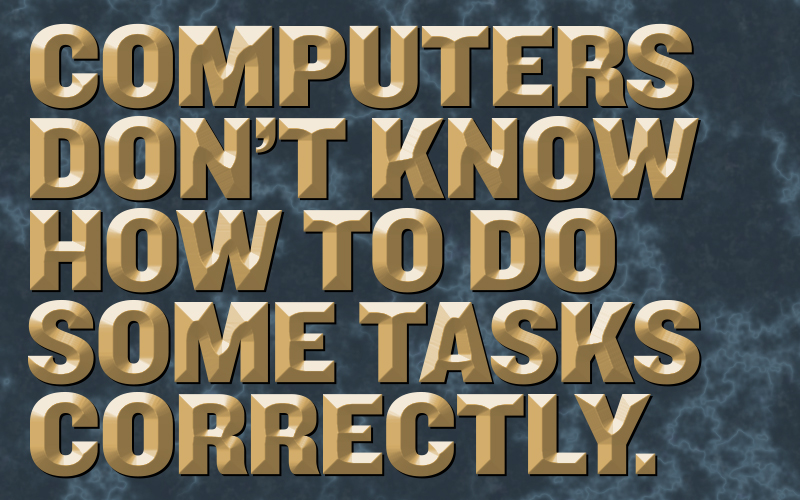
This is an example of Photoshop's inner bevel effect with the size setting maximized to create a would-be chiseled, prismatic effect. The results look like shit. The computer/software has no clue how to get the corners or joins beveled correctly. There is no computer software in existence that can generate this type of effect properly in any kind of automatic, simple click of a button way. No routing table software does it correctly. Even the most expensive 3D modeling programs can't do it right automatically.
Sign people carve primsamatic letters by hand. They might use a computer driven routing table to cut out the letter shapes to match a letter style and size exactly. But the remaining work must be done using "analog" carving tools. They'll either carve the letters directly (wood, HDU, etc.) or do the same thing to a mold for cast metal letters.
It is possible to model these kinds of letters using 3D modeling software like Maya or Cinema 4D. But it will probably take you more time to precisely model that stuff in the computer than it would for an experienced carver to generate it by hand.
| IP: Logged
|
|
Marcel Birgelen
Film God
Posts: 3357
From: Maastricht, Limburg, Netherlands
Registered: Feb 2012
|
posted 04-23-2014 06:04 PM
quote: Leo Enticknap
If it weren't for copyright issues (of course, by the time technology reaches that stage, the default copyright term will probably have been increased to 1,000 years) you'd probably be able to buy a copy of the disc on Amazon.
Yeah if somebody would ever be able to figure out all the rights, it will probably sell for $5 Million+ dollars, give or take a million... Or you could download your bootlegged version, free from DRM and non-skippable copyright warnings on the current iteration of The Pirate Bay... ![[Wink]](wink.gif)
But I guess you struck an important issue there, because copyright might be a bigger threat to archival in general than the progress of technology.
quote: Randy Stankey
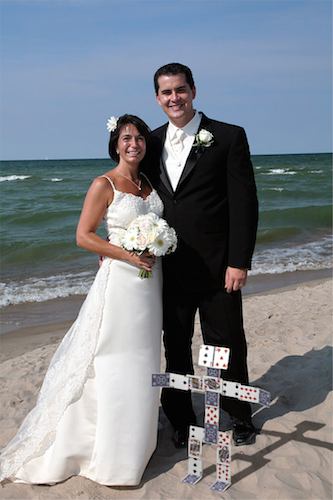
Okay, not the best picture in the world but the point is that I know how to do it. (BTW: that picture was an inside-joke.)
Maybe the JPEG artifacts did their part in hiding it, but when I first saw the picture I didn't recognize the thing in front (let's call it Card-Bot) as an inserted 3D rendering, so I guess you did a good job here .
quote: Randy Stankey
Would you rather have somebody cook you dinner in the kitchen or would you rather eat a frozen dinner from the microwave?
Maybe you should upgrade your analog microwave to a new digital one.
But, if you treat a microwave oven solely as a device to prepare low quality, prefabricated frozen food or reheat yesterday's leftovers, then yeah, sure, it's a device the devil brought in to make us all unhappy. Although a microwave is a bad example (maybe it really is a device from hell?), I've actually used as part of some proper meals. ![[Razz]](tongue.gif)
quote: Randy Stankey
Would you rather actually cook dinner for somebody else, give it to them to eat and have them appreciate it?
I happen to like cooking, especially the experimental part of it. But if I need to e.g. shred a bunch of onions, I sometimes happen to use a food processor. The same job could've been accomplished by hand, but it would be a menial task (at least for me) and the end result would not have been any better. Sure, somebody else might go bonkers on the cutting part, but for me that's not where the fun is, so if I can use a machine to do this, then I will gladly use it. I also don't think it takes creativity away, just the opposite actually.
quote: Bobby Henderson
You're leaving out one factor in digital archival costs: the labor costs of continually checking the data and moving it from an old volume to a new one. An archival film print, if stored properly, won't have to be touched for decades. Digital data has to be moved and even manipulated (saved to current, compatible versions, etc.) far more often.
Those things can be automated and if done right, it doesn't matter if you're moving a few gigabytes or some exabytes, the labor is the same. Modern file systems (e.g. ZFS) have built-in features to keep data consistent, there is really no need to manually check everything every so often. File systems of the future will surely improve on those features.
Fortunately, the awareness of the need of digital data archival is growing and data compatibility is one of the key issues. Still, this is a problem that can be quite easily overcome by standardizing on open, transparent formats. As long as those formats are well documented and lots of key data is stored in those formats, I'm sure we can ensure long-time compatibility and avoid the need to "transcode" those files every few years.
quote: Bobby Henderson
Some new cameras actually do have a global shutter based sensor. The new 4K camera from Blackmagic has a global shutter sensor. I don't know if there are any trade-offs with that sensor for it to have global shutter capability, such as a greatly reduced usable ISO range.
The Blackmagic 4K camera uses a CCD and not a CMOS sensor. Global (electronic) shutter and CMOS are as of yet, mutually exclusive. I would prefer CCD for film acquisition any time above CMOS based designs, because of the global shutter and more film-like look. The biggest downsides are cost (but Blackmagic has seemingly found a way to work it out) and a still relatively low frame rate.
quote: Bobby Henderson
It is possible to model these kinds of letters using 3D modeling software like Maya or Cinema 4D. But it will probably take you more time to precisely model that stuff in the computer than it would for an experienced carver to generate it by hand.
But depending on the amount of signs you sell, you could model every possible letter in any font you want to support just once and given the right tools/software, you could reuse those 3D models every time you need to make a sign with text and beveled edges.
| IP: Logged
|
|
Bobby Henderson
"Ask me about Trajan."
Posts: 10973
From: Lawton, OK, USA
Registered: Apr 2001
|
posted 04-23-2014 07:16 PM
quote: Marcel Birgelen
Fortunately, the awareness of the need of digital data archival is growing and data compatibility is one of the key issues. Still, this is a problem that can be quite easily overcome by standardizing on open, transparent formats.
The nature of business gets in the way of standarding digital assets on open, transparent formats. It costs a lot of money to develop professional level, industry leading software. The companies that develop that software have to keep improving their applications and adding new features in order to stay in business. The improvements and changes sometimes come at a cost of negatively affecting or removing backward compatibility of files saved in old versions of the software.
Very little of the graphics software I use is open source. I have a few open source fonts installed, such as Source Code Pro, which came in automatically via Adobe Creative Cloud updates to Adobe Illustrator or InDesign. The file formats containing my projects, (.AI, .CDR, .FS, .PSD/.PSB, .AEP, .INDD, etc.) are all proprietary. People working in the video/broadcast industry, print publishing industry, movie industry, game design industry and just about any other creative industry deal with the same thing. Common file formats used by many applications, like JPEG, TIFF, etc. are still controlled by an owner rather than existing as an open source format.
Open Source alternatives for some types of creative applications do exist. Inkscape is an open source vector drawing application. The Gimp is an open source image editor. Blender is an open source 3D modeling/animation program. They're decent applications, particularly for being free to download. But they're not a practical substitute for a professional level application, like Adobe Photoshop, Adobe Illustrator or Autodesk Maya.
quote: Marcel Birgelen
I would prefer CCD for film acquisition any time above CMOS based designs, because of the global shutter and more film-like look.
CCDs have their own trade-offs. They require more power than CMOS chips. CCDs cost more to manufacture. CCDs are prone to their own strange types of artifacts, like vertical smearing. But that's not nearly as bad as all the rolling shutter effects you get from CMOS chips. I'm not so sure global shutter designs will help video look more like film -much that film look is generated via color grading in post production. Newer d-cinema cameras have different color profile modes that change how the video is captured to aid in the color grading process.
quote: Marcel Birgelen
But depending on the amount of signs you sell, you could model every possible letter in any font you want to support just once and given the right tools/software, you could reuse those 3D models every time you need to make a sign with text and beveled edges.
That's not practical to do unless you're producing a lot of copies of the same sign -like the beveled, prismatic letters and golden arches on McDonald's signs. When doing projects for small businesses and regional companies you often have to start from scratch with each job.
| IP: Logged
|
|
|
|
Randy Stankey
Film God

Posts: 6539
From: Erie, Pennsylvania
Registered: Jun 99
|
posted 04-23-2014 07:41 PM
It's the shadows that give the secret away when I look at the picture of the Card-Bot. They don't map to the surface of the sand they way they should. It would have taken me a lot of time to model the ground surface then bump-map the shadows. The color and contrast of the shadow is a bit off, too. I wasn't about to spend an entire day doing that just to tell a visual joke.
I don't have a microwave oven but it's not because I don't like them. I don't want to spend the money and I can do just as well without one. It doesn't take me any longer to reheat food on the stove. I can make coffee or popcorn, actually, in less time on the stove top. If I had a microwave oven, I would use it as part of an overall cooking strategy. I have done so before but my wife took the microwave when she divorced me and I haven't seen fit to buy another one.
Same thing goes with a food processor. I have one but I don't use it very often. Mainly because of the amount of overhead involved. It is easier and faster to use a knife and cutting board than to assemble the food processor, use it then clean it and put it away than it is to just chop the onions. If I had a lot of onions to chop (e.g. onion soup) I would use the food processor. Most of the time, I'd rather just chop the onions.
Regardless of what device one uses to do a job, he needs to know how to do that job in the first place before he can decide which tool to use. Something that bugs me about digital cameras is the autofocus. It doesn't always work the way I want it to. I often end up disabling it and focusing manually, anyway. Otherwise, I'd have to press buttons to select "focus zones" or macro/landscape mode. When photographing a landscape with a lot of open sky, such as a sunset, autofocus does not work at all. I would rather just use a rangefinder focus system and dispense with all the automatic stuff.
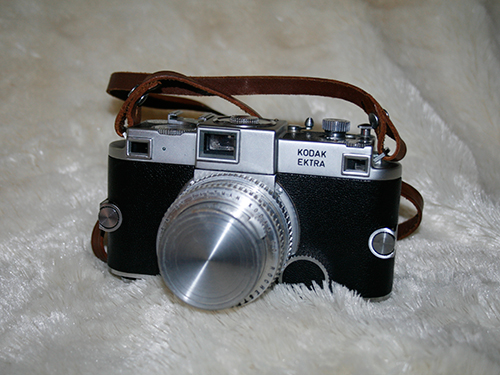
BTW, using an autofocus lens manually usually stinks. The range of motion on the focus control is usually too short to be useful when working by hand. The Ektra in the picture has a rough focus and a fine focus. That's what the little, black dial to the right of the lens is. If you learn how to use those controls and you can get razor sharp focus, quickly and easily. Again, the point is that you have to know how to do a job before you start.
There lies another point. Too many people think that "digital" means "easy." Maybe it does, some times, but, too often, "digital" means "just as crappy but faster."
| IP: Logged
|
|
|
|
|
|
|
|
|
|
Leo Enticknap
Film God
Posts: 7474
From: Loma Linda, CA
Registered: Jul 2000
|
posted 04-24-2014 12:44 AM

quote: Marcel Birgelen
But I guess you struck an important issue there, because copyright might be a bigger threat to archival in general than the progress of technology.
At the risk of veering off topic, it won't be so much of a threat to preservation, because both EU (2001 directive) and US copyright (DMCA) law incorporates specific exemptions and permissions for bona fide archives (defined slightly differently between the two) copying content in order to safeguard its preservation. It will be for access, though: multinational media giants are constantly spending millions on political lobbying to get the copyright subsistence term extended. In Europe, the 2001 directive standardised it at 70 years (after the death of the main creative personnel), whereas most member countries had much shorter terms than that for most media forms, and in US it was increased to 90 for some types of movie in the late '90s, basically in response to lobbying from Hollywood. As we're rapidly reaching the point at which some classic movies with significant IP value for DVDs, Netflix etc. are about to drop out into the public domain, the lobbying is going to move up a gear pretty soon, I'd guess.
| IP: Logged
|
|
|
|
All times are Central (GMT -6:00)
|
This topic comprises 3 pages: 1 2 3
|
Powered by Infopop Corporation
UBB.classicTM
6.3.1.2
The Film-Tech Forums are designed for various members related to the cinema industry to express their opinions, viewpoints and testimonials on various products, services and events based upon speculation, personal knowledge and factual information through use, therefore all views represented here allow no liability upon the publishers of this web site and the owners of said views assume no liability for any ill will resulting from these postings. The posts made here are for educational as well as entertainment purposes and as such anyone viewing this portion of the website must accept these views as statements of the author of that opinion
and agrees to release the authors from any and all liability.
|

 Home
Home






 Printer-friendly view of this topic