This is topic Best/worst projector in forum Film Handlers' Forum at Film-Tech Forum ARCHIVE.


To visit this topic, use this URL:
https://ft-forum.com/ft/cgi-bin/ubb/ultimatebb.cgi?ubb=get_topic;f=1;t=000180

Posted by Joe Redifer (Member # 3) on 08-05-1999, 03:57 PM:
 
What do you think are the best and worst projectors available, and why? I personally like Century's the best. Although they are what I was trained on, they were in great shape and good performers as well. I also like Simplex except for the sounddrum.

As far as worst, I'll have to say the gearless Christies win that top honor, although I have never worked with a Ballantyne, so they could be worse. The Christie's yield a very low performance to maitenence ratio.

[This message has been edited by Joe Redifer (edited 08-05-1999).]


Posted by Ian Price (Member # 14) on 08-05-1999, 04:45 PM:
 
Best Projector; Digital Projection Lightning 15sx $124,995.

Oh were you guys talking about film?

Worst Projector; Ballentyne.


Posted by John Pytlak (Member # 331) on 08-05-1999, 05:12 PM:
 
Don't forget to add the cost of a Pluto 360-gigabyte RAID array. I hope you have deep pockets or a lot of equity in your home that you can borrow on. Remove all the seats closer than 2 screen heights. And don't accidently hot-spot that lamphouse. Otherwise, I agree it looks attractive.

BTW, how do you intend to get those 360 gigs to your theatre? Shipping a loaded Pluto array or several D5 tapes doesn't count.

My choice is a Norelco AA-II or Century JJ with 35mm and 70mm DTS.

------------------
John Pytlak


Posted by Ian Price (Member # 14) on 08-05-1999, 05:23 PM:
 
John,

I agree with all your statements. I was just being silly.

Ian


Posted by Stephen Jones (Member # 16) on 08-05-1999, 09:05 PM:
 
The best projectors Ive used are Kinoton FP 30, Bauer U3 & B11 ( the Bauer B 11 is of 1956 vintage and as far as I know they are still running) and Century. The worst I have used are cinemecannica Vic 5 of course the older cinemmecanica projectors are good .

------------------


Posted by George Roher (Member # 91) on 08-05-1999, 10:05 PM:
 
I haven't worked with every single machine out there. But my absolute favorite is the Simplex XL. It gave me the steadiest picture and was the easiest to maintain and operate. And the worst machine I have worked with would be the Cinemeccanica Vic 5. The Vic's have horrible horizontal weave, and gave me many problems.


Posted by Ken Layton (Member # 133) on 08-05-1999, 11:02 PM:
 
Brenkerts are the best! Built like a tank and rock steady. They run for years. I also prefer Motiograph AA, Simplex XL, and Century "C" and "SA".

Ballentyne is crap. That framing coupler is a joke.


Posted by Aaron Mehocic (Member # 15) on 08-06-1999, 09:21 AM:
 
I like Simplex 35 and Simplex XL models myself.
 
Posted by Jason Burroughs (Member # 68) on 08-06-1999, 11:51 PM:
 
Best, Centry, hands down, wether be it JJ, SA (never worked with a C)

Worst, Cinemaccanica V-8, and Christie GPS.

I can take or leave Simplexes, I loathe that rubber wheel that rides on the emulsion, and I'm not fond of the oil bath either... but that aside they're decent machines

oh, all of the above are curved gates exepting the V-8


Posted by Aaron Sisemore (Member # 145) on 08-07-1999, 03:48 AM:
 
Best Projectors? Hmmm...

35mm
1. Brenkert BX 60/80/100 (virtually unstoppable!)

2. Simplex XL/1015/1050 (Very steady pictures, Easy on film and relatively quiet)

3. Simplex E-7 (Also easy on film and quiet)

4. Century SA/DA/TA series (Good with most film, easy to repair/rebuild)

5. Century C/CC/H/HH STRAIGHT GATE (Same as the SA series but a tad quieter)

6. CFS/Rentec Dreamcatcher (I wish they could make this less expensive- its a very nice projector, IMO)


70/35mm:

1. Norelco AAII (There Are No Substitutes.)

2. Century JJ (Another Solid Performer!)

Worst Projectors:

1. Super Simplex (weak gear train, high maintenance)

2. Cinecita SA (Made In India Century knockoff- poor quality)

3. Monee MSP (Another Indian Century Knockoff-poor quality)

4. Century H/HH CURVED GATE (Major problems with polyestar dust clogging the trap causing unfocusable pictures requiring stoppage of he show to chip the packed-in dust deposits out of the trap)

5. Norelco FP20 (Lots of very expensive plastic parts in places where they should be metal, I have seen several of these with trailers and other objects jammed in to hold the gate closed...)

Of Course, YMMV.

Aaron


Posted by Gordon McLeod (Member # 33) on 08-07-1999, 11:41 AM:
 
Best 35mm
Motiograph AAA
Century CC
Norelco FP20
Ernaman 8B
Ernaman 15

Worst
SuperSimplex
Cinecita/Monee (same company)
Victoria 5
Bauer U3

Best 35/70
Westrex 5000
Norelco DP70 (AA2)
Favorite (Prevost/Zeiss)
Century JJ

Worst 35/70mm
Victoria 8
DP75
Monee/cinecita
Wassman Eurokino
Simplex


OK Projectors
Ballantyne Pro35 (built like a tank run for ever and leak oil)
Century SA
Prevost P55
Ernaman 9
FP 7


Posted by Bruce McGee (Member # 131) on 08-08-1999, 12:10 PM:
 
Thank you for not including the toy 35mm Holmes on the best/worst list.

Except for being very tight to thread, and starting too quickly, the two I have havn't scratched anything, and have a decently steady picture, except when running polyester trailers. After running several last night, I learned about the shedding problem. It looked like it snowed under the intermittent.

I told 2 more theater friends about this site last night. One was telling me about a Technicolor reel shattering and going through the ceiling the other day. I thought of you guys.

Bruce McGee


Posted by Scott Norwood (Member # 30) on 08-08-1999, 12:20 PM:
 
What's so awful about the Super Simplex? I have one that I pretty much rebuilt and which seems decent. True, there's not a lot of "finger room" and the gate pressure isn't easily adjustable and the "drip-through" oil system leaves much to be desired, but the machine seems basically solid. Isn't the E-7 basically the same thing as the Super, but with a hand-operated oil pump? Obviously, I'd prefer a Century, and I wouldn't want to have to deal with these old Simplexes for daily theatre use, but I don't see what's so bad about them for home use. (I'm not defending the old Simplex stuff; I just haven't figured out what people really dislike about it yet.)
 
Posted by Aaron Sisemore (Member # 145) on 08-08-1999, 03:22 PM:
 
Scott...

Try running Supers in a real theatre with platters and you will soon see why Supers are so bad... Even more so with polyestar film

There are many differences between the Super and E7, the E7 has a more rugged gear train, and the casing was redesigned for more room, the gate and trap are different, and of course the E7 has the one-shot oil pump... I have had nothing but bad luck with Supers in modern theatre service, and after all the stripped gears and spun bushings we had an XL installed. As usual, YMMV...

Aaron


Posted by Trevor Bailey (Member # 75) on 08-08-1999, 05:54 PM:
 
Speaking from a maintenance standpoint, give me Century or give me death. Death would be defined as a Prevost P-93.

I am not very fond of Christie either, but the Prevost P-93 is the only inanimate object that has ever caused me to think of physical violence.

I could go on (at length) but you get the idea...

Others:
Simplex - they could run forever...but you see...the thing is...the theater has to put oil in them...
Ballantyne - that silly coupler...
Brenkert - great...until they break down...then none of the replacement parts fit right...
Norelco FP-20 - don't chains belong on bicycles?
Cinemeccanica - get a spare gear box and roll the dice...also good for practicing your "A-chain via telephone" skills


Posted by Jim Ziegler (Member # 86) on 08-09-1999, 01:28 AM:
 
Ah, someone else who as actually worked with P-93s... I would take my current Christie's anyday over a Prevost...

But the best projector I have ever had the pleasure to work with was a Simplex 35...


Posted by Gordon McLeod (Member # 33) on 08-09-1999, 09:52 AM:
 
P93 I am not familiar with but is itthe one with the timming belt running in the oil bath to drive the upper sprocket. (They also used that design on the Favorite 16B that they built and was also sold under the Zies Name)
In toronto there are probably several hundred of the P55's running each day. they are an all gear machine and give very little grief, except for leaking oil. There are also several of the Favorite 35/70 machine that they built (zies also marketed them)
 
Posted by Trevor Bailey (Member # 75) on 08-09-1999, 10:15 AM:
 
The P-93 has a timing belt driving the intermittent in an oil bath. That in turn has a gear driving the vertical shaft. All gears are held on with rolled or steel pins. The sound head area is a joke. Tension on the drum is by a roller assy that has a rolled pin and a spring. Slight film jam, pin breaks, no tension on the sound drum. Timing the shutter alone is a 30 minute process of disassembly. And they leak oil constantly. I've changed gaskets, but I am beginning to think they were designed to leak oil. Just like the SR-71 fuel tanks...yeah that's it, just like the SR-71.

BTW, has anyone else noticed Prevost also makes tour buses?


Posted by Gordon McLeod (Member # 33) on 08-09-1999, 04:47 PM:
 
That Prevost is a different company.
Prevost SPA also invented the flatbead film editing machine and they also made cine cameras
The P95 was designed to be a cheap projector
 
Posted by Mark Gulbrandsen (Member # 72) on 08-25-1999, 01:08 PM:
 
I used to have this list hanging in my office for some time with my employees and I going back and forth and adding and moving things. These are all machines that we have had experience(good and or bad)with.

WORST 35mm's.........
Any Shakeamecannicca model....film weave and oil leak central.

Super Simplex.....for platter operation.

Prevost P93.....They run great for about a month.

SORTA WORST 35mm's......

Ballantyne Pro35....The original Rock And Roll Machine.Watch out for one with a blown oil seal...I once slid into a VIP base from 8 feet away with my 40 lb tool kit! Also known as the Ballantyne Valdez!

Brenkert, except BX-60.....don't use any of those new spiral bevel gears outta Chicago!!

Simplex E-7.......for platter operation. Great film lab machine though, very steady picture. Hey....who pumped that oiler too many times today?

Powers 6B........ Ha? Whats this doin here? There have actually been a sighting or two of these.

DeVry........Old Man DeVry liked Supers and owned a bicycle factory.

REALLY WORST 35mm's.........

Any Holmes Model.......Thats a projector? Can the film be bent that tight around those rollers? Hey, are those rollers turning? Thats my I.B. print of "Gone With The Wind running on there!!

Standard Simplex..........Thankfully, none left except in Wheatfield, Iowa.

Any Cinecitta.......... I'll keep this one to myself.

Any Monee.............. This one too.

REALLY BEST 35mm's

Motiograph AA, And AAA,....They always had a small flicker problem that Motiograph could never fix, but this machne should easily get top honors in the steadiness catagory, and it had really great water cooling, and beefy 4" lens mount on the AAA.

Christie P35GP......When everything is juuuuuust riiiiiiight...............its darn good.

Phillips FP-7(Baby AA-2)FP-20, FP-30, Most all their 35mm's. I guess bicycle chains are ...well ....ok in 35 machines.

Simplex X-L....Runs forever if there's oil in it. Can project really steady images. That darn accessory cooling blower...I mean dust sucker upper. Poor water cooling....really JUST for the aperature plate. The new Strong Melinium model is the best yet and utilizes the Century Model A gate and trap and gives you an increased oil resevoir.

Brenkert BX-60.....I don't see any of those spiral bevel gears in there so its gotta be ok!!

Brenkert BX40,BX80,BX-100...With original Brenkert Spiral Bevel Gears inside they're really, really great!!

Century Model C,CC,SA,SAW,DAW........ Probably the best 35mm machine ever made till ORC got ahold of it. Strong has fixed the problems though. Very reliable, easy to work on.....even in between reel changes. Larger Star and cam in the A models than any other US built projector. The gate and trap are the best in a US made machine and Strong has recently put this design into the new Melinium version of the X-L. Need to install a two lens turrett? Use the Kelmar retrofit kit. The cast Iron C models are really, really great!!

Kalee Model 19, 20, 21......British made:Hand scraped cast iron main housing, parts have the fit and finish of a swiss watch, heavy cast bronze intermittant housing, double speed - single blade shutter (in 1955!), art deco appearance, heavest 35mm ever made at over a ton per machine, WOW!!!!! They were known to have crashed through the booth floors of several theaters. Just imagine the 35/70 would have weighed over 2 tons!

ABSOLUTE BEST 35mm machine....Gaumont Kalee Model 21
-----------------------------------------------
Worstest 35/70mm machines........

Any Shakeamecannica model, but for some reason they do run 70mm better than they run 35mm.

Ballantyne 35/70.......Sorry Mr Manager, but we'll have to wait for the technician to come change the gate,trap and sprockets so we can run that 35mm feature next. Caution: Not for use in a rep house!

Phillips DP-75......Too many pathetic plastic pieces on them.

Simplex 35/65/70?........thats right folks, it has never been updated for 70mm. Hence the narrow 65mm gate bands and sprockets. Hey,why's that extra 2.5mm of film hanging over each edge of the sprockets? And hows about that teenie weenie Star and Cam in thare??

Zeiss 35/70.........Its really a Prevost thats been disguised! Isn't that enough said.

Cinecitta 35/70.....The name has been changed to protect the innocent. Gee Ma these assemblies don't interchange for some reason.

Monee 35/70........If they made one it would be bad.

Wheely Great 70mm Machines..........

Norelco DP-70........Nothing need be said. Its wheely the best ever made. Thankyou Mike Todd!

Century JJ........Extremely Steady image....almost as good as the DP-70, excellent driven penthouse. Seperate 35 and 70mm mag heads makes em cheaper to replace. Great gate and trap design. Great water cooling, and that Cinefocus device really,really works.

Bauer U-2...... German made: Heavier that a DP-70(really). Has teflon coated metal gate bands, excellent driven Klangfilm penthouse, Steadiness as good as a JJ, but not quite as good as a DP-70. Complicated but reliable electrical system,unique 24/30 fps geared Pabst drive motor, conical shutter. A few are still running in the states.


Posted by Bruce McGee (Member # 131) on 08-26-1999, 05:15 AM:
 
I dont know of a Holmes running in a theater setting. I know the Holmes is tight and small, but wasn't that the point? They needed to design a portable. I think the sound system is for the birds. If you dont leave a 2 sprocket loop before the sound sprocket, the thing will rip your film either starting or stopping.

Mine has a sloppy intermittant. I can see the bounce on an 8' screen.
As for side weave, yes. Plenty.

The framing system is a hoot. Whatever you do, dont frame the lever in the extreme up position. Sprocket damage is possible.

BUT in the case of mine, they are still running after 50 years, or so without too much work besides having to clean all that nasty hard grease out of the body.

I ran an old CC the other night, and now I want one. Too bad they are so big. I have space for the Holmes, barely.

Bruce


Posted by Scott Norwood (Member # 30) on 08-26-1999, 09:28 AM:
 
Now that we've thoroughly covered the best/worst projector issue...how about best/worst for other items of theatre equipment. I'll nominate the following:

Worst amps: McMartin (no contest!)
Worst popcorn machine: "Star" (incredibly slow!)
Best exciter supply: Kelmar
Best rewind bench: Kelmar
Best shipping reels: "Hollywood Film Company" plastic reels with solid hub for 35mm, Goldberg steel floating-hub for 70mm
Worst shipping reels: Technicolor fall-apart grey or black reels
Best ticket machine: Automaticket
Best carbon-arc lamphouses: Peerless
Worst xenon lamphouses: Cinemeccanica vertical bulb
Best-looking projector for lobby display: Super Simplex with Peerless "F" lamphouse and old-style Simplex 2000' reel magazines (black with gold lettering)
Best popcorn topping: O'dell's butterfat
Worst popcorn topping: anything else
 
Posted by Mark Gulbrandsen (Member # 72) on 08-26-1999, 11:28 AM:
 
Hey Bruce,

A Century can be set up in a smaller space quite easily. Custom bases have been built in the past to fit these machines into incredibly small spaces. If ya don't want to make a custom base look for a Simplex Slim-Jim Base to put it on. They have a VERY small footprint. Also, try to find a used Kneisley 500 watt xenon lamphouse, or an ORC 1000 self contained lamphouse to go along with it and you'll have a great compact setup thats inmpossible to beat.......at least till you get that Norelco DP-70 and larger house to put it in.


Posted by Gordon McLeod (Member # 33) on 08-26-1999, 01:46 PM:
 
Actually a DP75 with the small Kinotone 500 watt zenon that actually is inside the shutter box is the smallest
Or one can always use pulse light
how come that isn't in any one worst list? I am getting address's so the truck load of pulsators should hit the road tomorrow for a new learniong experience for all

 
Posted by Brad Miller (Member # 2) on 08-26-1999, 02:59 PM:
 
Bruce,

If ya want a Century SAW and ORC integrated portable 1000watt lamphouse (which can all run off of 110v household current) I've got both in excellent conditon for sale. The Slim Jim base is a great idea for saving space. I forget the theater, but if you look at the pic warehouse index page, you'll see the theater that has them. Even with a standard pedestal, the setup would only take up about 2'X 6'X of floor space. With 8000' reels it would stand almost to an 8' ceiling. The Slim Jim would save even more.


Posted by Mark Gulbrandsen (Member # 72) on 08-26-1999, 05:26 PM:
 
Hey Gord,

Didn't Phillips only ever make two pulsenators?? That musta been the pair that was shown in the old red Theater Catalog.... Those lamps only last for 10 or so pulsinates anyway. Thats why there were a bunch of em mounted on an automatic lamp turret in the back. One good thing about it though was that it used a High Speed 5 to 1 pull down to make up for the pulsenators inefficiency.


Posted by Bruce McGee (Member # 131) on 08-26-1999, 07:09 PM:
 
My Holmes can be picked up and carried to the car (After removing Mags) and taken to my friends houses where we see old prints and party.

The take-up on the front means I can sit it on the end of a sturdy table.

This is my last Holmes reply for now.
Theres no real place for me to set up a real 35 projector, so I gotta stick to this right now. Still for all its shortcomings, it beats the hell out of 16mm.

Bruce


Posted by Scott Norwood (Member # 30) on 08-26-1999, 07:43 PM:
 
Bruce -- what are you using for a short-throw scope lens? I have this really nice Kollmorgen KA298 here, but it only focuses down to 50 feet...the longest throw possible in my house is 20 feet. :-( I'm told that the 1950's B&L lenses can focus down to 20 feet, but I'm interested in hearing what others are using at home. Anyone want to trade for the Kollmorgen?
 
Posted by Bruce McGee (Member # 131) on 08-26-1999, 09:41 PM:
 
I am embarassed to say that all I have for scope is an old 16mm scope lens that happens to fit my Eiki xenon.
I installed it in the front of my 4" lens. Its a presentable picture, but not very bright. My room is just under 14 feet wide.

I nearly died when I saw what scope lenses go for...

My flat lenses are 2.75" currently. Am thinking of cutting a window in the wall and moving the creature there.

Bruce


Posted by Mark Gulbrandsen (Member # 72) on 08-27-1999, 09:11 AM:
 
There is an easy way to modify the standard diameter Bausch & Lomb Anamorphics to focus down to about 15 feet. It takes about 15 min. to do. If anyone is interested in the modification e-mail me back and I'll send a picture of what and where to modify. I once had a B&L that had sharpness and contrast that even blew the people at Schneider away. There are a few really good ones out there. But years of rough handling and cleaning the glass improperly have left most unusable. My ultimate choice is the new ISCO 6 element lens. I used a pair on a dailies job when they forst came out and all I can say is WOW! My second choice would be the newest style Schneider with the allen key adjuster. Finally a lens that no one can throw out of alignment unless its intentional.
 
Posted by Gordon McLeod (Member # 33) on 08-27-1999, 09:34 AM:
 
Kinotone made a little 500 watt xenon lamphouse that used a xenon lamp in a par48 sealed beam unit that was made by GE. The lamp was disconitnued and kinotone built a retrofit reflector for it. It sticks out the back about 6 inches. We used a lot of them on telecine chains up here to get the higher colour temperature and light levels to punch through some very interesting telecine anamorphs
The pulse light was interesting and was actually very efficient considering the biggest one was only about 1KW (it need water cooling of the lamp)
The color was very blue as well
You knew you were in trouble if you had a travel ghost with a pulsator.
Kinotone also built a massive horizontal lamphouse that had the bulb in a small box with 4 condensors arround it shine out onto 4 45 degree mirriors that were converged into a clover leafed lens in he front of the lamphouse
Terrific amount of light I can remember getting about 17fl on a 40' screen with a 2Kw lamp and 16.6fl on the sides
Just an absolute pain to align and expensive after an explosion

 
Posted by Stefan Scholz (Member # 147) on 09-17-1999, 02:53 PM:
 
Good to see, at lweast someone mentioned the Bauer U2 35/70 mm projector, which is probably within the best projectors ever made. Of coarse, the popularity in the states (here known as National 70 in single phase version) has not been wide.
Compared to the Norelco this projector is fully developed, and in some points overengineered, but gives the best picture and sound reproduction possible.
The Norelco AA is a prototype, just like my SAVOY theatre (the first ever purpose built Todd AO auditorium/ type 1 65.04 mm focal length Cine Apergon originally), whereas the Bauer has no flaws at all.
Best 35mm: Bauer B11 or B14 head, same head, but larger or smaller model, Century, Simplex XL, and after some years of practise Norelco/ Kinotone projectors, specially the recent electronic gear ones.

Worst projectors: Monee, Holmes, Wassmann, Vic 5, Kallee 21 (bulk, heavy, silent as a machine gun).


Posted by Scott Norwood (Member # 30) on 09-17-1999, 03:29 PM:
 
The Bauer has no flaws at all? Wow! I can't claim to have worked with Bauers (I have been blessed with Centurys and Simplexes at the places where I've run film), but perhaps one "flaw" with the Bauer projectors is that the exciter lamp is no longer manufactured. I know of at least one theatre that has a pair of U-2's and which had to convert to LED reverse-scan a couple of years ago when they found that their exciter-lamp supplier could no longer get the lamps.
 
Posted by Gordon McLeod (Member # 33) on 09-17-1999, 10:04 PM:
 
Most U2 were converted over to 10v 5amp lamps
Personally I don't particularly care for the U2. The gear train is patterened after the ernaman 9 and the drum shutter isn't light efficient
Westrex 5000 is the best :-)
 
Posted by Stefan Scholz (Member # 147) on 09-18-1999, 03:12 PM:
 
Scott, there are flaws with the Bauer... it is simply an overengineered piece of technology-...but advanced if compared to the EL 4k prototype from Holland.
The exciter is different in Europe's 3 phase version than with the National 70 single phase version. But I converted it about 3years ago to Laser pickup...
 
Posted by Stefan Scholz (Member # 147) on 09-18-1999, 03:21 PM:
 
Gordon, the gear train of U2 is different from Ernemann 9, a projector I dislike very much. The shutter is conical 2 blade XtraLight type at the U2 projector. I run theese at the Orpheum Theatre.

 
Posted by Ben Wales (Member # 92) on 09-18-1999, 06:46 PM:
 
No one has mentioned the British made BTH Supers or the Kalee 37's and what about the Westrex 7000's as the worst, but Iagree the Vic 5 comes out on top as the worst 'washing machine' technology!.
 
Posted by Stephen Jones (Member # 16) on 09-18-1999, 08:43 PM:
 
The only B.T.H product I have used here in Aus is the B.T.H lamp house I havent come across the projector.The lamp house was used in conjunction with a Super standard projector with R.C.A sound head. The Super Standard projector I believe was made here in Australia and was distributed in Australia by R.C.A Australia, they were mainly used in drive-ins with a handfull in hardtops.The Super Standard was a good performer and solidly built.I worked in a Drive-In useing Weststar projectors,Westrex sound heads and Ashcraft super Cinex arc lamphouses. I believe the Weststars were built in the U.K under license to Century as they are identical and were distributed in Australia by Westrex, also a projector called centrex was built in Australia under license to century and again they were the same as Century a exact copy and were also distributed by Westrex here in Oz and were used in Drive-ins and a lot of hardtops all useing of course Westrex sound heads with Ashcraft arcs in Drive-ins and the Peerless arc in hardtops and like Century,s they were a good projectors, there are a few still used here.Another projector that was used a lot here was the Kalee 21 one of the best projectors I have used and I agree that the vic 5 is worst projector I have used They remind me of a chaff cutter.

------------------


Posted by Gordon Leslie (Member # 139) on 09-18-1999, 09:00 PM:
 
I don't know about best or worst projector but i've just finished changing the lamp blower fan in a christie H25Z lamphouse .. What were those guy's thinking when they designed these?. I have never worked on any thing thats so complicated!!.
 
Posted by AndrewBurnell (Member # 122) on 09-19-1999, 12:42 AM:
 
I'd have to go for the Kinoton FP30. They just keep going and going. Ours here are over 10 years old and don't look like stopping any time soon.
 
Posted by Mark Gulbrandsen (Member # 72) on 09-20-1999, 05:51 AM:
 
I definately agree with Stephan on the U-2. Very well made machine and the one I had defintely had a conical shutter. The drive motor is very ingenious the way you change from 24 to 30 fps. Also its at least as heavy as a AA-2 if not heavier and the square magazines are way cool! A few years ago I talked with someone at UA's service and they said there were still a number of these in service in the eastern US that they had no plans of replacing.
 
Posted by Aaron Sisemore (Member # 145) on 07-04-2001, 03:00 AM:
 
Yet another topic coming back from the dead for Will Kutler.

Rock on...

Aaron


Posted by Will Kutler (Member # 770) on 07-30-2001, 07:55 PM:
 
OK Gang!

I finally got to see a Century G1/RCA 9030 and a Motiograph AA in action. Both machines had flat traps and neither had VKF sprockets. No film cleaner was being used. Both machines were somewhat dirty and in need of some TLC. Both soundheads had been upgraded with reverse scan l.e.d. optics. Both machines were mounted to some very old box bases--I could not i.d. the type, but neither projector was securely mounted to the booth floor. Cinemeccanica towers were used as the transport devices. Nonetheless, there was, unlike the Christie P35GPS, no film shedding, and the print was clean and the images steady!!!!!!!!!!!!!!!!!!!!!!!!!


Posted by Steve Guttag (Member # 268) on 07-31-2001, 10:11 PM:
 
I would definately not classify the U2 as the end all of all projectors and not above the AA2 nor classify the AA2 as a "prototype" projector.

The U2's mag head system is horrid...the guide rollers are so far away from the head that the film is allowed to weave about. In fact the guide roller for mag sound on a pivot that is also too far away and give the roller poor lateral stability.

The gates are definately interesting. The gate runners move forward like a simplex but the lens moves with it...as such focus is always maintained, even if the gate is opened and closed.

The sprockets are made from softened butter! They wear a bit too fast for my liking but they are 70mm or 35mm sprockets so if you run one format more than the other (ie 35mm) you don't have to pitch perfectly good 70mm sprockets.

One of the niftyist features of the U2 is the loop adjuster on the fly...the lower sprocket has a clutch feature that can allow the operator to increase or decrease the lower loop size while the projector is running!

The magazines you can have!...the reel is held on by vitue of the door since there is no latch (the door has a special holder for the reel hub).

For the most part though...I'll still take the AA2

Steve

------------------
"Old projectionists never die, they just changeover!"


Posted by Serge Bosschaerts (Member # 298) on 08-01-2001, 04:06 AM:
 
The loop adjuster was standard on the bottom and top sprocket off the Bauer B12.
On the B8B, B11 and B14 this was standard on the bottom and optional on the top sprocket.
Also the U3 and U4 had one on the bottom sprocket.

The advantage of this loop adjuster is that you can always correct the size of the loops while the machine is running, that's one of the reasons that the B12 is my favourite 35mm projector.


Posted by System Notices (Member # 2357) on 11-23-2004, 01:43 PM:
 

It has been 1210 days since the last post.


Posted by Timothy Eiler (Member # 383) on 11-23-2004, 01:43 PM:
 
Those old century c projectors just keep humming away for me.
 
Posted by Dan Lyons (Member # 1454) on 11-23-2004, 02:49 PM:
 
They sure do. I've got 2 of them at my theatre that have been running for over 40years. Nice steady picture.

danny
 
Posted by Don Furr (Member # 1469) on 11-23-2004, 03:10 PM:
 
Nothing wrong with a Century "C" but beginning with Supers in 1960 and running everything else since, I've got to stick with my XL's. I just don't think you can beat 'em. [beer] [thumbsup]
 
Posted by Scott Norwood (Member # 30) on 11-23-2004, 05:58 PM:
 
Since my earlier post, I _have_ run Super Simplexes in a theatre and, like Aaron said, they suck, unless you like oily messes. I have also acquired a pair of practically mint-condition Century SAs (complete with older ISCO scope lenses, which focus down to 17'). I've also worked with various other types of equipment.

I really like Century Cs, SAs, and JJs. I also like Simplex X-Ls/PR-1014s and Kinoton FP30s. I'm not especially fond of Cinemeccanica V5s, Super Simplexes, or MP-30 portables. I have not (yet?) worked with Brenkerts or Norelcos.

My current "most hated machine" is the Prevost 16mm (P-16?), though I am sure that Gordon will pop in here to defend it. Maybe they work better in Canada.
 
Posted by Steve Guttag (Member # 268) on 11-23-2004, 07:29 PM:
 
The Pevost P-16 is an unqualified piece of Crap. The potential is there but it doesn't deliver.

Steve
 
Posted by Mark Gulbrandsen (Member # 72) on 11-23-2004, 07:39 PM:
 
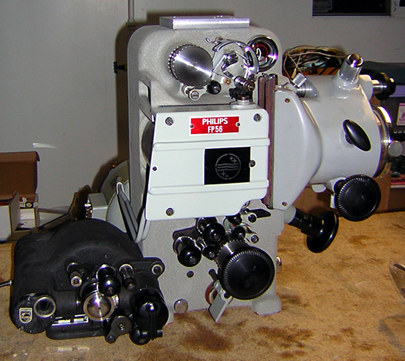
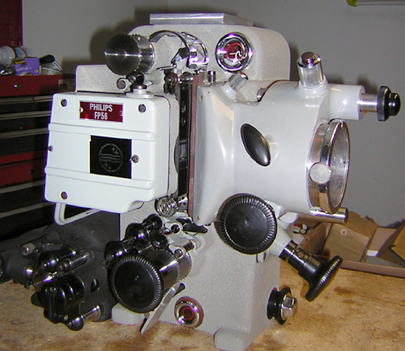
In my office I have always had a bulletin board with "Mark's Favorite Projector" posted on it. Its changed from time to time as Steve K will tell you. Always my favorite 70mm is the DP-70 and I doubt that will change. The(current)favorite 35mm is the Phillips FP-56.

This is an amazingly well made 35mm and is very tiny but very heavy as is all Phillips machinery. Its so well built that much of the DP-70 is based on many of its features and gearing. Its the only 35mm projector I've run that is as quiet as a well tuned Kodak Paegent 16mm. Splices also pass through inaudible due to the design of the gate which places the entry and exit positions for the splice at its slowest acceleration point. The back door does not require a gasket due to internal baffles and the projector doesn't leak a drop.

The down sides of the projector are the somewhat hard to change aperature plates and the odd size lens mount...adaptors must be machined for standard lenses but the ultra fine fine vernier focus more than makes up for that defficiency.

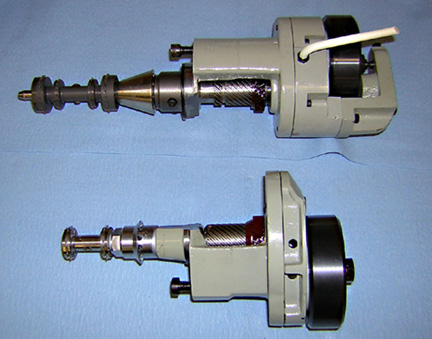
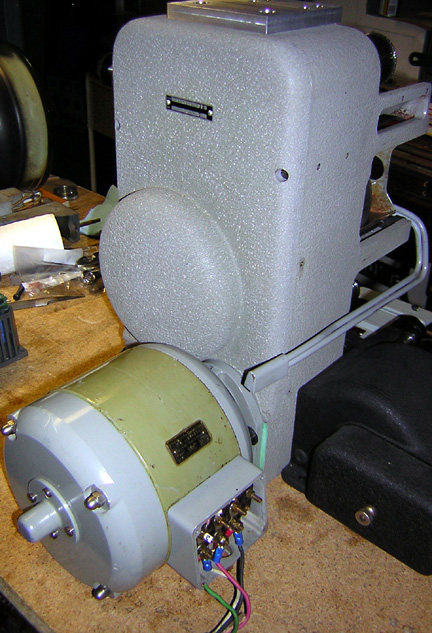
Photos below......

 -

Like brand new FP-56 Projector Head with Older Model Phillips Sound Reproducer.

 -

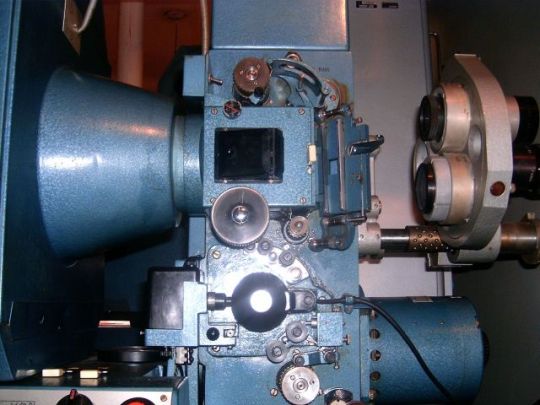
Comparison of DP-70 Movement(Top) With FP-56 Movement(Bottom)Both use the same flywheel and drive gear.

 -
Sorry Strong... but Phillips had direct drive(with a safety clutch!)back in the mid 1950's. You're a little late.....
 
Posted by Sam D. Chavez (Member # 1841) on 11-23-2004, 07:45 PM:
 
Cool pictures Mark.

I am starting to sell more and more reader kits for this sound head which has the same form as the AA11. Two to Denmark today.

How similar is the intermittent?
 
Posted by Paul Vollmers (Member # 927) on 11-23-2004, 08:52 PM:
 
Hands down..........the best 35/70mm projector is seen in the photo to the left....

<--------- the DP70 [thumbsup]
 
Posted by Robert John Jeromson (Member # 2559) on 11-23-2004, 09:34 PM:
 
I have to go wth the Kinoton FP-30E, no maltese cross, steady as a rock and really quiet. FP-30D is also pretty good.

Kinda fond of the DP 70 as well.
 
Posted by Mark Gulbrandsen (Member # 72) on 11-23-2004, 09:37 PM:
 
Sam,

Am glad those kits sales are picking up... That tells me that there are quite a few of these projectors still running and that people still appreciate a well made projector. Most parts are still available for them. I will probably order a kit for mine sometime right after the first of the year.

The movement is very similar except that the star and cam are not conically ground as in the DP-70, although they seem to be a bit wider. The star bushing is slightly eccentric to allow adjustment of clearance and the cam pin is eccentric(as it is in the DP-70) for absolutely perfect alignment with the slot in the star. These movements basically make no noise at all when they run... heck the projector is hard to hear running without film in it and with film is still very quiet. These are definately the coolest projectors I've ever owned!!!

Mark @ CLACO
 
Posted by Ed Inman (Member # 2583) on 11-23-2004, 09:46 PM:
 
My lowly Super Simplex projectors may indeed "suck" by modern standards, but 67 years after they were originally manufactured they are still projecting a clear, steady picture. I wonder if you will be able to say that about the $124,995 Digital Projection Lightning 15sx projector? (LOL)
Ed
 
Posted by Brian D. Whitish (Member # 825) on 11-24-2004, 09:57 AM:
 
Funny you would mention that Ed. I ran a digital demonstration last year for a SMPTE meeting they had here in Seattle. One of the SMPTE guys was much more interested in my Norelco AA2. I basically asked him if he thought that the digital projectors of today would still be running great in 40 years like the Norelco and he laughed. I love my Norelcos. When ever I go to run another projector I feel like Im running a toy. But I ran Simplex XLs for a number of years and never had any problems. Also ran a few JJ2 Centuries that ran well too.
 
Posted by Gordon McLeod (Member # 33) on 11-24-2004, 10:31 AM:
 
Mark the Ernaman machines also had direct coupled motors as did seeral Italian machines of long ago it wasn't a unique idea to phillips
 
Posted by Phil Blake (Member # 2012) on 11-24-2004, 10:34 AM:
 
I have similar comment as Stephen Jones , having experienced time on the same equipment, BTH Arcs , Super standards and Centrex.

I will agree most of the 50's and 60's made projectors were over engineered. BUT they did their job and did it well for 20 years without alot of problems.

Apart fromchanging aperture plates , I would vote the kalee 21 as the best , they will run for 20 years without problems.

And as for the worst , looks like most of you others think the same , my current projectors , the Vic 5 lucky to run for 20 days without hassels. They sadly lack the engineering quality , but are mass produced for this disposable society in which we live today.
 
Posted by Gordon McLeod (Member # 33) on 11-24-2004, 10:39 AM:
 
" the Vic 5 lucky to run for 20 days without hassels."
Probably the most installed machine in circuits I service and outside of abuse they have given next to no trouble. As long as the belts are changed yearly and the gearbox is kept properly lubed and the starter is set for the correct ramp they just run
 
Posted by Mark Gulbrandsen (Member # 72) on 11-24-2004, 12:16 PM:
 
quote: Gordon McLeod
As long as the belts are changed yearly and the gearbox is kept properly lubed and the starter is set for the correct ramp they just run

And the pulleys are replaced with the belts and the gate cleaned after EVERY show and the oil changed every 100 hours and the curved gates removed and the straight gates put back on and the intermittent sprocket is changed every two years and the lenses kept clean... and the projector replaced with a Kinoton you know Gord I'm just trying to egg you on.... [Wink] !

quote: Phil Blake
They sadly lack the engineering quality
Some relation to Strong must be working there??????

Mark
 
Posted by Christian Volpi (Member # 2370) on 11-24-2004, 02:04 PM:
 
In my own opinion the best projector has got to be the Century C. I had 4 of them that were about 40-50 years old and ran perfect every time. I could have threaded pots and pans in those machines and it wouldn't even phase them. Right now I'm running the worst projectors known to the industry, The Simplex Apogee. I've got 14 of those bastards and I would trade them in any day for a greasy old Century C.
 
Posted by Phil Blake (Member # 2012) on 11-25-2004, 07:54 AM:
 
I will agree with you Gordon, the Vic 5 is probably the most installed machine these days , but I does not mean they are the best. I would imagine most multiplex developers would choose them due to economics not quailty.

The Vic 5 quailty control at the factory seems to be asleep, we bought 3 new ones, 1 works fine ,2 has noisy shutter gearbox, 3 has noisy intermittent. and they were like that from out of the box. I guess I just see the engineering on these as being very "tinny" when stacked up against the older heavy duty machines.
 
Posted by Mark Gulbrandsen (Member # 72) on 11-25-2004, 08:41 AM:
 
quote: Gordon McLeod
Mark the Ernaman machines also had direct coupled motors as did seeral Italian machines of long ago it wasn't a unique idea to phillips
Gord,
Am very aware of that my point was why did it take the U.S. till 2003 to produce a unitized one piece gear driven projector?

Mark
 
Posted by Sam D. Chavez (Member # 1841) on 11-25-2004, 12:58 PM:
 
I have a couple of q's for Christian.

What is it exactly you do not like about the Apogee? I know there have been complaints about the bands and there are some initial oil
leaks but it sounds like you really hate this device so I'm trying to determine the root of the problem.
 
Posted by Tim Reed (Member # 137) on 11-25-2004, 03:12 PM:
 
My vote for all-time favorite, all things considered (ease of use, reliability, service, parts availability, etc...):

Century SAW.
 
Posted by Rick Long Jr (Member # 541) on 11-25-2004, 03:43 PM:
 
I'll probably get flamed for this, but I like the Vic 5. Better than I like the Simplex 1050, 60, or Millenium. The new gate is much more complicated than it has to be, but does show a good image. Their basement digital reader retro-fit perform quite well, and I've noticed lower vertical jitter rates than on any 5 Star. Like Gord says, if they get proper service, they just run and run.
Having said this, I haven't seen any new Vic 5's. The newest ones I deal with are late 80's models.
 
Posted by Edward Jurich (Member # 1787) on 11-25-2004, 05:23 PM:
 
quote:
1. Norelco AAII (There Are No Substitutes.)
Those Norleco's put out an outstanding picture. I stood next to our screen (50' wide) and the picture is rock steady. However, these are not the best machines for concession stand projectionist [Wink]
 
Posted by Christian Volpi (Member # 2370) on 11-26-2004, 08:53 PM:
 
quote: Sam D. Chavez
I have a couple of q's for Christian.
Well,

The biggest problem I have is with the tension bands. They break constantly and when they do they implant themselves right in the sprocket holes of the film and if you are not watching the print it will slice one side of the film off as it plays. The bad thing is that my failsafe doesn't catch it and it will keep doing this until you stop the film. I destroyed an entire print of After the Sunset because of that. Another reason I don't like them is the teeny tiny cramped loop that you have to make right as you come out of the intermittent. When splices try to make that cramped little loop they often fold at the seam and when the splice snaps back in place it causes the film to jump out of frame. I already have intermittent sprockets rollers falling apart and they are being held in place with RUBBERBANDS!! The dousers constantly need adjusting. I could type all night. I told Ballantyne about all of these problems and they are sending one of there tech's up to inspect. I'll keep you posted on what he says. As far as oil leaks I haven't had a single one...yet.
 
Posted by Mark Gulbrandsen (Member # 72) on 11-26-2004, 10:28 PM:
 
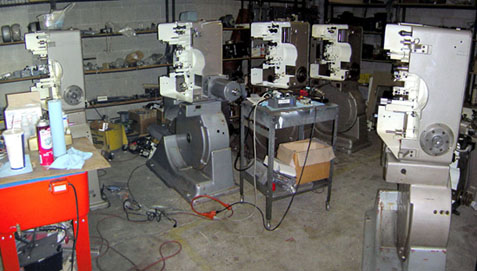
quote:
(There Are No Substitutes.)
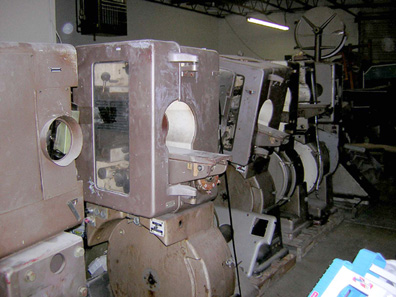
For Ed Jurich....... I couldn't agree more.... 5/12 AA-2 in progress in our shops for an upcomming plex . Behind the one on the far right and sitting on the floor peeking out is one of the two DP-70 from the Stag Theatre at Lucasfilm....

 -

Mark @ CLACO
 
Posted by Steve Kraus (Member # 476) on 11-26-2004, 11:55 PM:
 
Gray? Tsk tsk

Are you going to end up with the biggest concentration of DP-70's and AAII's in the world?
 
Posted by Mark Gulbrandsen (Member # 72) on 11-27-2004, 06:54 AM:
 
Gray? I don't see Gray anywhere...... Perhaps the last greatest concentration of DP-70's anywhere in the world for a very wise customer [thumbsup] !! The Silver Hammertone bases in the photo were not painted by us..... The bases are still to be painted/rewired for the frequency drive motors they're all getting.... BTW: The Lucas machines are Metalic Black.
 -
DP70's anyone????

Mark
 
Posted by Thomas King (Member # 2745) on 11-27-2004, 06:59 AM:
 
We got a Vic 5 in 1995 (how appropriate) and I can't say it's been well looked after: a tri-yearly service from the company that installed it and perhaps an intermittent oil change every year, if we were really lucky. It may be a bit noisy, but it's not audible outside the booth. I know that the projection manager at the local multiplex prefers them to his flock of Kinotons (which have plastic gateplates and a tendency to wobble). I had noticed that they are very modular (when attempting to change the dash-pot oil, I discovered we didn't have a dash-pot), but it's never given me the impression of being poorly made.
 
Posted by Jon Miller (Member # 163) on 11-27-2004, 10:06 AM:
 
quote: Mark Gulbrandsen
one of the two DP-70 from the Stag Theatre at Lucasfilm....

And what did Georgie replace these things of beauty (DP70s/AA-IIs in general) with? If it was with a Century or a Simplex, he should have been talked to. If it was with a Christie or a Cinemec, a arse-kicking would have been in order.

If a digital projector replaced the Norelcos, he should have been taken out and shot! [Smile] [evil] [dlp] [bs]
 
Posted by Mark Gulbrandsen (Member # 72) on 11-27-2004, 01:13 PM:
 
Would you believe 35/70 X-L's...... Talk about a one giant step down. All politics I would assume. I was told they had focus/steadiness problems running 35mm but with my experience with these projectors either the runners needed to be surfaced, the lateral guide rollers were out of adjustment or they were doing something seriously wrong.

Tha amazing part was that there was absolutely NO WEAR to the mechanism or intermittent. These machines were in better condition than any I've seen. They obviously changesd oil alot. The delrin rollers in the 70mm penthouses were another story though with some of the bores amost half again the normal size. These machines clearly ran loads of 70mm, probably in the print grading process.

Mark @ CLACO
 
Posted by Jon Miller (Member # 163) on 11-27-2004, 01:31 PM:
 
Thanks, Mark! Why they replaced the entire system when a simple tuneup would have sufficed is beyond me. It reminds me of a bumper sticker I spotted yesterday that had a political reference and this phrase: If it ain't broke, fix it anyway. [Roll Eyes]
 
Posted by Aaron Sisemore (Member # 145) on 11-27-2004, 01:49 PM:
 
quote:
If a digital projector replaced the Norelcos, he should have been taken out and shot!
There is a DLP in the Stag booth, but it sits alongside the two 35mm machines. Film still gets run there more than you might think.

quote: Mark Gulbrandsen
Would you believe 35/70 X-L's...... Talk about a one giant step down.
Actually they were replaced with 35mm ONLY Simplex XL's (on SH1000 soundheads). At this time the Stag does not have any 70mm capability.

Mark, I am glad to hear that the Stag's Norelcos were still in great shape, I really wish I could have had a chance to use them when I had them [Frown] [Frown]

-Aaron
 
Posted by Mark Gulbrandsen (Member # 72) on 11-27-2004, 02:23 PM:
 
Aaron,
I was told that by Doug Raden a few years back, in fact he may have been the one that sold the X-L's to them. Perhaps they also found the 35/70 X-L the same way I have.....

Whats funny is all the mixing stages there have/had the rock and roll Magnatechs which are better than whats mow in the Stag. Thanks for the insight.

Mark @ CLACO
 
Posted by Neil Robinson (Member # 2459) on 11-27-2004, 04:55 PM:
 
megasystems 8/70 big green pile of junk.
 
Posted by Steve Kraus (Member # 476) on 11-27-2004, 06:57 PM:
 
How about the Norelco AA-II 8-perf? LOL
 
Posted by Steve Guttag (Member # 268) on 11-28-2004, 07:34 AM:
 
I did have the chance to see a film in the Stag on those Norelcos...the picture was not impressive at all. There was notable weave and jump and the image was poorly focused (Schneider anamorphics)...the operator racked focus and it was uniform.

Steve
 
Posted by Scott Norwood (Member # 30) on 11-28-2004, 09:50 AM:
 
Why is it that X-Ls seem to be popular studio machines, yet one almost never hears of a Century installation in a screening room? Also, what is the difference between the theatre-model X-L (PR-1014) and the studio model (PR-1020)?

And wouldn't the electronic Kinotons be more appropriate than either Simplex or Century, anyway? I'd think that the electronic controls and improved picture quality would be highly desirable features. I can't really imagine why anyone would choose anything else for a studio screening room.
 
Posted by Mark Gulbrandsen (Member # 72) on 11-28-2004, 09:53 AM:
 
Have not screen tested them as of yet. The runners are still at Kinoton for re-grind. The lateral guide rollers were worn quite a bit but not beyond re-adjustment. A factory (or an exact duplicate)lateral guide roller alignment gauge is almost mandatory for best performance from both gauges in a DP-70. I never saw 35mm projected from them but the 70mm screening of "Die Hard 2" was dam good. I look foreword to seeing what these two machines can do on the screen.

Scott, many of those Simplex's and Centurys were installed way before electronic projectors existed, although RCA did produce them back in the early 80's, FR35, and FR35B of which dubbing theatre versions were produced. The RCA FR35B was actually a very good machine. Also today some of the determining factors would be budget and the exact use you're going to put the screening room to.

If it were just a regular day in-day out room to watch film in (Like Steve K's) then I would install Centurys. I've never seen any other projector come close to the steadiness of a well tweeked Century, although don't expect the best light efficiency but light distribution is excellent with the right lamphouse. It is easy to get them to beat all SMPTE specs by a wide margin on a daily basis provided you have large enough lamps. Either a Century or a Simplex is easy to retrofit with three bladed shutters. Also keep in mind that the Simplex intermittent oil pump is not going to be doing very much work with an X-L running backwards!! The rock and roll X-L is another legitimate P.O.J. that uses the tiny moviola reversing clutches for feed and take up. They can barely handle 1K foot reels of film let alone 2k's.

If it were a re-recording or mixing facility then an electronic machine is mandatory but even many of those have fallen by the wayside in favor of digital projection today because it speeds things up quite a bit over using film on the dubbing stage. Time is money in that world.

Mark @ CLACO
 
Posted by Scott Norwood (Member # 30) on 11-28-2004, 10:31 AM:
 
Regarding light efficiency: I have a Century brochure from the late 1960s that states that "the light path of the mechanism is designed for an optical speed of f/1.5"; what, exactly, does this mean? I understand the concept of "speed" as it applies to lenses, but how does this apply to projector mechanisms and lamphouses? And what happens if I use an f/2.0 lens in an f/1.5 projector? Does anyone make f/1.5 projection lenses?
 
Posted by Gordon McLeod (Member # 33) on 11-28-2004, 10:48 AM:
 
the vast majority of studio/lab screening room we service are all kinotons (from older fp20s-newer e machines)
the simplexs just didn't cut it in the eyes of most lab people for steadiness especially at high speed
 
Posted by Steve Guttag (Member # 268) on 11-28-2004, 03:04 PM:
 
Sorry...I like Simplexes over Century...the Century JJ though does seem to do quite well with 35mm ...better than the SA, in my opinion.

As to the PR-1014 (cinema) versus the PR-1020 (studio) head. There are several changes...the studio head gets a 3-wing shutter, a fire shutter is standard (optional on the PR-1014 now) and a studio straight gate. The intermittent shoe and the gate pads on a studio head are different and all overlap each other. I also believe the 35/70 lateral lens adjuster is either standard or listed as an option on the PR-1020.

I'll agree that the PR-1030 (reversing) runing in reverse is not a pretty sight as compared to electronic solutions (or even the Kinoton cross).

Steve
 
Posted by Monte L Fullmer (Member # 2797) on 11-28-2004, 11:10 PM:
 
Yo, Marko: Remember when we did that screening here in Nampa at the college campus back in 1999, when we used that Kinoton setup? I've never seen a more precise, well built portable that can run 35mm so quiet and smooth. A good example of a well-built machine that shows that it is possible that such a machine can be built with such precision.
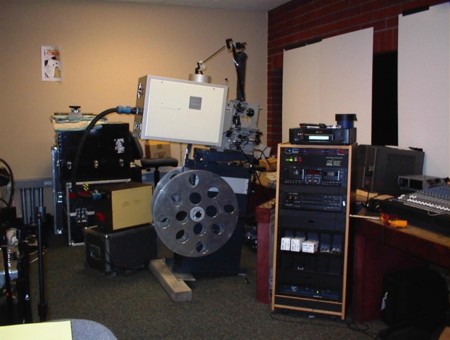
Yes,I also like the Simplex XL and it's offsprings. Just wish that we can find a cure for the oil leak problem outside of the 2000Mil's "O" ring fix that was finally done with the INT case.

As you can tell, I still like the P35GPS CHR for the advantage of NO OIL.

Yes, Century's are great machines as well - just grease up the gears one a month,check the INT for oil level and your set for life.

Any blurb on Simplex's Apogee machine? Only thing I've heard is that this machine has some bugs to clear out or something.

thx-Monte
 
Posted by John Pytlak (Member # 331) on 11-29-2004, 09:15 AM:
 
At Kodak, we have some Century projectors that have had less than 1/10 of a square movement on-screen (about 0.0004 inches or 0.01 millimeters) using the SMPTE 35-PA (RP40) Projector Alignment film for evaluation of steadiness.

With moderate lamp power (screening rooms), and three-blade shutters, we've achieved 80 line pairs per millimeter resolution out to the corners of the image (Isco Ultra MC Studio lenses).
 
Posted by Leo Enticknap (Member # 534) on 11-29-2004, 09:22 AM:
 
quote: Monte L Fullmer
I've never seen a more precise, well built portable that can run 35mm so quiet and smooth.
If you mean the FP-23 that's a portable version of the 20 - and I like them, too. They use a 400w halogen bulb if I remember correctly.
 
Posted by Sam D. Chavez (Member # 1841) on 11-29-2004, 12:33 PM:
 
The AA 11's at the Stag were not wonderful as to side weave. This projector is not too good on this parameter, particularly in scope. It was downright embarrassing against the DLP side by side in motion artifacts.

The gates did not fit the projector properly despite having the correct serial number.

I sold the carcasses of the XL's to Dan Eiseman who interfaced them for use at the Stag. Believe it or not they were the most basic of old Drive In junkers.

Why Lucas decided to eliminate 70mm capacity is the question. There is no place on the ranch to see 70mm prints.
 
Posted by Monte L Fullmer (Member # 2797) on 11-29-2004, 02:35 PM:
 
Thx for the model number. Yes, it was the FP-23, and we had a 2.5K xenon lamphouse tied behind that Kinoton - just a very pretty, extremely steady picture. Here's the pict of that setup we ran. thx-Monte

 -
 
Posted by Mark Gulbrandsen (Member # 72) on 11-29-2004, 08:00 PM:
 
quote: Steve Guttag
As to the PR-1014 (cinema) versus the PR-1020 (studio) head. There are several changes...the studio head gets a 3-wing shutter, a fire shutter is standard (optional on the PR-1014 now) and a studio straight gate.
First off that straight gate is one of the worst gate designs to come from Simplex. Parts are also sometimes VERY hard to get for them and it seems that only one employee at Strong knows about them. Cineplex ordered that gate for quite a few locations on its standard booth package and one other local giant plex also has them. Use them(or any other Simplex straight gate) if you want bad focus flutter with any lamp over about 2kw. Heat filtes don't help.... Cinefocus on the other hand is amazing in what it does. Another really poor feature of that gate is that individual pads, especially the top pad, does not get even pressure from the springs and hence the film is not getting even pressure. This also causes the flat film trap runners to wear unevenly and the pressure pads also typically wear unevenly. Yea, really good design [Roll Eyes] .

Any Simplex or Century can be equiped with a 3 bladed shutter,it no big deal and is fairly inexpensive. The Century SA can also recenter its lens mount as a standard feature... as well as be refitted with the JJ lens shifter detent if the detents are required for exact C/L lens-film alignment.

Sam,
The gates on the DP-70 were never matched to a new projector, they were all machined with fixtures at the factory to tolerances tight enough that matching was not required on a new assembly. They were typocally lept in the wooden boxes so they would end up back on the same projector as wear pattern develope differently on the guides and runner and its the wear patterns that need to be kept track of. The only non-interghangable part that is pinned is the outboard movement bearing and this is located and then pinned and the trap can fit on any machine if everytin else is set up correctly. In fact the gauge for setting the lateral guide position is seperate and is not done with the gate on the projector. If the guides and leaf spring pressure are correctly set the 35mm steadiness easily meets SMPTE. So far I can't remember a rebuilt mechanism leaving for a location that didn't meet it. Another factor is being sure the runner is good.

Mark

Mark
 
Posted by Sam D. Chavez (Member # 1841) on 11-29-2004, 09:42 PM:
 
Mark,

I hear you, but check out the way the gate fits the Stag projectors. when you tighten the gate knob it looks like it wants to fit crooked like something is sprung.
 
Posted by Steve Guttag (Member # 268) on 11-29-2004, 10:41 PM:
 
The way the PR-1014 reads on the build sheet is a PR-1020 with a change in shutter and gate.

Steve
 
Posted by Michael Wilkinson (Member # 2389) on 11-30-2004, 01:34 AM:
 
As for favorite machines. I still love my 1014's with curved gates. New 1961! I believe they were changed from straight gate at some point in the 60's or 70's. I was fortunate enough to find a screen scope for one machine. In the last eight years, other than routine cleaning, I have had only to replace the pressure straps, gaskets, the intermittent sprocket (just the sprocket), and the framing lamp switch in one machine.
The picture is rock steady, and the machine runs quiet and smooth. Okay it leaks a little-so what?

As far as the soundhead, I'm running 1947 vintage RCA 9030's. Not one problem-ever-except for the time the cast aluminum Christie projector mounting bracket snapped [Eek!] In spite of the fall, the only damage was to the motor mounting bracket and the cement floor. Being relatively new out here-I just noticed some old posts for sound-drum modifications? I assume that the reference is to the annoying rubber pad which is on both older Simplex and RCA's alike? Can anyone point me to that topic?

PS Sam, thanks for thinking of us with the 9030 RSTR reader mounting bracket. [thumbsup]
But while I have you here-Am I sacrifcing too much sound quality with a 9030?
 
Posted by Monte L Fullmer (Member # 2797) on 11-30-2004, 01:51 AM:
 
Okey. Newbie talking here on interesting topics and have to ask some questions:

We know that the 1014 was the old "XL" head with a new name, color and made it look more modern, since they had the curve gate "XL" back prob right after they were manufactured back in the early'50s. And I've ran the old black baked on wrinkled versions with the one piece solid rails in my earlier booth years. Now, This is where I get lost: What was the "studio" verion-outside of the three rail assembly in the gate being different of the solid rails of the standard assembly. What was the advantage of the three rail version? Yet, I've seen the three rail version with Supers and E-7's.

Next question, and I'm a bit ashamed on not knowing this that the "XL" had the optional 3 bladed shutter. Wouldn't this cut some light down considerable with that extra blade swinging in the light beam, or am I missing something and don't know the tricks to this variation?

Now, here's the biggie: We know that the "XL" had two INT assemblies: Standard and Hi-Speed. With seeing the diagrams in the part manuals, I'm having a hard time understanding how the hi-speed INT action works. Do they use the same INT sprocket between the two assemblies and what was the hi-speed INT action for..little help here, if possible.

thx a bunch - Monte
 
Posted by Mark Gulbrandsen (Member # 72) on 11-30-2004, 08:02 AM:
 
quote: Monte L Fullmer
What was the advantage of the three rail version? Yet, I've seen the three rail version with Supers and E-7's.

No advantages that I have visually seen. Splices make alot more noise with these gates and the trap runners wear down unevenly.

quote: Monte L Fullmer
Wouldn't this cut some light down considerable with that extra blade swinging in the light beam, or am I missing something and don't know the tricks to this variation?

Yes they do cut the light level down. A larger lamp is required with these projectors.

quote: Monte L Fullmer
I'm having a hard time understanding how the hi-speed INT action works. Do they use the same INT sprocket between the two assemblies and what was the hi-speed INT action for..little help here, if possible.

There is driver that replaces the normal location of the cam and is attached to the flywheel in the normal way. On the head of the driver there is a slot for a sliding bar.... the sliding bar has a hole though it that couples to the cam pin which is extended through the back of the cam(mounted to the front half of the movement casing. Due to the angle difference between the location of that sliding bar and its attachment point to the cam pin an acceleration is achieved for the pull down. BTW: The star wheel is a standard star wheel.

Now if you're not confused by what I wrote above then I sure am [Wink] . Perhaps someone else here can shed some light on why there are at least four different Simplex straight gate assys. The better one has the one piece solid straight pressure pads like in a Ballantyne. These seem to provide the most consistantly even film pressure and much more even wear on the flat trap runners.

Mark @ CLACO
 
Posted by Monte L Fullmer (Member # 2797) on 11-30-2004, 05:34 PM:
 
Thx Marko for your help on this. Your definition on the Hi-speed INT helped well. But, I still have to ask another question: You know the IMAX here in Boise that REG took over. They installed a Strong console/Simplex 1060 system (can't remember the name of the console, but using the 4k bulb in it) to show 35mm on that big screen. I heard that the 1060 has a hi-speed INT assembly for usage on the big screen presentation-is the jest of my earlier question of the hi-speed INT assembly. Wouldn't a standard INT assembly be justified, or is there a trick in using the hi-speed INT for this special kind of presentation?

I notice this bar/cam arrangement in the parts diagram. Yes, I've seen the different wear pattern on each of the studio's rails and does make sense of the one piece rail that we commonly use - to have the even wear from top to bottom . thx-Monte
 
Posted by Steve Guttag (Member # 268) on 11-30-2004, 06:27 PM:
 
Monte,

JST CUR, IS THR SOM RZN YOU WRT WTH 3 LTR WRDs?

STG

On to other matters...

quote: Monte L Fullmer
We know that the 1014 was the old "XL" head with a new name, color and made it look more modern, since they had the curve gate "XL" back prob right after they were manufactured back in the early'50s.
We do...do we? Actually, the first version of the PR-1014 was a black wrinkle finish just like PR-1001. Once upon a time, just about any variation to a Simplex product warranted a new part number. A projector head with the door springs (to hold the door open), for instance was a Drive-In head and would have a different PR number than one purchased for Indoor use.

They eventually converged on the PR-1014 for the projector either indoor or outdoor, likewise, the soundheads (SH-1028, if I recall correctly). The removable exciter holder that lasted up until the LED reader era was actaully from the Drive-In version... the Indoor soundheads had a dual holder with a lever to switch between the two lamps...it was the single holder that ended up being the winner.

If Simplex were to have continued as they had (even before Strong aquired them from NSS in the mid-80s) the PR-1014 designation should have been retired as changes were made to the projector. Century fell victum to their incosistant naming too. When the SA came out...it should have been the "A"...the double shutter should have been the "AA"...not this SA and DA crap. But the "A" and "AA" names were used by other manufacturers, I guess.

Next...The Simplex XL came out in the late 40s ('49 if I recall correctly). The oldest document I have for the curve gate is dated FEB 1957. Not exactly right after the machine came out. Note, most of the curved gate specific parts are P-4000 series. Most of the 35mm magnetic penthouse specific parts are P-3000 series...placing the curved gate after 4-track magnetic in 1953.

Steve
 
Posted by Mark Gulbrandsen (Member # 72) on 11-30-2004, 07:28 PM:
 
Steve,

The three leter thing Monte uses is a local thing in that area of the country only. It hasn't transmuted as far as Boise yet but when it does that city will be nothing but an abreviation.

Monte....

The high speed movement allows for about 70 plus percent light efficiency depending on how far you open the shutter wings up. Originally released in the 60's for drive inns they are no longer made and if the movement "blows" out all you can do is to convert it over to regular pull down.... that conversion takes some machine work and relocating some bushings to accomplish. Not to hard though. I've always noticed a much improved image when using high sopeed movements. The only other one I know of other than in the old RCA and Simplex TV film chain projectors was in the Century Cinemascope 55 projectors. The Powers mechanisms also had a relatively high speed pull down of 5 to 1 instead of the standard 3 to 1 normally used but theyn were not designed as such. Its just a spioff of having the pin cross movement.

Mark
 
Posted by Brad Miller (Member # 2) on 11-30-2004, 08:38 PM:
 
Monte, please learn to spell out your words. Not everyone can follow your abbreviations and even those who can, it's annoying.
 
Posted by David Yauch (Member # 2754) on 12-01-2004, 01:02 AM:
 
Quick question: Most of you listed the V5 on your list of worst projectors because of the horizontal weave. Well after I saw that I went and checked every theatre during my next shift. About 5/25 had noticable weave, one or two were questionable, and the others were as steady as I could imagine them being. The 5 that weren't were all in our smallest auditoriums too. So where does this problem come from, if its not affecting all of them? Of course there is a chance that somewhere along the line these have been modified in some way by our corporate engineering personel, but nothing that I know of.
 
Posted by Monte L Fullmer (Member # 2797) on 12-01-2004, 01:21 AM:
 
lol - like a new language.... Ok I'll spell things out, even I've been writing INT's for intermittent for years - just easier to type three words instead of going the full yard. Habit from speed writing in my earlier days. But, it made you think some...

No, Boise and surrounding areas of Boise, are growing like crazy!
Now, there are plans for THREE 18 screeners- all in Meridian/Eagle area, (one REG, and two Indies, plus a 10 screener downtown Boise, in which we don't know right now who is going in-either Marshall Smith, or REG, since it isn't officialy announced..) - down the street from the Egyptain, and across the street from the Flicks.

-Monte
 
Posted by Ian Joseph Parfrey (Member # 2682) on 12-03-2004, 01:40 AM:
 
No contest.
First choice ...Super Standard
Second choice ..C&W P6.
Aussie born and bred with two important attributes.
1. Built to last
2. Simple uncluttered designs without the crap that modern projector designers insist on infecting their machines with. [thumbsup]
 
Posted by Stephen Jones (Member # 16) on 12-03-2004, 07:17 PM:
 
G'day Ian

Yep I second that they are both good projectors and still a few around giving good service.I used a few Supers over the years and they were married to the RCA sound heads mentioned in another thread.I found that a good combination and found them great never had oil leak probs at all.If I remember RCA Australia were the distributors for the super standards and sold them as a pakage to drive-in's at the time usually with BTH arc's.And have worked on the odd C&W both Senior and Junior modles nice and quiet being chain driven just like my favourit Kinoton's.If you ever in Mebourne pop down to Geelong and say G'day.
Cheers [beer]

Steve
 
Posted by Ian Joseph Parfrey (Member # 2682) on 12-03-2004, 09:38 PM:
 
Hi Steve.
I am familiar with Geelong very well as I once was a Melbournian in a past life.

I have mixed feelings about good old Geelong, in particular the old Star Drive-in that was once there. During one our theatre treks, my brother and I went to the Star just before it closed. That was a real nice place and was drive-in done right! We were looking for some gear and was told that two weeks before, the Kalee 21's were scrapped and the bases sold to a scrap metal dealer. Why do they do this? I think they had Strong Futura 11's on the back if I remember rightly. A good combination I'm told though I still reckon the gate and aperture setup on the 21's is still dumb.
The Super Standards and the Super 75s were an ideal combination when teamed with my beloved RCA soundheads. I know that the Village in Ballarat had the RCA setup but I don't know what the Village Drive-in in Geelong had. I'll guess that they were probably Century's with Strong's on the back.
You may remember the old cinema in the main street there, I can't remember the name but I do know they had Bauer's, I think either B12's or 14's. It's now flattened and a nice row of stores, consigned to the annals of history.
Geelong's a top spot and can't wait to get back down there and say Hi. [thumbsup]
 
Posted by Stephen Jones (Member # 16) on 12-04-2004, 01:02 AM:
 
Hi Ian,
Unfortunately I never saw the drive-ins here in Geelong as I have only been here for 8 yrs.Village transfered me from Tassy back in 96 as LTM at Village Geelong 11 which is the worst site that I ever worked at in my 25 yrs with Village I left after differences of opinion with the site GM I think you know who I mean as you worked with Village in Melbourne .I now work at Reading Entertainment at thier Waurnponds site using Kinoton FP50D'S and Kinoton platters which in my opinion is the best pakage for multiplex cinemas.Yes the Kalee apature plate was a stupid arrangement which was my only fault with them.I worked with many a Kalee 21 over the years most of them on RCA soundheads with one pair I had at Hoyts in Hobart that were on Westrex sound heads with Kalee President arcs,these Kalees also had the Kalee Mag Heads, last I heard these projectors etc were sitting in shed somewhere in Hobart.We ran 6000' spls with a full trim of carbons.

Cheers [beer]

Steve
 
Posted by Phil Blake (Member # 2012) on 12-04-2004, 09:20 AM:
 
hi Ian,
I would have to agree the Super Standard was a very simple uncluttered machine , it was the very first machine I used.They ran well without many problems, although they were a little noisy when the shutter bevel gear bushes became warn. The kalee 21 was equally as good , probably with the advanced solenoid changeover and constant oiling gave them the edge and the fact they were very quiet.
Still..... both of them run rings around what we are buying today.

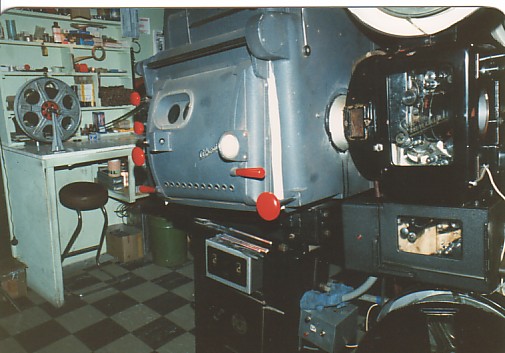
my first
 -
 
Posted by Mark Gulbrandsen (Member # 72) on 12-04-2004, 11:19 AM:
 
Well, the lamphouse in that photo is definately a good piece....

Mark
 
Posted by Monte L Fullmer (Member # 2797) on 12-04-2004, 01:37 PM:
 
..only thing about Supers is when changing out or rotating the intermittent sprocket: is the usage of those taper pins and having to take the assembly apart to do this service. Otherwise a nifty little Simplex.

Okey, question from this "newbie" here:

I'm a "babysitter" of a bunch of 1050's here, and I have one 1050 that when I change the oil in this unit, no more than a week later, the oil turns into a dark caramel color.

Granted, I think of a main vertical shaft bearing(s) going bad, or shutter bearings, yet they spin free without any noise when I take the weight off of them. Plus, the unique thing on this unit is that it has one of the longest coast times for any 1050 that I have when the power is turned off-almost 30 seconds.

See what you think on this one. thx-Monte
 
Posted by Will Kutler (Member # 770) on 12-04-2004, 08:48 PM:
 
Early Standards had the single bearing intermittent. Older Standards started using the double bearing type.

I do believe that Standard and Super double bearing intermittents are interchangeable.

Depending on the star/sprocket style you have, it could either be the taper pin or the later screw/locknut style.

If you have the taper pin style, then a lot of care must be taken to remove that pin. I do believe that there was a special fixture for this to prevent accidental shaft damage.

Cheers

K.
 
Posted by Monte L Fullmer (Member # 2797) on 12-05-2004, 02:20 AM:
 
Thx, even though it's been years since I did a Super intermittent sprocket replacement, and this one was with the taper pins to secure the sprocket on the shaft, I just had to make sure which side of the shaft and sprocket had the bigger holes to match the taper of the pin. otherwise, it was curtains for the pins. When I did that rebuild, I had a small brass hammer to drive out the pins with a tap or two, which were easy to drift out and tap back into place.

It was the alignment of the nosepiece to mate the starwheel back up with the cam, since I "disturbed" the seating of cam and starwheel when separating the two pieces, for that was the trick to do. But, it didn't take long for each part to find home base where they accepted each other in harmony and the assembly ran very smooth and quiet from there on.

This theatre where I did this Super rebuild was in Midvale,UT .. the Gazebo, on Main St. when I lived down there back in the mid 70's. This one Super had a sprocket that was hooking badly, being worn on the one side. By turning the sprocket around help make the film run a lot quieter.
 
Posted by Ian Joseph Parfrey (Member # 2682) on 12-05-2004, 04:27 AM:
 
Hi Phil
That bevel gear problem would be about the only thing that gave any trouble on those Super Standards. Did you have any experience of the Super 75's?
I know there are still a pair of Super Standards and RCA's in operation at the Palace Theatre in St. Kilda Melbourne with Strong X-60 C's on the back. Nice rock steady pic and not too much bevel noise!

Ahh Yes, The Super Standard....Aussie Built....Aussie Tough!
[thumbsup]

Ohh, Steve. Not another Village victim? Y,know, before they went public, they were a great bunch to work for! You'd bust your arse for 'em and they'd appreciate it. Memories of David Aalders spring to mind.
Agree on the Kalee's. The Presidents were an under-rated lamphouse I reckon. So, they're in a garage somewhere?...... I wonder.... [evil]
 
Posted by Stephen Jones (Member # 16) on 12-05-2004, 06:10 PM:


Posted by Stephen Jones (Member # 16) on 12-05-2004, 06:21 PM:
 
Hi Ian,
They were the good days at Village then but then they went public and had to keep the share holders happy and lost a lot of great projectionists in the process.I didnt know that the Palace Theatre had Super Standards under the impression it had Cinemecanica V8'S,have you any photos of the bio?I have only been in the foyers and the stalls area a great old picture place of the 30's and its good its still standing and being used and I hope it dosent fall victim to progress it just wouldnt be St Kilda without the Place

[thumbsup]
Steve
 
Posted by Phil Blake (Member # 2012) on 12-06-2004, 09:36 AM:
 
Ian I never had any experiences with the Super 75's.

It was ironic that about two years ago I came across a visitor from Perth in the cinema , he chatted about his passion for collecting and restoring old projectors. It was then uncovered that he in fact had both of the Super standards from my drive in in his possession and was restoring them .
I love a happy ending.

and Yes Mark those lamphouses were a good one. The one in the picture was converted from rotating positive black carbons to copper carbons (10mm positives) and they put out a fantastic light indeed.
 
Posted by Ian Joseph Parfrey (Member # 2682) on 12-08-2004, 05:04 AM:
 
Stephen.
Yep, I am certain about the Super Standards at the Palace, St Kilda.
Went up to the box during a screening, during MIFF a few years ago.
Dave Thomas was the operator at that time. I don't have any photos but I do remember they were the grey Supers with X-60's on the back and a REAL long throw! They may have been changed since then.
The Regent in Collins St. Melbourne has Cinemeccanica Vic 8's with full 70mm capability.
There IS life after Village, eh? [evil]
 
Posted by Stan Gunn (Member # 554) on 12-08-2004, 05:21 AM:
 
It is the PALAIS theatre at STKILDA a wonderfull old lady and the Super standards are still running sweet I am about to fit my red led convert.

Stan Gunn [Wink]
 
Posted by Mark Gulbrandsen (Member # 72) on 12-08-2004, 07:38 PM:
 
quote: Stan Gunn
I am about to fit my red led convert
Should we be afraid [Eek!] ?

Mark
 
Posted by Monte L Fullmer (Member # 2797) on 12-09-2004, 01:11 AM:
 
Okey - I need some help on this one: I've got a 1050, that when I change the oil, which is almost clear,that in a couple of weeks the oil is a very dark caramel color. Have I got a bearing heading south? For I've taken the back off, unbolted the INT assembly drive gear to let the vertical shaft spin freely, and absolutely no drag what so ever even with this gear being released. Shutter spins freely, no noise...just if anyone out there have ever had this problem before. -thx Monte
 
Posted by Mark Gulbrandsen (Member # 72) on 12-09-2004, 08:03 AM:
 
Does the oil smell burnt or is it just dirty? Sometimes it can take several oil changes over a few weeks time to clean out any gunk thats in the sump. More likely something has turned rusty or the sump is just really dirty.... to check the sump just pull the oil pump out and check the sump for sludge buildup. If that doesn't help then a complete teardown might be in order.... somewhat like exploratory surgery.

Mark @ CLACO
 
Posted by Monte L Fullmer (Member # 2797) on 12-09-2004, 01:35 PM:
 
Nope, just dirty. And, I've even cleaned out the sump area as best, short of taking the pump out. Prob have to do that what you recommend-more frequent changes to "wash" the gunk out, and if that doesn't do, it could be surgery. Yet, I really don't want to, for that machine is one of my smoothest running. Thx for the help, Marko. - Monte
 
Posted by Mark Gulbrandsen (Member # 72) on 12-09-2004, 07:23 PM:
 
If its running smooth its probably not a bearing. I would change the oil once a day before the forst show is run over the next three days in a row and see if that helps... this type of quick sucessive oil change will get rid of what ever the dirt is very quickly. If it still keeps getting dirty then a tear down is in order before the excessive dirt wears the mechanism out.

Mark @ CLACO
 
Posted by Phil Blake (Member # 2012) on 12-10-2004, 10:10 AM:
 
The BTH lamphouse looks like it was more common than I thought in Australia during the carbon years.
I never came across many in WA but it looks like there were a few about in OZ.
They were a very reliable lamphouse but did not produce a light as good as the ashcraft.

For those who are not familiar with the BTH ....
 -
 
Posted by Joshua Waaland (Member # 287) on 12-10-2004, 10:42 AM:
 
I am a Simplex XL man for life! They may leak oil but I have never had one break down as opposed to the Century's. I like the Century's too but I lost count haw many intermittents we changed in those things. Also the gears needed changed once or twice too.

Mark,

I love those Norelco's you guys have at Claco. I have never gotten to see one in person but have seen many pictures and read quite a bit on them. I am sure I would love them. Just can't afford the $10,000 price tag attached to them. I love any kind of machinery that is totally overbuilt like that (I got a Brenkert BX-60 from a guy for that reason).

[ 04-02-2008, 12:24 AM: Message edited by: Joshua Waaland ]
 
Posted by Mark Gulbrandsen (Member # 72) on 12-10-2004, 08:04 PM:
 
quote:
I am a Simplex XL man for life!
Well, I went through what you are going through a long time ago. I had just about every projector made in my home screening room at one time or another as Steve K will attest to. I won't make any comments about the X-L as thats a whole other thread and I could write a book about it.

My present favorite projector is not the DP-70 but is the Phillips FP-56. This projector would be very hard to beat in any aspect and reportedly the only others that can equal or beat it are certain models of older Bauers. The important thing is that you appreciate the machinery [thumbsup] .

BTW: DP-70's don't have to cost 10K unless you want one completely redone... you can still aquire them just as you did your X-L for the same price.... or less in some cases.
I will leave you with a picture of the FP-56 to drool over [Wink] .

 -

Mark
 
Posted by Gordon McLeod (Member # 33) on 12-10-2004, 09:32 PM:
 
Mark the ernaman 8b is a better machine than the phillips
 
Posted by Mark Gulbrandsen (Member # 72) on 12-10-2004, 10:17 PM:
 
Probably more of an equal than better as I mentioned above..... Having had both machines apart I can say that the build quality of both are very close to each other with the scale tipping in favor of the Phillips which has a much better designed and built movement and gear train. The Phillips is easier to service and also has the advantage of handling up to 4" diameter lenses while the Ernamann can't.

Actually I like both but the Phillips is a more practical machine even for use today.

Mark
 
Posted by Monte L Fullmer (Member # 2797) on 12-11-2004, 02:12 AM:
 
Philips-pretty good looking machine..looks like an oversized 17 jewel pocketwatch-for you know this thing will run smooth. Them Europeans know how to build them, and they stay in business!
 
Posted by Dan Lyons (Member # 1454) on 12-11-2004, 05:06 AM:
 
Mark,

Do you have a manual for that? I'd love to see more info on that creature.
 
Posted by Mark Gulbrandsen (Member # 72) on 12-11-2004, 05:54 AM:
 
Yes I do. Its such a simple machine that the manual is more like a pamphlet than a manual. It covers operation, maintenance, and parts in about ten pages. I'll see what I can do to get it converted to Adobe for Brad to post in the manuals section.

Mark
 
Posted by Matthew Jaro (Member # 1786) on 12-11-2004, 10:36 AM:
 
Mark --- I notice that the FP-56 has a straight film trap. I like the XLs because the curved gate keeps older films in focus.
 
Posted by Mark Gulbrandsen (Member # 72) on 12-11-2004, 04:52 PM:
 
Matt,
Most of the older European machines have straight gates. They are generally good to about a 3kw xenon and more with proper heat filters. The 56 has water cooling that is better than even the Century.... which is pretty hard to beat. So the combo of heat filter, water cooling would get you to 4KW without too much trouble. The X-L water cooling is pathetic at best and really only cools tha aperature plate proper while the rest of the head bakes in the extreme heat and literally warps. The best water cooling again lies in Phillips design for the DP-70 with its copper cooling line thats silver soldered to the silver plated copper cooling plate which makes up the entire gate. The runner on the DP-70 is in a fixed position. DP-70's typically run at room temperature provided a proper water circulator is fitted to them and the FP-56 cooling is not far behind as the heat exchanger is located and is well in contact with the main casting itself.
Oh... did I forget to mention that the Phillips FP-56 has a form of Cinefocus built in to eliminate focus flutter and to further help cool the film?????? The upper lens mount rod is the inlet tube for that..... Oh well.... is a curved gate really necessary with this machine? I can't answer that for sure...... but it may not be.

Mark
 
Posted by Ian Joseph Parfrey (Member # 2682) on 12-12-2004, 04:14 AM:
 
Mark,
Your beloved FP-56 aint a million miles from the Bauer B11!
Even down to the fibre gate runners.
The major difference would be the B11 had a swing away lens mount as opposed to the Phillips.
Hmmm, nice [thumbsup]
 
Posted by Stephen Jones (Member # 16) on 12-12-2004, 06:09 AM:
 
Ah the Bauer B11 a fine piece of German engineering.Worked on a pair back in the mid 80s never had any major work done to them only thing I remember was we replaced the sprockets and thats about it.They just keep going.Ian the last place I heard is that they were at was the Roadshow theatrett untill FP30S went in , and I believe they are now in a shed of a person we both know but not a 100% sure you may have more info than me.The Sun Theatre Yarraville Uses A couple B14s and a B11 and a U3.

[beer]

Steve
 
Posted by Mark Gulbrandsen (Member # 72) on 12-12-2004, 09:06 AM:
 
quote: Stephen Jones
and I believe they are now in a shed of a person we both know
How come every old projector ends up in someones shed down under.... I've seen this refrence on F-T from you Aussies several times before..... don't you guys have warehouses down there [Wink] ? We DO have sheds up here but they usually contain lawn mowers and yard maintainance instruments. Those Canadians up north of us use old semi trailers to store their old projectors in...... a form of shed I guess.
Mark
 
Posted by Matthew Jaro (Member # 1786) on 12-12-2004, 10:01 AM:
 
Mark --- I wasn't only referring to cooling. I have some old prints that were slightly warped. When I projected them on an old E-7 with a straight gate that I used to have, the frame went in and out of focus. However, with my XLs, the picture is in perfect focus. Heat is not a factor since I'm running 1.6 KW with three blade shutters.
 
Posted by Mark Gulbrandsen (Member # 72) on 12-12-2004, 11:40 AM:
 
The E-7 trap isn't long enough to do much with a warped print. I once had a mag optical print of 2001 that was badly warped and the only priojector it would run on was a Brenkert with its very long straight trap. A mag optical print of the Sand Pebbles wouldn't run on any machine!

Curved gates are not the cure all for all problems...... They are also much harder on film in general unless you go to the delrin type as in the older Phillips and Kinoton machines. The delrin material has about the same coefficient of friction as the film itself. Enjoy your X-L for the time being but eventually you will grow unhappy with it as most other collectors I know eventually have!

Mark
 
Posted by Steve Kraus (Member # 476) on 12-12-2004, 04:49 PM:
 
Mark, I once managed to get some of that 2001 print through a Super Simplex at the old facility. It must have spent literally years in the same position because besides the shrinkage and warping the severe fading varied like one side of the film rolls had been kept warmer (causing more fading) than the other. So the color flickered as it went through.
 
Posted by Stephen Jones (Member # 16) on 12-12-2004, 08:30 PM:
 
Yep Mark thats about it, we store a lot of things in our sheds.O f course the average Aussie shed isnt a ramshackle thing down the end of the yard,It is usully a well constructed piece of work equipped with all modcons lke a fridge, toilet, fully equippped work bench, pool table and of it wouldnt be without a fully stocked bar ,TV etc and most times a computer.And some that belong to projectionist's have 35mm setup as well.Of course any projection equipment isnt just sitting in a pile in the corner its usually set up and covered awaiting restoration or to be re used somewhere.
You cant beat a shed to escape from the missus(wife) and to check up on Film-Tech of course or what ever you want including looking up Phill's porn site
[beer]
Steve
 
Posted by Don Sneed (Member # 955) on 12-12-2004, 09:17 PM:
 
Here's a good one, I have installed over 28 of the Apogees projectors, been around & service over 60 Apogees, I found these are going to be a great projector, once a few bugs are gone & Strong is working on those bugs...after threading so many of these I went to PM a theatre that had Strong Millennium projectors, almost forgot how to thread it, I kept reaching for the lens turret release knob at the top of the turret, instead of at the bottom, also needed to sdjust the turret up/dowm postion & kept loosing the wrong screws, got so use to the Apogees now...after seeing the steady picture the Apogees has & how quite it is, the Millennium can't compete...I am sold on the Apogees...it takes a little to get use to, but once you do, I prefer the Apogees now.....
 
Posted by Monte L Fullmer (Member # 2797) on 12-12-2004, 09:34 PM:
 
quote: Don Sneed
I found these are going to be a great projector, once a few bugs are gone & Strong is working on those bugs
What kind of bugs does this Apogee's contain that Strong needs to clear up before this CAN be a great projector? I've heard of such "teething and growing pains" with this new lineup from Stong.

thx-Monte
 
Posted by Don Sneed (Member # 955) on 12-12-2004, 09:46 PM:
 
Monte, it's a great machine, Strong is replacing the gate & rail in the film trap to prevent the bands (straps as Strong calls it)from being bent & causing film damage, this a a major plus...& you will no longer have to use the allen wrench to set the gate clearance...another plus....& they are going to lock tight the pad roller shaft screw to prevent coming loose...after this is done the machine is runs great, quite, & smooth, takes a little to get use to the threading, but I like it !!! Working on the lens turret control is much easier now to get to...& the two small cooling fans in top of the machine keeps the aperture plate cool, this is a major plus to stop burning your fingers when filing aperture plates...I just notice my figerprints are coming back now...Thank You STRONG !!!
 
Posted by Monte L Fullmer (Member # 2797) on 12-12-2004, 10:04 PM:
 
Thx for your reply and helping with your comments. True, the allen adjustment thing for the trap can be somewhat of a hassle, for I've seen Mils with bouncing pictures, with tensions set all the way up, and finding out that the gate/band pressure was way too loose due to this alignment/setting factor.

Now, another question: did Strong use the same intermittent assembly, vertical drive shaft, motor drive assembly, associated with the "XL" frame, or started fresh anew with a new transmission assembly? I haven't seen any work manuals on this new machine. thx again-Monte
 
Posted by Mark Gulbrandsen (Member # 72) on 12-12-2004, 10:39 PM:
 
quote:
it's a great machine,
Bwahahahaha.... And then Don goes on to list all the things that Strong is "fixing" on it. Had the Apogee be designed by the old Simplex Co. it would have never made it into normal service with all those "fixes" needed. Those would have been taken care of long before the first machine was "sold". How you can actually reccomend that pile of crap when you can buy a new Kinoton for less money is beyond me? You been near some of that I-30 stuff lately Don?

Mark
 
Posted by Don Sneed (Member # 955) on 12-12-2004, 10:41 PM:
 
The Apogee use the same intermittent, the drive train is like the reg. simplex except the vert. shaft is longer, the shutter assy is slightly different in lenght, the oil pump has been moved to a higher position & now sit horizontal, more oil is use, & the motor is smaller & is direct drive, no more belts...the sound drum flywheel is larger & heavier...the gate is longer for a steadier picture...
 
Posted by Steve Kraus (Member # 476) on 12-12-2004, 11:35 PM:
 
Am I missing something or is this machine still not shown on the Strong website?
 
Posted by Ian Joseph Parfrey (Member # 2682) on 12-13-2004, 12:38 AM:
 
Stephen.
I do indeed know those B11's very well as it was I who drove them for twelve years at the Theatrette. They had originally on the back a Fumeo 5ooW xenon block, then dropped that for an... URG!!...ORC 1600 B shitbox lamphouse. I still don't think the Kinotons were much of a step up in comparison to the B11's though.
I wish my shed was as big as that guy's [Wink] , I've only got a 20' container.
Methinks the Sun's B14's are ex Footscray Grand??
I still want a pair.
 
Posted by Don Sneed (Member # 955) on 12-13-2004, 09:51 AM:
 
Mark, I-30 ??? sorry, fill me in on I-30..I really starting to like the Apogee, at first I didn't, but once properly adjusted it works very well...now I do agree with you, us in the field should not have to align anything, it should come from the factory, ready to to go without doing anything except wiring it up....now I am not a Christie projector fan at all, but I do admitt, all I have to is mount the proj., wire it in, & run movies....Christie do have their stuff together on that...this is something Strong should really look into, no alignment of any kind, uncrate it, wire it, use it....until they can get to that level, we just have to deal with it, complaining does no good...but I still like the new machine....
 
Posted by Mark Gulbrandsen (Member # 72) on 12-13-2004, 07:52 PM:
 
quote:
until they can get to that level, we just have to deal with it,
Unfortunately the top brass at Strong doesn't have the mentality to get it to that level Don. But I sure do hope they can at least weed out existing problems so that those buying it don't get screwed too badly. Hopefully Strong is covering dealers technical expenses on any repairs that are done by other than their people. In the old days Simplex used to wring out all the new stuff at Radio City Music Hall!! Those guys were the best in the buisness back then, but I'd bet there wasn't much to weed out!

I agree about the Christie.... but its a whole lot more bang for the buck since it costs quite a bit less. The fit and finish on a Christie is also miles ahead of the Strong stuff. We just installed 8 new Christie Cine-X 35's last week for a customer. Check them out.... you will find these way ahead of the 35GP which is soon to be discontinued. Totally different belt drive and that nasty double sided belt is gone.

Mark
 
Posted by Phil Hill (Member # 371) on 12-13-2004, 08:13 PM:
 
quote: Mark Gulbrandsen
Unfortunately the top brass at Strong doesn't have the mentality to get it to that level Don.
That is right on target for the last seveal years. THEY ***REALLY*** need to clean house and get some new talent/blood!
 
Posted by Matt Manalis (Member # 2367) on 12-13-2004, 08:22 PM:
 
i havn't read all the posts on this topic but has anyone mentioned a C & W model 8 or P8???? they were a australian built projector.
 
Posted by Monte L Fullmer (Member # 2797) on 12-14-2004, 12:44 AM:
 
Oooooo! That's pretty trickey for the CINE-X35 machines...getting rid of the lower constant feed sprocket/pulldown knob assembly and having the middle constant speed sprocket to do two jobs at once (like an old Kalart Victor 16mm machine..) - one side of the sprocket pulling the film from the trap to the soundhead, and the other side of the sprocket pulling the film from the soundhead to the transport assembly(ies).
Only thing is to get used to the reverse directions that the two constant speed sprockets (anti-clockwise) are going compared to the intermittent sprocket (clockwise), being that the dbl sided belt has been omitted, thus the belt travel having to go in one direction for both belts. Especially, the upper constant speed sprocket in a reverse direction that with all of the other standard projectors, where we've been lacing up that upper constant sprocket clockwise forever. Only projector that uses the anti-clockwise upper sprocket that I've seen is the AutoLoad FilmoSound Bell&Howell 16mm projectors.

That would dispense of that dbl tooth outer belt of the P35GPS units. And glad that they are using a lot better and stronger alloy belt sprockets for the belt drives - to save early changes and early belt wear (and breakage..as a bunch of have gone through, esp with the shutter belts busting and burning a hole through the single bladed shuters...) thx-Monte

[ 12-14-2004, 05:23 AM: Message edited by: Monte L Fullmer ]
 
Posted by Mark Gulbrandsen (Member # 72) on 12-14-2004, 07:27 AM:
 
Actually they use both sides of the 2nd constant feed sprocket just as in a Motiograph sound head. The drive bellts are now round tooth timming belts for near zero flutter in the sound reproducer. This allowed them to go back and use the SRD basement reader and they are now getting error rates of 1's and 2's.... or if you live in Texas readings of 0 [Wink] . Both constant feed belts are the same so you only have to stock two kinds of belts. Feed and shutter. We installed all ourd with Panastereo CSP 1200's and DTS XD-10s.

Mark
 
Posted by Monte L Fullmer (Member # 2797) on 12-14-2004, 02:19 PM:
 
With the round tooth belts, it be like the newer Strong variety-quieter running, more durablilty and stronger? - thx Monte
 
Posted by Jean-Michel Grin (Member # 1360) on 12-14-2004, 04:42 PM:
 
Hi guys !

For me the best projectors are for the Old Europe Cinemeccanica (hi Antonio !) V5 with curved gate. The must is Kinoton prjectors, but I never had the oportunity to work on it.
Simplex and Century are for me good projectors, Realy easy to understand how they work.
Christie projectors sems to me really difficult to set up whit their multiples belts: Syncronising the shutter wit a belt transmission sems to me a bit difficult, but i could be wrong.
Te worst projector a ever see in our theaters are the Monee projector: A lot of picture shaking, impossible to improve the focus on the screen, a spare part never fit in to replace a wear part.. and so and so...
But it's work for small theater...

Season Greeting, and apoligyse for my weak English !
 
Posted by Gordon McLeod (Member # 33) on 12-14-2004, 07:47 PM:
 
mark said"Had the Apogee be designed by the old Simplex Co. it would have never made it into normal service with all those "fixes" needed"Bull look at the E7 introduced in repeated different verions throughout the late 30's and 40's and the XL was on and off the market as well with fixes
 
Posted by Mark Gulbrandsen (Member # 72) on 12-15-2004, 07:19 PM:
 
Donno Gord, There were several Oblique E-7's running in this area till about 4 years ago when I awapped them out for used X-L's at the customers request. We also have in good shape at least 4 oblique E-7's in the basement at work that ran till not too long ago. Yes, the E0-7 had a more fragile gear train but if you treated it as such you rarely had any problems. The X-L's first major change was at SN/149 or there abouts...in which they made several minor changes to the shutter compensator and went form a sand cast shutter housing to a die cast housing. Shutter housing, other than that Simplex didn't make many changes till later on when they were sold. Neither the X-L or the E-7 are favorites of mine though....... Speaking of problems lets discuss how many aspects Strong engineered for the X-L and then had to go back and fix..... Lets start with the TU-2000 and the motorcycle oil gauge..... neither ever worked worth a hoot.... then there were the original seal kits and so on and so forth. well, oil leaks are just part of the ownership of an X-L no matter when it was made... [Eek!] .... they might want to consult with Harley Davidson to find out how to make em leak proof... they know how.

Mark
 
Posted by Scott Norwood (Member # 30) on 12-15-2004, 07:59 PM:
 
Having never actually used a Christie projector or even seen one up close, I'm curious: what is the difference between the 35GP and the Cine-X 35? Which is better/more expensive? Do they still make that large format (8/70?) machine, too?
 
Posted by Mark Gulbrandsen (Member # 72) on 12-15-2004, 09:25 PM:
 
quote: Scott Norwood
I'm curious: what is the difference between the 35GP and the Cine-X 35? Which is better/more expensive? Do they still make that large format (8/70?) machine, too?


The Cine-X 35 has no lower hold back sprocket. It makes use of both sides of the sprocket thats located just below the intermittent like a Motiograph sound reproducer does. Eliminating that lower holdback sprocket allowed them to utilize a very simple belt drive layout that eliminated that confounded double side belt. The double side belt was responsible for much of the flutter that was present in the P35GP's anlog sound and in not being able to use a basement SRD reader. The new projector now has very low flutter and affords excellent SRD tracking with very low error rates. There are still three belts but now only two different types present. The main two are round tooth metric type and the same shutter belt was retained.

The Cine-X 35 would be the better choice if you want good analog or basement SRD playback. The 35GP will soon be discontinued anyway. The Cine-X 35 is quite a bit LESS EXPENSIVE than either the Millennium or Apogee especially when you get it in a Christie package combined with console or what ever. Our present install of a new 10 plex has the Cine-X 35's on Christie consoles. This probably saved the customer about 2K per projector over other makes. Both the 35GP and the Cine-X 35 are two of the very few projectors that work 100% right out of the box so to speak... They definitely have their act together at Christie.....

They no longer make any of the electronic projectors. That was all shelved a few years back.
 
Posted by Monte L Fullmer (Member # 2797) on 12-16-2004, 02:09 AM:
 
quote: Mark Gulbrandsen
Speaking of problems lets discuss how many aspects Strong engineered for the X-L and then had to go back and fix..... Lets start with the TU-2000 and the motorcycle oil gauge..... neither ever worked worth a hoot
We can also add why they place that oil fill on the early 1050's below the dowser selenoid assembly (I miss the old ZIPPER dowsers) just to make it a pain in the hoosegow to fill if one doesn't have an oilcan, and the drain petcock on the SIDE of the casting-in the area where one has to make a 3 ft drain trail to drain and capture the oil without making a mess all over the machinery.

Just why they didn't leave that old oil fill/level/drain in front like the old black wrinkled "XL's" were in the first place?

Okey, then they got a little more smart: took the drain and finally placed it in front of the casting, but still in the vicinity where one still have to make a drain trail to make the drain neat without making a mess, and FINALLY, with the Mil2000's, using the "O" ring conception around the intermittent assembly to seal the leaky thing, and put the oil fill on top of the back door.

I'd go back to Christie any day of the week for their well built operations, for putting up with belts is nothing and is much cleaner-not so messy.

Goto the Christie site www.christie-digital.com and check out the specs on the Cine X-35 machine. Quite interesting.

-thx Monte
 
Posted by Steve Kraus (Member # 476) on 12-16-2004, 05:12 PM:
 
Or go to http://www.christiedigital.com/
 
Posted by Mark Gulbrandsen (Member # 72) on 12-16-2004, 05:38 PM:
 
I vote for Steve to replace Joe as moderator.....

Mark
 
Posted by Monte L Fullmer (Member # 2797) on 12-17-2004, 04:00 AM:
 
Whoops. Got Strong's address style mixed up with Christie's. My goof there. thx-Monte
 
Posted by Steve Kraus (Member # 476) on 12-17-2004, 05:53 AM:
 
Could someone post some pics of the Apogee please? k.thx.bye.
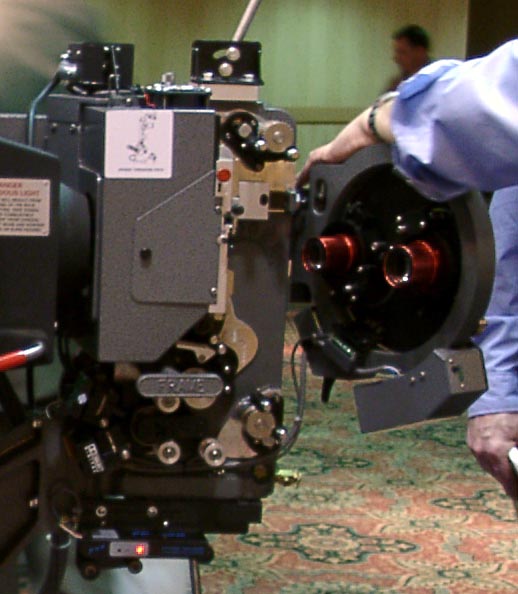
 
Posted by Mark Gulbrandsen (Member # 72) on 12-17-2004, 06:54 PM:
 
quote: Possible New Moderator
Could someone post some pics of the Apogee please? k.thx.bye.
As someone I would nominate for moderator you really should know first that its not wise to waste bandwidth.....

Mark
 
Posted by Brad Miller (Member # 2) on 12-17-2004, 06:59 PM:
 
Not the best pic, but a pic nonetheless....

 -
 
Posted by Steve Kraus (Member # 476) on 12-18-2004, 12:13 AM:
 
Yikes! Where's the PRNDL?

The framing...um, I hesitate to call it a knob...the framing T-handle...in picture, at first glance looks like it says KRAMS on it. That would give anyone pause! [Razz]

Is there a Perigee to follow?
 
Posted by Michael Schaffer (Member # 1204) on 12-18-2004, 04:02 AM:
 
That's a great picture of the Bally's showroom carpet, thanks Brad.
If you want a really long gate and an overly complicated soundhead mechanism without the framing thing in the way, just buy an Ernemann 15, that's where they "quoted" the "design innovations" from anyway.
 
Posted by Scott Norwood (Member # 30) on 12-18-2004, 06:27 AM:
 
The current production PR-1014 has that same framing "handle" on the operator side, too. They still use the black round "FRAME" knob on the non-operator side for some reason, though.
 
Posted by Richard Fowler (Member # 893) on 12-18-2004, 09:28 AM:
 
The Ernemann gate bands, even though thin in width, has a velvet strip bonded to the metal; little chance of breaking [Wink]
 
Posted by Mark Gulbrandsen (Member # 72) on 12-18-2004, 09:32 AM:
 
The Ernemann 15 is not that bad of machine and the 24 or so of them in this area give us far less trouble combined than the Simplex's that are out here. The Ernemann has some quirks and I know Guttag hates the thing. As for the bands they don't break but the velvet doesn't hold up very well in a miltiplex situation. Other than the bands we have only experienced two motor failures. Some of them are approaching 9 years old... all still have their original Lasers.
 
Posted by Monte L Fullmer (Member # 2797) on 12-18-2004, 03:28 PM:
 
With the pict of the Apogee, it looks like the Christie CINE X-35, has this one beat hands down without a fight! That Apogee is a "horrible" design and one ugly machine - it looks like they were starting and trying something in creativity, got confused then gave up.

I can easily see scraped knuckles working with this thing, and that's even operating that "T" handle FRAME device. (Yeah, what's was wrong with the old round "XL" FRAME knob anywho...)

Does that thing in the pict have SPECO arms? ..yeech! Kelmars and Neumades are tons better.

(UH..oh - The "EDSEL" from Strong is upon us..)

-Monte
 
Posted by Steve Guttag (Member # 268) on 12-19-2004, 12:11 AM:
 
I'll take an oil bath machine over a belt drive any day and twice on Sunday....and yes you can keep your Ernemann things too. Another lousy design.

Steve
 
Posted by Mark Gulbrandsen (Member # 72) on 12-19-2004, 08:19 AM:
 
quote: Steve Guttag
I'll take an oil bath machine over a belt drive any day and twice on Sunday....and yes you can keep your Ernemann things too. Another lousy design.

Seems to me that with the exception of the Apogee and a couple of Kinotons that all machines that are oil bath are also belt driven. Or should we say that all of todays projectors important parts are in an oil bath anyway... that of course would include the Christie, Simplex X-L, Century, Ernemann, DP-70, and just about every other projector out there being made today.

Mark
 
Posted by Steve Guttag (Member # 268) on 12-19-2004, 03:31 PM:
 
No, no...none of this quasi-belt driven crap.

The only belt I'll tolerate is the motor to projector OR Soundhead...the rest must go. I'll take direct drive too.

All of the Kinoton D projectors are beltless...I do not count chains as belts in that I have NEVER had to change one or heard of one freying...etc.

I've always preferred the SH-10XX soundheads (gearbox) over the 5-star varients in Simplex...I like the direction Strong took with the Apogee in moving away from the belt driven soundhead.

The Norelco DP-70 had the right idea too with the beltless (except for the lower motor) projector.

One of the things I dislike most of the Kinoton E projectors are the belts and o-rings.

As to Ernemann...most recent page...belt broke that drives the sprockets...and what stupid tensioning system they have...an unsupported idler pulley.

Simplex and Kinoton remain the low-end of the service call chain for us. Keep the oil changed and they run and run...service time is much less too.

Once you get belts into the works, it becomes messy and service calls and PM times go up.

Mark, I'm surprised at your endorsement of Christie's projector since you discount Strong's efforts with the Simplex. I can think of no projector that has had as much constant tinkering as the Christie projector since it came out. I remember when they first came out..."the first projector designed by a computer" or some such nonsense...then all the changes started happening...motor changes (including all the flywheel and capcitor vaients in addition to frame size), shutter boxes, intermittent gears, pullies...heck it took them years to "discover" the curved gate and these are some MAJOR changes...then the big switch to the gearless projector...another major change. They had the most "wow-free and flutter-free" soundhead in the industry...until digital sound proved otherwise.

This isn't a pick on Christie so much as to show when a new product comes out...it isn't until it is in the field with the "sorry state of the art" operators and the real projection environment get their hands on it until you find just what needs improvement.

As to Christie being right out of the crate...Christie's assembly has always been top notch...sure a few slip out but in general...they assemble their products real well. Then again, I've had Christie soundheads (back in the solar cell days) with cross-talk so good it actually was scratching the film! Any tech that thinks that they shouldn't have to do the final alignment on an installation just isn't that good. It is great that the factory gets it 90% there but one shoudl expect that final aligment should be done in the field where it is installed.

Steve
 
Posted by Mark Gulbrandsen (Member # 72) on 12-19-2004, 04:48 PM:
 
quote: Steve Guttag
The only belt I'll tolerate is the motor to projector OR Soundhead
Steve, thats a load of crap! Belts are more efficient if utilized properly and completely eliminate the need for a messy oil bath which I guess you love so much. There is only one more belt in the Christie than on a Mellennuim. Big wah who. All belts should get replaced yearly no matter the make of machine so whats one more belt.... its no big deal. All belt drive machines generate some mess form the belts wearing but the Simplex holds top honors in that catagory with the oil mixing with the belt compound on the 5 stars. I don't have much belt shedding in any of the Christies that I service. I use Film-Guard on them before they get installed [thumbsup] .

quote: Steve Guttag
Mark, I'm surprised at your endorsement of Christie's projector
In spite of Strongs improvements(and unimprovements)I've still never been a big fan of the Simplex X-L. Its an OK projector and there are certainly a large number of them in the field that can't and never will perform within SMPTE specs over the long haul. The quality just has never been there from the first machine! Those cheesy cast alumnium sprocket assys that are a pain in the ass to clean and still use bronze bushings that over time chew up the sprocket shafts..... yea, really great design! Even the Century with its sprocket shaft bushings was better in this regard. The tiny Simplex star and cam that cannot maintain accuracy over only 5 years time in normal multiplex environments, the tiny cam pin that wears flat faster than a hen can peck.... they sure sound like a hen pecking. I can go on and on about the literal hundreds of them which I have worked on and or overhauled.... should I bring up the huge variances that are in all the main castings wall thickness over the years, some of the older black ones are as thin as 3/32" up front? Ok, Strong did fix the casting dilemma....well done too.

Yes, the Christie right now is a far superior machine belts or not over the long haul and for less money too. Its performance on screen even through all its different gestations has always been consistant and much better than the X-L. There is one Christie S/N 23 thats on one of my routes.... sounds like hell but puts out an excellent ultra steady picture. This machine has only broken down once since it was first installed... lets see.... over 15 years ago and probably closer to 20.

The Christie has a better movement, better turrett, better sprocket assembly, and a far sturdier main frame made from 1/2" thick alumnium plate. OK, the change-over sucks to have to work on it. The fit and finish is second to none, makes Strong products look and feel cheap because Strong products are cheaply made.

As for checking sound heads, of course its always done... how else would I know that 99% of the time everyting at the factory is being done correctly......

P.S. The DP-70's that leave our shop ARE direct drive [Cool] . The motors also automatically jog to the thread position.
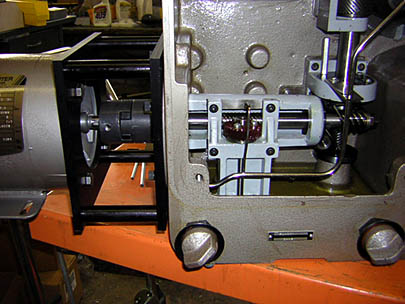
 -

Mark
 
Posted by Steve Guttag (Member # 268) on 12-19-2004, 06:04 PM:
 
quote:
teve, thats a load of crap! Belts are more efficient if utilized properly and completely eliminate the need for a messy oil bath which I guess you love so much.
No...it is fact. Gear drive is the most efficient. If you've got belts...you've got extra service and many weak links.

quote: Mark Gulbrandsen
In spite of Strongs improvements(and unimprovements)I've still never been a big fan of the Simplex X-L.
You are certainly entitled to your opinion...and I to mine. The X-L was a wonderfully designed machine and a workhorse.

quote: Mark Gulbrandsen
Its an OK projector and there are certainly a large number of them in the field that can't and never will perform within SMPTE specs over the long haul.
And yet I've not had the problem of getting to perform within spec. And in terms of long-haul...the machines that consistantly have their original parts in them for the longest time...is the Simplex...can't beat that oil bath.

quote:
Those cheesy cast alumnium sprocket assys that are a pain in the ass to clean and still use bronze bushings that over time chew up the sprocket shafts..... yea, really great design!
You mean the assemblies that draw the oil into the bushing and back out...those assemblies...yeah, a great design...I've not had the damage you seem to have had.

quote: Mark Gulbrandsen
Even the Century with its sprocket shaft bushings was better in this regard.
No way...many more ST-2 changes ...oh wait...they are not oil bath...also on the R-31 penthouse...bronze bushing, no method of applying lubricant...don't even go into the Century versus Simplex on the mechanical designs...the Simplex was designed...the Century...slapped together with god awful loadings on the gears, shafts and bearings.

quote: Mark Gulbrandsen
Simplex star and cam that cannot maintain accuracy over only 5 years time in normal multiplex environments, the tiny cam pin that wears flat faster than a hen can peck.... they sure sound like a hen pecking
And yet, Century intermittent rebuilds consistantly for the last 25-years I've been involved with both are 10:1...more century intermittents gone bad. Is the Century intermittent more robust...absolutely...does it get oiled properly...many times not...it is typical to find orange residue once the case is cracked. If the Century intermittent was used in an oil bath machine...it would be near indestructable.

Ya know, if Christie made their projector with gears and an oil bath...it would have been a much better machine. Their precision is there but their dive system is not. I've had too many Ultramittent failures as well.

Help yourself to your belt-drive machines...I'm sticking with my oil-bath Simplexes. Look on the bright side...we won't deplete each other's equipment supply. [Smile]

Steve
 
Posted by Steve Kraus (Member # 476) on 12-19-2004, 07:48 PM:
 
Has Christie ever increased the size of their shutter? There's a reason that other machines' shutters are the size they are: Light efficiency. Less percent time transitioning from light to dark and vice versa means more fully open time. That after-the-fact change to a 2X speed shutter helps but why not just have a full sized shutter. And if they want to 2X that like a DP70 then all the better even. Also weren't there problems with some lamps where the little shutter was incapable of fully blocking the beam for the entire film travel resulting in travel ghost no matter how it was adjusted?

Remember when Century was advertising "Built as one. Sold as one." ? Me not knowing any better back then actually thought the machine depicted was an actual one piece projector...that just happened to look a lot like an ordinary projector/soundhead combo! [Big Grin]
 
Posted by Mark Gulbrandsen (Member # 72) on 12-19-2004, 07:50 PM:
 
quote: Steve Guttag
No...it is fact. Gear drive is the most efficient.
Not that I also don't like gear drive... the DP-70 is probably the best example of how efficient gearing can be BUT..... ask any mechanical engineer which is more efficient.... and he will tell you that belts are. Discounting the intermittent which is a separate entity in itself the main reason for needing any oil bath at all is because the gears would wear out quickly without it. Put a belt in an oil bath and it really doesn't matter much, it will last just about as long without the oil. Without oil orthogonal gearing such as in the X-L and DP-70 create heat from the rubbing action... which is definate loss of efficiency by itself in a big way. Timing belts don't have this problem, there is almost zero rubbing action with timing belts and they can tolerate heat very well... they are even more efficient than chains... one of the main reasons that Harley Davidson now sells just about every bike with timing belt final drive.

I completely agree with you on the Century movement!! We make tons of money on both Simplex and Century movement failures over the course of a year. Its been over two years since an Ultramittent has failed.

Mark
 
Posted by Monte L Fullmer (Member # 2797) on 12-19-2004, 07:55 PM:
 
Being the projection field too many years, and have seen both -the belts and the oil/wet gear drives, I can see why lately the desire for oil bath types are more desireable-less site maintenance, thus the need for less service calls, since the new way of running cinemas with the useage of high-school/unprofessional employees who don't give a hoot about their job, just do the job and no skills taught in maintenance, and management don't want to worry on such technical matters only when needed to call the area "tekkie" to come and fix their problems. In otherwords, a "machine" operation-no skills, no training, no logical understanding of the operation, just "robots"-being told what to do.

Can you imagine on showing "robots" on how to do belt changes in the Christie 35/P35GPS/CineX-35 units, let alone the manager, who doesn't even want to open up the back of one of these machines and to try to figure out how to do it, and being taught how, for he figures that he's more important than doing "tekkie" work?

Oil changes are actually nothing. And even then, some of these cinemas will let their Simplexes run dry, burn up intermittent assemblies, trash gears, etc, and they wonder why it crashed on them since they were never shown in the first place, or took over the cinema without a clue on what to do.

I know where Marko is coming from - from the quality standpoint of the "trade"-where there were actual, professional projectionists taking care of all of this equipment.

And I see where the others are coming from as well for the oil bath machinery - some for the employee/personnel part: they're in the KISS format (Keeping It Simple, STUPID..) that the machine will run forever with very little effort in maintenance. These kind of compainies expect the "tekkie" to do all the work needed and come in a holler's notice, and if the service work is completed when they leave, and something breaks down, who do the managers/owner blame?...they blame the "tekkies", since the "tekkies" know everything and know how to make things work correctly.

A somewhat sad trend in the presentation department of this industry. - thx Monte
 
Posted by Steve Guttag (Member # 268) on 12-19-2004, 08:16 PM:
 
Its not like I haven't had some Mechanical Engineering training, ya know. Yes, the gear does need lubricant (just like bearings and such)...that is part of the system...if properly lubricated, and the gear system is well designed...their life span is quite long.

As to belts they introduce elasticity to the system, which takes away from efficentcy. Part of the energy goes into stretching the belt and then you set up a harmonic. The system is a bit more controllable with just two points...typically in a projector a belt that drive sprockets is hitting 3 or more pullies that each have their harmonics. Take a strobe to the belt and you can see the thing moving forward and back...take a look at the sprockets driven by a belt...they often are not turning smoothly with respect to each other. I don't doubt the new Christie got a big improvement by using the same sprocket on either side of the sound head. With two sprockets driven off the same belt they are going to beat against each other and set up a jitter.

Listen to most any belt drive machine without the film threaded...you can hear the period of the belt as it works its way around. Then you throw the bearings into the mix...depending on environment...typical bearings will rust out on you in the Mid Atlantic area with the cycle of humid/dry seasons. How many projectors that run on ball bearings for their various shafts have them last very long? Compare that to a bronze bearing with oil delivery.

BTW Monte, my preference for oil bath machines are not just on the decrease in maintenence...I like the Simplex machine. Not that it is perfect but on the whole...it has done me and many others well over the years. Call it a preference if you want, but I prefer the Simplex over the Century or Christie. I've NEVER been a fan of the 5-star soundhead though...it has a poor belt path design that improperly loads the sprocket shaft outboard of bearing support (66-tooth pulley should not be the last thing on that shaft...another bearing to support the shaft would have save many many shaft and bearing failures. I prefer the gearbox soundheads. The Apogee does that one better in that now it is just one big happy oil sump rather than two with different oil grades. Too bad they don't plan to make it in a single lens version to suppor the types of theatres we typically install (screening rooms with 4-5 picture formats).

Steve
 
Posted by Mark Gulbrandsen (Member # 72) on 12-19-2004, 08:47 PM:
 
Steve,

Elasticity is not much of a factor in a properly designed belt driven system, but in an overloaded system it can be a huge factor. Some elasticity could also be a good thing and take up unwanted shock. Modern Kevlar timing belts really don't stretch at all!!

The harmonic problem is more true of square tooth belts but not really a factor with round tooth belts. But it is even more of a factor with double sided belts which is where the 35GP flitter problem lays!! Harmonics are also a factor in gearing but to a lessser degree. The harmonic problem is one reason they changed(as Strong did)to the round tooth belts. Although I can't exactly remember I also believe that each sprocket has its own belt now but I would have to look at one of the new machines again to see. The proof that it works and works well is in the SRD error rate which is now in the 1's and 2's with the basement reader.... thats dam low error rate for any basement reader

Mark
 
Posted by Monte L Fullmer (Member # 2797) on 12-19-2004, 09:11 PM:
 
True. I DO miss the old SH-1000,"4-star" head. These heads would neve die, but as always, have to keep an eye on the oil level and oil changing frequency in that transmission due to the brass sprocket gears being driven by the steel worm motor gear.

The "5-star", to me, was a letdown from Simplex, even though of the more simplicity and compactness in design. Just too bad that they didn't find a way to gear drive that head as well, just to keep the quality at the highest.

I also miss Motiographs "AA's" - built like a tank. Just that the Mirrorphonic soundhead needed that flywheel on the motor so the machine didn't start up so jack-rabbit quick-to start up smoothly as of the SH-1000.

One can say comparing "Apples to Oranges", "Chevys and Cadillacs", "Blondes and Brunettes", et.al. .. who gonna win and who's gonna lose? NOBODY! ALL are winners in each of the individual's eyes.

Then, we all must be winners in this facinating world of the presentation trade to stay in it this long. Otherwise, we all wouldn't be here. We'd be off doing something else.

thx-Monte
 
Posted by Sam D. Chavez (Member # 1841) on 12-19-2004, 11:21 PM:
 
I've been watching the banter between two very good friends about Christie vs. Simplex with some interest.

I'm a bit amazed at Mark's faith in the new Christie design after the continual changing of this machine since 1980.

It's Ultramittent is one of those ideas that looked good on paper but it has never proven to be any better than an ordinary movement.

Some healthy skepticism might be in order here.

When it comes to projectors, the proof of the pudding is in the eating. I've seen any number of XL's with over 30 years on them and nary a part change besides sprockets.

The intermittent parts are indeed small but this is a very happy projector that does not beat itself to death.

I agree they have a number of faults but the basic design is very sound, and Strong kept the best of it intact in the design of the Apogee.

To paraphrase Patrick Moynihan, we are all entitled to our own opinions, but not our own facts.

The Simplex has proven to be the industry work horse for longer than most of has been alive. The basic reason is you start with a good design and build on it.

A similar concept is the Chevy V8 engine that has been around since 1955. It has been developed, enhanced, reworked and improved constantly ever since. This is no accident. It was a great design and people keep finding ways to get a bit more performance out of this venerable work horse.

Meanwhile, you don't see that with any other engine of that era. Why?
 
Posted by Steve Kraus (Member # 476) on 12-20-2004, 12:02 AM:
 
Refresh my memory what the great innovation of the Ultramittent was/is. An ordinary intermittent with seals?
 
Posted by Monte L Fullmer (Member # 2797) on 12-20-2004, 04:55 AM:
 
What's funny about the Ultramittent, is that this unit design reminds me of the way the old Simplex-Standard/Super/E-7 assemblies were designed, outside of the usage for the taper pins of the Super. -Monte
 
Posted by Steve Guttag (Member # 268) on 12-20-2004, 06:57 AM:
 
Not that I'm a car buff or anything...but Sam...when did the Crysler Slant-6 come into existance? Oil is optional on that baby....but yes the Chevy 350 is one of those that seem to have had devine intervention.

Steve
 
Posted by Mark Gulbrandsen (Member # 72) on 12-20-2004, 07:28 PM:
 
quote: Sam D. Chavez
I'm a bit amazed at Mark's faith in the new Christie design after the continual changing of this machine since 1980.

Continual changes are not what bothers me. Its when there is a problem and its not dealt with. While the machine has gone through more changes than anyone in North America could remember the thing that I notice is that what ever version you run into they are still putting out dam good pictures. Even the straight gate machines performed admirable and had a very well designed pressure pad system.... much better then todays straight gate X-L pads that wear very unevenly. The Christies wear very even and in some ways the straight gate performs better than the curved gate does. I have alot of faith in the new projector because it went through considerable field testing before it was released.

quote: Sam D. Chavez
When it comes to projectors, the proof of the pudding is in the eating. I've seen any number of XL's with over 30 years on them and nary a part change besides sprockets.

Yes Sam you hit the nail on the head! You need to find a 30 year old machine to get one that has decent quality stars, cams and other important metal parts. Todays CNC manufacturing world does not allow the use of steel that is nearly as high of grade as was being used when those parts were all hand made. Better steel is harder on tooling and slows down production, just the inverse of why there is CNC in the first place. In fact today the only hand done step in those critical parts is done when the final grind is done on the slot. The metals used are no where near as hard nor are they hardened to the Rockewell spec that the old parts were. Believe me, I've measured them myself with a Rockwell hardmess tester and they are simply not the quality of yesteryears stuff. Personally I'd rather keep the good intermittent parts and keep the crappy main casting if there were a choice today

Another thing to consider is that LaVezzi rates the life span of the movement parts at 5 years assuming 8 hour days and so on. I was told this by Al himself. The thing that helps the Ultramittent outlive many other movements is the synthetic brew its filled with. The same long service can be had from the Century movement if you use the same oil... Its too heavy for the X-L but there are other good synthetics that can help extend the life span past 5 years.... but few use them. This is one thing Strong may ultimately change on the Apogee. I hope they do.

quote: Mark Gulbrandsen was the last to post
Meanwhile, you don't see that with any other engine of that era. Why?

Actually there were several other engines of the era that were also bullett proof. The 292 Chevy 6, 283, 327, and the Chrysler 318 were every bit as reliable as the 350 was, the 318 perhaps even more so then the 350! Ford... at least they were First On Race Day probably only because the 390 was also as great an engine.

quote: Steve Kraus
Refresh my memory what the great innovation of the Ultramittent was/is. An ordinary intermittent with seals?

A permanently sealed all ball bearing intermittent. Yes even its gone through changes for the better in which the star and cam inside ball bearings were replaced with bronze bushings. Both outer ball bearings were retained. While older movements may occasionally fail its very rare for the later style to actually fail. About the only thing that fails is one or both of the outer ball bearings. Slap in new bearings and keep on goin. Some of these movements have been running in excess of 10 years and thats darn good service if you base it on the 5 year average life that LaVezzi told me. Did it deserve an Oscar.... probably not because its internals are definately nothing at all new in the least. Motiograph used ball bearings for both outers in its movements as well. LAVezzi should have receivd an Oscar for the VKF sprocket design way before the Ultramittent was considered. The VKF stuff has greatly contributed to decreasing film damage more than almost any other thing I can think of.

Mark
 
Posted by Sam D. Chavez (Member # 1841) on 12-20-2004, 09:00 PM:
 
Mark,

I would say you are missing my point on the Dodge and Ford engines. Bulletproof is not the order of the day, adaptability to future uses are the issues (The Ford engine you mentioned came from the 352 and was only competitive for one season). The Chevy 265, 283 and 327 ware all earlier adaptations of the 350.

I'll bet there is not even one interchangeable part from the first Christie to the present version apart from the sprockets and the screws.

While we are at this, why does every Christie sound head have a broken air pot?
 
Posted by Steve Guttag (Member # 268) on 12-21-2004, 07:51 AM:
 
quote: Mark Gulbrandsen
Slap in new bearings and keep on goin. Some of these movements have been running in excess of 10 years and thats darn good service if you base it on the 5 year average life that LaVezzi told me.
That may be what Al told you but I can't verify that from the field...With reasonable oil changes...they are going way beyond 5 or 10-years.

When Poly first hit...we were getting an awful lot ot dusting into the outer bearing that would try to sieze them but that isn't much of an issue anymore (note we even put an oil hole on the outter bearing but that just allow the dust turn to goo.

The company I used to work for (back in the 80s) had Christie and Simplexes...the Simplexes consistantly were steadier, more reliable, better supported and MUCH MUCH more longer lasting to the point all of the Christies were eventually retired for Simplexes and I mean ZERO of them survive to this day. When Century moved to Strong...one prominate chain went to Christie to avoid the Strong connection...that didn't last either...they are back to Century.

When it comes to movie projectors...you show me belts and ball bearings...I'll show you more service calls, maintenence.

Then again, I'm not a fan of slapping grease onto spinning gears either...too many main-drive, shutter and intermittent drive gear changes. The fault there isn't the gear, persay...it is the lubrication delivery system (there isn't any) and the rather rough loading of the system.

About the only thing I costantly like about the Christie is their precision. Things line up, consistantly...the film path doesn't skew...their machining is top notch. Ya know, if they had an oil bath on the backside (and nix the belts) they'd have a nice machine.

Steve
 
Posted by Gordon McLeod (Member # 33) on 12-21-2004, 10:05 AM:
 
I guess I should interject finally I actually agree with Mark on the belt issue We service lots of vic5's ernemanns and if the timeing belt is replaced yearly then there is no issues with them
Also the Vic5 has very low flutter or digital jitter
And I agree with steve (this is a red letter day) on the issue of the poor lubicration system on century gears
 
Posted by Richard Fowler (Member # 893) on 12-21-2004, 12:06 PM:
 
Remember the grease pump for Century projector that Kelmar designed for U. A. Cinemas....the device looked like a refugee from a porno shop [Big Grin] ; it did address the issue of trapping grease around the main drive gear, which was always poorly lubricated. The belt idler does suck on the Ernemann; we made our own units with a flanged timing gear of a larger diameter....no problems so far.
 
Posted by John Hawkinson (Member # 1135) on 12-21-2004, 01:44 PM:
 
You know, "just replace the belt yearly," seems like a lot to ask when there are other projectors that will just keep trucking with only lubrication-based maintenance.

--jhawk
 
Posted by Steve Kraus (Member # 476) on 12-21-2004, 03:11 PM:
 
It would make sense if there was a greatly reduced first cost for a belt machine vs. a shaft & gear oil bath unit. Is there?
 
Posted by Mark Gulbrandsen (Member # 72) on 12-21-2004, 07:33 PM:
 
Yes, around 2K per machine less. We went this route because another customer has the shop jemmed with 12 DP-70 being redone. More than 12 at a time in our shop would be a bit much. Kets see this was a 10 plex and the math is easy so it saven them ALOT of money that we stuck into other more important areas.

Sam, Yes the dashopts are crap and expensive to replace but most barely function when they are brand new anyway so should we say they really don't even have one .... They may not even be needed on the new machines anyway.

quote: Gordon McLeod
And I agree with steve (this is a red letter day) on the issue of the poor lubicration system on century gears

Gord, What lubrication system?

quote: John Hawkinson
You know, "just replace the belt yearly," seems like a lot to ask when there are other projectors that will just keep trucking with only lubrication-based maintenance.

J Hawk,
There are few projectors that will keep on trucking reliably with out annual belt replacement. There are so few direct drive machines that you can just about count em on one hand, mainly Kinoton. I don't condider the SH-1000 to be a direct drive unit because there is an intermediate gear between the projector and sound repro. and those gears do fail and I condsider this some what of a weak link, I've seen four myself this year. So lets assume that the majority of the worlds multiplex installations have at least one or two belts per screen! I can't point my finger at any specific machine that I would label as a belt eater but even new belts can and will break unexpectedly but very rarely. The use of Kevlar reinforced belts pretty much guarantees that'll never happen but they are not available in all types and kinds of belts. No matter what its smart policy to install new belts every year in any important venue. It sure is cheap insurance. Total cost on a set of P35 belts is less than 25.00! Thats a pretty insignificent cost per screen per year. The differemce in savings of 2K on a projector will allow you to replace belts for 80 years before you're equal with the price of the Apogee.

Mark
 
Posted by Sam D. Chavez (Member # 1841) on 12-21-2004, 08:19 PM:
 
Gordon,

I remember during my first visits in the early '80's to Famous Playes, at the Canadian technicians affection for the V8, and later the V5, when both were the worst performing projectors, sound wise.

It just goes to show you, nostalgia just ain't what it used to be.
 
Posted by Gordon McLeod (Member # 33) on 12-21-2004, 09:26 PM:
 
The only beef witht them was the optical slit and excitor something reverse scan readers corrected
as for mag the soft loop in the penthouse minimised print wear
 
Posted by Sam D. Chavez (Member # 1841) on 12-22-2004, 05:57 PM:
 
I never had much experience running 70mm on Vic. projectors so never had to dig into the penthouse. The design was very simialr to the RCA 35mm penthouse complete with slip clutch on the flywheel.

As to the optical, that lens was the absolute worst and of course Christie chose it to put into their soundhead.
 
Posted by Gordon McLeod (Member # 33) on 12-22-2004, 08:47 PM:
 
Yes sam but with BACP readers they work very well and with the cinemecanica basement reader they consistently have excellent error rates
 
Posted by Sam D. Chavez (Member # 1841) on 12-23-2004, 12:19 AM:
 
Gordon,

Stop already, this is not an ad! The funny thing is, the flutter readings on the V8 were among the best ever logged. Problem is, the flutter bridge totally ignored the fact that the film was sometimes darting back and forth in the sound drum steering the Dolby matrix card all over the place.

Some clever techs machined the outer bell for a tighter fit on the 35mm film and this problem went away.

The reverse scan readers, whatever brand, were the best thing to ever happen as this projector, as they made the sound go from some of the worst to one of the best in one easy step.
 
Posted by Mark Gulbrandsen (Member # 72) on 12-26-2004, 12:12 PM:
 
quote: Sam D. Chavez
Stop already, this is not an ad! The funny thing is, the flutter readings on the V8 were among the best ever logged. Problem is, the flutter bridge totally ignored the fact that the film was sometimes darting back and forth in the sound drum steering the Dolby matrix card all over the place.

Some clever techs machined the outer bell for a tighter fit on the 35mm film and this problem went away.

The reverse scan readers, whatever brand, were the best thing to ever happen as this projector, as they made the sound go from some of the worst to one of the best in one easy step.

Sam,
If I had a product as good as yours I wouldn't be shy about plugging it now and then!

The Machines do have very low flutter as Sam says but the end bells were a problem. Cinemecanica eventually came out with a tighter sound drum for improved running of the tracks. I've installed a few of these over the years and they work well. Although the Italian machines are not my favorite because of the extremely high parts prices they do have my respect because they literally run for decades with little to no breakdown at all. I recently replaced the main contactor on a 35 year old Vic 8 and this was the first major breakdown this machine ever suffered.

While the SRD rates may be low on those machines that thin edge of support the bell gives that side of the track always scared me a bit.

Mark
 
Posted by Stephen Furley (Member # 1277) on 12-27-2004, 10:25 AM:
 
quote:
I'd have to go for the Kinoton FP30. They just keep going and going. Ours here are over 10 years old and don't look like stopping any time soon.
If they are only 10 years old I should certainly hope they won't be stopping any time soon!
 
Posted by Monte L Fullmer (Member # 2797) on 01-04-2005, 03:03 AM:
 
Yo..all MPMO "brothers!"

Need a little help here:

WAS getting ready to do a seal kit for a Mil2000 machine, and this is what I found when I took the locknut off of the end of the belt sprocket:

 -

Looks like when those "Delbert Dumbbutts" at STRONG assembled this Mil2000 machine, they got crazy with the speedwrench and really torqued down the nut, which distorted this washer that is in front of the teflon washer. With this distortion, the washer hole has flanged itself behind the threads of the drive shaft, making it impossible to remove this sprocket.

Any clues outside of drilling around the shaft to enlarge the washer hole so I can remove this sprocket and do the seal replacement?

STRONG does it again-... [Roll Eyes]

-thx Monte
 
Posted by Steve Guttag (Member # 268) on 01-04-2005, 06:40 AM:
 
Gee with a seal that good, you'd think the thing wouldn't leak! [Smile]

Gear and/or bearing puller could do the trick. Probably a bearing puller since it should be able to scoot behind the pulley.

I would keep things that create filings to a minimum in that area.

Steve
 
Posted by Mark Gulbrandsen (Member # 72) on 01-04-2005, 08:03 AM:
 
Just be careful not to distort the pulley and generally a small bit of pulling will easily release them. The seals on all those machines are about at the right time for replacement so you should do them all. They only cost a few dollars but you need a small arbor press to install them properly. Also that distorted washer is normal because it pulls the teflon washer in against the end of the pulley and shaft to create a seal at that point. Can't remember ever seeing a washer that wasn't cupped like that.

What about that picture... still an old one.....just in disguise.....

Mark @ CLACO
 
Posted by Phil Blake (Member # 2012) on 01-04-2005, 10:11 AM:
 
i have heard lot about the aussie C & W I have yet to see one,
can someone post a pic please .
 
Posted by Monte L Fullmer (Member # 2797) on 01-04-2005, 12:54 PM:
 
Thx, Marko. I'll give that one a whirl on the puller concept.

I sent Brad a new pict to replace this one, since this old one got up without my request, for I knew of the rules of recent picts to be used in the forum.

thx - Monte
 
Posted by Christian Volpi (Member # 2370) on 01-18-2005, 09:41 AM:
 
Fellow Film-Techer Richard Hamilton is here servicing my Apogee's. Most of the kinks have been worked out of them and we even found out why all of our prints were getting scratched and got the part replaced and we haven't scratched a print since. I'm really starting to like these machines. Do I like them better then my greasy old Century's? Not yet, but I'm getting there. If they could only start making the tension bands out of velvet (like the Ernamens) I would be a happy camper. Otherwise these machines are great.
 
Posted by Mark Gulbrandsen (Member # 72) on 01-18-2005, 07:40 PM:
 
quote: Christian Volpi
Otherwise these machines are great.

[Eek!] OHMYGODHESBEENBRAINWASHED [Eek!]
 
Posted by Phil Hill (Member # 371) on 01-18-2005, 07:55 PM:
 
Yeah, I agree Mark. Those Apogee's are just as bad as any of those POS "greasy old Century's". [Razz] YUK!
 
Posted by Mark Gulbrandsen (Member # 72) on 01-18-2005, 07:59 PM:
 
quote: Christian Volpi
and we even found out why all of our prints were getting scratched and got the part replaced and we haven't scratched a print since

Ohhhh, dang.....I missed the best part....... [Roll Eyes]
 
Posted by Monte L Fullmer (Member # 2797) on 01-19-2005, 04:40 AM:
 
I'm waiting to goto ShoWest this spring to see these Apogee's in person.

But by the pictures that I've seen of this unit, it looks like Strong forgot to finish off the lower half of this machine, for it looks like it's not completely assembled-just left hanging there.

And it looks like a midget with tiny hands are the only ones who can lace this thing up without any problem-so compact - just as bad as a Simplex/Acme portable.
 
Posted by Thomas Dieter (Member # 2507) on 01-19-2005, 03:29 PM:
 
I have to say that out of all the projectors that I've worked with, Century JJ and Simplex are the best. I was trained on Century JJ and Orc Platters (I never had a problem like it shows in the reviews), and while the drive inns were open here in Yakima, I learned Reel to Reel Projection on the Simplex XL with RCA Sound head. I kind of like the idea of loose tension sound head.

I've also had the most unforgiving privilege of running Ballantyne Pro35 and Cinecita. I always found my bottom loop hard to thread after the intermittent with the Cinecita. I never really liked how the Ballantyne was threaded, although I was able to thread it without knowing how, but I guess most of you can do that with almost any projector as they are for the most part the same. All you have to know is if they are tight tension or loose tension.
 
Posted by Mark Gulbrandsen (Member # 72) on 03-08-2005, 08:18 PM:
 
quote: Steve Guttag
I did have the chance to see a film in the Stag on those Norelcos...the picture was not impressive at all. There was notable weave and jump and the image was poorly focused (Schneider anamorphics)...the operator racked focus and it was uniform.
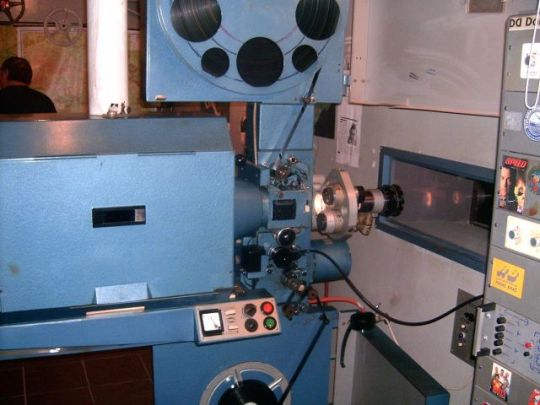
For those that are curious we did have some 35mm unsteadiness with the one Lucasfilm machine that has been re-installed so far. Even though Kinoton U.S. re-ground all 12 of the 35mm runners for this job there was still some noticable image movement that could not be gotten rid of. This was cured by installing one of James Bond's compound curved 35mm custom runners. The image is now dead steady and very sharp with a 4kw Xetron/Big Sky lamp behind it. This runner has no flat area to it at the aperature as do the originals. These runners were designed by Jim and cnc machined by the late Norm Lauderbach.

Mark
 
Posted by Monte L Fullmer (Member # 2797) on 03-22-2005, 06:08 AM:
 
I know this topic has became a bit outdated but I have to show some of this to watch out for:

 -

Once again, good ol' Strong comes through with this:

Caused by the erroneous design of the Mil2000 machines.
(this is not much of a problem with the older "XL/1050" machines)

Being that, due to the new taller case, the upper constant speed sprocket was moved up almost two inches, but keeping the same width distance between trap and gate and the trailing end of the sprocket. Thus, when operators makes their upper loops so tall, that the loop has to "bend" backwards before entering into the trap and gate assembly.

Thus, this massive wear at the top corner of the band. Yet sad, that the rest of the band still has very little wear,

Christie P35's are smart in having the upper constant speed sprocket far enough forward to the front that the upper loop size can be a lot lower, thus the film never has to touch this corner of the band.

-Monte
 
Posted by Darryl Spicer (Member # 711) on 03-22-2005, 09:39 AM:
 
the 1060's had that top feed sprocket raised too. So it could accomodate the newer turret design. What I have them do is when they make that top loop at the lowest point of the loop (Where it should be if timed correctly) they are to make sure that the top part of the loop is at the same level that the upper part of the sprocket bolt is on that top feed sprocket. Things run smoother when this is done.
 
Posted by Jacek Dejnarowicz (Member # 3062) on 03-23-2005, 12:27 PM:
 
In my single theater I have old Prexer AP 51 projectors and I'm wondering if anyone ever heard about Prexer?

[ 03-23-2005, 02:25 PM: Message edited by: Jacek Dejnarowicz ]
 
Posted by Marin Zorica (Member # 1716) on 04-03-2005, 05:39 AM:
 
Yes yes i got prexer also, it's made in poland obout 70's til 92 i think when lodzikie cinematography zaklady broke and stop producting it.
I got Ap61's, Ap 622's and AP621's here, but i servicing them many.
 
Posted by Richard Fowler (Member # 893) on 04-03-2005, 12:15 PM:
 
Prexer was handled by Arriflex and later Kinoton in certain foriegn markets. The main company Verimex stopped producing machines in the early 90's and is now basically trading optical and military goods. We had clients with AP621 with a halogen lamphouse which we made kits to convert to 1000 watt xenon many years ago.
 
Posted by Jacek Dejnarowicz (Member # 3062) on 04-03-2005, 01:30 PM:
 
I also have AP621 with 1000watt halogen. Sometimes I use them for alfresco shows.
BTW, in march I replaced the old sound scan with brand new reverse scan which is produced by my tech company. But I'm still wondering if I can use reverse by Kelmar or another for Prexer?
 
Posted by Mark Gulbrandsen (Member # 72) on 04-03-2005, 01:48 PM:
 
Can someone post a photo of a Prexer Machine? It would be interesting to see......

Thanks!
Mark
 
Posted by Marin Zorica (Member # 1716) on 04-03-2005, 02:39 PM:
 
Here is photo of PREXER AP-61(blue) and PREXER AP-621 (silver)

 -
 -
 -

If you need more let me know!
 
Posted by Richard Fowler (Member # 893) on 04-03-2005, 02:43 PM:
 
The basic chassis for most Prexer units are derived from the Ernemann 7B projector layout. Interesting with the collapse of the Polish market with Soviet umbrella gone; this company like many others had to go into other markets to survive....notably military hardware and arms for the Polish military.
 
Posted by Jacek Dejnarowicz (Member # 3062) on 04-03-2005, 03:49 PM:
 
That's true, our cinema market realy colapsed in early 90's. But I heard that Prexer had been producing military goods a long time before 92. Some people say that producing cinema projectors was only cover for military production. Before 1989 everything related to military was top secret in Poland.
 
Posted by Marin Zorica (Member # 1716) on 04-03-2005, 06:22 PM:
 
Richard,

you are ok that is prexer made of ernemann 7B, but real projector tat is made of ernemann 7B principies is ISKRA NP-21.

ISKRA was producing in Slovenia from 1947 till i thing late 1960's (1969).

Major difference in prexer and iskra (also and ernemann) is in inside mechanism, iskra and ernemann got all inside force transmission with cog-wheel, and prexer got central axle for force transmission from motor to film wheel and maltez cross, also iskra and prexer maltez cross are same.
Also ISKRA fisrs model was NP-2 (don't know for NP-1 year) about 1948, and then in 1950's was NP-21, in 1960 where KN-3 and ISKRA 35.

This are very good projectors, expecialy ISKRA because i servicing one open air cinema for past two summer and they have got Np-2 from 1948, wirh no mistake in mechanism!!!!!!!!!!!

Prexer is also good, i have here one what is in service from 1973 and works perfect with proper care, only thing what is bad about prexer is that oil liques from inside of mechanism, but with good technican this can be solved.

This is picture of ISKRA NP-21:

It's little stange that is painted in blue, this is because projectionist painted it because he got a couple of paint extra,hm?

 -

This is sound head of NP-21:

It's got 6V 5A exciter lamp

 -

This is KN-3, made in 1960's from ISKRA:
Sorry but i don't have real picture, i scaned it from book

 -

What are you'r opinion about this projectors???
 
Posted by Monte L Fullmer (Member # 2797) on 04-03-2005, 07:05 PM:
 
Interesting machine to say. Question: does the lower loop tailing off of the intermittent sprocket, "float" above those three white rollers before heading down to the scanner drum assembly?

Reminds me of the way Cinemeccanica does their "floating" loop as well - being that there is no middle constant speed sprocket after the intermittent sprocket to gather up the lower loop before scanner drum.

Also, wonder if a picture could be taken of the "gear side" of the machine to see the inner workings....
-thx Monte
 
Posted by Gordon McLeod (Member # 33) on 04-03-2005, 08:33 PM:
 
That soundhead reminds me of an Erneman IX soundhead
 
Posted by Mark Gulbrandsen (Member # 72) on 04-03-2005, 08:48 PM:
 
Thanks both of you for posting those photos, very interesting stuff indeed. Definately looks based on the Ernemann. Also, its nice to have both of you on the forum [thumbsup] !! It is interesting to see whats going on in other areas of the world.

Hey Sam, Are you working on a new BACP reader for those????

Mark
 
Posted by Michael Schaffer (Member # 1204) on 04-03-2005, 09:40 PM:
 
Tons of pictures of historical projectors and equipment can be viewed in the galleries of the German projectionsts' forum http://gallery.filmvorfuehrer.de/gallery/
The site is (not surprisingly) in German, but the galleries have index pictures, so you can easily navigate through them.
Where it says "Alben:..." in bold letters, you can click on the image to open a sub-album.
 
Posted by Mark Gulbrandsen (Member # 72) on 04-03-2005, 11:17 PM:
 
VEry nice site Michael! There are even instructions for the famous "Loopmatic".

Mark
 
Posted by Monte L Fullmer (Member # 2797) on 04-04-2005, 03:00 AM:
 
..and for us non-speaking German folks like us here, head on over to www.freetranslation.com , then cut the German text from the images, and paste them in the translation box in this site. Works pretty good. Only thing is that the translation is "gisted" or actual translation, instead of how the message is to be meant.

You get the idea though.

e.g. ->Filmvorführer Gallery and the translation ->Film demonstrator Gallery (once again, a "gisted" translation)

After seeing some of these pictures in this site, especially of the Ernemann machines, I bet the Ernemann were the "Simplex" of Germany. And what was interesting that the booth layout of the early cinemas, that the Ernemanns were built with right hand threading and left hand threading patterns, so the projectionist was dead center of the booth doing his changeovers and lacings. I bet that was a bit confusing, especially when the projectionist went to other cinemas (Kinos) and ran those Dresdens, and FF-99 machines-let along running US built Simplexes and MotioGraphs and the Philips DP-70 machines.
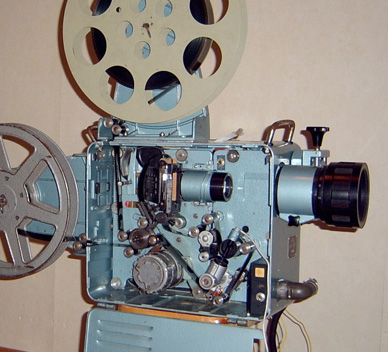
-Monte

[ 04-04-2005, 05:22 AM: Message edited by: Monte L Fullmer ]
 
Posted by Mark Gulbrandsen (Member # 72) on 04-04-2005, 05:46 AM:
 
quote: Monte L Fullmer
I bet the Ernemann were the "Simplex" of Germany.
Monte,

That line is actually an insult to the Germans! Any Ernemann is far superior to any Simplex in my book! Simplex= pot metal piece of crap, Ernemann= Mercedes Benz. The fit and finish are so far ahead of anything we ever made.....

Mark
 
Posted by Svetoo Dumdum (Member # 3054) on 04-04-2005, 06:15 AM:
 
Here is photo of KN-17 portable projector. KN-17 was producing in USSR.
 -

What are your opinion about this projectors???
If you need more picture let me know!
 
Posted by Michael Schaffer (Member # 1204) on 04-04-2005, 06:55 AM:
 
That thing is basically the same as the Carl Zeiss TK 35 which was built in large numbers after the war, from 1947 or so onwards. Zeiss-Ikon, the optical factory with great tradition, and Ernemann Projektorenwerke had merged some time before that, I think. The TK 35 was massively used in bringing cinema to the people. They were installed in trains and projectionists travelled the countryside, setting up their equipment in village taverns and community centres to play uplifiting features and newsreels to spread the good news of the unstoppable advance of communism to the happy people.
After the war, Germany was split in 2 parts, the free West and the communist East. A lot of the factories which were located in the East were dispossesed by the communists while the original owners reformed their businesses in the West. Of course, the "people's own" factories in the East didn't pay any royalties to or respected patents of the original owners who were, after all, evil capitalists. Many of the engineers in the East were actually top-notch people with excellent training and good grounding in traditional crafts on top of that. But the sad reality is that centralist communist mismanagement and shortage of materials often deprived them of the means to work on the level they were capable of.
Still, they made very good projectors in East Germany (the "Dresden series") until sometime in the 60s when the Eastern Block governments decided that they didn't need to manufacture the same stuff in every country, but should work together and share products to simplify production and create standards across all the communist countries. So, the manufacturing of projectors in East Germany came to an end, and from that time on, all the people's projectors were made in (then) Czechoslovakia by Meopta. They were actually quite decent machines too. I think they still make the MEO5XB. I had never heard of the Polish machines mentioned above. BTW, the MEOs all ran on 25fps. That was the standard in the Eastern Block, because it made cinema and TV transfers more compatible.
The TK 35 was actually a very solidly made unit, and many of them were still in use decades after they had been manufactured. After the reunifaction, we used to play with those machines a lot and played open air events with them. I think a fair number of the TK 35 are still in use, in community centres and student film theatres and similar locations.
 
Posted by Mark Gulbrandsen (Member # 72) on 04-04-2005, 08:00 AM:
 
quote: Svetoo Dumdum
Here is photo of KN-17 portable projector. KN-17 was producing in USSR.

I actually have a pair of KN-17's in storage back in the Midwest area. Yea, almost a direct copy of the Zeiss machine right down to the gig wooden ear.. They actually run pretty well but the motors do get very hot. I also have the voltage select box and the amplifier. The pair came from the Toronto area.....

Mark
 
Posted by Monte L Fullmer (Member # 2797) on 04-04-2005, 01:01 PM:
 
Whoops, sorry Marko. I should have added as for the "popularity" of make to the country as with Simplex to the US, not in the quality sense of the term.
For it's obvious that the Ernemann looks far better built, and prob in the same manufacturer rate as the Kinoton than any of the US built machines by a long shot.

Curious question then: are there any Ernemanns operating here in the States or Canada, if one wonders?

-Monte
 
Posted by Marin Zorica (Member # 1716) on 04-04-2005, 01:28 PM:
 
quote: Monte L Fullmer
Interesting machine to say. Question: does the lower loop tailing off of the intermittent sprocket, "float" above those three white rollers before heading down to the scanner drum assembly?

Reminds me of the way Cinemeccanica does their "floating" loop as well - being that there is no middle constant speed sprocket after the intermittent sprocket to gather up the lower loop before scanner drum.

Also, wonder if a picture could be taken of the "gear side" of the machine to see the inner workings....

-thx Monte
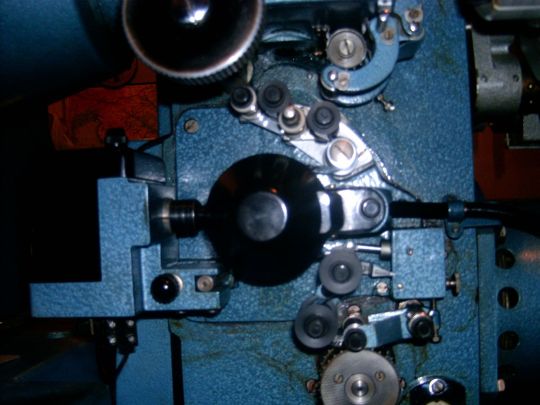

Actually there are four rollers, and fifth is in front of scanner drum, film goes in middle of big and small roller, then thru fifth and thru scanner drum.

The firs four rollers (two big and two small) we pass film in middle of them and then two upper smaller rollers are pressed to big rollers, so film is going thruu all four of them.

If you didn't understand me this is couple pictures of that four roller with and without film on prexer AP-61, is like on ISKRA, just difference is that smaller rollers pressing film from down, and on ISKRA are pressing from up.

 -

 -

 -

Considering Ernemann projector this is picture of mine

Ernemann 4 projector:
 -

Also JAcek can you upload a pic of you're AP-51, i think is same as mine AP-61 but with different lamp house?

Also i will put picture of PREXER and ISKRA inside when i get mine camera.
 
Posted by Brent Allen Sadler (Member # 2987) on 04-04-2005, 02:36 PM:
 
Out of all the projectors I have used I like the Simplex XL's the best. The century C's are great machines too with easy maintenance and a solid picture. The two worst are the Cinemeccanica V4's and the Christie gearless. These two are just junk. Christie's monstrosity of belts is just a joke and the V4's picture won't stay still on the screen. And before the Cyan reader was installed on the V4's the sound head was designed terribly. If, heaven forbid, you would fall victim to a "brain wrap" the sound head bracket usually bent badly or just simply snapped off.
 
Posted by Jacek Dejnarowicz (Member # 3062) on 04-04-2005, 03:00 PM:
 
Ap51 looks exactly the same as AP61, including color. I think only difference is automation. AP 51 are extremly manual.

Nice to see KN17 again. My father worked with the KN in mobile cinema, than he got a pair of TK35. He claims that TK was much better than KN. TK was my first projector I threaded. I have these TKs and they still work well. [Smile]
 
Posted by Christian Appelt (Member # 1067) on 04-04-2005, 05:57 PM:
 
The KN-17 is not the only TK-35 clone. In the early 1990s, I saw a machine at the Photokina fair at Cologne that looked much more TK35 than the KN17, it was made by a company from India (not Monee).

When I asked about the construction, they told me that they just had made up the compact design, that every detail had been invented by their company just two years ago... [Smile]
 
Posted by Sam D. Chavez (Member # 1841) on 04-05-2005, 12:33 AM:
 
Great pictures!

Matrix in Turkey makes a reader kit for the Iskra based on a BACP reader with custom made reader lens holder and LED brackets.

BACP will be showing some hardware kits at Cine Expo Amsterdam to allow fitting for a number of European projectors.
 
Posted by Jacek Dejnarowicz (Member # 3062) on 04-05-2005, 01:38 AM:
 
The two readers which I've already had are probably based on BACP. They are made and installed by a polish tech company. But I had been seeking some self montage kit for three months before I bought them. I even thought about adapting complete analog and digital reader from Vic 5.
 
Posted by Sam D. Chavez (Member # 1841) on 04-05-2005, 08:34 PM:
 
I did suppy readers to Kinekspert in Poland. Perhaps this is the company you refer to.
 
Posted by Jacek Dejnarowicz (Member # 3062) on 04-06-2005, 03:23 PM:
 
Yes Kinekspert. And below is their work. One pic is with old sound scan and two with new red led reverse made by Kinekspert.
 -
 -
 -

[ 04-06-2005, 04:48 PM: Message edited by: Jacek Dejnarowicz ]
 
Posted by Monte L Fullmer (Member # 2797) on 04-06-2005, 05:29 PM:
 
..just a comment:

It's interesting with all of these pictures from these Ernemann and Dresden machines (which I've heard can run circles around any US built machine), and their respective clones, is that of the payout reel direction is of the clockwise direction. (obviously, because of the upper constant speed sprocket's placement and pad roller assembly being behind the trap and gate assembly, instead of being in front of the trap and gate assembly, thus creating that forward upper loop...), which makes one wonder if this was the beginning standard of the front "A" wind of the reel for the machine usage in Europe, where we here over in the states went to the "B", or the "S" wind from the upper reel.

Also, it's also interesting to see of the usage of reels in the majority of theatres is still used instead of seeing operations using platter or big reel transports.

-thx Monte
 
Posted by Mark Gulbrandsen (Member # 72) on 04-06-2005, 08:27 PM:
 
quote: Monte L Fullmer
is that of the payout reel direction is of the clockwise direction.
Monte,
This is because the Germans are much smarter and they know that when you use that wind you have almost no focus drift over an entire reel [thumbsup] . Over here we have/had union operators that were paid to supposedly "keep" it in focus. Seems to me one operator on this thread uses that wind in every day practice... or at least he used to.

Mark
 
Posted by Monte L Fullmer (Member # 2797) on 04-06-2005, 10:34 PM:
 
quote: Mark Gulbrandsen
This is because the Germans are much smarter and they know that when you use that wind you have almost no focus drift over an entire reel
Hi again Marko: Then a simple question: where did we "goof" up in using the "S" wind whereas the Germans proved that this clockwise wind was better in the focus department?

Yet true, I've seen operators at the old Chief in Pocatello, ID use the clockwise wind in their "XL" setup-even at the Alameda Triplex in that same town when they had 6k changeover machines. They configured the Golde rewinder to rewind anti-clockwise. I never knew why they were doing this form of reel direction-reminded me of running 8/16mm which uses the "A" clockwise wind when I saw this first time.

Yet, I noticed that the Zeiss TK35's and the KN-17 clone also had the reel feed in the same direction-clockwise as well.

Now, the only thing that I can think of is when we take a reel out of the can, the natural curl of the film is curling anti-clockwise. I always thought that is how the roll came from the printer, thus this is the way the film travels in the machine.

Now, this may seem a bit contradictive, but since the majority of us wind our film on the platter deck EMULSION OUT, wouldn't this be a bit of what we're trying to dispose of in the first place-focus drift, even though with emulsion out is less contact with the rollers to the emulsion? Wouldn't the emulsion in be more of the way-the way of a clockwise wind on a reel on payout, or doe it matter? Have to ask that one.

Sorry, this is one area that I'm sorta vague on. Maybe John P., or others can answer some of these topics in a better light, or links from Kodak, or other sources.

thx-Monte
 
Posted by Gordon McLeod (Member # 33) on 04-07-2005, 04:28 AM:
 
I believe that Edision started the S wind
 
Posted by John Pytlak (Member # 331) on 04-07-2005, 11:21 AM:
 
Again, SMPTE Recommended Practice RP39 recommends emulsion-in winding be maintained for 35mm release prints on TRIACETATE base, based on the work of Kodak's Paul Preo and Eric Yavitz:

http://www.film-tech.com/warehouse/wareview.php?id=1027&category=2

Modern prints on polyester print stock use slightly thinner base, and their humidity curl characteristics are different than triacetate prints. Some find the emulsion-in orientation is still beneficial to maintain better focus stability, but others find print performance is better emulsion-out (especially for platter transport characteristics). The "core-set" on a large diameter platter hub is negligible, whereas it is a significant factor when using small hub reels or cores.
 
Posted by Robert Throop (Member # 61) on 04-07-2005, 11:24 AM:
 
I think that the emulsion in orientation in Europe was a result of tradition and at least originally had nothing to do with focus stability.
When the SMPTE came out with the emulsion in recommendation in the late sixties about half the theatres in my local's jurisdiction (local 337, Utica, NY) converted. The other half did not. If you were a relief man you had to pay attention.
Bob
 
Posted by Jacek Dejnarowicz (Member # 3062) on 04-07-2005, 01:23 PM:
 
Oh no, not every projectionist in Poland uses direction shown in my picture. Some people prefer "S" wind from the upper reel but it is less popular in my country. Personaly, I prefer clockwise direction so do my projectionsts, and it's easier if everybody uses the same direction in your theater.
Newly opened theaters are mostly equipped with platters. Last year I worked in small 4plex and there were Kinoton projectors with platters.
 
Posted by Brent Allen Sadler (Member # 2987) on 04-08-2005, 03:32 PM:
 
I see that everyone is complaining about the Cinemeccanica models. I too have 4 Cinemeccanica Victoria 4 models and I feel that although they are reliable, the are very poor machines when it comes to picture steadiness. A little history now: the Cinemeccanica projectors were never intended to be used for movie theatres (with the exception of newer models). They were manufactured originally to be used for naval defence presentations. After the company realized that they had built a dependable machine, they decided to open up their projector line to the movie theatres. Believe me, they are still laughing at us for even still having the machine, particularly the V4s and the V5s, and now are charging premium prices for their parts. No, these machines no longer put on an acceptable presentation but are cheaper than buying new machines. These things are simply outdated.
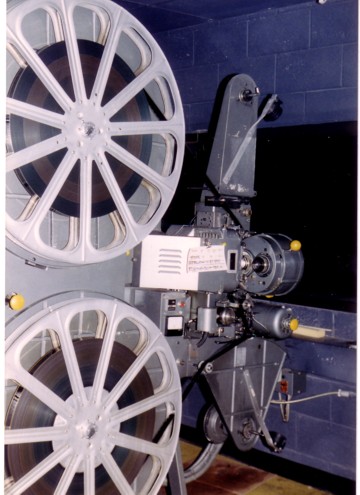
 
Posted by Mark Gulbrandsen (Member # 72) on 04-08-2005, 07:00 PM:
 
quote: Brent Allen Sadler
I see that everyone is complaining about the Cinemeccanica models. I too have 4 Cinemeccanica Victoria 4 models and I feel that although they are reliable, the are very poor machines when it comes to picture steadiness. A little history now: the Cinemeccanica projectors were never intended to be used for movie theatres (with the exception of newer models). They were manufactured originally to be used for naval defence presentations. After the company realized that they had built a dependable machine, they decided to open up their projector line to the movie theatres. Believe me, they are still laughing at us for even still having the machine, particularly the V4s and the V5s, and now are charging premium prices for their parts. No, these machines no longer put on an acceptable presentation but are cheaper than buying new machines. These things are simply outdated.

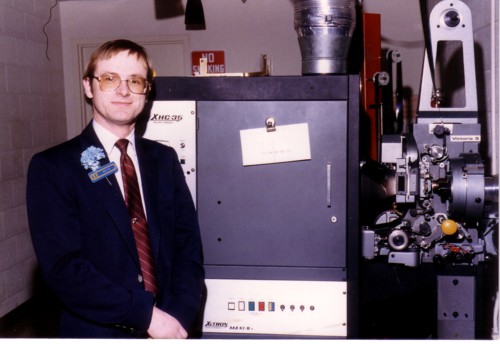
Boy, thats some wierd posting! I would have to say that the Vic 4 was a p.o.c. when it was new. They always leaked and the small gate is a joke.... also somewhat hard on older Acetate film. The Vic 5 is touch and go but is for the most part acceptable overall. The new curved gate is a p.o.c. though. Both machines have a longevity they defies their on screen picture quality which is normally pretty bad. They didn't garner the name "Shakamecanicca" for no reason at all.

What navy are you taking about.... must be the Italian Navy. The U.S. Navy would never allow such junk in for duty.

Mark
 
Posted by Gordon McLeod (Member # 33) on 04-08-2005, 07:07 PM:
 
"A little history now: the Cinemeccanica projectors were never intended to be used for movie theatres (with the exception of newer models). They were manufactured originally to be used for naval defence presentations. After the company realized that they had built a dependable machine, they decided to open up their projector line to the movie theatres. Believe me, they are still laughing at us for even still having the machine, particularly the V4s and the V5s, and now are charging premium prices for their parts. No, these machines no longer put on an acceptable presentation but are cheaper than buying new machines. These things are simply outdated. "
I would like to know what you are smoking
Cinemecanica has been manufactureing cinema products longer than any other manufacturer still in business and the V4 was a staple in european cinemas from its date of conception
They have also like the entire cinemacanica line proven to be very robust and dependable
The V4 image steadiness may be an issue but there are work around improvements
 
Posted by Monte L Fullmer (Member # 2797) on 04-09-2005, 04:15 AM:
 
True. I Loved my Cine V-18 13k reel (which held 145min of film) setup. One of the best machines that I ever worked with-much better than any Simplex around (course, once again, it's how you treat and work with the machine). Yet, I've heard tekkies dread working on a V-8/18 setup, and hated this assembly(ies). I babied these things until they would run as I want them to. I also had the 10k reels for the front arms, but never used them due to the platter guidance rollers.

Here is my V-18 at a theatre that I used to work at and now is closed:

 -

We were a discount twin house and sometimes had 3 prints playing in one house. The first two prints were on AW-2's which was behind the unit, and the reel transport would hold the 3rd print. The other house had the V-18 setup as well, but I didn't want to use the reel transport much due to the original transission had slightly worn brass gears whereas the one in this picture had a new transmission and motor. Units were all 3phase 208v-even the little blower motor that cools the aperture area was a 208v motor. Why the 3phase due to the reel motor started in steps: motor, in 1st phase, would come on first before the projector motor. Then would goto 2nd phase for more takeup tension, then final tension would be with the 3rd phase kicking in. The sideshooter lamphouse would be on all the time. There was a big dowser plate that would block the light and could take the heat from the lamp. We had 2500w vertical bulbs with "red tint" glass mirrors.

Yours truly at a Mann Theatre in the mid 80's with my first experience with V-5's, LP 270's and Xetron Consoles. I learned quite a bit about these machines, on how they'd tick and what to expect from them. In a whole, these V-5's weren't that bad of a machine. Just had to get used to belt driven machines and aluminum belt sprockets that would wear easily. Only thing that I didn't like with the Cine's that there were no middle constant speed sprocket-the sprocket right after the intermittent. Unit relied on even flow of film from intermittent through the scanner drum area to the final sprocket. Any "bumps" and "jogs" within this film path was murder on optical playback. Thus, those plastic rollers and dampner units, had to be constantly maintained for smooth film travel.

Yet, I've noticed that with the Ernemanns, and the Dresdens, this sprocket wasn't on these machines as well.

 -

-Monte
 
Posted by Louis Bornwasser (Member # 3063) on 04-09-2005, 07:51 AM:
 
I was told that the Italian Merchant Marine was the "first-user." The pictures I saw showed a projector stored in a wooden crate beneath the galley lunch table. The mechanism was then lifted onto the table and secured. The reels were under the table, This is the origin of the machine that had a film chute up and over the lamphouse. (AMC Theatres vintage 1968-1976) Louis
 
Posted by Richard Fowler (Member # 893) on 04-09-2005, 10:41 AM:
 
On Ernemann 12 and 15 they use a film clutch drag roller and keeper to back tension the film prior to going into the soundhead.
 
Posted by Mark Gulbrandsen (Member # 72) on 04-09-2005, 01:06 PM:
 
quote: Louis Bornwasser
I was told that the Italian Merchant Marine was the "first-user."
As I suspected, not exactly Navy duty of any sort!!

Mark
 
Posted by Larry Shaw (Member # 388) on 05-06-2005, 06:05 PM:
 
Back to the posts about Lucasfilm/Stag/etc. (around Nov 2004) FWIW the new ILM facility at the Citadel has FP-38ECII's.
Not "all video" for Mr Lucas yet it seems.....
 
Posted by System Notices (Member # 2357) on 05-14-2008, 10:28 PM:
 

It has been 1104 days since the last post.


Posted by Joe Redifer (Member # 3) on 05-14-2008, 10:28 PM:
 
There were a few different threads about best/worst projector, including one that was started back when all we had was the old bulletin board style forum where everyone's posts were all individual links on a single page (but the posts were translated to fit these forums). This thread seems to have the most discussion and was started on the UBB, so it is the one I chose to resurrect.

It's funny how opinions change over time. In my original post, I preferred the Century SA as the best and the Christie gearless as the worst. My choices are now quite different. Here they are along with explanations:

Out of the equipment that I have used (and I have by no means used every piece of equipment ever made):

Best Projector:
Christie gearless. - Christie made tons of improvements to this projector over the years, even when I was working with my previously crappy ones. By the time I left that theater, they were great. The new ones are even better. I still like the Century SA, don't get me wrong, but I like the Christie a little more than that now. I have not used a Kinoton, but they look bizarre. They need to put racing stripes or a spoiler or something on them to make them look sexier. They look pregnant. I have decided that I do not approve of this. You shouldn't, either.

Worst Projector:
I hate Brenkerts! They were a pain to thread and I swear they leaked a gallon of oil per show. There is a damn good reason they stopped making these things. If they were better, they would have sold more.

I also do not particularly like Simplex projectors (note: some people refer to them simply as "Strong" these days). Yes, they are built like tanks. Tanks must leak a hell of a lot of oil. Truthfully they aren't gawdaful, but that 5 star soundhead design in beyond stupid. The designer should be ashamed. I take comfort in knowing that he is likely dead now and will not be designing any more soundheads.

I do not like Cinemeccanica, either. They are great if you happen to be in an earthquake zone, as that is the only way to compensate for the built-in shakiness and get a steady picture on screen with these machines. Sheesh!

Let's take this further!

Best Platter:
Christie AW3 without doubt or hesitation. No need to explain why. I don't understand why other brands of platters even exist.

Worst Platter:
ORC/CFS Super Platter. These orange things are the worst! Check out our review on these things. Crappy MUT as well.

I do not care for Strong platters, but they are a hell of a lot better than the Super Platter. Even so, the wimpy brain design, no backtension, tiny rollers, lack of film cleaner mount, speed which is controlled by the variac and horizontal MUT all are poor choices in platter design. Who designed this? One thing is for certain, the designer never worked in a booth!

Best Lamphouse:
Christie SLC series. What more do you need? Want motorized lamp adjustment? You've got it (as an add-on option). Frickin' awesome light emitted from these god damn things.

Worst Lamphouse:
Those orange ORC pieces of crap. Or pretty much anything that has a vertically sitting bulb which reflects off of a mirror. Who thought this would be a good thing?

Best Splicer:
I still like the Neumade 35SS and the Splycemar 35SS which is the exact same thing but much cheaper than the Neumade. I guess there really is no need to purchase the Neumade version unless you enjoy spending more. In second place is the Strong splicer, but it is a very, very, very distant second place.

Worst Splicer:
CIR. Yuck!

Best Automation:
Christie/Pennywise CA21 - This used to be my most hated automation and it was pretty much worthless. Then I demanded that Pennywise improve it. Oh boy, did they ever! They'll customize it for you as well and it can be configured to do just about anything. Best automation ever. Why use anything else?

Worst Automation:
Really hard to say, but I am currently hating on the Christie AM8 Basic automation which we have installed in two auditoriums at my current theater including our large giant screen auditorium! It accepts only one cue, it does not trigger non-sync when the stop button is pressed until 8 seconds have passed, it offers next to no control of anything and is pretty much worthless. I am not sure why such an inferior and incapable automation was ever invented. And what is it doing in our largest house?

Best Rewind Bench:
I am partial to the Kelmars. Every modern theater has at least one and they work great. Perhaps a bit expensive, but they do the job well.

Worst Rewind Bench:
Neumade PRT Ultra - Ug. These things offer limited control, crappy spindles and nothing about them is good. Nothing. Or maybe those 2000' reel rewinders which have two speeds; full speed and off. That is just stupid. I don't think intelligence had been invented yet when those things were designed.

Best Sound Processor:
Dolby C650 - The screen is way too small to be anything more than "barely useful", but it is a class processor regardless. Unfortunately there are no games built into the CP650 like there were in the CP500... that I have discovered.

Worst Sound Processor:
Not sure, probably something by EPRAD. I'm comfortable saying that, I think. I also do not like the Dolby CP45. What the hell was up with that thing?

I could go on, but I won't. You can, though.
 
Posted by Sean McKinnon (Member # 612) on 05-15-2008, 10:04 AM:
 
quote: Joe Redifer
that is the only way to compensate for the built-in shakiness and get a steady picture on screen with these machines.
Sorry Joe, I have to take issue with this. I have serviced theatres with Cinnemecanicca machines and after some basic TLC, and replacement of worn parts, and a shutter gearbox or 10 these machines would run very smooth, quiet, and steady. I also feel the same way about the Pro-35 with some care, replacement of framing couplers (Bobbins!!!) and some other parts these machines would run very quiet an put out a rock solid picture. Training of the theatre staff to thread in frame and to be very gentle with the framing control was important too!

I think the potts, strong, and neumade with the tiny ball bearing rollers, micro-switch feed plates, motors that need to be disengaged for tear down, and decks supported by "fins" underneath are the worst platter design. A film handling machine should not need to be modified out of the box to not damage film. The lack of back tension itsekf is enough to cause a lot of film damage.

I would vote for the Eprad "Starlette" or "Star Scope" and those turqois colored Smart processors (I forget the model) as the worst Sound Processors easily hands down. I actually services 2 theatres that had these Starlette's and Star Scopes! It was awesome when someone would yell in the soundtrack all of a sudden there would be a loud "click" in the surrounds and they would suddenly come one then shut off a few seconds later. VERY VERY distracting. I guess these created a surround channel by taking anything signal over a certain volume and using it as a "cue" to turn on the surround speakers which were fed the same mono signal as the center channel [Roll Eyes] [Eek!]

I vote for the Cinemation Mark Four as the worst automation because each machine I have seen is wired differently with different colored wire and different components. I can imagine a room full of blue haired old english ladies sitting there wiring these things up over a never ending gossip session!! [Smile]
 
Posted by Mark Gulbrandsen (Member # 72) on 05-15-2008, 10:15 AM:
 
I agree pretty much with what Joes says. The Christie gear made today is well beyond the quality of any other equipment produced in North America. Then only two places Joe is dead wrong is about splicers and Brenkerts.

First off the Strong International(This is very definately one place to call them Wrong International) splicer. This thing is a total waste of metal and people's energy to assemble them! It doesn't even rate at my end. I have yet to see one that actually cuts the tape and perforates the film completely. I'd rate this splicer right up there with the 69.00 Indian copy of the Ciro. Both these seem to work well when new for about 50 splices.

Brenkerts.... Joe.... Brenkerts go way back to 1939! All oil bath machines drip some oil and Brenkerts CAN be made as drip proof as a Black wrinkle Simplex if rebuilt properly. I used to service tons of Brenkerts in Chicago and they gave little trouble overall. Yea, they can be a bit messy and they are a heavy load on the soundhead gearbox but the machines are built like a tank and the BX-60 literally is THE projector that NEVER wears out. There are still a half dozen BX-60's running in this general area putting out rock steady pictures. BTW: The earlier cast iron variant of the BX-80 weighs in at nearly 140 lbs just for a projector head! The BX- 40, 80 and 100 are dead though because Wolk screwed up the only replacement batch of conical fibre shutter gears they made for these models. The BX-60 doesn't use that gear. If you can find an original Brenkert shutter gear laying around... even a used one... the machine will keep on chugging for more decades.

Sean... I completely disagree with you on the Shakeamecannicas! This paragraph will more than likely start a barrage of other comments in the Vic 5's favor but oh well... I've always seen the Vic 5 is a total piece of junk... right up there with the old P-35's with the gearbox's. Now take a Vic-8 or Vic 10.... even a VIC-4 is tons better than the 5 is. To me the 5 has always been an excuse for a projector... while the 4, 8, 9, and 10 were real projectors. I service a location that has several Vic 8's that are 45 years old! Yea, lately its taken a few repairs(contactors) to keep em running but nothing major. Original gear trains and so on have never been touched. I did catch a partially plugged oil galley in one of them a few years back however.

Ballantoons... another excuse of a projector. The Ballantoon has too many weak spots in it for general service duty in any multiplex. Also the star and cam ARE NOT hardened and even a simple film pile up that doesn't phase other projectors will break or bend the tip of the Ballantoon star wheel. Another downside... Wrong International has discontinued many parts for it and other machines. Just try to get gate parts such as castings or certain springs, lens mount parts don't exist. Wrong quit making it several years ago because no one wanted it... they did the right thing. Hey... they did do one thing right... as Louis says.

Mark
 
Posted by Galen Murphy-Fahlgren (Member # 4535) on 05-15-2008, 01:27 PM:
 
I have to agree, the V5 sucks. I have three (used to be four) and apart from their propensity to break constantly, it should not be that hard to get a steady image. Sean, perhaps you know some secret that I don't, but if proper belt tension, lubrication, and threading don't do the trick, it's junk. V5s are only good for showing Cloverfield, and why would you want to do that?
 
Posted by John Hawkinson (Member # 1135) on 05-15-2008, 03:42 PM:
 
OK, guys, let's get some numbers on jitter and weave. No "rocky steady," please. Just numbers. How steady, quantitatively, is your
Cinnemecanicca, using RP40? What is the vertical image (un)steadiness as measured in RP40 squares (each RP40 square is 0.004125")?

(an RP40 square is just over 0.5% of the 4-perf image height.) Less than 1/10th of a square of movement is pretty good.

--jhawk
 
Posted by Galen Murphy-Fahlgren (Member # 4535) on 05-15-2008, 04:02 PM:
 
Well, I would obviously have to measure that, but I can say that my V5s are noticeably less steady than my Christie P35GPs or my Simplex XLs, despite the fact that my V5s occupy 3 of my 4 smallest screens. I could have actual measurements by no earlier than Sunday.
 
Posted by Chris Slycord (Member # 4239) on 05-15-2008, 04:27 PM:
 
quote: Galen Murphy-Fahlgren
Well, I would obviously have to measure that
I maybe wrong but I think that's exactly what he wants you to do. [Razz]
 
Posted by Michael Moore (Member # 3867) on 05-15-2008, 04:31 PM:
 
I have used Cinnemecanicca, Simplex, and Century; at some point in time and like all of these projectors, and soundheads alike. I can't say either way one is "the bomb" and all projectors fall to ruin in its proverbial wake. In review of others who have posted here, I can fairly say many of you waffle more then a waffle iron, back and forth, “I like it- I don't like it- I like it- I don't like it.” Come on, give me a break!

Again, I have to go back to what I have said before, the operator(s) are responsible (greater then 90% of the time) for equipment failure. Remember at a theatre "you" are not the only one there. Remember there will be ones to follow you, and or work with you right now. And everyone is different and treats machines differently, so “you” or they can’t control each other completely.

Are there design flaws out their, sure, can any one of us engineer a solution to solve it? ---Most likely, fact is no projector is just the end of all projectors, sure there are you kinoton bitches, as well as Christy sluts out their, who praise these machines as if god crapped them out himself on the 8th day and said let their be perfect projection equipment. Sure there are people who will love Simplex till the day they die, and the machine will still be around long after the casket is closed. And yes, I agree there are little V5 lovers out their just running their mouth how perfect their projectors are. Century punks, Motiographaphiles; the list could go on and on.

I have no qualification to be and expert about any machine nor would I ever say I’m an expert, (that’s an ego thing for many). However I can safely assure anyone here that I have used some equipment that I have looked at and said “well why did they do that when they could have done this” or “that is just dumb.” I have also stood back and looked at some stuff and said “wow that works.”

Whatever, get over yourselves. I’m tired of these pissing contests: “My sprockets better then yours! My sprockets better then yours!”
Just take care of what you have and get the most out of it.

Mike
 
Posted by David Stambaugh (Member # 1102) on 05-15-2008, 04:51 PM:
 
When I was in the 6th grade I loved running those Bell & Howell autothreading 16mm machines. Those were the bomb. [Wink]
 
Posted by Mark Gulbrandsen (Member # 72) on 05-15-2008, 07:44 PM:
 
quote:
I’m tired of these pissing contests:
Mikey,

Film-Tech has always been this way. Its a mix of some of us helping others when they need it, others having vague arguments and yet others having very definate arguments. All of us here are opinioniated including you. Our discussions are fun and in fact quite a few people I know in the industry love reading the pissing matches that go on here. My feeling is that if you don't like the once in a while pissing match or the opinions of which sprocket is better or not then you should consider going and taking a good dump and get the load off your back!

quote: Michael Moore
Just take care of what you have and get the most out of it.
If only you knew the real world.... You'd know that it was just about the opposite of that!

Mark
 
Posted by Monte L Fullmer (Member # 2797) on 05-15-2008, 08:42 PM:
 
quote:
then you should consider going and taking a good dump and get the load off your back!

(As Confucious would say: "Take a bran muffin, for one needs a colon cleaning once in a while..." [Big Grin] )

...............................................

The early 175 up to the 399 Bell&Howells were the best 16mm around - being all manual thread (and the 202 was a mag/optical variety and the 399 had sapphire jeweled trap runners),but agree with the later 500+ series being as the autoload "shredders".

Only thing saved the later models is using the lower wattage halogen bulbs and solid state amplifier circuitry compared to the earlier models with those current drawing, heat creating, short hour 1000w monster bulbs that they used and using tube amplifiers. It took a good 1200w out of the wall to run these earlier machines,.

..and "oh GAG!" how about them Graflex 16mm as being the worst in the 16mm catagory...

...I also like Brenkherts...very well built machine,

..go ahead an kick me for this, but I also liked Motiographs.

-Monte
 
Posted by James Westbrook (Member # 3690) on 05-15-2008, 09:29 PM:
 
"Kinotone Bitches and Christie Sluts".
I'm sorry, but I'm STILL laughing at that. [Big Grin]
I agree that pissing contests are counterproductive, but these can be quite fun to read. I refer to it as "Tech Fight."
 
Posted by Michael Moore (Member # 3867) on 05-15-2008, 09:39 PM:
 
ok
 
Posted by Steve Guttag (Member # 268) on 05-15-2008, 10:24 PM:
 
Its true....you could find the most god awful piece of crap and there is going to be someone out there that just thinks it is "da bomb."

I, personally, much prefer one defending one's "bitches" or "sluts" and touting why they think they are so horney...ah, er good!, than merely saying...yadda, yadda, yadda is a piece of crap and giving no apparent reason why.

As to this thread...it is just impossible to state what is the best projector, in general terms. One would have to know the criteria that they are going for. It would be like saying "which is the best car"...An Indy car is pretty important to have if you are going to drive in the Indianapolis 500...a pretty poor choice to drive to work on public roads for a whole slew of reasons...staring with being illegal.

Most every projector has its strong and weak points...which ones bother you or please you most and that tends to make what one thinks is the best or worst projector (or any other piece of equipment).

As to Cinemeccanicas...I know many a European that think the Vic 5s are just the best thing to have in the world. I've never much cared for them myself...never had a great picture...too many shutter box failures, c/o dousers are beyond slow (but I think only the American companies got that right)...sound drum being out of round too many times...too many solar cells ripped off their brackets (back when those were used)...and the list just keeps going on.

Steve
 
Posted by Brad Miller (Member # 2) on 05-16-2008, 03:01 AM:
 
Regarding the Strong splicer...Joe, you are probably remembering the splicer we tested and the improvement with the registration pins that Strong swore to us would be immediately forthcoming to solve the issues we had with it.

Well, the review went up and Strong dropped the ball and never fixed the issue. Given that issue alone, I would rate it an "F". Interestingly enough, another member did a re-review of the splicer months down the line and found that his splicer did not even punch properly, but damaged the film.
 
Posted by Jaime Tuzzio (Member # 4760) on 05-16-2008, 08:19 AM:
 
quote: Joe Redifer
Unfortunately there are no games built into the CP650 like there were in the CP500... that I have discovered.
What? Where the hell was I?!

I've only ever known Simplex projectors: 1060's, Millenium's, and Apogee's. I am trying to be at peace with CP65's after spending the last five years with 500's and 650's. And I am happy to say that I am quickly re-learning the ways in which you can "fix" a 5-star with a Q-tip, appease a CP65 by following a specific order of turning things on and off, and fix an SCDC optical 4 error with a sledge hammer.

Or I may have dreamt that last one.
 
Posted by Louis Bornwasser (Member # 3063) on 05-16-2008, 08:54 AM:
 
Steve is right; the best projector is. . . . . . the one you can most "deal with." All have some kind of "issue."

I was once asked during questions from the floor which projector I liked best? My answer; which problem can you most accept? Louis
 
Posted by Chad M Calpito (Member # 3736) on 05-16-2008, 09:19 AM:
 
The equipment that I've been working with so far are the Simplex 35's with the 5-Star Soundhead, Christie SLC Consoles with the AM-10 Automation and, of course, the awesome Christie AW3R Platters. I also use the Kelmar Build Table as well.

Of course, I dealt with others like the Strong AP Platters (don't like these), Strong Millenium Projectors (these are okay) and the Big Sky Industries Lamphouses & Series II Automation. I used to use the Century JJ Projector at Grossmont Center 10 before I transferred to Gaslamp 15.

A projector that I could not stand was the Christie Projector that I used at the Ultra Star Poway 10 many years ago.

Anyway, I'm sure that there are other projectors that are better than what I'm working with currently.
 
Posted by Sean McKinnon (Member # 612) on 05-16-2008, 10:14 AM:
 
Dont get me wrong, I am not saying that Cinemeccanicas are my favorite projector, or that I enjoy working on them. I was just saying that I think Joe's abviously exagerated statement that the only way to compensate for unsteadiness is to be in an earthquake. I beleive with the right maintenance and care these machines will run well. For how long? Thats another story. Same thing with the PRO-35. I have been able to get a great picture out of these, how long it stays that way after I walk out the door is another issue.

Those two are probaby some of my least favortie machines. All I am saying is that it is possible to get a decent picture out of them at least for a little while! [beer]

BTW, I beleive that debate strengthens the mind, and helps to keep one sharp much in the same way that teaching does. I find that sometimes I will have a vague understanding of something until I try to explain it to someone else and then all of a sudden it clicks in and I "get it" better than I did before. Whenever I am confronted with a problem that I don't understand right away I will call up one of my friends (regardless of wether they know what im talking about) and start to explain the problem to them, and the process I am thinking about using to troubleshoot it. Most of the time I will get halfway through the explanation and something will "click" and I will have the answer then I'll say "Gotta Go!" and hang up leaving them sitting there scratching thier heads! I see constructive debate in the same way, arguing your opinion's can lead to you having a better understanding of why you have that opinion, and you can also always learn something from the person you are arguing with. I have found that if you want to learn from someone who may be hesitant to share thier knowledge that if you trick them into a debate or argument with you they will end up giving away that knowledge to win the argument and then, who really won? [Big Grin] [beer]
 
Posted by Joe Redifer (Member # 3) on 05-16-2008, 10:52 AM:
 
quote: Brad Miller
Regarding the Strong splicer...Joe, you are probably remembering the splicer we tested and the improvement with the registration pins that Strong swore to us would be immediately forthcoming to solve the issues we had with it.
I said it was in a super-distant second place, but I believe I have only used three different types of splicers. The registration pins on the Strong are ASS! Also pathetic is the way it holds a roll of tape. When the roll gets less than half full, the tape becomes extremely hard to pull. Also the cutting arm is way too damned stiff. It does not make very clean cuts, either. Strong has always been a company who has been asleep at the wheel in the design department. They're not like Christie or Pennywise who will work with you to improve their products.
 
Posted by Scott Norwood (Member # 30) on 05-16-2008, 11:20 AM:
 
Sean--out of curiousity, who has PRO-35s in this area? I've never seen any in this region and am curious as to what chain/theatre bought them. From what I have seen, this seems to be basically a Simplex/Century town, with Cinemeccanicas in ex-GCC installations from the 1980s and 1990s. Kinotons are also common in recent BL&S installations. There is also the occasional Norelco installation. Have I missed out on anything exciting in this region?
 
Posted by David Zylstra (Member # 4230) on 05-16-2008, 11:48 AM:
 
I've always been partial to the Century, but admittedly it is because I "grew up" running them. I also personally like the ORC platter (NOT the one reviewed here but a late '80s generation) almost as much as the Christie, but again it is mostly because that is what we ran in my booth and we learned to live with the quirks so they did not seem that bad (Like the $100 potentiometer replacements). Strong's platters were OK but I never liked the idea of the take up governing pay out, if memory serves the Xetron platters were similar in operation to Christie. The CFS Rentec ESP platter had a horrible feed plate - decent concept but they did not have enough time to perfect their feed plate design before closing the business, the second generation was better than the first but it still needed work - I'd say if you are stuck with one of the 1st gen ESP platters you are in maintenance hell keeping them running.

I think some opinions (including mine) are colored by what generation equipment one learned on or used most frequently - i.e. if I had started with the Strong made Century my opinion would definitely be different.

On splicers - we used the Hollywood HFC tape splicer that used pre-perforated tape, I came from using a Neumade and today I would still prefer the HFC (it did take me a while to warm up and get adept at using it) . . . . . only problem is the tape is very expensive.
 
Posted by Sean McKinnon (Member # 612) on 05-17-2008, 03:24 PM:
 
Scott,

The theatre I serviced with the Pro-35's was way up in newhampshire on the vermont border.


Powered by Infopop Corporation
UBB.classicTM 6.3.1.2