This is topic Kodak Projection Training in forum Film Handlers' Forum at Film-Tech Forum ARCHIVE.
To visit this topic, use this URL:
https://ft-forum.com/ft/cgi-bin/ubb/ultimatebb.cgi?ubb=get_topic;f=1;t=000202
Posted by Joe Redifer (Member # 3) on 08-19-1999, 06:07 AM:
I could not pass this one up. Here is Kodak's latest ad from Box Office magazine:

It is good that there is a place people can turn if they feel that they need to learn more. But is the picture in this ad the best way to represent that? Look carefully.
Posted by Joe Redifer (Member # 3) on 08-19-1999, 06:12 AM:
In case you missed it, here is a blowup of the goofy part. What is this guy thinking? Why does he look so baffled? What exactly is it that he is trying ever so hard to accomplish? I could not resist adding my own captions.
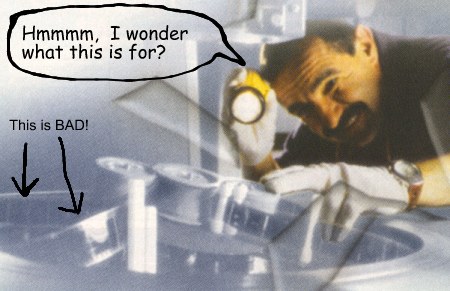
Also, note that the film is seriously misthreaded. I hope that nobody uses this as a quick threading diagram for the Christie platter. Is this the guy who teaches the seminar? Why is he wearing gloves and holding a flashlight? I don't think he's going to be able to fix the film that way. The fact that he is wearing gloves leads me to believe that he is from Kodak and trying to set a good example. But the misthreaded film and the clueless look on his face leads me to believe that he is a confused "projectionist" or something representing how others feel in the booth around machinery that they do not quite understand. Forgive me, John, but I just think that this ad is funny!Whatever happened to Kodak trainer Jeff Johnson? Did he get fed up and quit and go become a police officer or something?
A tip from Joe: Don't listen if somebody tells you to wind the film on the platter "emulsion in". This is bad. Always wind "emulsion out" or soundtrack up. At least the guy in this picture seems to have done that, as far as I can tell.
Posted by Scott Norwood (Member # 30) on 08-19-1999, 08:58 AM:
That ad is really funny. I still haven't figured out the whole emulsion-in vs. emulsion-out debate, personally, so I just stick to the standard "S-wind" approach for reel-to-reel work; top reel is wound emulsion-out and spins counterclockwise, bottom reel takes up emulsion in and spins clockwise. I store films heads-out/emulsion-out, although I have been known to use the shipping reels as take-ups on the last show and ship the films tails-out/emulsion-in. Any problems that I've had with focus drift seem to have more to do with the print, lab, and stock, rather than winding orientation as the print arrived at the theatre.
Posted by Jason Burroughs (Member # 68) on 08-19-1999, 01:20 PM:
Interresting side note, the Kodak projection training seminar is taught by a former AMC "projectionist/manager" Given that one REALLY has to wonder about the quality of instruction given.
Posted by George Roher (Member # 91) on 08-19-1999, 09:55 PM:
I think the worried guy in the picture is a manager who refuses to hire a real projectionist and is suffering for it. 
I have worked with people who threaded Christie platters the same way shown in the photo. It was fun.
Posted by Brad Miller (Member # 2) on 08-20-1999, 03:52 AM:
If the fellow would just change the little platter arm light, he wouldn't be struggling with that flashlight and might be able to see what he screwed up. 
Posted by John Pytlak (Member # 331) on 08-20-1999, 09:26 AM:
Welcome to the wonderful world of advertising! The graphics in ads often don't reflect reality, but are intended to get your attention. From the reaction of some of you, the ad certainly got your attention.The guy in the ad is Mark, a skilled film technician who works with me at Kodak. The photo was one of many posed at a local General Cinema Theatre by an outside photographer, working for the ad agency. We did not have a say in the choice of the photo chosen, or of the later digital manipulation of the image done to enhance the ad's visual impact, at the expense of "real" practice. For example:
The photographer insisted on the flashlight prop, to add visual interest. Film handler's gloves are a Kodak recommendation rarely followed by projectionists. I personally prefer to handle film "bare hands", which is fine as long as you have the discipline to handle the film by the edges only, and not get fingerprints onto the image area. But lint-free gloves are recommended if you tend to touch the image area. Can everyone honestly say they never leave fingerprints on the image area?
Keen eyes would see that not only is the platter "misthreaded", the threading shown is impossible to achieve in reality. Note that two strands of film seem to be coming from the inside of the feed roll. Note that the platter column is behind Mark, but the film strand is going off to the left. I'm surprised that no one caught that the frames on the print appear to 6-perf pulldown (no, it's not a Cinerama print), and the film does not have a soundtrack. The ad agency evidently thought that these changes enhanced the appearance of the ad. I suspect that sometimes these "errors" are deliberate, to attract attention to the ad.
Mark was told to "look concerned". He was playing the role of a ScreenCheck inspector, but they used the photo to represent a projectionist who worked hard, but Kodak could "help you to do your job better".
BTW, Mark does NOT have a beard --- it was digitally added later to make the ad more interesting (or change his identity to protect the innocent).
------------------
John Pytlak
Posted by John Pytlak (Member # 331) on 08-20-1999, 10:07 AM:
The SMPTE Recommended Practice RP39 "Specifications for Maintaining an Emulsion-In Orientation on Theatrical Release Prints" applies mostly to film wound on reels and cores with a small hub diameter. The "core-set" imparted by emulsion-in orientation helps reduce focus flutter at higher power levels (e.g., 4000 watts or more). Focus flutter is much less of an issue at lower power levels.With platters, the effect of winding orientation on focus flutter is much less important. Compared to a core or reel, the hub diameter is much greater, so there is little "core-set". The preferred winding orientation on a platter depends mostly upon the curl of the film, which in turn, depends upon the relative humidity in the projection room. Use the orientation that gives the best winding quality, and the least tendency for "static cling" in your situation.
------------------
John Pytlak
Posted by Brad Miller (Member # 2) on 08-20-1999, 01:04 PM:
"Can anyone honestly say they never leave fingerprints in the image area?"Those of us with dry skin can! Of course, it really doesn't matter when using FilmGuard. (shameless plug  )
)
"Note that the platter column is behind Mark."
Actually, no. If you look at his head, you will notice the top platter's arm with burned out light. Also, simply look at the brain's orientation to realize the film is headed toward the column.
But I'll give ya credit for the 6 perf! I didn't notice that in Joe's scan. haha Out of curiosity, why did they go to the trouble of loading up such a print? Why didn't they just get a shot of an existing print at the theater?
Posted by Joe Redifer (Member # 3) on 08-20-1999, 04:26 PM:
OK, so the ad grabs attention. But wouldn't it be the advertiser's resposibility to make sure something good was done with that attention? If I were Kodak, I would rather the attention be something like "Gee, perhaps these guys can teach me a thing or two" instead of "Wow, these guys are crazy! I think I'll laugh at them. Here goes: Ha ha ha ha ha ha " You need to get the right kind of attention. Oh yeah, notice how the film has a complete tralier pack. Must have cost a ton of $$$ to print up a special film just for this ad. I don't think most people will really dive into it except those of us who already know this stuff.
Actually I am willing to bet that the 6-perf film is actually 4-perf, just digitally "enhanced".
Posted by Joe Redifer (Member # 3) on 08-22-1999, 09:32 PM:
Here is the way I think the Kodak ad should have been:
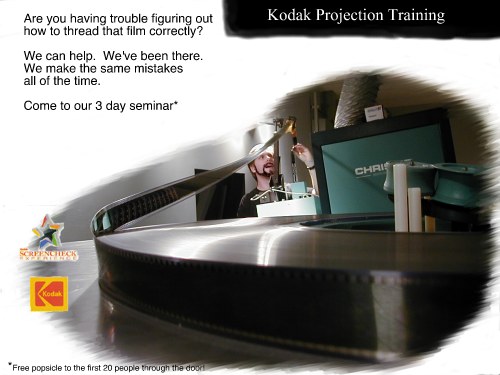
This ad is intended to be a farce, so people won't be confused about what is supposed to be going on in the pic. It is very clear that this guy is trying to thread the film with the tail going straight from the platter disc to the projector. Note that he also has a digital beard, just like other Kodak ads. No Kodak ad is complete without a digital beard.
Posted by John Pytlak (Member # 331) on 08-23-1999, 09:42 AM:
Joe --- please send your resume, and I'll give it to our advertising agency. I'm sure they can digitally enhance it. ------------------
John Pytlak
Posted by Joe Redifer (Member # 3) on 08-23-1999, 12:21 PM:
John-If you like that, then I have a short (about 2 minutes or so) projection seminar video that you would like to see. Please specify VHS or S-VHS. I believe I still have your mailing address at Kodak.
--Joe
Posted by John Pytlak (Member # 331) on 08-23-1999, 12:49 PM:
I prefer D5 or Pluto RAID array, so I can look at video on a BIG screen. But VHS will do.------------------
John Pytlak
Posted by Gordon McLeod (Member # 33) on 08-25-1999, 10:31 AM:
Get it on high res beta
Posted by Joe Redifer (Member # 3) on 08-25-1999, 06:11 PM:
Actually, I was thinking of that Fisher-Price thing about 15 years back (or so) where it recorded black and white video onto a cassette tape! technology at it's finest! I think they used the same camera to film Blair Witch, if I am not mistaken.
Posted by Mark DeLettera (Member # 125) on 08-26-1999, 07:40 AM:
Hi, I'm Mark DeLettera, the technician "modeling" in the Kodak print ad. I am not a projectionist, nor do I play one on TV, (or in magazines)! As John Pytlak said, I was posing as a ScreenCheck inspector at the time of the shoot. Inspecting for damaged rollers with a flashlight in a dark projection booth is not unheard of. Also, using the white cotton gloves was not for handling the film, it is a way to rub fingers over the rails and rollers to inspect for cleanliness.
Just wanted to say Hi!
Posted by Joe Redifer (Member # 3) on 08-26-1999, 08:41 AM:
Hi, Mark! Nice digital beard! Since you were there, was the film really 6-perf or was that also enhanced on the computer? Did the photographer mess up the film threading or did he make you do it? I am always curious about the little details.
Posted by John Pytlak (Member # 331) on 08-26-1999, 12:41 PM:
Mark is on vacation for a long weekend, so I'll answer Joe's question. The photos were taken at a local Rochester GCC 6-plex on April 23, 1999, in late morning, minutes before the first show of the day. (You wanted details! ) The print was the actual print being used at that theatre, and had already been threaded by the head projectionist. The photographer posed the picture, and suggested the use of the flashlight and film handler's gloves. My guess is they hand-turned the platter back a bit to throw some interesting (but "This is BAD") film slack into the picture (the extra loop of film in the foreground and roller misthread that started this whole discussion). Mark's beard and "enhancement" of the film frames to look like 6-perf were done digitally by the ad agency after the fact. Mark and I did not see the final ad until it appeared in print.------------------
John Pytlak
Posted by John Pytlak (Member # 331) on 10-28-1999, 01:34 PM:
Mark is a senior technician in Kodak's Worldwide Technical Services Group. Although he is not a ScreenCheck field engineer, he and I helped develop the specifications for ScreenCheck certification and re-inspection.ScreenCheck field engineers are contracted from established theatre service companies, and already have considerable experience in projection and sound. The program is managed by Kodak's Cinema Operations Group, headquartered in Los Angeles.
The pre-certification inspection covers over 130 aspects of presentation quality. The periodic follow-up inspections cover over 80 items. Each item is rated on a report card, and weighted according to its importance. Theatres must meet and maintain better than a "B" grade on ALL critical items (e.g., screen luminance, focus stability, steadiness, etc.), and a 75% weighted score overall. The detailed inspection report is shared with the theatre so they can fix any problems or deficiencies.
Accidental damage to a print will not cause a theatre to lose its ScreenCheck certification, but consistent neglect of problems that could damage prints will (e.g., hot spotting, poorly maintained equipment, lack of proper splicing equipment).
Posted by Joe Redifer (Member # 3) on 10-28-1999, 03:50 PM:
The use of FilmGuard should automatically give any theatre a better grade on Kodak's report card. It improves the presentation dramatically. I don't think Kodak is quite up to speed on FilmGuard yet, though.Image steadiness is a criteria? So therefore you automatically eliminate every theatre that has a Christie projector! Too bad Kodak Screencheck does not also apply to manufacturers (like THX) who have to meet certain criteria for their products to be used in a certified theatre.
Nobody in Colorado is doing ScreenCheck (although we received a ton of those trailers with the goofy guys "cleaning" up the onscreen problems). Maybe this means we are automatically certified?
Posted by John Pytlak (Member # 331) on 10-29-1999, 07:50 AM:
Joe --- ScreenCheck measures the results on the screen, and doesn't pre-judge whether a particular brand of equipment can achieve good quality. Steadiness is measured using a roll of SMPTE 35-PA (RP40) test film. For vertical steadiness (jump), an "A" rating is less than 1/10 of a square movement, a "B" is 1/10 square, a "C" is 2/10, a "D" is 3/10 and an "F" is greater than 3/10. For horizontal movement (weave), "A" is less than 4/10 of a square movement, "B" is 4/10, "C" is 5/10, "D" is 6/10, and "F" is more than 6/10. These criteria are based on SMPTE Recommended Practice RP105, "Method of Determining the Degree of Jump and Weave...". As you know, each square on the 35-PA film represents 1/2 percent of image width, or 0.004125 inches on the film.------------------
John Pytlak, Senior Technical Specialist
Worldwide Technical Services, Professional Motion Imaging
Research Labs, Building 69, Room 7419
Eastman Kodak Company
Rochester, NY 14650-1922 USA
Tel: 716-477-5325 Fax: 716-722-7243
Posted by Joe Redifer (Member # 3) on 10-29-1999, 02:08 PM:
Then you still must automatically fail all theatres with Christie projectors, as surely they will get an 'F' in vertical steadiness with that horrible Ultramittent. I don't care if it won an Academy Award or not, it sucks!
Posted by Steve Guttag (Member # 268) on 10-29-1999, 07:04 PM:
One day you must really explain why emulsion-in on a platter is "bad". It is my default orientation (and has been so for 20-years) and have never had a problem with it. As John stated earlier, humidity conditions may dictate which way I'll wind a print to achieve the best wind and payout...but heck I hate platters anyway ;-)
The only quasi-valid point I've seen on winding emulsion out is if the take-up guide roller causes the edge of the print to scrape the SDDS track off.
And to Scott...at the beloved Uptown, I switched the booth to emulsion-in wrap in 1988 (reel-to-reel with 8" hubs and 22" flanges).
The theatre has traditionally played extended runs and the longer the run the more difficult the focus became.
Now the Uptown has been a union house since it was built in 1936 and is steeped in tradion...I went through the "I've been running film this way for...blah, blah years...and such but got them to go along with it for one feature. The difference was dramtic...400+ shows and the focus was the same on the first show as the last. Nothing sells a system to an old-time union operator like being able to sit on his a**. (It was right around the time of Roger Rabbit)...it has been emulsion-in ever sense and still works just fine.
To John...touch a frame of picture with one's bare hand, of course not...That is why I have always used "scrap film" spliced onto the protective leader and protective tail of each reel. You hands touch the scrap film (after all what are all those old dumb ad films for...think of it as recycling :-)). After threading, wind down to the countdown. There is no reason for the film to hit the ground or be handled near the projection part of the film. The protective leader/tails create a nice buffer zone so the reel changes don't look crappy.
Steve
Posted by Brad Miller (Member # 2) on 10-29-1999, 07:36 PM:
Thank you for backing up that point of mine on adding extra leader, Steve. No one seems to do this! Minimum of 50 feet head and tail on platters and minimum of 20 feet on changeovers is my rule. The more the better. Even Joe said the day he came back from Telluride after running changeovers for the first time that the reel changed started to look crappy after only a couple of runs! This is a perfect example of why leaders MUST be extended. This is also a prime reason why I do NOT like running brute force (reel to reel) projection.
- You've got the stress of the film having to pull the weight of the supply reel.
- You've got the high back tension on the film at the end of the reel.
- You've got a constantly changing takeup tension being applied to the film.
- You've got the stress of rewinding after each show.
- You've got the chance of cinch mark scratching vertically from film convolutions slipping against one another.
- You've got the chance of cinch mark scratching horizontally from film not properly being "flange binded" against a side of a reel.
- You've got the constant handling of the film.
- Need I go on???
In regards to emulsion in and out, I have always ran emulsion out whether it be on a platter or reel to reel. I have never, not once had a problem with focus, and yes I have used binoculars to verify. I'm thinking there is something else that is aggravating the situation at your location. Also, my emulsion out practice wasn't ever an argument I would make with acetate film except on platters. I was just simply making a point with acetate stocks that was how "I" did it. With polyester film, I will argue the point to the end of time. Hopefully Mr. Pytlak will get SMPTE to re-evaluate the whole (and very outdated) emulsion in recommendation.
One must remember, the whole emulsion in recommendation in it's SIMPLEST form was to prevent the film from developing an excessive curl. With acetate film, the curl was outward towards the emulsion. With polyester film, the curl is outward toward the base. Film will always develop a curl in the opposite direction of the core...thus my point that no polyester film should be ran emulsion in for best focus and stability. I think the guys on the forum here can back me up on this. (For platter guys, emulsion out winding is running soundtrack up on the platter and emulsion in winding is running the soundtrack down on the platter.)
Try running polyester film emulsion out for awhile and see what you think.