This is topic carpeted booths? in forum Film Handlers' Forum at Film-Tech Forum ARCHIVE.
To visit this topic, use this URL:
https://ft-forum.com/ft/cgi-bin/ubb/ultimatebb.cgi?ubb=get_topic;f=1;t=000272
Posted by Scott Norwood (Member # 30) on 09-30-1999, 08:02 AM:
What is the general consensus on the usefulness of a carpeted floor in projection booths? I know that most booths have tile floors, but the few that I have seen that have carpeted floors seem to be cleaner and much quieter than those with tile floors.
I know that carpet can cause static problems with ESTAR-base film on platters, but that's probably fixable by adding a humidifier in the booth.
Are there any other real disadvantages to carpeted floors (assuming that the projectors don't leak too much oil)?
Posted by Art Averett (Member # 367) on 09-30-1999, 08:13 AM:
Yes I have. I worked in a small twin theater that the other projectionist put down carpeting. It was not a good thing. After two years, one of the intermittants had to be re-built. Also, do not use a humidifier with an estar or polyester base print. You'll have more problems than you want. Keep the floor in the booth clean with a vacuum cleaner or damp mop to keep dust and dirt down to a minimum.
Posted by Gordon McLeod (Member # 33) on 09-30-1999, 01:08 PM:
Carpeted booths I don't like because of the problem of keeping them clean and oil free
With estar film a humidifier is a must if you want any hope of avoiding static cling
Posted by Brad Miller (Member # 2) on 09-30-1999, 01:09 PM:
I love carpet in booths. It makes everything significantly quieter and after crashing on a freshly mopped floor a few times, is better for mobility as well.Plus, of course, it just makes the place more like home. 
As far as film problems, I don't have a problem with either type of booth and do not use anything extra, like a humidifier.
Posted by Joe Redifer (Member # 3) on 09-30-1999, 03:12 PM:
I like carpeted booths because they are definitely quieter. I work in a concrete booth right now. We rarely ever sweep it, unless you can visibly see dirt on the floor. Our films remain clean now, especially since we got the new Christie delrin intermittent shoes. It is also important to keep the leader off of the floor. But carpet looks better. Also can be vacuumed easilly. I hate sweeping!
Posted by Rick Long (Member # 213) on 09-30-1999, 03:20 PM:
Odeon Canada, years ago, stopped carpeting their new booths due to a fear of static build up when walking across the carpet playing hell with sensitive CMOS equipment such as Dolby and solid-state automation systems. CMOS chips have become much less prone to static over the years, and this should no longer be a problem.
I find that if you are working a ten-hour shift in a booth, carpeting is a lot easier on the feet than tile (or cement floors as have sometimes been used recently).
Use a type of carpet that grease , oil and coke spills can easily be wiped up.
Posted by Ian Price (Member # 14) on 09-30-1999, 05:06 PM:
Just a thought on the carpeted booth question. Have you ever seen carpet in an operating room or an electronics factory?I think not!
Posted by Kelsey Black (Member # 126) on 09-30-1999, 05:28 PM:
the theater that I run had carpet that was old, dirty, oil-soaked, as well as soda, glue, and anything else that you can think of in it that isn't good for film. I ripped it out about 2 weeks ago when I had some free time to re-arrange the booth... the result:
bare plywood floors, more vibration noise downstairs, less dirt, somewhat cleaner prints (I haven't sent in my money order for FilmGuard yet... I'm very successful at being a procrastinator.) and I can vouch for the harder floors... even though the carpet was pretty well flattened, my feet can tell the difference at the end of a day. I intend to put carpet under the rewind towers and rectifiers, but you know how those things go...
luckily we're shut down this weekend for "the Tribute of The Century" for Rex Allen, here in Willcox Arizona. we have entertainers on stage in one of our auditoriums, and the other has a TV running his old movies... tons of other things going on around town. (come by if you can, it's a 4 day thing.) Anyways, hopefully I should be able to rebuild both projectors while this is going on....Why can't I ever manage to make a short post?
Posted by Ken Layton (Member # 133) on 09-30-1999, 08:08 PM:
Why not have the best of both worlds: tile under the platter and projector with carpet everywhere else. Have you ever worked on a projector and dropped a screw onto the carpet and couldn't find it?Some of the booths I have been in that are all carpeted have ratty, stained, oil soaked, and duct taped carpet that's a thousand years old.
I prefer tile myself.
Posted by George Roher (Member # 91) on 09-30-1999, 11:17 PM:
Bring on the carpet! Running around on a hard floor 18 hours in a row is hell on feet.
Posted by John Pytlak (Member # 331) on 10-01-1999, 02:10 PM:
Generally, the floors and work surfaces in a projection room should be easy to keep clean, and not be a dirt source (e.g., lint, cement dust) themselves. Carpeting can be a source of dirt, but it does NOT contribute to "static cling" on platters, as long as the platter and projector are well grounded. Any static shocks you get from carpet are due to generating charge on yourself by rubbing across the carpet, and being insulated until you touch a grounded surface. The main risk of that type of static is to get a surprise shock or accidently "zap" sensitive electronic components. Most technicians working on circuit boards use a grounded static control wrist strap to bleed off any charge buildup before it causes damage.
I'd rather see a really clean short-nap carpet in good shape, than a unfinished cement floor, or a damaged tile floor that is full of debris, dirt, and film chips. But the ideal is a vinyl floor that can be damp mopped on a regular basis to keep it clean and dust-free.
Posted by Joe Redifer (Member # 3) on 10-01-1999, 04:16 PM:
John, on your day off, can you come down to my theatre and put in vinyl flooring? We have concrete now. We would love to be a test theatre for vinyl floors. There is around 15,000 square feet to do and you will not be paid. But we will let you watch a free movie of your choice. 
Just kidding, of course!
Posted by John Pytlak (Member # 331) on 10-01-1999, 04:33 PM:
Joe --- if you currently have unfinished concrete floors that tend to dust, the least expensive fix is probably to treat them with several coats of a durable, non-chipping epoxy or polyurethane deck enamel or floor finish. But you'll have to find someone else to apply it, as my wife has first dibs on my painting talents 
Posted by Scott Norwood (Member # 30) on 10-01-1999, 06:43 PM:
Hmm...maybe Joe has an idea here. Just in case any other manufacturers are lurking here, I'll volunteer my basement to be the testing facility for the latest and greatest cinema equipment. I wouldn't mind a pair of Century JJ's, a Kinoton 16mm projector, full sets of ISCO lenses for all formats, a vinyl floor, Dolby processors, top-of-the-line amps and speakers, and anything else that anyone would like for me to test... <grin>
Posted by Joe Redifer (Member # 3) on 10-02-1999, 03:17 AM:
Actually the floor to my booth is sealed. But what is interesting is that the south booth was sealed with 2 coats of sealer. The north booth only 1 coat, and half assedly at that. The north booth generally tends to be 2 to 3 times cleaner in respects to the floor. I find alot of gunk on the south booth floor, usually underneath the platter legs, of all places.
Posted by Stephen Jones (Member # 16) on 10-02-1999, 10:56 PM:
I have worked on both carpet and vinyl covered floors and prefer vinyl to carpet as I find it easier to keep clean, the problem I found with carpet is that it collects cue foil, used splicing tape but worst of all after techs have left after a service or installation work is the amount of solder drips,bits of wire, metal fileings etc they leave behind.Even after useing a powerfull vacum cleaner, bits still remain for weeks after.------------------
Posted by Rick Long (Member # 213) on 10-03-1999, 09:50 PM:
Stephen, as a tech myself, let me suggest a cure for this problem. At the end of the service call, when the tech has gone to wash his hands, answer a page or whatever, sweep up the solder bits, wire, and aperture dust, and dump them into his tool box. You may have to do this on several calls before he gets the idea.
Sorta like training your dog not to go on the carpet - techs just take a lot longer to catch on.
Posted by Rick Long (Member # 213) on 10-03-1999, 10:14 PM:
P.S. Know the difference between an engineer and a technician? You're an engineer until you ask for a raise. Then, suddenly, you're a technician.
Posted by Randy Stankey (Member # 64) on 10-07-1999, 12:05 AM:
'My booth' at the Cinema-Googolplex (TT17) has the worst static problems. During the winter the humidity goes down to less than 40%. Humidifiers in the booth don't help. Even if you put the thing right next to the platter. The place is too darned big. I don't think carpet would make any difference. (but it sure would make that 750-foot walk down to #17 from #1 a lot nicer! -- Only problem is... Who would vacuum it every week??!! -- It's hard enough to get people to mop the tile floor!)(I'm trying to get the boss to buy some FilmGuard, too!)
Posted by William Hooper (Member # 71) on 10-11-1999, 02:43 AM:
Regular paint on cement floors (walls, ceilings, ornamental pilasters) will almost always be fairly short-lived. The paint for cement is 2-part epoxy paint; the paint store will know what you want. Get application instructions, deal with the muriatic acid. Nasty going on, nearly bulletproof when its done. You'll love it if you've got it.Regular paint on cement will forever be chipping, peeling, etc. Do it right the first time: if regular paint is already on the cement, it's scraping, and/or blasting to get the wrong stuff off before the new stuff goes on.
Inherited piebald regular paint on the booth floor here, wonderful (except for the application) 2-part epoxy in other areas with painted cement floors & walls.
Posted by John Walsh (Member # 168) on 10-11-1999, 10:12 AM:
Be careful when using the muriatic acid. Even from a distance away, it will cause any exposed finished surfaces to discolor. This includes ball bearings, (both inside and out)
gate and trap runners, etc.
But it does make that floor paint stick like crazy.
Posted by Darren Brown (Member # 178) on 10-20-1999, 01:04 PM:
I prefer a short pile anti static carpet.Its easy to install and keep clean. Its great for noise and those tiny little screws that occasionally fall on the floor don´t go rolling into never never land. If you follow the first rule of film handling and "KEEP THE FILM OFF THE FLOOR" you will not have any problems with carpet. In our booths I allways secify beige walls with "Christie Blue" carpet(to match the consoles) and electrical ducts are "Christie Blue"as well. I like it and it looks great.
Posted by Will Kutler (Member # 770) on 06-25-2001, 05:42 PM:
I am not really a fan of carpeted booths. carpet can become nasty over time. As a machinist, I like painted/no slip flooring. I believe that there is also such a thing as sound deadening non-slip tile! Another aspect to consider. The Christie AW-3 MUT's do not have the sturdiest legs/feet. It was a little difficult to get them to solidly plant still on a carpeted floor during build-up/tear-down. I had to constantly watch for film bounce to avoid platter scratches, and had to constantly readjust the MUT during these operations.
Posted by Paul Cunningham (Member # 501) on 06-25-2001, 06:28 PM:
If you are going to put carpet down, choose the right one, many carpets tend to release "fur balls" when they are new and even after a long time can still let lots of fluff and stuff loose. Carpet is a dust trap, even if you vacuun it regularly it doesn't come out, try using a water cleaner ( I call it a VAX I dont know what its real name is) on your carpet and see how much crud comes out. Every time you walk on carpet a small dust cloud will be created which you will not even be able to see and when you vacuum you'll get an even bigger one. I definitely dont like carpet in the projection room.Paul
Posted by Paul G. Thompson (Member # 655) on 06-25-2001, 08:22 PM:
Bring your house trained dog in the booth. He'll eat the furballs, and throw them up in just one pile for you. Dogs are excellent carpet cleaners. They'll eat anything, such as popcorn and candy, and lick up projector and popcorn oil. They also make good garbage disposals for the hot dogs that have to be charged off to spoilage. They are good alert alarms if unauthorized personnel enter your forbidden territory. They love the TES people, too. (What more can you possibly ask for?) They also use their paws to collect splice tape and cue tape remnants, just to mention a few. And, they keep you company on long 10 to 12 hour shifts. Seriously, I prefer carpeted booths, as they cut down the ambient noise, as well as the strain on feet, ankles, knees, and legs. If the booth floor carpet is swept daily with a vacuum sweeper, and cleaned with a steam cleaner on a regular basis, the dust problem is negligable. (providing, of course, an industrial grade of carpet is used)
Posted by Christopher Duvall (Member # 284) on 06-25-2001, 10:58 PM:
We have the entire booth carpetd except under the projectors and platters. It is definately much quiter that a tiled floor. As for static, for the year I have been there, I have not seen much static at all. Even in the desert.
Keeping the booth clean has never been a problem for me either with either carpet or tiles. I tend to be obsessive/compulsive about keeping the booth in a hospital like state.To each his own.
------------------
Chris Duvall
General Manager
Regal Cinemas Colonnade14
Las Vegas, NV
Posted by Mike Judge (Member # 558) on 06-25-2001, 11:41 PM:
Chris, is yours an old ACT III theatre? When I was last down there I was over at the Village Square and I know they're the Act III style, I love that setup, so much nicer. I'm in a true Regal build. Blah...I'd kill for an old Act III booth.
Posted by Christopher Duvall (Member # 284) on 06-26-2001, 01:40 AM:
The Colonnade was designed by ACT III and the construction was finished by Regal. Overall, an ACT III building with very minute Regal touches. A few of the Regal things I could have gone for did not make it, but I can't complain. The building is great. The only thing I do not like is the weird color scheme. Or should I say multiple schemes? The building is almost identical to Village Square.------------------
Chris Duvall
General Manager
Regal Cinemas Colonnade14
Las Vegas, NV
Posted by David Kilderry (Member # 142) on 06-26-2001, 06:30 AM:
Carpet was not too bad in some old single screeners once the carbons were removed but...............
At a sixplex that I worked at cheap carpet was installed in all boxes (booths) if it was not vaccumed weekly it accumulated all sorts of dust and other debris that often found its way onto leaders and tails.
One amusing occurrence directly related to the carpet was with our brand new (back then) Dolby CP 200. We ran 70mm all the time on spools with Vic 8's. As you selected your next format for the change-over and waited to hit "GO" it sometimes changed over the sound before you hit the button!
This was due to a static charge picked up from the carpet that would arc from your finger when you were still half an inch away. I can tell you on a full house for "Raiders" it was very embarrassing!!!!
David Kilderry
Posted by Bob Maar (Member # 763) on 06-26-2001, 10:23 AM:
One of my great surprises came after taking a few days off back about this time in 1969 where I was supervising construction a twin theatre in Muskogee,Oklahoma, I came back to find the booth carpeted. Since they had gone to all the trouble of cutting around the projector bases and the operator wasn't complaining I left it. The Manager/operator kept that booth immaculate for many years. It's the only time I did a booth with carpet.Again I owe you fellows a debt of gratitude...thank's for the memories.
Posted by John Pytlak (Member # 331) on 06-26-2001, 03:34 PM:
In general, carpeting is much harder to keep clean than a smooth washable surface. ------------------
John P. Pytlak, Senior Technical Specialist
Worldwide Technical Services, Entertainment Imaging
Eastman Kodak Company
Research Labs, Building 69, Room 7419
Rochester, New York, 14650-1922 USA
Tel: 716-477-5325 Cell: 716-781-4036 Fax: 716-722-7243
E-Mail: john.pytlak@kodak.com
Web site: http://www.kodak.com/go/motion
Posted by Mike Jones (Member # 522) on 06-27-2001, 11:53 PM:
Our independent theatre is opening a state of the art 12 screen this fall, and we're installing neither carpet or tile. Instead we're putting it a rubber matting in the entire booth. Does anything have this in their place? What this will do is help cut down on sound, be easy on our feet and absorb dust and reduce static.My booth has a low pile carpet. We vacuum it every week and if you ask me it is far better than tile. Would you rather vacuum it once a week or sweep AND mop a tiled floor probably daily?
Like Randy said, my theatre has static problems too. Putting the humidifier next to the platter doesn't help much because the booth is too big. We have one projector that has tiling behind it and let me tell you it helps cut down the sound vibration SOOOO much. Like night and day.
And there really is no difference that I can tell with helping or hindering static. Then again, I have never worked in a tiled booth.
Posted by Brad Miller (Member # 2) on 06-28-2001, 02:39 AM:
I may get flamed here for saying this, but I LOVE carpeted booths. The ambient noise level is significantly decreased and in the event that a piece of film hits the floor (say the power goes out and the platter drops, or the tip of a trailer hits the floor during a trailer change), I do not want the film hitting an abrasive surface. I would much rather have to wipe that tiny stretch of film off from "carpet lint/dust" than have a scratch, which is permanent. Also, anyone who can not keep the film off of the floor in general really needs to find another profession anyway.I will grant that static will be a little bit higher in a carpeted booth on film that is run dry, but who wants to run their films dry??? 
Posted by John Pytlak (Member # 331) on 06-28-2001, 06:55 AM:
There are antistatic treatments that can be applied to carpeting that help reduce static generation.
http://www.aclstaticide.com/01/
http://www.ultrastatinc.com/static_carpet_spray.html For a large area, the anti-static solution can be applied by spraying it using a pressurized garden sprayer.
------------------
John P. Pytlak, Senior Technical Specialist
Worldwide Technical Services, Entertainment Imaging
Eastman Kodak Company
Research Labs, Building 69, Room 7419
Rochester, New York, 14650-1922 USA
Tel: 716-477-5325 Cell: 716-781-4036 Fax: 716-722-7243
E-Mail: john.pytlak@kodak.com
Web site: http://www.kodak.com/go/motion
Posted by Will Kutler (Member # 770) on 06-28-2001, 07:28 PM:
I saw a neat little idea that someone had to aid in keeping film off the floor during trailer changes-they used a clean trash can with a clean trash bag so film would not be on floor.Also, machinists use rubber mats at work stations, helps prevent slipping, and is a shock absorber for the body. Will cut down on noise, but can be a pain to get real clean if crap becomes imbedded in them.
Posted by Rick Long (Member # 213) on 06-28-2001, 07:44 PM:
Will brings up a good point! I remember the booths that used to use black rubber matting (available in rolls) along the most heavily travelled paths. They are cheap, not bad to clean (as long as techs don't drop hot solder onto it), easily replaceable, or moveable should you change your mind.
They also used to go a long way in releiving the strain on the legs after a 12-hour day in the booth.
Posted by Brad Miller (Member # 2) on 06-28-2001, 10:49 PM:
Will, sooner or later I will get the time to make a "how to change trailers" instruction page. There is no need to ever handle a trailer from the floor or trash can or any other form of containment. There is also no need to run the film down or skip trailers on the change-out presentation. I still see this all of the time. 
Posted by Scott Norwood (Member # 30) on 06-28-2001, 11:06 PM:
I'm with Brad on this one...why would anyone need to let film touch the floor when changing out trailers? At least on Christie platters, trailer changes can be done very easily without any damage to the film.
(And I say this as one who does not enjoy changing out trailers on platters, but who has gotten relatively good at it lately, "thanks" to NCN ads...)
Posted by Paul G. Thompson (Member # 655) on 06-28-2001, 11:42 PM:
Scott and Brad, the same can be done very easily if you have an old CFS or any other MUT that has the power spindle on the top. All you have to do is come up with a wooden or plastic disc (if the MUT's disc is not big enough) for the trailers to be wound upon. You have to wind them with the sound track down since it is basically opposite rotation of the platter. Then, take the old trailers off, and splice on the ones you just made up.
Please remember, this works best if you have old trailers already on the show. Take the old ones off, and replace them with the roll you just made up. Of course, you'll have to flop your newly made roll over to match up the soundtracks.
Then use the old plastic lined trash can trick to dismantle your old trailers if they are to be saved. Hold the old trailers in your hand, unwind 10 convolutions into the trash can, twist the roll, and unwind 10 more and so on. When you then wind them on a core, they will not tie themselves into a nasty knot. The convolutions will cancel each other. With proper handling techniques, you will not damage the trailers.
Posted by Brad Miller (Member # 2) on 06-29-2001, 12:20 AM:
Paul, check out in the tips section the bottom of the page on "cutting trailers properly". The use of a roller is more easier, quicker and gentler (to the film) approach to winding trailers back onto cores.
Posted by Paul G. Thompson (Member # 655) on 06-29-2001, 03:45 AM:
Yes, Brad. I just finished looking at that as per your suggestion. Your method is very effective, but I never made hardware to adapt to the horizontal tables. Normally, when we changed trailers, we were never going to run them again, so in many instances, I simply pulled the threading leader off the whole shebang and tossed the trailers in the trash. But, I will admit, if the trailers are going to be used in the circuit's sub-run houses, your idea is probably the best if the booth is equipped with equipment similar to what is depicted in the pictures. With the old CFS MUTS and those worthless Strong MUTS, I found it much easier to either toss the trailers in the trash, or use the trash can technique to salvage them for "practice reels". I never had the time to fiddle with trailers that were going to be thrown in the garbage anyway.
When I had projectionists use my practice reels, I came equipped with all kinds of neat stuff to make the film jump rollers, suck itself through the pay-out heads, and some tools to remove sprocket perfs from the film, and purposely be club-footed and walk through the film path, and things like that.
Now those old Brenkerts sometimes outfoxed me. I could cut the film 3/4 of the way though, as well as removing 8 inches of sprocket perfs, and it would not even phase those old Brenkerts. 
In my training sessions, anything that can happen in a booth I made it happen, as long as it would not damage the equipment itself. I have also been known to install a bad belt on something like a Century or a Simplex 5-Star, and while the machine was running, a razor blade applied to the belt was very effective. Then I just stood there and watch the prospective projectionist scratch his or her butt trying to figure out what was wrong, and then I would walk over to another machine and sliced the film in two, or shut a platter motor down, or trip a circuit breaker or two.
Devil I was, yes! But many of my trainees became the best!
Posted by Will Kutler (Member # 770) on 06-29-2001, 02:26 PM:
Sorry guys, I did not mean to infer that I changed trailers by letting them drop on the floor! It was just a suggestion that I had come accross, and I forgot where. One good use that I can see for it is when handling threading leaders when doing trailer changes. If I needed to add a new trailer in the #1 position, I would remove the center ring, detach the threading leader, move the center ring to an unused deck, wind the threading trailer onto it, splice on the trailer, wind it on, then move it to the print and reattach. Sounds involved, but is really quite simple and only took a couple of minutes, and trailers were quite "neat and clean" when reattached to the print. The trash-can thing would come in handy to keep threading leaders of the floor when re-winding onto center ring?I have heard that Christie is comming out with a new platter design. It uses two different diameter center rings per deck. The larger diameter to be used for normal operations, the smaller diameter to be used with trailer changes. Does anyone know about this?
Posted by Brad Miller (Member # 2) on 06-29-2001, 02:40 PM:
Will, you're still wasting a little bit of time in that procedure, but that's better than what most booth do. However, I still maintain that you do not need a trash can for that leader. Trash cans are for trash. The Christie item you are referring to is not a new "platter", just a new center ring. The idea is to takeup a movie onto the new 19" center ring right before you change your trailers out. This gives you TONS of room to drop in new trailers. Also convenient is loading up the feature alone (say for a screening) and taking up on the larger ring and then you will have plenty of space to drop in an entire trailer pack.
Personally, I prefer the 19" center rings over the standard ones hands down for ALL use. Using them allows for a retiming of the platters to 15 1/2 RPMs, which makes it virtually IMPOSSIBLE to throw a print. It also allows for clamping of Costner-length movies with normal clamps, where the clamps would otherwise have not fit.
I'll try and get pictures later if you want them.
Posted by Will Kutler (Member # 770) on 06-29-2001, 03:24 PM:
Did not mean to argue with y'all, but this is how my bosses wanted things done. Brad, you do make sense. I do not have the Christie book in front of me, but I remember reading somewhere that your style of practice helped equalize brush wear on the platter motors? But in breaking down prints, never had a problem maintaining constant/even tension or film bounce.Yes, I would like to see those platter pictures,
Regards,
W.K.
Posted by Brad Miller (Member # 2) on 06-30-2001, 01:28 AM:
Here's the pics Will requested. 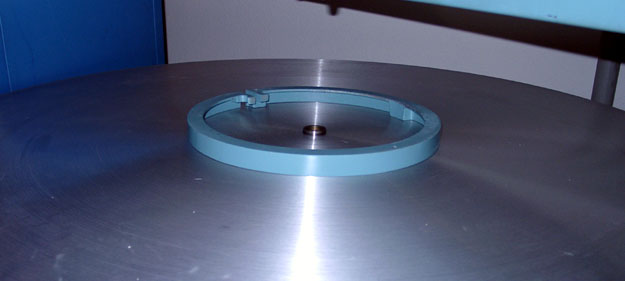
The standard Christie center ring.
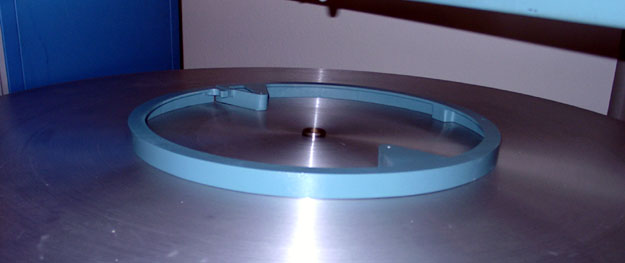
The new 19 inch Christie center ring.
Posted by David Whitbeck (Member # 894) on 06-30-2001, 03:56 AM:
I work at a 2 screen in which the entire booth is carpeted. Lately, we've been having static problems with only one of the two booths. Very strange and I've tried many different things in hopes of getting rid of the static. I hate it when the film sucks through the brain and jumps over one of the rollers on the outside of the brain. We use Strong platters and many of you seem to be using Christie. It's funny that you say the 19" ring is new because we've had those for our Strongs since before I even worked at the place and that was two years ago. Anyway, I have no idea where the static is coming from because it's quite nasty. We get the "bubbles" in the film and static from there. We use this Kinetronics StaticVac thing that seems to dust the film off just a little bit. We also have a swamp cooler in the vicinity but the static just won't go away. If anyone has some suggestions... And no, we don't have Film Guard, maybe someday. By the way, I do like my carpet, it's kinda cozy and definitely quiet.
Posted by John Pytlak (Member # 331) on 06-30-2001, 07:41 AM:
To Dave Whitbeck: Measure and compare the relative humidity of the booth having static problems to the one that does not. I suspect you will find a significant difference. In some cases, differences in the HVAC balance or in the heat load (smaller room, larger lamps) can cause significantly drier conditions.BTW, carpets do NOT affect static cling. As long as the platters are well grounded electrically, and the film surface has a "path to ground" through metal or conductive rollers, any static generated by walking across the carpet should not be an issue. But when you get shocks after walking across a carpet, it's usually a sign that the humidity is much too low.
------------------
John P. Pytlak, Senior Technical Specialist
Worldwide Technical Services, Entertainment Imaging
Eastman Kodak Company
Research Labs, Building 69, Room 7419
Rochester, New York, 14650-1922 USA
Tel: 716-477-5325 Cell: 716-781-4036 Fax: 716-722-7243
E-Mail: john.pytlak@kodak.com
Web site: http://www.kodak.com/go/motion