This is topic It went "Phfft!" in forum Film Handlers' Forum at Film-Tech Forum ARCHIVE.
To visit this topic, use this URL:
https://ft-forum.com/ft/cgi-bin/ubb/ultimatebb.cgi?ubb=get_topic;f=1;t=000287
Posted by Bruce McGee (Member # 131) on 10-06-1999, 09:42 AM:
Last night, I was running an older title on the Holmes. It was my first real audience. I had gotten up to the final reel where there is a big train crash. My Sony receiver crashed. Nothing was any louder than normal.I blew the pre-amp.
What do I need to get to reduce and properly EQ the solar cell output? I need to get it close to the impedance levels on the system.
I was running my amp with the bass "all the way down" and treble about normal. I am happy that I didn't ruin the amp. I thought I had blown the outputs.
For now, there is no sound. Should I give up and go back to a real PA amplifier? I've never designed anything to change the impedance on anything, so I dont know what to do here.
With all the incredible talent lurking all over this site, there has got to be someone that will tell me what to do next.
((Some of you have already told me what to do: buy a real projector!))
I hope that you folks can shed some light on this problem. I will have the receiver running in a day or two. I'll run the Holmes thru another old projector (Eiki) like I used to... Sucky sound!
Oh yeah...The Holmes is still forced to use the Eiki solar cell installed in the PE cell socket. It is going from there thru a small mixer to lower the level enough to not fry the Sony. The bass levels were very hot.
I tried a few days ago to make a cassette recording of a soundtrack so I could hear it later without the drone of the Holmes. The signal was very bass-heavy and low. I was obviously warned then that something was very wrong.
My brain must have skipped a groove. Too much film cleaner?
Thanks
Posted by Scott Norwood (Member # 30) on 10-06-1999, 11:23 AM:
A microphone preamp will work. I have an old Altec mixer/amp thing that was evidently designed for PA applications, but which will work fine with a standard solar cell. Just wire the red+green outputs from the solar cell to pin 2 of a standard XLR connector, and the black wire from the solar cell to pin 3. Connect the cable shield to a projector ground point. This works fine. If you want to get fancy, you can add an EQ box to simulate the proper "academy curve" and the high-end roll off point. Some Dolby manuals explain this better than I can. Basically, it's an early noise-reduction scheme that works pretty well, considering the primitive technology in use in the 1930s.
Or you could just get a real projector. <grin>
Posted by John Walsh (Member # 168) on 10-06-1999, 11:30 AM:
If you know the output impedence of the projector and the input impedence of the preamp, we can figure out a resistor network to match them. A better, but more expensive way it to use a transformer. I'm guessing, but it seems that the input level is to high, which could be solved with a simple attenuator.
Posted by Rick Long (Member # 213) on 10-06-1999, 12:03 PM:
To alleviate the heavy bass problem, try loading the cell with a 1K resistor (cell + to cell - ),typically red to black. This should reduce the gain somewhat as well.
BTW what input were you using on the Sony receiver?
Posted by Rick Long (Member # 213) on 10-06-1999, 12:26 PM:
If heavy bass is still a problem, try putting a capacitor in series with the hot lead coming from the cell. Somewhere between 0.01 uF and 0.22 uF oughta do it. Experiment until you get the balance you're happy with. Capacitor voltage rating at this point in the circuit should not be a problem.
Posted by Bruce McGee (Member # 131) on 10-06-1999, 12:50 PM:
I have a 1K resistor on hand. If that doesent work, I'll try the cap. I was using the AUX input. I have a nice 4/2 mixer to control the volume. It has to be the over-ripe bass level that is causing the blow-up.BTW: There is no standard on this Holmes for wiring. Red is hot (+) and black is negative/ground/frame ground. There are no voltage leaks anywhere. That was the first thought. I have the nice stereo cell that Brad sent me. I have not installed it yet. There is no where for it to go without stray light affecting it, for now.
Posted by David Koegel (Member # 25) on 10-06-1999, 01:48 PM:
Wow! I'm shocked <g> that the voltage was high enough out of the solar cell to fry the preamp. AUX inputs are typically good for around 1 volt. MIC inputs (which I'm using) are much lower, in the millivolt range, just like the PHONO input but without the added equalization. Furthermore, doesn't the Academy curve look similar to the RIAA curve, with the optical track having a boosted treble and suppressed bass (to prevent over modulation of the track) that is equalized in the preamp/processor?From what you are telling us, I think that it was "just time" for that receiver :-)
-- David Koegel
Posted by Brad Miller (Member # 2) on 10-06-1999, 02:40 PM:
How old is this Sony receiver? I too am shocked that the output from a solar cell could damage the "AUX" input! I could see perhaps if you were using the "PHONO" input...but the AUX??? I'm assuming you don't have any test eqiupment, so let's test this in a simple way. Get yourself a cassette or reel to reel deck. Hook up your cd player. Run some typical program material (not classical) into it in "record/pause" mode. Set your levels so the signal occasionally tips into the red.
Now, without touching those input recording levels, hook up your Holmes into this tape deck and play something such as a trailer (they're always recorded "hot"). Are the levels pinning the meter? If they are the same or lower, your Sony was ready to die anyway and the Holmes probably wasn't to blame. I'll bet you will find your levels won't even tip into the red, though.
Let us know. That's the simplest way I can think of to see what kind of output that Holmes is sending.
Posted by Joe Redifer (Member # 3) on 10-06-1999, 04:39 PM:
I've said it before and I'll say it again: Sony Sucks! Whether it is a $1 blank tape or a $10,000+ SDDS system, they are up to no good. Get a different brand of receiver.
Posted by Bruce McGee (Member # 131) on 10-06-1999, 05:49 PM:
I was shocked at Davids reply! <g>Actually, even though I have no meter for voltage checking, I have already done the Brad Miller approach. I tried a CD and the record levels. With the levels set at normal for CD's the film sound level was much hotter with bass.
I am sure that the Sony was not getting ready to die again, as the aux input was the only function that died. It's a 4 year old receiver, and other than the trouble that I posted here recently, I've had no problems. I ordered a pair of IC's today that will be here by Tuesday. These both carry the signal from aux in to the preamp input chips. (one each L & R)
My scope (which is junk) showed a signal coming in to each of the IC's and nothing coming out although all VCC voltage is normal. Anyway, the signal was not too hot because I had no problems with clipping, and distortion on high frequencies. I am going to try the resistor, and cap method and see what happens.
I should get a real projector and give up.
WHAT AM I SAYING? Holmes is GOOD.
Posted by Brad Miller (Member # 2) on 10-06-1999, 09:22 PM:
Out of curiosity, what is your exciter running at?
Posted by Martin Murray (Member # 162) on 10-07-1999, 01:08 AM:
Bruce, If you lower the voltage to your exciter bulb to around 3.5-4 volts it should cure most of your problem. I've set up several drive-ins in the Carolinas with stereo sound and have had to lower the voltage on every one to protect the car radios and speakers, most of them can't handle the hot bass. I also add a Techniques {sp} equalizer [available at Circuit City or your local pawn shop] in the solar cell line before the mixer/preamp this will let you cut some of the bass and also cut out any noise that needs to go. The same set up will work will work with mono, just use one side of the eq, I know because I did one drive-in that did not want to update the solar cell. I've done it several ways without using a processor and what you are doing is basicly the same thing. Just e-mail me if you have any questions driveinnc@webtv.net
Martin
Posted by David Koegel (Member # 25) on 10-07-1999, 09:39 AM:
Bruce: With your abilities to fix electronics at the board level, HOW CAN YOU NOT HAVE A VOLTMETER? I just got a steal of one on Yahoo auction, digital, for $17.50. Want one for Christmas :-)I wish you had one, 'cause I'd love to know what kind of voltage levels your solar cells are putting out. Sounds more like the higher voltage of a photocell -- ouch!
Posted by Bruce McGee (Member # 131) on 10-07-1999, 04:24 PM:
I have a B&K digital meter that has the worst 1 volt or less sensitivity that I have ever seen. I get no indications on the millivolt settings. The fuses are all good, and the meter has been to the service center once. There is no PE voltage on the Holmes, beause there is a solar cell that generates its own current, and there is no 90v potential. I have lowered the exciter voltage. Sound has less boom, but will try the resistor hopefully tonight, and the caps latER IF this doesent work. For now, the supply house had one IC for the Sony in stock. The other will be direct shipped to me in a day or so.
My roommate had a suggestion: static.
I dont think so, because there is a 3 prong plug grounding the case and gearcase together, and a wire grounding the amp to the projector in addition to the patch cables. The outlet is properly grounded, too.
This Sony has been trouble, but it was only poor soldering. These are the first new anythings I've bought for it. It has no problem pumping my speakers.
Posted by Rick Long (Member # 213) on 10-07-1999, 09:28 PM:
Bruce, as I understand it, you were running from the solar cell into the mixer and then, from the mixer output into the Sony receiver. Are you sure that the mixer didn't go "belly-up" causing the damage to the Sony? You might want to check the mixer out before re-connecting it to the receiver. Regarding the resistor and cap ideas, try the resistor first. If the bass is still to strong, leave the resistor in place (across the cell) and then put the cap from cell + to the input of the mixer. Wire the low or ground side as normal.
If the signal is still too strong, try using a voltage-divider network, consisting of two 470-ohm resistors in series across the cell. Pick off the line going to the mixer, from ground, and the junction of these two resistors. In other words total cell voltage appears across the combination of the two resistors. By picking your feed across one resistor, you are dropping your input signal voltage by 1/2. Clear as mud?
Just some clarification. Good luck.
Posted by Rick Long (Member # 213) on 10-07-1999, 10:14 PM:
BTW You've left me wondering, what was the feature you were showing the night the system (as well as the train) crashed; "Greatest Show on Earth"?, "Silver Streak"?, "The Fugitive"?, "Casandra Crossing"? ,"Lawrence of Arabia"?, "The Great Locomotive Chase"?
Posted by Bruce McGee (Member # 131) on 10-08-1999, 09:05 AM:
The 1K resistor may take care of most of the problem! I installed it, and tried it out with the spare amp just now. Now, I have the volume on the mixer turned up wide open with the amp set at just above half-full volume. Before, the mixer was set at about 6. With the exciter voltage cut, there is less bass thump, but I still have to keep the bass level all the way down. I will get the caps now and see what happens. I borrowed a decent meter last night to check for transient voltage. As I suspected, there is none, so this kills the bad ground theory. I still wonder about a static zap though. This system ran for several months daily with no problems. Dont want it to happen again. I thank everyone for your interest and opinions...Even you, David. <grin, hehe>Now, here is what I am up against. You "real" operators are going to think this is pure Rube Goldberg stuff. Go ahead and laugh. I do.
There was no amp / exciter supply for this machine when I got it. I found that the original exciter lamp is obsolete and expensive. I decided to go with what ever I could find around the house to get me running.
I am using a 1156LL auto-type bulb as the exciter. Has not burned out the first one yet. I am using a 3 amp regulated DC power supply that I made by copying one that a friend has. It runs the lamp at about 11 volts, now, as compared to 12.4 before this thread started. The lamp filament is aligned with the slit lens. I get a good white light at the slit with no yellow or bluish light. The beam is uniform across the slit. I check the lamp focus regularly, because of possible filament sag. No problem to date.
The solar cell is snatched from a junked Eiki. It is exactly 1 1/2" from the film surface installed inside the original PE cell enclosure. It is on a straight line from the filament, lens slit. I experimented until I got the sharpest sound by adjusting the cell angle while running a mono print over and over... It has several minutes of piano music in the reel...
I dont know if this is exactly the way to go with this, but I am at a loss because there is no place for me to install the cell that Brad sent me close enough to the slit opening to achieve real stereo (sort-of) without getting stray light. This was designed in the '40's and does not use a conventional sound drum.
Can I get a larger solar cell? The face of this one is just about 1/4" across. I've always thought that if I could shine the entire beam of light on the cell I might get better, more equalized sound.
Sorry if this is running on and on. I have never designed a system from scratch before.
I have a single 5000k SMPTE loop. My levels (read across speaker output) were set at the highest level that I could get while adjusting the slit focus. I think it sounds good. Beats 16mm to death.
I appreciate all of your opinions here.
Posted by Bruce McGee (Member # 131) on 10-08-1999, 06:44 PM:
It is finished. A friend donated an old graphic equalizer to the Holmes cause. Between the resistor, and the adjustments I made with the EQ, the controls are all set at normal. The spare amp sounds fine, and the excessive bass is under control. Maybe my Sony is not as well-built as a PA amp after all...Thanks guys for all the suggestions and solutions. I do appreciate it.
Bruce McGee
Posted by Gordon McLeod (Member # 33) on 10-08-1999, 07:23 PM:
for what it is worth
A solar cell is a current source device not a voltage source
The better preamps for solar cells use it in the current mode IE it runns into a shortcircuit
Bang and Olfsen discovered this fact back in the seventies and built a mag cartridge phono preamp around it
Kintek (even there mono preamps) PanaStereo, Eprad DSS(not the starscope) and a mono system that LP used to flog used this method
Posted by Pete Lawrence (Member # 130) on 10-08-1999, 08:07 PM:
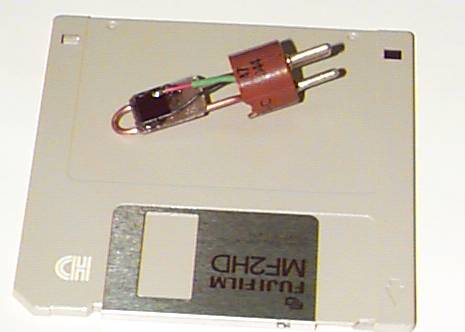
I am doing the same as you, building up the sound system from almost scratch. The only real difference is I am using DeVry XD machines instead of Holmes. You should pick a solar cell that is big enough to capture all the light from the exciter. This may complicate one of your problems and produce a higher signal voltage but I think it will improve the sound quality by reducing distortion. I rebuilt my old PE tubes into silicon solar cells. You can get the unmounted cells from www.digikey.com for a good price. The one I am using is a PDB-C609-2. Measures about .25" square and costs $7.75. They also sell a PDB-C613-2 that should be about .37" square for $11.00.
These are just square pieces of silicon wafer with leads that must be mounted to something. I used RTV and a small piece of circuit board. Then put the whole thing in the old photo tube base so it plugs in. Output goes to the resistor capacitor network that was previously described. I used 470 ohms across the cell, a series cap and a two resistor attenuator. The series capacitor is important in that it blocks the DC coming from the solar cell. It's less than a volt DC, but should be kept out of the preamp. I am going into a Shure mike mixer then an old transistor amplifier. There is no hum that I can detect, even with headphones. The exciter is an old 5 Volt regulated DC supply on a normally 6 volt exciter lamp. Sound is only mono but with really nice fidelity. There is no hope of converting this to stereo with just a change to a stereo cell. There would be no separation between the left and right channels. Which brings me to another project. Does anyone have one or two old used reverse scan pickups? They don't even have to work, I just need the optics.
If the UBB code works, below is a picture of the photo cell conversion.
Posted by Bruce McGee (Member # 131) on 10-08-1999, 09:47 PM:
I printed the last post to save the address. Your solar cell in a socket looks a hell of alot better than mine. The Eiki cell is still mounted on a piece of plastic with a hole thru it. It fits by friction on a sharpie pen barrel installed and glued into the tube socket base. I pre-wired the base with 2 copper insulated wires to carry the signal.
I understand the difference between current and voltage. I have never had the chance to work on a B&O anything, though I have seen many of them in use.It is amazing what you can come up with when you have to do it cheap. My first projector was almost a DeVry XD. I had no way to go get it in NJ at the time, so I let it go. The Holmes came from Virginia and it fell in my lap--sorta--after I dropped $$$ in the sellers hands. He got me exactly what I was looking for. fixer-upper. It has good steady sound, and a more stable image with the addition of a thin washer on the lateral guide above the gate.
Good luck with the XD. Can we see it?
Bruce
Posted by Tim Reed (Member # 137) on 10-10-1999, 02:40 PM:
When converting from phototubes to solar cells, don't forget to clip the 90V... just a thought.
Posted by Sheldon Harris (Member # 69) on 10-10-1999, 10:33 PM:
After reading all the above problems and seeing what you are going through, I consider myself very luckey. I purchased my 35mm Super Simplex with an RCA Soundhead which originally used a photo tube. The conversion consisted solely of a mono solar cell put in the place normally occupied by the photo tube. It was friction fitted into the tube's case using a wad of tissue paper behind it. When I purchased the unit no amps came along with the equipment. Finding two leads coming from the solar cell, I connected them to mic cable and ran it into the mic input of an old tape deck which has a volume control, from the tape deck output I split the line into a stereo equalizer.... from which one channel then goes to a mono amplifyer and to the center speaker, the other channel from the equalizer goes to an old Kenwood 4 channel receiver (remember SQ and Discrete in the 70's) and to the left and right front speakers and two rear speakers. I'll cut to the chase.... without any regard to matching impedances, using resistors, capacitors or whatever, I'm getting great sound, no hum and my audiences rave over it... luckey me.
Posted by Bruce McGee (Member # 131) on 10-12-1999, 06:51 PM:
Here is my last post on this subject. I got the 2 IC's installed in the Sony, it works again. I have just hooked it back up to the Holmes thru the new EQ, and resistor changes. I played a 35mm TV show that arrived today. Sounds fine. Made a cassette copy of the audio. It was fine also.
You guys have done it again! Thanks!
Bruce McGee
Posted by Geoffrey Weiss (Member # 882) on 06-06-2001, 10:35 AM:
You guys rock! I'm new to collecting and just acquired a Super Simplex w/ Simplex sh-1000 soundheads. I'm learning as I go and your conversion stories have given me beaucoup ideas.Can anyone recommend a basic electronics book that would bring me up to speed on the discussion in this thread? I've found several good websites and a couple of books, but I always like to use what worked for the experts.
Geoff Weiss
PS. Only a few weeks on the list and Brad Miller is my new hero!
Posted by Bill Langfield (Member # 818) on 06-06-2001, 11:12 AM:
Geoff,
Brad is my hero too.
But do yo have to say it out loud!!Bill.
Posted by Bruce McGee (Member # 131) on 06-06-2001, 03:32 PM:
Wow. This one again! I can say that the Sony has been returned to stereo use. For the first time it is hooked up as the center of the home entertainment system.
I went back to the Dynaco Stereo 70 and the Sony pre-amp, with the Realistic mixer and EQ.
Recently I finally had a chance to hear a film with the Holmes in a booth. I was horrified to find that the sound is not as fine as I thought. I think that the cell is being blinded by the excessive area of light on its surface. I should get a bigger cell, OR just go with the PE cell, and hook it to the Holmes amplifier that John Anastasio gave me.
The #2, and #3 Holmes... an 8, and an Educator... sound great with PE cells, and the original amp. Much better than I anticipated. I got these machines in the fall of 2000.