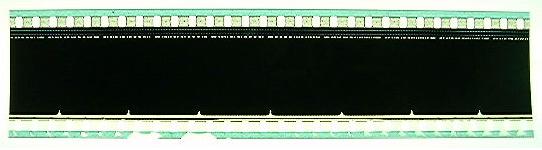
The interesting part of this is the damage looks physical, as under close observation, the scratching away of the track is clearly on the emulsion side. Most of it looks as if the track was "sprocketed". The print came from Deluxe Hollywood and was on dye washed Kodak 2383. Clearly, this does not play in SDDS. Of course, the DTS and SRD tracks are fine.
This isn't the best picture, but it's the best I could come up with. If someone knows a better way than to shoot this strip other than backlit, please let me know and I will reshoot it. This is also a fairly tame example of the missing data on the P track. During the reel, there are sections 2 inches long where the P track is clear.
Anyone care to hazard a guess as to what caused this?
Shitty-ass lab work, of course...The lab that printed that should be ashamed of the horrible job tey did with that print, be it SDDS or SRD or anything else.... that is just not acceptablr under normal conditions...
-Aaron
------------------
John Pytlak, Senior Technical Specialist
Worldwide Technical Services, Professional Motion Imaging
Research Labs, Building 69, Room 7419
Eastman Kodak Company
Rochester, NY 14650-1922 USA
Tel: 716-477-5325 Fax: 716-722-7243
I'll be glad to snatch a foot or so off of the leader and send you. Send me your shipping address to my email.
Also, I never said "all" reel 5s would be affected. However, since generelly the majority of all reel 5s would've been printed at the same time, there is a good chance there are more floating around out there. Heck, could be a bunch of reel 2s, but I doubt it. I'll bet the problem was corrected before another reel was put on the printer.

-Mike
But seriously, the labs have had the problems with Dolby digital too...who hasn't had a DD print where the the block moved into the perforation.
And to not leave DTS out...had the track printed a little off such that the LED starts blinking or with enough of of the track playing havoc with the Left optical channel.
Steve
------------------
"Old projectionists never die, they just changeover!"
------------------
"Young projectionists never miss a changeover, because they have platters!"
Thanks for sending the 6-frame clip of the damaged print leader to Kodak for analysis. I gave it to our experts in MicroAnalytical Services and here is their report:
"A short piece of 35mm processed film was received from the United Artists Galaxy Theatre in Dallas, TX. The film, SDDS soundtrack, used as leader, had been damaged along one edge, near the perforations. The customer wanted to know if the damage occurred pre- or post-processing. Photomicrographs were also requested".
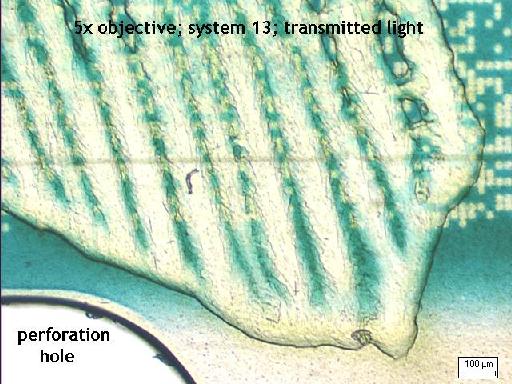
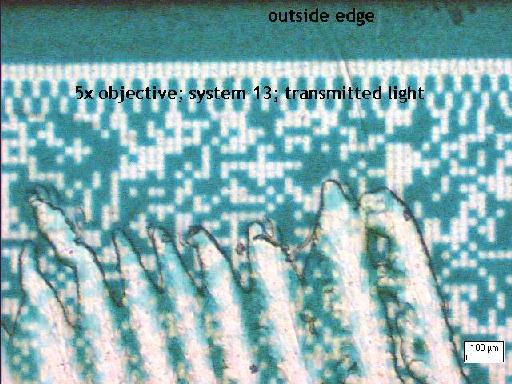
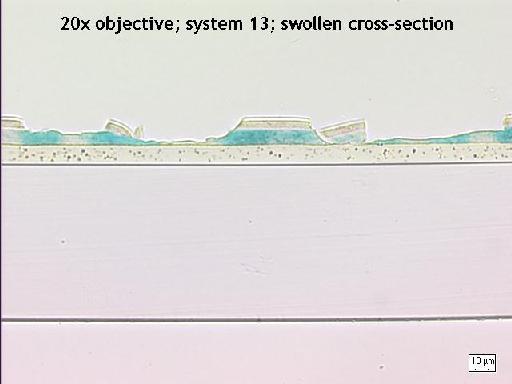
"Optical microscope examination of the damage revealed that most of the imperfections were closely associated with the perf holes and appeared as if they may have been generated by a sprocket. The imperfections, which looked like heavy scuff marks, were somewhat directional. The appeared to have come in from the outside edge of the film and dug in towards the perf holes. Cross-sections suggested that the damage most likely occured post-processing". Report dated 1/27/2000
I looked at the photomicrographs, and agree that the damage appears to have occurred after the print was processed. There are areas where chips of the magenta and cyan layers of emulsion with images of the SDDS bits have been peeled away from the film by the sideways scuffing action of sprocket teeth. Some chips were still attached to the film. I suspect that sometime after the lab processed the film, the film rode up off a sprocket, and was damaged by the teeth. It appears this type of damage would be an isolated incident that may have occured in the lab, or the exchange, or the theatre. From personal experience, I think the damage was done by a footage counter or syncronizer sprocket, since it is on unprojected leader.
------------------
John P. Pytlak, Senior Technical Specialist
Worldwide Technical Services, Professional Motion Imaging
Eastman Kodak Company
Research Labs, Building 69, Room 7419
Rochester, New York, 14650-1922 USA
Tel: 716-477-5325 Fax: 716-722-7243
E-Mail: john.pytlak@kodak.com
I think the reason is that we've stopped using it! 
Seriously... If a film comes in Quad-Trax and it goes into a mult-player house we play it in DTS. (Even if the manager says SDDS)
The only times we always play SDDS is in the houses that only have SDDS.
Anybody else notice that more and more prints are comming without SDDS tracks? (I hope the trend continues!)
------------------
John P. Pytlak, Senior Technical Specialist
Worldwide Technical Services, Professional Motion Imaging
Eastman Kodak Company
Research Labs, Building 69, Room 7419
Rochester, New York, 14650-1922 USA
Tel: 716-477-5325 Fax: 716-722-7243
E-Mail: john.pytlak@kodak.com
Thanks for being a frequent contributor on this forum. I, myself, mostly just lurk ... but someone's gotta do it Guess I'll never make it to "expert film handler" at this rate.....