
Anybody got any tips? Better yet, any pics of film cleaners on the platter?
The instruction sheet that came w/ the bracket is pretty straightforward but you know, there's always some finer points that can only be learned from experirnce...
Thanks!
Randy
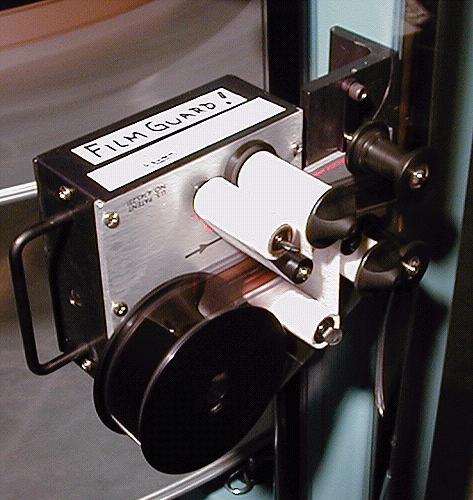
What about height? Just anywhere that gives a good film path? How much room does the film need to flex between the last stationary roller on the cleaner and the payout roller/caster at the top of the tree? I figure about a foot or so...
I plan to put it on the tree about even with the top platter (more or less) if I can get a good film path. If not, down near the bottom of the radical.
{When I train new people, I tell them that the film on the platter looks like a giant square root symbol (proper name is 'radical'), hence "down near the bottom of the radical" means the place where the film turns the corner then goes back up to the top of the tree and out to the proj.}
Any help from you guy's will be highly appreciated
It's not a very "clean" adaption. You can't close the magazine door with it on, and you must remove the "wedge" thing that tilts the magazine forward. (If you have either of these: If you are running platters, someone has probably already removed the doors, and the "wedge" thing was usually for use with carbon lamps.)
Also, Scott's right: there are four (metric, of course) bolts that are spaced much farther apart then the way American projector magazines are mounted.
I'm getting on my soapbox now, so you can stop reading if you want....
I feel that the design of the V8 magazines were (hardly anyone uses magazines today) much better than almost any other projector. They could hold an hour of film (a Century JJ could only hold a 40 min reel.) The sides of the magazines were part of the door, which moved out of the way when opened, so you could get your fingers around the reel. (Not so on a Century or a AAII.) The spindles (on 70mm models) had two "locks," one to hold a 35mm reel and another for 70mm. So, you didn't have to change spindles when going to/from 35/70. Although, this meant your house reels had to be 1/2" spindles (not a problem, they cost the same), and "Reel-A-Alarms" had to be custom mounted.
(And don't say, "1/2" spindles! You can't run the reel of the feature on ship out night right on to the shipping reel with 1/2" spindles!) The firetraps could also easily be changed for emulsion in or out winds. (A AAII could also, I know.)
OK, I'm getting down now.......
Works pretty good, too. We were able to clean the film four times this morning/afternoon. Once more for the screening and one for the "money show" will make six. Film is looking pretty good!
(With the cleaner mounted on the proj., we could only clean it two, maybe three times!)
Funny story: The guy who helped me mount the bracket took a look at the cleaner and said, "So, do you use any kind of 'solvent' on this?" I never mentioned FilmGuard! Guess that means that FG is kind of a 'natural'?
I use a reel arm for the upper reel, and yes the 4 holes on the top are very wide appart, not US standard i think.
I will just make my own mounting-plate then of some old iron and save 50$ 
Martin
With all the time and money spent on cleaning and taking care of these crummy movies, the question has been put to me, "Shouldn't somebody be paying you to do all this?" At first it was humorous. Then when the bill came, the question got serious! If you add it all up, including the cleaner, media, FilmGuard, installation labor and just the plain extra time the bill comes to over $800! For a poor little school like Mercyhurst, that's at least one, maybe two more movies we could have shown!
What are the 'parameters' of getting paid? Could we 'charge-back' the company?
Well, I'd probably have better luck if I wished for a pony, but at least I asked.
Those must've been emulsion side scratches originally. That's the "wet gate type" projection you're seeing there. 
Unfortunately, there is no real way to charge them to clean up their films. However, since the cleaner and bracket was a one time expense, cleaning in the future will be extremely inexpensive and as you have just learned, incredibly effortless! All you will need to buy when your supply runs out is another bottle of FilmGuard and another box of media pads. Not bad when you think about it to improve the quality of your presentation.
Yup, they were emulsion scratches. FilmGuard wasn't able to remove them completely. (At least in the number of times I ran the print) However, FilmGuard WAS able to minimize them to where they weren't noticible unless you looked for them in all but the brightest scenes. I'm guessing that when the film gets scratched like that, dirt gets down into the scratch and it takes a bunch of runs to get the dirt out of the scratch before the FULL effect is noticed. You CAN see that each run minimizes the scratch a little more. I dunno. Brad's the expert on this. That's just my observations.
Second...
People are getting SPOILED by FilmGuard. Get this... I was asked today NOT to FilmGuard the print on the screening so that people could see what a dirty print looks like! Since we started using it (September) EVERY single run of film through our proj. has had at least one run of F.G. Nobody but me and Mike, the Work Study student, have seen dirty film! I might do it just to show them the difference.
Since we got the second mounting bracket, cleaning film has been a LOT easier! We can double the number of cleanings the film gets. The picture looks even BETTER!
Using simplex xl's and also will be installing in another theater using cinemacannica's using the speco's as well.
------------------
"If it's not worth doing, I have allready been there and done it"