This is topic Rebuilding an RCA 1040 in forum Film Handlers' Forum at Film-Tech Forum ARCHIVE.
To visit this topic, use this URL:
https://ft-forum.com/ft/cgi-bin/ubb/ultimatebb.cgi?ubb=get_topic;f=1;t=000852
Posted by Harry Robinson (Member # 265) on 04-11-2000, 11:48 AM:
I am about to embark on an extensive maintenance project on ny 1040. I have a replacement rubber roller from Wolk (and boy was he proud of it!). The bearings seem fine. I'm going to soak them in oil.Also I'm going to take the drum out, put the shaft in a drill press and sand and polish it till it looks like new.
I'd like to remove the sprokets, etc., but I'm a little timid for that. My question is:
Can I take th whole mess and stick it in a galvanized washtub and spray the heck out of it with mineral spirits?
Is there any part of the mechanism I need to protect?
I'm having a hard time figuring out how to dimantle the drum, etc. Does the inside section of the devise come out with those three large screws, making the guts a little easier to access?
Do any of you guys have any other tips that might help me out?
Posted by Pete Lawrence (Member # 130) on 04-11-2000, 04:24 PM:
I'm also in the process of working over a pair of RCA 1040s, strictly as a hobby. Mine have a half inch of crud in all the impossible to reach places and assorted rust spots on the outside. In answer to your "can I spray the heck out of it" question, be careful. You don't want to get any cleaner or other liquid in the slit-lens optics. I'd be worried about just spraying the motor. Also, be careful of the rubber mounts that the sound optics and drum are supported by. They are oil resistant but I'm not sure about solvents. I'm doing it the hard way, complete disassembly, then clean it.
If you have worked on the rubber pressure roller you have already moved the slit lens to get roller assembly out. To remove the drum you'll have to remove the prism or photocell mount, if it was converted. Once the area around the drum is clear, remove the nut on the damping flywheel, remove the flywheel and the shaft will simply pull out. There is a steel tube in between the ball bearings of the drum shaft that may fall out of position. It can be coaxed back from the backside if necessary. Or simply remove the rear ball bearing then re-assemble it. Be sure to make some notes as to what went where as you disassemble things! The manual is available on this site.
So far, I have one of these monsters completely apart. I have found a few things that were obviously caused by someone not installing parts correctly in the past. I never would have found them if I hadn't taken it apart.
I'd be interested to know how much Wolk gets for the roller. Also, Brad has a "fix" so the roller isn't needed and no longer touches the image area on the film. I used a larger diameter rubber tube than he suggests (not all of us have spare Kelmar parts in our tool box), but it works fine.
This is a good time to ask if anyone has a spare drive gear to mate the 1040 to a simplex E7 head. I have the E7 parts but need the steel gear with the take-up pulley. Can anyone help?
I'm sure there are a couple guys here that rebuild these things. Anything else we should know?
Posted by Richard B. Perrine (Member # 409) on 04-11-2000, 05:43 PM:
I think I may have the metal main drive gear you need. It's for the E-7 head ....the one with the belt pully milled into it?
E-mail me .....RBPerrine@aol.com
Posted by Mark Gulbrandsen (Member # 72) on 04-11-2000, 06:43 PM:
Its best to do a complete disassembley on the thing to go through it and do a proper clean up. Thats also good time to check out the bronze gear, pinion, and bearings for wear. New gaskets are available from Wolk for re-assembley. If they seem shrunk when you get then soak themn in water and let them sit to dry overnight. They should fit fine then. Also install a new oil gauge if the old one shows signs of leaking. These can be made fairly oil tight if you do all this, but keep in mind that there will always be some seapage in the thing.
Mark
Posted by Bill Purdy (Member # 202) on 04-12-2000, 10:02 AM:
I would strongly recommend that you replace the bearings for the sound drum. They are very commonly available motor bearings and are easy to find at bearing suppliers for two or three dollars apiece. When you start taking the shaft out, you may be able to pull it out, but there is a good chance that the old oil has glued it in place. Please, please get yourself a six to eight inch piece of hardwood dowel to use in driving that shaft out. It is also a good idea to have someone to catch it when it suddenly comes loose and wants to fly across the room. Taking the lateral guide assembly apart on an RCA is quite a trick. There is a small retaining ring buried inside that you need to know about.
Also, when you polish the drum surface I would suggest that you use one of the rubberized abrasive pads that are around. Use a fine textured one so that you don't create surface that will scratch film.
I ran one of these under an E7 for years with good results even though the motor ran too hot to touch. Sorry, I don't have the gear you want.
One of my favorite methods for cleaning this sort of stuff is good old "Tide". Get the parts wet, sprinkle on the "Tide", wait 15 or 20 minutes, go over the nooks and crannies with a brush, and hose off. Put in a warm place so that they will dry quickly.
Have fun!
------------------
Bill Purdy
Comonent Engineering
Posted by Pete Lawrence (Member # 130) on 05-24-2000, 11:39 PM:
Well, it's been a very interesting project so far. I've completely rebuilt the RCA sound head. It was dis-assembled and repainted, but only required bearings, one bronze gear, and a few gaskets. The Simplex E7 sitting on top of it only required a real good cleaning and an oil change. Also, I did have to buy the drive gear that couples the two together. Two gears and the gaskets cost me more then both the sound and picture head, ouch! Thanks to Scott Norwood I now have a Simplex base. That's being repainted now. The last item I'm still lacking is the Simplex LL2 base to RCA 1040 bracket. But, I'm able to run loops with the machine "up on blocks." It purrs like a kitten. Next month I'll start cleaning up the second machine.That brings me to another question. Can anyone offer any tips on running test loops so they don't self-destruct in about 15 minutes? I want to do some scratch tests but it's hard to tell what's causing the scratches with the film rubbing on the castings. I know I need a couple more rollers.
Harry, how are you doing with your machine?
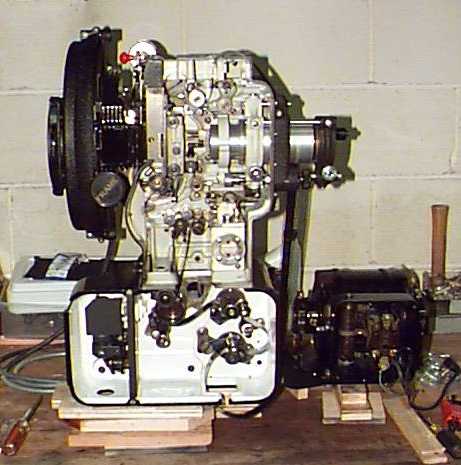
"A fifty year old Simplex is newer than a six month old VCR"
Posted by Brad Miller (Member # 2) on 05-25-2000, 02:54 AM:
I wouldn't worry too much about the scratching until you have the machine set up on a pedestal. Ideally, get yourself a set of platter guidance arms/rollers and just angle them specifically for running a loop. (Also, you might want to thread the soundhead so the film isn't dragging up against the front wall.  )
)
Posted by Bruce McGee (Member # 131) on 05-25-2000, 05:57 AM:
What a beautiful machine. You should be proud.Bruce
Posted by Scott Norwood (Member # 30) on 05-25-2000, 07:36 AM:
I will mention here that I'm looking for the same bracket that Pete needs. I have one "on loan" at the moment, but I'd really like to return it. If anyone out there has three of these for a not-terribly-outrageous price, please send two to him and one to me! Thanks.
Posted by Ken Layton (Member # 133) on 05-25-2000, 07:55 AM:
Pete:Boy that soundhead looks great! We are still using the 1050 soundhead at the Chehalis Theater.
Posted by Mark Gulbrandsen (Member # 72) on 05-25-2000, 08:14 AM:
Hey Peter,
Wolk may very well have the base adaptor you need. That is a fairly common adaptor. He used to have a huge pile of base adaptors of all kinds when he was on Wabash Ave. I assume he still has them at the new place too. Great job on the rebuild. I wish Harry would post some pictures too. Is your E-7 a verticle shaft version or Oblique? The oblique is not as common but is more collectible. I have an almost new E-7 oblique head that came from Detroit Edisons screening room in Detroit. Its in absolutley gorgeous condition and I'm not sure if I even want to run it. I think I'll just keep it in its basically unused condition. Have fun with your setup.
Mark
Posted by Harry Robinson (Member # 265) on 05-25-2000, 09:23 AM:
Great looking job Pete! Mine is still in pieces. I had to leave town for a couple of weeks (graduations and weddings). Now I'm going to set to it and put this thing back together. When I'm done I'll post a picture. Incidently, my son managed to adapt an old mounting bracket so it would work with the 1040 and my RCA base. He did it by redrilling the holes on the bottom, then widening the slots at the top. You have to use washers to hold everyting in place, but it's good until I find the true part.
Posted by Colin Wiseley (Member # 247) on 05-25-2000, 11:14 AM:
Great job Pete! Pretty soon I'm going to start rebuilding an old 1040 to use with a Super Simplex film head as a functional display unit in our lobby. Will it be possible to replace the gaskets and seal up the unit so it won't leak oil on the carpet? Who's a good source for parts? Thanks!PS - Anyone out there know if Super Simplex parts are available?
------------------
Colin Wiseley
Lyric Theatre
Blacksburg, VA www.thelyric.com
Posted by Mark Gulbrandsen (Member # 72) on 05-25-2000, 12:01 PM:
Colin,
We have quite a few parts that are new old stock. We even have a brand new LaVezzi intermittant rebuild kit for the movement. Wolk also still has most parts for them. Let me know what U need. 801-485-5012.
Mark@ GTS
Posted by Pete Lawrence (Member # 130) on 05-25-2000, 02:05 PM:
Thanks for the kind comments, it's been a lot of fun. And since I want to run changeovers, I get to do it all again on a second machine.  I still need a second base.
I'll try to answer the questions & comments in one post:
Brad,
"Also, you might want to thread the soundhead so the film isn't dragging up against the front wall." Ooh, that hurt. It just looks like it's hitting in the picture. I do agreee the loop is a little to big though.
Bruce,
How about some Holmes pictures?
Scott,
Thanks again for the base.
Mark,
I got the parts I needed from Edw. Wolk. Norm, the person there I talked to, was very helpful and was quoting part numbers for the 1040 from memory! Quite expensive though. I didn't ask him about the adapter as I didn't yet have the base. I'll ask him. This and the second good E7 and a third for parts are all oblique shaft machines.
Harry,
Looks like I'm slightly ahead of you, but not for long.
Colin,
The 1040 seems to be OK as to oil leaks, so far. The shafts are not "oil sealed" but do have splash shields on them and seem not to leak. The key is a new gasket for the gear box casting and the right oil level. I'm afraid the Super Simplex is designed to leak oil! On a regular Simplex head that came with my 1040's someone had installed a drip pan between the picture and sound head. It directs the oil to one corner where there was a small catch container. It's just a piece of sheet metal with the edges bent up. Looks like it might work, but your probably asking for trouble putting it directly on a carpet. Your also asking for trouble if your display machine is placed where the kids can get their fingers into it. They will!
Parts are available from Edw. Wolk and I believe from John Eickhof, although I haven't been able to catch up with John yet. Anyone know any other sources? See the Links and the For Sale forum for e-mail addresses and phone numbers, and manuals section for part numbers here.
Posted by Scott Norwood (Member # 30) on 05-25-2000, 02:19 PM:
For what it's worth, the AFI theatre in the Kennedy Center in DC has a pair of Super Simplexes with RCA soundheads and Peerless "F" lamphouses on display at the entrance door. That equipment is in beautiful condition (though not authentic...the soundheads have Kelmar solar cells in them). I wish that more theatres would put stuff like this on display rather than let it rust away in attics and basements.
Posted by Colin Wiseley (Member # 247) on 05-25-2000, 03:19 PM:
Pete, thanks for the advice. Your concerns are my concerns as well. My three mottos for this project (in order of importance) are:1) Make it safe.
2) Make it clean (No oil drips)
3) Make it work!
We've had the pedestal set up in the lobby with an old Peerless lamphouse for about a month now without any trouble. But I'll need to figure out a way to lock the doors on the film and sound heads once they're added. I even have a few ideas on how to make it project and produce sound!
------------------
Colin Wiseley
Lyric Theatre
Blacksburg, VA
www.thelyric.com
Posted by Jeff Stricker (Member # 224) on 05-25-2000, 04:59 PM:
Pete, that looks grea!!! If you had half the fun as I did restoring a Brenkert BX-40 and SH-1000 that I got from Mark G., then you had a ball!! This old stuff runs great and I figure will outlast me. Its real hoot to watch the reaction of your friends when you sit them in the couch (hand them a bowl of popcorn) and run some film. When I get started on my second Brenkert restoration this fall, I'll post some pictures.
Posted by Mark Gulbrandsen (Member # 72) on 05-25-2000, 06:00 PM:
Yea, Norm is amazing!! Charlie(excuse me, Don)couldn't last without him. He knows exactly whats in the place part for part. I'm sure he would have the adaptor.
Mark
Posted by Josh Jones (Member # 447) on 05-25-2000, 11:10 PM:
Harry,do yourself a favor. drain the oil from
the gearbox before you unscrew it from the chassis. I made this same mistake on a
1040 I am currently cleaning out.
ruined my pair of shorts and got the carpet dirty. oh well Life goes on.
P.s. oil goes through a super like water!
Good luck, and might I add, nice job on the paint Pete. what kinda paint did you use?
Josh
Posted by Harry Robinson (Member # 265) on 05-26-2000, 10:05 AM:
Josh,
I'm one step aheasd of ya'! I did drain the oil out of the gear box. Man, the crud inside that thing was revolting...all viscous and clotty-looking. I cleaned up all the gears with mineral spirits and was surprised to see they were made of beautiful brass and in mint condition. I got gaskets from Norm, bearings from the local dealer and a new roller from Jim Duncan in Decatur.
I went down to see Mr. Duncan a couple of months ago. I saw them rebuilding an old Century, and that's what inspired me to go all the way with the rebuild. Mr. Duncan is worth a whole thread...a very interesting guy.
The paint I used for the interior of my 1040 was epoxy enamel. The exterior is rustoleum black enamel. It looks great, and I think the epoxy stuff should last awhile. So far mine looks identical to Pete's. Again, when I'm done I'll post a picture.
Posted by Harry Robinson (Member # 265) on 06-19-2000, 09:45 PM:
Well, here I am three weeks later. I had to take 26 high school kids on a ten day choir tour on a bus, which delayed the final assembly of my 1040. Rookie that I am, I didn't realize that the constant speed sprocket gear inside the gearbox was thrashed. I thought it was supposed to look all flanged out. Well, I got the thing together and when I crank up the sound head (without the projector head mounted) it makes a certain amount of noise. Not a lot, but it's not the quiet purr Pete Lawrence describes. Will this trash the rest of the unit if I try to live with it, or should I bite the bullet and send all my money to Norm at Wolk? The replacement is around a hundred bucks.
Jim Duncan in Decatur says these things will sometimes burn in if you run them. I'm just afraid I'll start ruining the rest of the gears.
What do you guys think?
Posted by Dave Bird (Member # 490) on 06-20-2000, 07:31 AM:
I wonder, how have you applied the paint to the inside and outside of your machines? I have some work to do on a couple I have. How did you prep them? They can be very oilly from years in the booth.------------------
Dave Bird
Posted by Harry Robinson (Member # 265) on 06-20-2000, 04:00 PM:
Dave, I used mineral spirits to clean all the castings, then some grease-cutting contact cleaner. I sprayed white epoxy enamel (this is meant for appliances) on the inside and regular high-gloss Rustoleum black on the outside. The thing looks great. I'll shoot some pix once I get the whole thing together.
Posted by Dave Bird (Member # 490) on 06-20-2000, 04:08 PM:
Ok, yes, I know the stuff. It comes in little spray bombs. My wife once did a fabulous job on the old avocado cottage fridge with it. Stove looked great too, till she used it (didn't use high-heat stuff!!) I assume you masked the sprockets, or did you paint while disassembled? Thanks.
The XL's I have are the old familiar "pebbled
black" finish. Closest thing these days is powder-coat. So I'm torn what type of black to use. I know it'll take a real good cleansing, with the years of oil.
Posted by Ken Layton (Member # 133) on 06-20-2000, 04:24 PM:
Dave:
Use Zynolyte #1300 Black Wrinkle spray paint. It's tough as nails, covers many surface imperfections, and doesn't need a primer. It's what I used on my Brenkert BX-60 projector.
Posted by Gordon McLeod (Member # 33) on 06-20-2000, 05:58 PM:
Who makes that paint?
and where can you get it
Posted by Mark Gulbrandsen (Member # 72) on 06-20-2000, 06:53 PM:
In all my experiences with paint and projectors goes( I have refinished in excess of 200 machines) you should do only one of two things.1. The best and most durable finish is to powder coat. They do have black wrinlke powder coat if you've just gotta have it!! Just be sure to mask, and or plug all holes as powder coat has to be machined off once its baked on. There is no other easy way to remove it, it is literally bullitt proof!.
2. Grey Hammertone has always been my second choice. It does not hold dirt and oil and is extremely easy to clean up. Thats why most new machines have this finish. Keeping a black wrinkle finish looking clean and new over the years is a pain in the butt. Unless you are going for the original manufacturers look consider hammertone. It is the most practical. This can also be done by powder coating as well. Durable Coatings in Chicago makes a bake on industrial Hammertone thats hard to beat and when baked on has a glass like finish. Use an aircraft type oxide primer(greenish-yellow) on alumnium parts, and standard high quality primer on ferrous parts.
And almost lastly.....
Any paint is extremely dangerous, flammable and a health hazard. Use a respirator.....not just a paint mask or gas mask as these industrial finishes have chemicals that off the shelf paints do not contain and some cannot be filtered out by normal means.
Powder coating is really the safest way in this respect and the most environmentally friendly of the lot. I had my VistaVision projector powder coated and was very happy with the results.
Very Lastly........
Keep it all hidden from the EPA!
Good Luck!
Mark
Posted by Mark Gulbrandsen (Member # 72) on 06-20-2000, 06:57 PM:
In all my experiences with paint and projectors( I have refinished in excess of 200 machines) you should do only one of two things after stripping them or having them stripped to bare metal. Do not sandblast them!!!!!!! Dip stripping is the best way do handle castings that have to retain their built in precision machining. Super high pressure waater blasting sometimes works well too.1. The best and most durable finish is to powder coat. They do have black wrinkle powder coat if you've just gotta have it!! Just be sure to mask, and or plug all holes as powder coat has to be machined off once its baked on. There is no other easy way to remove it, it is literally bullitt proof!.
2. Grey Hammertone has always been my second choice. It does not hold dirt and oil and is extremely easy to clean up. Thats why most new machines have this finish(some are powder caoted Hammertone). Keeping a black wrinkle finish looking clean and new over the years is a pain in the butt. Unless you are going for the original manufacturers look consider hammertone. It is the most practical. This can also be done by powder coating as well. Durable Coatings in Chicago makes a bake on industrial Hammertone thats hard to beat and when baked on has a glass like finish. Use an aircraft type oxide primer(greenish-yellow) on alumnium parts, and standard high quality primer on ferrous parts.
And almost lastly.....
Any paint is extremely dangerous, flammable and a health hazard. Use a respirator.....not just a paint mask or gas mask as these industrial finishes have chemicals that off the shelf paints do not contain and some cannot be filtered out by normal means.
Powder coating is really the safest way in this respect and the most environmentally friendly of the lot. I had my VistaVision projector and several others powder coated and was very happy with the results.
Very Lastly........
Keep it all hidden from the EPA!
Good Luck!
Mark
Posted by Dave Bird (Member # 490) on 06-20-2000, 07:03 PM:
Mark, are you saying that you bake it (as in automotive paint booth)? What is the brand name of the powder coat wrinkle paint?Gordon, I looked up Zynolyte. It is a brand of ICI paints, which is carried by Glidden Paints up here in Canada. I've e-mailed them for details, wasn't able to find "wrinkle-paint", but I'm sure it's there. Barring that, I'll stop in at the local Glidden store and let you know.
------------------
Dave Bird
Posted by Ken Layton (Member # 133) on 06-20-2000, 11:26 PM:
The address for Zynolyte is:Zynolyte Products Company
2320 E. Dominguez St.
P.O. Box 6244
Carson, California 90749-6244
Phone: (310) 513-0700
Fax: 310-513-1593
The Zynolyte Black Wrinkle finish I got was stocked locally ON THE SHELF at my local paint store. When I used up their store stock, they gladly called Zynolyte and re-ordered more for me. It was only $5.00 per can list price!
The paint is called Black Wrinkle #1300 which carries a barcode # 36333 01300.
Posted by Mark Gulbrandsen (Member # 72) on 06-20-2000, 11:46 PM:
Dave,
Powder coating is not a do it at home type of process, nor was real wrinkle paint a home type of process. It takes special ovens, and special applicating equiment to do either. Commmercial powder coating shops that will do one up items are common in the states. Many race type cars use parts that are powder coated too. I think it cost me under 50.00 to have the Vista machine powdered in black. The Hammertone paint from Durable Coatings although a commercial finish, and pretty nasty  , can be applied at home but must be baked on to cure it. It takes months to air dry. I used to use a regular oven at 190 degrees for 30 min. Works great but just don't bake the chocolate chips at the same time!
Mark
Posted by Ken Layton (Member # 133) on 06-21-2000, 11:29 AM:
I got great results with the Zynolyte Black Wrinkle spray paint. In order to have the wrinkle finish come out properly, the paint and the item being painted should be between 80 and 90 degrees (F). All I had to do was set the projector outside on a nice hot sunny day (letting the sun bake it on) and in 4 hours it was ready to handle.There's a trick to making the wrinkle finish: first spray the paint in horizontal strokes, wait 3 minutes, spray again with vertical strokes, wait another 3 minutes, then finally spray in diagonal strokes with the spray paint. You won't be able to tell it wasn't done in a professional shop!
Posted by John Eickhof (Member # 323) on 06-24-2000, 12:13 AM:
Dave, you can still get 'Wrinkle finish' spray in cans from Eastwood Auto Acc. http://www.eastwoodcompany.com/cgi-bin/sgdynamo.exe?HTNAME=default2.htm
If you want to restore to the original type finish. There are also a few professional
paint shops around that will do wrinkle but
it is very expensive! Sherwin Williams also stocks wrinkle in cans in most store locations. Long live WRINKLE FINISH projectors! John