This is topic Unnecessary Bells & Whistles in the Booth? in forum Film Handlers' Forum at Film-Tech Forum ARCHIVE.
To visit this topic, use this URL:
https://ft-forum.com/ft/cgi-bin/ubb/ultimatebb.cgi?ubb=get_topic;f=1;t=000855
Posted by Alan Brandt (Member # 426) on 04-12-2000, 02:13 AM:
Does GCC still install unnecessary booth equipment at their new cinemas?  They used to have timers, remote switches from every possible location throughout the building, indicator lights everywhere, alarms, If they do...WHY?
  Don't they hire projectionists to do all that, or do they just hire m
  nkeys to thread and take the chance that all will be well when they remote-start the movie from 2 miles away?
Posted by Joe Redifer (Member # 3) on 04-12-2000, 02:36 AM:
I can't speak for GCC, but having status panels to indicate whether the movies are running or whatever in a large building is awfully nice. So are timers, if the projectionist is a good one. In my building, we have four booths and over 80,000 some odd square feet of space. Alarms are very nice, and in my opinion, an absolute necessity in a multiplex.We don't have any remote switches, but I could get a software package that would let me start, stop, adjust volume, or do anything else from my desk while I sit on my ass.
Posted by Brad Miller (Member # 2) on 04-12-2000, 02:51 AM:
It's not unnecessary in a multiplex. Even if there is a full time projectionist on duty, many booths today (and even older 6 plex GCC theaters) have their booths set up in different rooms or around corners and such where the projectionist cannot keep watch on every screen at the same time. Status panels and alarms are definitely not an unnecessary thing to have. Also, let's say you are running a 16 plex by yourself and have 5 prints to build up and a few to break down all in one 7 hour shift. Timers make that a reality. Timers are also a fantastic feature to have in a booth should the projectionist lose track of time for whatever reason as well as if a projector breaks down and the projectionist must attend to it...timers will keep the shows running.Such items are not money wasted by any means.
Posted by Mark Gulbrandsen (Member # 72) on 04-12-2000, 08:27 AM:
I've always thought that having some sort of steam whistle of large bell that goes off when the film breaks would be neat.
Actually I prefer to keep the booth as simple as possible. Timers are real nice in large theaters (6 or more screens) and a run indicator at the projectionists station or at the ticket box. Beyond that not much else really is needed. Anything else WILL just confuse a releif projectionist anyway.
Mark
Posted by Dave Williams (Member # 299) on 04-12-2000, 05:39 PM:
I myself have a bell and a whistle, but no one here knows how to ring or blow. And timers would be nice, or even alarm clocks, you know, to let me know when to wake up so I can turn the lights on.
------------------
"If it's not worth doing, I have allready been there and done it"
Posted by Dustin Mitchell (Member # 372) on 04-12-2000, 06:20 PM:
Timers would be nice, problem is certain projectors have 'little problems' that necessitate someone being there when it is started. Like malfunctioning dousers on our Christies. Some are either stuck up, or keep falling down, requiring them to be taped up. So unless you want that nice bright light on the screen (we use clear leader) you gotta be there to put down the hand douser.Oh, and before you guys start making suggestions to fix these like the helpful folks you are, we've had this problem for a while now and MTS can't figure out why they keep breaking.
Posted by Dwayne Caldwell (Member # 417) on 04-12-2000, 08:40 PM:
Personally, I think it'd be nice to have klaxons and sirens blazing in the booth if there's a problem. But that might be because I had a print dump its first fifteen minutes on the floor recently. Hadn't had that happen since I worked at AMC (gag here) almost two years ago.------------------
The man with the magic hands.
Posted by Joe Redifer (Member # 3) on 04-12-2000, 08:54 PM:
Dwayne- There will be alarms in your booth soon when a platter does not engage. In fact, it will be impossible to dump film onto the floor unless you personally hit the motor switch on purpose.Dustin-- Don't bitch at MTS about your Christie changeovers. Bitch at Christie. Try e-mailing:
engineering@christieinc.com
and tell them of your problems. Tell them that you expect the projectors to be functional! The Century 16 theatre out here has the same problem, and they are only a year old. They are still under warranty. Why they don't get them fixed or have Gary Stanley fix them is beyond me.
Posted by George Roher (Member # 91) on 04-12-2000, 09:28 PM:
Status boards and timers are not unnecessary extras in modern plexes. The most professional projectionist on earth can't be in two places at the same time. At the larger plexes where shows start every 5 to 10 minutes all day, and rat mazes of booths are all over the building, timers are essential if any print work is going to get done (unless multiple operators are on duty).
Posted by Andrew D'Vrey (Member # 285) on 04-12-2000, 10:42 PM:
I'm a GCC Monkey...just read the signature.We have a very large booth. Only 14 screens, but the distance between the two furthest projectors is greater than any in our area. Put it this way...management rides a bike between the two large booths.
We run one operator. It is impossible to watch all 14 screens at once. We need status indicators. There is also a status board in our lobby. It's nice when a customer asks, "Did the movie start yet?" you can look up and say yes and know it.
Failsafe, failed lamp ignition, failed vent, and tension alarms are very handy.
Timers are a luxury. But it certainly helps start pritns on time when management schedules opposite end simultaneous startup times. That and I like to timer ahead when I do Interlocks so I can maintain focus on that.
I don't have any more problems using timers than I do when I'm there to start. And in combination with alarms, it's rarely a big deal.
------------------
"And the monkey flips the switch."
- Major Don West, "Lost In Space"
Andrew D'Vrey
IATSE Local 219
Posted by Dwayne Caldwell (Member # 417) on 04-13-2000, 12:38 AM:
I hope you don't think I was being critical of the booth I'm working at now, Joe. I just think I'd be cool to have klaxons and sirens. Maybe even a voice that says "ALERT,ALERT" until you cancel the alarm.------------------
The man with the magic hands.
Posted by Joe Redifer (Member # 3) on 04-13-2000, 12:59 AM:
Actually what I want is for all the lights to go off in the booth. Then a bunch of strobe lights would come on and pulsate at independant intervals. There would be an audible siren and a female voice saying "Alert! Projector number 11 is down. Immediate attention required." At the downed projector would be bright, twirling lights. All that would be needed beyond that would be aliens crawling in the ceiling. That way the booth would feel just like a James Cameron movie.
Posted by Tim Reed (Member # 137) on 04-13-2000, 12:27 PM:
Guys: I vote for one that says, "(beeep, beeep) Climb! Climb!"------------------
Better Projection Pays!
Posted by Greg Anderson (Member # 235) on 04-13-2000, 04:49 PM:
Back when I was a teenage projectionist, I worked at a six-screen multiplex. I spent most of my time downstairs helping the ushers, but I was continually going upstairs to perform my other duties. Each time a film ended, I would first help the ushers clean garbage out of the auditorium. Next, I'd run upstairs and re-thread that particular projector. Then I'd come back downstairs to help the ushers. THEN, when it was time for the show to start, I'd go back upstairs and start it. And then, once I knew it was running okay, I'd go back downstairs and stand in the back of the auditorium for a minute to make sure the presentation was still good from the audience's perspective. If there was a problem, I'd make another trip upstairs. That was my typical mode of operation for all six auditoriums for eight hours a day, five days a week. Man I was in great shape back then! (The other guys would typically not go upstairs until it was time for the show to start, then they'd thread the machine and start it in just one trip.)If we'd had the automation which could start the projectors, even a meticulous guy like me could have saved at least one round trip upstairs per showing. (And imagine if I'd waited until TWO projectors needed to be re-threaded!) I could have really gotten a kick out of standing in the back of the auditorium, looking at my watch and then seeing the show start up all by itself. Cool! Then again, I can imagine myself going upstairs and standing next to the projector to watch it start up all by itself. It's more fun to stand behind a machine to make sure it's doing its job than to stand behind a person and make sure he's doing his job.
Efficiency doesn't mean the projectionist is lazy. And why should the sprinkler timer in my yard have more brains than the automation on your projector? No, I don't think any of this technology is unnecessary.
Posted by Alan Brandt (Member # 426) on 04-13-2000, 05:18 PM:
With experience in a 24 screen theater, I can honestly say that I have done it all by myself more than once.  It was at Cinemark Theatres Movies 24 in Houston, TX. It was a Thursday in July, and the other projectionist never showed for his shift. Because Cinemark is a cheap chain, they didn't call anybody else in. Cinemarks Policy is no alarms, no indicators, no timers, etc...just projectionist(s) on duty to run the booth. If there was other stuff to do, like build 5 prints, breakdown 3, and make up 18 different trailer packs, you just had to learn to budget your time, and wisely at that. Sure, all of those extra items would have been nice, but by no means were they "necessary". Anyone who has ever worked for a Cinemark can vouch for this. Their corporate policy is any theatre 12 screens or less is to be manned by no more than one (1) projectionist, with the only exception being a Thursday night and/or Friday morning for obvious reasons. Anyone who has ever worked for Cinemark can support the fact that one doesn't need all those gadgets in a piddly 6 screen ...regardless of how many walls there are. How long does it actually take to walk the booth of a 6, 8, 10,or 12 screen theater? From 30 to 60 seconds? With this in mind, that is why I don't see the logic with those items in a booth. .. ESPECIALLY ANY cinema with fewer than 12 or 14 screens. A projectionist (without the aid of alarms and such) was able to find a problem quickly in the booth because he was doing his job as opposed to running the booth like Homer Simpson runs the Nuclear Power Plant.
Posted by Greg Anderson (Member # 235) on 04-13-2000, 06:02 PM:
...and how much did they pay you to run yourself ragged on that Thursday in July? For the money they save by overworking and underpaying a guy like you, they could certainly afford to buy some automation to assist you, I would think.
Posted by Dwayne Caldwell (Member # 417) on 04-13-2000, 07:09 PM:
I'd like to go with the James Cameron automation myself. Hey, at what point does a movie theatre become a megaplex? Is there a minimal number involved? Would a ten screen be considered a megaplex while a nine screen is just your standard theatre? Or does it have to have at least fifteen screens to qualify for the title? Just curious.------------------
The man with the magic hands.
Posted by Scott Norwood (Member # 30) on 04-13-2000, 07:57 PM:
I just can't imagine how it would be possible to do a genuinely good job while running a 24-plex by oneself without start timers or alarm panels. Sure, it can probably be done, but I doubt that the results are consistent.
Yes, I suffered through one night at a single-screen all by myself (doing everything including tickets, popcorn, and projection) with no platters or automation of any kind, but I sure wouldn't want to do it again and there's no way that anyone could do this consistently.
Besides, many medium-size multiplexes have multiple booths, which pretty much necessitates alarm panels, since it's impossible to hear the sound of gears being stripped while the projectionist is two booths away doing threadups.
Posted by Alan Brandt (Member # 426) on 04-14-2000, 01:28 AM:
Well, as I said before, although I've done it all more than once, it was a good thing that it wasn't a standard way of doing things. At least with that many screens to run, they were pretty good about making sure there was more than just one or two people scheduled to work the whole booth. However on occasion, there were the typical no-shows...who were consequently never permitted in the booth again, although they were offered positions as floor staff. The theory behind that was simply the fact that they were not dependable enough to work the booth where time is of great importance. Most Cinemarks to my knowledge only contain one booth level unless they are fitted stadium seating. In that case there were different levels, but again, the number of projectionists to run the booth was appropriated for the size and type of booth. (Ex: A 16 screen all stadium would typically have 3 projectionists. Two, just because it was more than 12 screens, plus one more because it would be a multi-level booth.) Unless the booth was not taken care of very well, with that many projectionists, even in the 24 screen, there was plenty of time to thread, start, build, break, and even tend to "issues" when they arose. Dwayne:
As far as what determines a "Megaplex"...Although I'm not sure this is standard, but I have always considered more than 12 screens to have that title. Meaning 12 or under is simply a "12 screen" or "8 screen", or whatever, whereas a 17 screen (which Cinemark apparently thinks is funny to have pioneered the concept of an ODD number of screens)... ...would be a 17-plex, or the aforementioned "megaplex". But that's all just my opinion.
Posted by Jason Burroughs (Member # 68) on 04-14-2000, 01:52 PM:
Scott,Speaking from experience when I was running the booth at the AMC Grand 24 here in Dallas shrotly after it opened, it IS possible to run 24 screens with one operator, and no timers, successfully, but it IS difficult. I acutally had less probems running the booth by myself then when splitting the booth amongst other operators. Shows were started every 5 minutes, and on one house the automation did not work, and had to be run manually. Let me tell ya, by the end of the shift I was dog tired. Fortunatly I only had to do that a few times.
Posted by Randy Stankey (Member # 64) on 04-14-2000, 02:12 PM:
I work at Cinemark, and I do have to say that timers and status boards would be nice but they're not necessary at all. Anybody out there who's at all competent can run a big booth like ours. (17 screens) It's not that big of a deal.I WOULD like to have the ability to put the projectors on timers, though. As was said earlier, budgeting time is a big priority on build-up day! In fact, that's the number one thing I get hollered at for. Usually I'm in one place changing trailers or building up when I realize I'm supposed to start a proj.
On the other hand, having timers would just encourage some lazy people to get even lazier.
Posted by John Walsh (Member # 168) on 04-14-2000, 02:38 PM:
Jason is right; In days of yore, I would not allow anymore than 3 regular operators at a theater at one time. Just too hard to keep everyone on the same page. Also, you get to know the other guy, (and he knows you) so you do a better job. You know they will find out soon if you are a screw-up. Sort of the same concept of there always being at least two people to count money.An "Unnecessary Bells & Whistles" story:
A place I worked had a Rank automation (the one with pins.) Like any automation, there were relay contacts to hook up an audible alarm to sound if the film broke. (Actually, the Rank also would sound the alarm if the lamp went out, which was nice.)
No remote panel was used/installed, because there was only one booth. It was only about a 20ft by 15ft area.
The installer hooked up a 12VDC "Sonalert" to sound on failsafe. It was really loud. Since every new installation has some problems at first, it went off for one reason or another a few times.
I got annoyed, and disconnected it. The installer came back (for other stuff) and re-connected it. I disconnected it again.
He made a scene in front of my boss. I said; What good does it do? I can't get far enough away from the projectors to not know something is wrong. Who wants to listen to that thing while you're trying to fix a problem. He sort of pulled rank, and connected it again. About a week later, I removed it, hooked it up to 110VAC, baked it to well-done, then put it back in.
Posted by Joe Redifer (Member # 3) on 04-14-2000, 03:36 PM:
Come work in my booth about 3 months ago. Christie and Pennywise made a very embarrassing faux pas with their CA21 automation. It would not detect the failsafes. So you could be in another booth threading and a film starts on the other side and the platter fails. The projector just stops. No alarm. And sometimes the projector doesn't even stop... it would continue to dump film onto the floor! You can't be everywhere at once. How would you handle that, Alan? I guess we're too stupid since we need reliable automation, eh?
Posted by Brad Miller (Member # 2) on 04-14-2000, 03:51 PM:
Look familiar Joe? 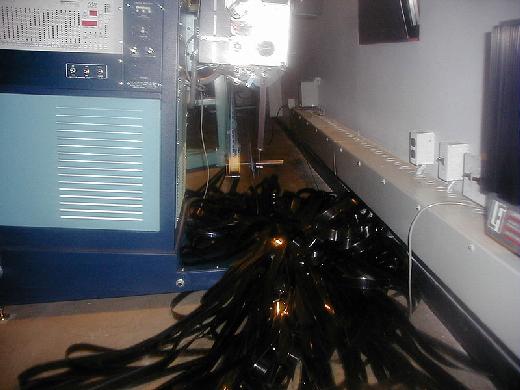
Now who was it that was saying such items as failsafes and status panels were unnecessary???
Posted by Chris Erwin (Member # 176) on 04-16-2000, 09:50 AM:
For a big multi, wouldn't be cool to rig an alarm to a pager the head projectionist could wear. Something like...BEEP...
PROJECTOR 2,FAULT 2
on a alphanumeric pager. That way if it's something major,the head proj. can go to it or let the others handle it.
I like toys...
--Chris
Posted by Gordon McLeod (Member # 33) on 04-16-2000, 10:21 AM:
RGM made a pager type alarm system but I don't think it ever got off the ground
Posted by Brad Miller (Member # 2) on 04-16-2000, 05:12 PM:
VERY cool! A pager!!! That would be great for when the operator is walking the theaters for quality control.
Posted by Gordon McLeod (Member # 33) on 04-16-2000, 05:20 PM:
I new one theatre that the operator wired his own remote into the nextdoor pub
Posted by John Walsh (Member # 168) on 04-16-2000, 09:09 PM:
Remember that guy Drew Kaplan and "DAK" catalogs? He sold a watch with two buttons on it that used RF to throw a remote relay. I hooked it up to start the show. Cool toy, but it broke about 1 month after I got it. It was cheap, anyway, but still it was fun.
Posted by Brad Miller (Member # 2) on 04-16-2000, 09:38 PM:
haha I had forgotten about Mr. Drew Alan Kaplan! Lots of neat toys in his catalog. Ashamed the quality of them was always crap.You can do the same thing today with the X-10 modular controllers, but with reliability. Remote clock timers preset for the entire week, remote starts, wireless remote controls...it can do it all for the rigging oriented. 