This is topic Anyone ever seen a XeTron Loop-Matic? in forum Film Handlers' Forum at Film-Tech Forum ARCHIVE.
To visit this topic, use this URL:
https://ft-forum.com/ft/cgi-bin/ubb/ultimatebb.cgi?ubb=get_topic;f=1;t=001006
Posted by Tim Reed (Member # 137) on 05-20-2000, 09:51 AM:
Anyone ever see a Loop-Matic, or have a book on one? This was the bifilar-wound continuous loop system. Very impressive, but I've heard they were too complicated for lowly button-pushers to build prints onto.It was two vertical, open-style reels, placed in the same position as you'd locate a platter. The print was double-wound back on itself, on a reel (like you'd roll-up a sound loop, without breaking the splice apart). One side of the loop fed directly down to the takeup reel and the front half through the machine. Half way through the film, some arms would trip, which would reverse the direction of the reels, and reattach the film to the (now) empty supply reel. Then the second-half of the program finished and the process repeated at the end/beginning of the show. All this time, the projector ran continuously, with no interruption. It was pretty fantastic, from all accounts. I'd love to have seen one in action!
I only had a sales sheet on one of these things, but it looked like it'd be the only continuous loop system that would work.
Any war stories?
------------------
Better Projection Pays!
Posted by Brad Miller (Member # 2) on 05-20-2000, 02:02 PM:
Is there a picture of that on your sales sheet I could post to this thread? I'm not 100% understanding the principle of the machine here.
Posted by Russ Kress (Member # 461) on 05-20-2000, 02:43 PM:
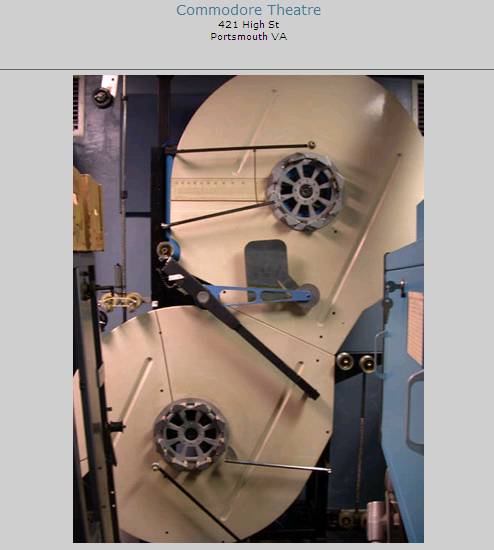
I believe I was shown one on these once during a tour of The Commodore Dinner Theatre in Portsmouth, VA, but it has been awhile.Russ
Posted by Ken Layton (Member # 133) on 05-20-2000, 03:28 PM:
I would like to see a picture of it, too.
Posted by John Walsh (Member # 168) on 05-20-2000, 04:09 PM:
Is that the thing with a whole bunch of rollers arranged around (what looks like) the top of a platter deck?
Posted by Gordon McLeod (Member # 33) on 05-20-2000, 05:12 PM:
I think that was the Potts endless loop disaster
Posted by Tim Reed (Member # 137) on 05-20-2000, 10:06 PM:
I wish I still had the sheet, it had a beautiful picture of both sides of the unit. XeTron (Carbons, Inc.) used to advertise the heck out of it in the early 70s, in Boxoffice. I fell in love with it, but never got to see one.It does not resemble a platter in the least and, Brad, I did not fully understand the operation either, until I took 20-30 ft of film, spliced it in a loop and "tested" it on the bench. It's one of those things that's brilliantly simple. It would even work without fail using the polyester film because, in that respect, it'd be like running it on reels.
I did learn that, in order to make-up a print, you first must measure each reel out to the foot. The makeup section holds TWO exchange reels. When you calculate the EXACT center of the movie, begin the makeup there, forming a loop, which is inserted in the center hub of the Loop-Matic reel. Whenever a head or tail is reached, stop and splice the next reel and proceed. You're actually winding onto the Loop-Matic TWO lengths of film, from two different shipping reels, at once. When you're all done, you end-up with the head of reel one and the tail of the last reel, which you then splice together and thread through the machine. Then you're done until the next change of bill.
------------------
Better Projection Pays!
Posted by Scott Norwood (Member # 30) on 05-20-2000, 10:54 PM:
Yes, I believe that the Commodore Theatre (Portsmouth, VA.) still has one of these, although they were using giant Cinerama-size reels and a separate reel-handling unit (which sat behind the Cinemeccanica V8) when I was last there.
Apparently, the disadvantage of the Loop-Matic system was that you could only run one film at any given time and that film changes would be cumbersome at best. Interesting idea, though...
Posted by Christos Mitsakis (Member # 143) on 05-21-2000, 02:44 AM:
Since I haven't figured out yet how to put images in these posts I sent a scan of the Loopmatic principle to Brad in order to post it here.
It is a scan from SMTE journal Dec 1976
form Bernard Happe presentation of Photokina 76.
I hope you will find it enlighting.I haven't seen one for real but I belive making up a print for
the loopmatic seems to be time consuming.
Christos.
Posted by Tim Reed (Member # 137) on 05-21-2000, 10:23 AM:
TERRIFIC! Thanks for the info, Christos, I can't wait to see it! Agreed, Scott. It probably wouldn't be a good idea in this day and age, where managers like to play "musical auditoriums" with the prints. But in the late 60s/early 70s, prints would stay for months (or years) sometimes.
Of everything I've read about this device (several manufacturers abroad had their own versions), it seems to have Russian origins. Last I heard, it was still used extensively over there.
Bring on the diagrams! 
------------------
Better Projection Pays!
Posted by Brad Miller (Member # 2) on 05-21-2000, 02:13 PM:
Christos,F.Y.I. I have not yet received an email with the scan as of yet. Please check the address and send again. Thanks.
Flix@film-tech.com
Posted by John Walsh (Member # 168) on 05-21-2000, 07:41 PM:
Yeah, I also was interested in this thing. At first I thought it was some platter-like thing I saw many years ago at a SMPTE convention, but that was from Potts (and another tip o' the hat to Gordon's great memory!)Anyway, when Christos mentioned the SMPTE journal it is shown in, I looked it up. It says that it was just distributed by Xetron (then Carbons, Inc.) It was made by Famco AG of Vaduz, Leichtenstein.
"The principle is known as bi-filar winding, the looped film being wound as a double-layer spiral on one spool."
When the drawing is posted, it's easy to see how it works. It is pretty cool.
The article also shows two pictures of projectors with platters mounted directly under the lamp. One was a Philips Kinton FP30, and the other was a Bauer U6.
Posted by Tim Reed (Member # 137) on 05-22-2000, 07:37 PM:
Thanks John for the info!------------------
Better Projection Pays!
Posted by Brad Miller (Member # 2) on 05-23-2000, 05:18 AM:
Here it is. 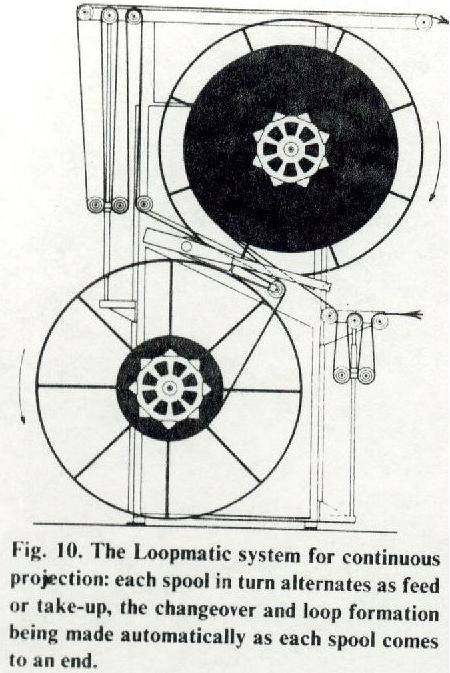
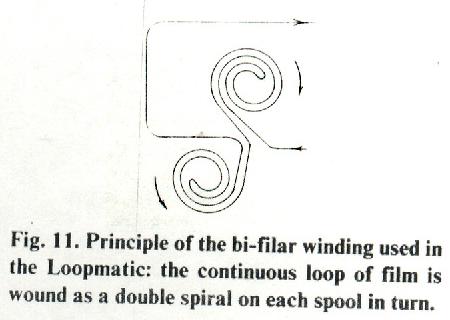
Posted by Tim Reed (Member # 137) on 05-24-2000, 09:53 PM:
Beautiful, isn't it?Brad: did you get any other pictures? This says Fig. 10 and 11, like there's at least nine more... I'd like to see how the reel-reversals takes place.
------------------
Better Projection Pays!
Posted by John Walsh (Member # 168) on 05-24-2000, 10:46 PM:
The article was really about the "Photokina" trade show in Cologne in 1976. The other figures (Fig. 1-9) show other equipment exhibited there- there are no more pictures relating to the "Loop-Matic."The description is as follows:
<Note: Copied from the Journal of the Society of Motion Picture and Television Engineers- Vol. 85, No. 12 (Dec. 1976) pp. 895>
"Long-Run Projection
All 35mm theater projectors at Photokina show the demand for long-running program presentation and all accomodate spools of at least 2000-m (6500-ft) capacity. Some, like the Ernemann 12, can take 4000-m (13,000-ft) spools with both feed and take-up set below the main projector body, but in most cases spools larger than about 2700 m (8860 ft) are handled by separate freestanding units. The long-play "tower," with a pair of large reels having separate take-up drive and tension control, usually takes up to 4000-m (13,000-ft) spools; units of this type are offered by Ernemann, Hasso, Wassermann (Madrid) and Weston. The Weston 5035 assembly is double-sided and mounted on a turntable, so that one 2 1/2-h program can be assembled or rewound while the other is being projected. For even longer lengths the horizontal turntable system which avoids rewinding ("platter" or "cakestand") was shown in its freestanding form as the Christie Autowind, the Zeiss Ikon Ernowind, and the Philips Kinoton Disc. A four-plate version was shown by both Christie and Philips for feeding two projectors simultaneously where one projection box serves two auditoria in a twinned theater. A horizontal feed and take-up system for up to 6000 m (20,000 ft) but requiring rewinding between showing is available as part of the Bauer U6 projector (Fig. 9). All these long-run facilities have been in use for several years but a significantly new approach was provided by the Loopmatic system (Fig. 10) manufactured by Famco AG of Vaduz, Leichtenstein (represented in the U.S. by Carbon Inc. of Cedar Knolls, New Jersey). This accommodates up to 18,500 ft (5640 m) of 35mm film as an endless loop, so that uninterrupted presentation is possible for as long as is required. The principle is known as bi-filar winding, the looped film being wound as a double-layer spiral on one spool. When feeding off, one of the two strands passes to the projector while the other goes to a take-up reel, where it is similarly wound as a double layer with the strand coming from the projector (Fig. 11). When the first spool is empty, half-way through the loop length, the second spool becomes the feed and the first the take-up, the changeover from one to the other, the re-formation of the double path and the reversal of the direction of rotation all being completely automatic. Monkey elevators before and after the projector function during the brief period while moving arms transfer the take-up and allow continuous projection at all times. A prototype bi-filar system for a similar purpose was also being demonstrated at Photokina by the projector manufacturer Auvitel of Boulogne."
Posted by Christos Mitsakis (Member # 143) on 05-25-2000, 03:20 AM:
John is right (and faster than me on the reply - we have a time difference of almost 10 hours though).He also seems to be a quick typist 
Regards from Greece.
Posted by Tim Reed (Member # 137) on 05-25-2000, 06:37 AM:
Thanks to all, it's much appreciated!------------------
Better Projection Pays!
Posted by John Walsh (Member # 168) on 05-25-2000, 08:08 AM:
Christos:I'm a lousy typist, with a good OCR scanning program! If I really typed all of that myself, I'd need more than 10 hours!
Posted by Steve Kraus (Member # 476) on 05-25-2000, 11:51 AM:
That clearly doesn't tell the whole story. So far we've got:1. Bifilar winding
2. One film over to projector and back to
takeup while other goes direct.
3. Reel reversal at end.
4. Elevators to cover the period during
reversal.
What we are missing is what happens during the flip flop. I've never seen one so I can only go by the general descriptions I've heard but apparently the film goes around a roller at the hub of the reel (this instead of conventional attachment) and this little roller pops out at the end while another one is put in to make the feed the take up. Or something like that. The basics can be worked out, as others have said, with a loop of scrap film. But the direction change, aye that's where the magic is and I'd love to get a clear explanation.
Posted by Tim Reed (Member # 137) on 05-25-2000, 12:30 PM:
Steve: what I've gathered over the years of being a fan of this contraption, is each space in the hubs of the reels, is a rather large opening. There are two arms in the center of the frame, one is a roller, and the other is an arm with a protruding pin. Somehow, the roller arm drops (or rises, as the case may be) and the pin-arm follows, to shove the end of the film/loop into one of the hub openings. As the reel winds back on itself, it is held in place.At least, that's what I've deduced over the years. I'd purely LOVE to see one in operation. I remember reading an old BOXOFFICE article about a trade show demo. They said you could hear everyone holding their collective breath, as the reels came to a stop, the film transferred, and the reels reversed direction; all the while the projector cranked away. It was an amusing read.
It would indeed be a hoot to see this occur.
------------------
Better Projection Pays!
Posted by John Walsh (Member # 168) on 05-25-2000, 03:01 PM:
Nuemade bought Xetron, and moved to Newtown, CT. which is about 10 min. away from where I work. I would call them and ask if they had more pictures, or a copy of the Loop-Matic instruction manual, etc., but I am reluctant. I've called four times for an instruction manual for a rewind table they currently make, and while everyone there is "happy-happy-joy-joy" no manual is ever sent. A few key people left there and started Big-Sky, and now I think Nuemade/Xetron is in some kind of disarray. Too bad, because I think they make good stuff.They probably don't even have a copy of it anymore.
Posted by Steve Kraus (Member # 476) on 05-25-2000, 09:08 PM:
While I think the regular loop systems (Christie or Potts) are awful because the film rubs on itself as it gets pushed inward * the Loopmatic idea is extremely interesting. Maybe not so good for normal theatrical usage if it's so hard to change trailers but for museums and special venues. This seems like it would be as easy on film as Disney or CFS/Rentec film roller cabinet.How about an IMAX version? Put an end to rethreading every half hour.
*-I have always thought that special film stock could be made for the platter style loops with raised embossed edges that keep the film layers from touching as they rub.
Posted by John Pytlak (Member # 331) on 05-26-2000, 05:25 AM:
Steve:
Unlikely to have a special film stock made, as Kodak color print film is coated in wide rolls, and slit to 38 35mm strips. So it's all the same thickness across the strips. But could you consider coating a narrow strip of material (e.g., 3M Scotchgard Film Protector, AKA "PhotoGard") along the edges after processing?Continuous loop platters are often problematic, especially when the temperature and humidity can't be controlled precisely.
------------------
John P. Pytlak, Senior Technical Specialist
Worldwide Technical Services, Entertainment Imaging
Eastman Kodak Company
Research Labs, Building 69, Room 7419
Rochester, New York, 14650-1922 USA
Tel: 716-477-5325 Fax: 716-722-7243
E-Mail: john.pytlak@kodak.com
Posted by Steve Kraus (Member # 476) on 05-26-2000, 10:50 AM:
Yeah, I know about the wide rolls; I was thinking in terms of some sort of thermal embossing to create a raised edge after the film is slit or perforated. Maybe even after the print is made. Or raised striping of some sort applied ala mag tracks--ideally something with a low coefficient of friction. I'm amazed that those loops can work without ruining the print with scratching as it is. Anyone know how widespread they are? I know the owner of the Classic Cinemas chain near Chicago was as fond of them as he was unfond of projectionists. Of course he was the one who got stuck with the one-armed 70mm operator.
Posted by John Pytlak (Member # 331) on 05-26-2000, 11:48 AM:
The Technicolor Super-8 cartridge projector (e.g., the one used by TransCom on airplanes in the 1970's) used a special film lubricant on the continuous loop to allow the film to slide with minimal friction and scratching. The lube was called "VYDAX", and was evidently tiny spherical beads of TEFLON applied to the film using a solvent. The VYDAX acted as tiny "ball bearings" to lubricate the print.IMHO, that cumbersome system seemed to be more reliable than some of the video systems now in use on planes, and could give much better image quality using a Super-8 feature-length print with dye track optical sound.
BTW, does anyone recall the early days of "InFlight" motion pictures, where a single polyester 16mm print was strung through multiple projectors over the length of a Boeing 707 cabin? And you had to choose the correct audio channel that was in sync with the projector you were watching?
------------------
John P. Pytlak, Senior Technical Specialist
Worldwide Technical Services, Entertainment Imaging
Eastman Kodak Company
Research Labs, Building 69, Room 7419
Rochester, New York, 14650-1922 USA
Tel: 716-477-5325 Fax: 716-722-7243
E-Mail: john.pytlak@kodak.com
Posted by Tim Reed (Member # 137) on 05-26-2000, 12:23 PM:
John, I was just talking to a fellow in Orlando last week, who used to service these. Pretty impressive, from his description. I would've loved to seen it!Steve: My thoughts exactly on the Loopmatic. It looks like the only continuous-loop system that would work.
------------------
Better Projection Pays!
Posted by Tim Reed (Member # 137) on 05-26-2000, 12:24 PM:
>>I think Nuemade/Xetron is in some kind of disarray. <<Oh, how right you are!
------------------
Better Projection Pays!
Posted by Gordon McLeod (Member # 33) on 05-26-2000, 01:12 PM:
For years we had what was called the GANTZ loopers here at ontario place running 35mm film in exhibits. We had a teflon tape bonded to the edges of the film (similar to perfix tape) or had them magstripped to prevent rubbing
All that is long gone
Posted by Steve Kraus (Member # 476) on 05-26-2000, 06:13 PM:
For many years Chicago's Museum of Science and Industry's Sears Circus Exhibit (gone now) ran a film whose soundtrack (and some effects cues) ran as a 35mm fullcoat loop up and down several dozen rollers. But the picture? That was 16mm looped in one of those glorified 8-track gizmos that sits atop the projector. But the kicker was that the format was a triple height 16mm frame reduced from a vertically oriented 65mm negative (it was in American Cinematographer years back). The projector was a Century modified with special sprockets, pads, gate and trap. Triple frame 16mm has a frame height that is in the general ballpark of 4-perf 35mm so sprocket diameter isn't too oddball.
Mark G. did repairs on this setup. As I recall there was a second such machine (later canibalized to keep Sears going) but it ran a conventional widescreen film (about farming) so they had a Perchan (sp?) prism to turn the image 90 degrees.
In my opinion the image quality was poor and they would have been better off converting to normal 35mm albeit with a vertical Scope orientation (slightly masked at the sides). They could have run that over rollers just like the track. Only problem was the 65mm negative was AWOL and all they had were the 16mm reduction materials.
Posted by Tim Reed (Member # 137) on 05-27-2000, 11:06 AM:
Jeepers!------------------
Better Projection Pays!
Posted by Steve Kraus (Member # 476) on 10-14-2003, 11:26 AM:
I'm bumping up this old chestnut in hopes that one of the many new visitors might be able to track down a bifilar loop machine and maybe we can get a video of one in action.
To recap, this is a long play continuous loop system that uses reels instead of a platter-style mechanism. The film is formed into a loop and starting at the halfway point is wound onto a reel in the same way as you would roll up a rubber band. As the reel turns two layers of film come off, one goes through the projector, one by-passes on rollers and the take up reel winds up both. When the reel reaches the end through some amazing action of levers and rollers the reels reverse and now the other layer of film plays through with no interruption.
Anyone know where one can be found?
[ 10-15-2003, 11:47 PM: Message edited by: Steve Kraus ]
Posted by Vernon Cramer (Member # 1181) on 10-14-2003, 07:46 PM:
Steve,
Fred Schoenfeld, a good friend of mine has one in his theater (Commodore Theater in Portsmouth, VA) in perfect working order. From what I'm gathering, it is possibly the only one still working in the U.S.. Fred normally runs film off of a tower but will use the Xetron when he has a really long feature that won't fit on a reel. Last show that he ran on it was LOTR: The Two Towers.
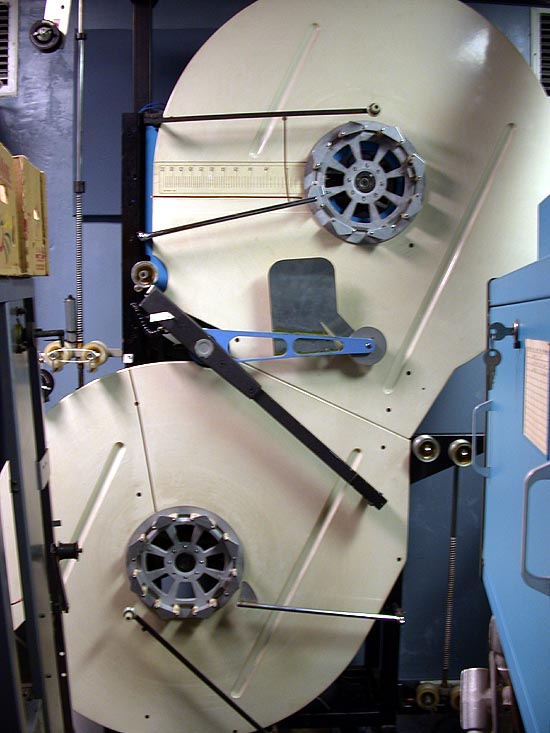
It is something that you really have to see in operation to be able to understand exactly what it is doing. Fred explained how it works to me but, to be perfectly honest, it doesn't necessarily make sense without seeing it in action. Part of the time the film is playing off of one hub while taking up on the other hub (or reel, if you will). Then, when the last bit of film leaves one hub, a sensor trips and an arm swings around, gently grabs a loop of film, brings it back up to the now empty hub and the machine starts taking up film on the empty hub while the full hub has started to play out. (If you're like me before you see it in action, this explanation will probably only add to the mystery.) But it works and never damages the film. Titanic ran for 22 weeks on this machine and left in the same condition as it arrived.
At this point, the next time it will get used will be in December, assuming LOTR: Return of the King is booked at the theater as anticipated. I will see what I can do to get some footage of this beast in action, as well as some footage of what it takes to build a show on the critter (have yet to see this myself).
Posted by Mark Gulbrandsen (Member # 72) on 10-14-2003, 08:14 PM:
"I believe I was shown one on these once during a tour of The Commodore Dinner Theatre"
_________________________________________________________________
Probably a good place to have it so everyone can enjoy their dinner while the button pushers attempt to figure it out...... I think there's one of these at the Cedar Twin in Cedar City. Its in the back hallway by the equipment junk pile in caseanyone else is interested.....
Mark @ CLACO
Posted by Steve Kraus (Member # 476) on 10-15-2003, 11:51 PM:
I am, Mark. Not that I have a need of one; I just think it's hilarious.
Also, it's the only loop (besides the roller cabinets) that doesn't have film sliding over itself, something that horrifies me unless someone can put raised edges like a thick mag track on the film so the surfaces don't actually touch.
Posted by Frank Angel (Member # 248) on 10-16-2003, 04:15 AM:
Very interesting indeed. We need to get a video of this thing in action. Though I can't imagine that the film wouldn't at least get a mild crease in it at the point where the loop slides into the hub.
I also like the early name for the plater. The "cakestand." Much more colorful; that's what I'm going to call them from now on.
Frank
Posted by Steve Kraus (Member # 476) on 10-16-2003, 07:19 AM:
Speculation:
I believe the ends of the loops go around small rollers that are held in the reel hubs so there is no crease. Something like that probably.
Posted by Steve Kraus (Member # 476) on 08-05-2004, 11:46 PM:
Bumping this up in the hope that someone can come up with some photos or better yet a video of the Loop-Matic beast in operation and changing ends.
Posted by Brad Miller (Member # 2) on 08-06-2004, 12:40 AM:
Someone emailed me a few months back about having a video of this thing in operation, but I never heard back again from them.
Posted by Steve Kraus (Member # 476) on 08-06-2004, 01:25 PM:
Hey if you had one running at one of your gatherings you might even get me to attend! ![[Razz]](tongue.gif)
Posted by Mike Fitzgerald (Member # 1304) on 08-06-2004, 01:44 PM:
I have emailed the Commodore Theater to see if he could send us pictures of it
Posted by Brad Miller (Member # 2) on 08-06-2004, 05:39 PM:
Sorry Steve, we only run 35mm changeover and 70mm via platter at those gatherings. There is a new Cinemark being built in Rockwall though. Maybe we can interlock a movie between there and the screening room at a future gathering.
Posted by Steve Kraus (Member # 476) on 08-07-2004, 12:41 AM:
I wasn't suggesting screening from it; I just want to see it run. Load it up with 10K ft of Phil's old pornos.
Posted by Vernon Cramer (Member # 1181) on 08-07-2004, 09:24 AM:
I'll fess up on this one. After this topic came back up a few months ago I took a Canon XL-I to the Commodore in Portsmouth, VA and shot quite a bit of footage of the unit in action while LOTR: Return of the King was playing (also shot some footage of the print being loaded onto the beast). I wanted to make sure that I got decent footage of the key moments when the film runs off the top hub, is caught by the arm and rethreded back into the top hub (also needed footage for the action with the bottom hub as there are some difference). It took a couple of visits to the booth to get decent shots at these moments.
Since then my challenge has been finding time when I was free and the editing system was available to edit this down to a reasonable length before sending it to Brad. (We took some hits in staffing at work and I've had to put a number of things on the back burner until I could get some positions refilled.) Right now the footage sits on my desk as a daily reminder that I still need to knock this project out (along with several others).
Bear with me on this and I'll do my best to get it to Brad as soon as I can.
Posted by Steve Kraus (Member # 476) on 08-07-2004, 10:39 AM:
How much would he want to sell it? ![[Big Grin]](biggrin.gif)
Posted by Brad Miller (Member # 2) on 08-07-2004, 02:55 PM:
Send me a copy of the MiniDV tape and we'll chop it down here.
Posted by Tim Reed (Member # 137) on 08-08-2004, 01:00 AM:
Good man, Vernon! I've waited to see this for years!
Posted by Steve Kraus (Member # 476) on 08-08-2004, 07:57 PM:
Film-Guard and Loop-Matics! It'll revolutionize the business!
Posted by Scott Norwood (Member # 30) on 08-09-2004, 07:10 AM:
I think that Steve should get one of these for his screening room. Then we could hold the next F-T gathering there. ![[Smile]](smile.gif)
Posted by Steve Kraus (Member # 476) on 08-09-2004, 07:57 AM:
Wouldn't help my line of work but I could probably sell tickets for people to watch it change ends. I know I'd pay a buck or two to see that.
The one flaw in the Loop-Matic + Film Guard theory of completely labor-free projection would be the media cleaner. Can we do an endless loop on the media too? How about it pass through a tiny washing machine & dryer and then get FG reapplied?
Posted by Daryl C. W. O'Shea (Member # 1303) on 08-09-2004, 07:51 PM:
No problem there Steve. Just use a 3000' roll of media instead of cutting it into short lengths.
Posted by Steve Kraus (Member # 476) on 08-09-2004, 08:16 PM:
How many runs does that get you? I rather like the idea of the tiny washing machine. It would be the size of a breadmaker.
Posted by Daryl C. W. O'Shea (Member # 1303) on 08-09-2004, 08:25 PM:
It'd be enough for the week, at least.
Posted by Steve Kraus (Member # 476) on 08-09-2004, 08:52 PM:
That's too much expensive (!) labor. Needs to be able to go a few weeks if the print doesn't move.
Posted by Randy Stankey (Member # 64) on 08-09-2004, 10:09 PM:
Aww! C'Mon, guys! You mean to tell me that nobody has thought of inventing the Loopmatic Media Cleaner?!
Posted by Ron Yost (Member # 1850) on 08-09-2004, 10:33 PM:
It should be a mobius loop so it'll use both sides of the web.
Ron Yost
Posted by Steve Kraus (Member # 476) on 08-09-2004, 11:30 PM:
I bet you could redesign the Kelmar to do that. Quick, call the patent office!
Posted by Justin West (Member # 920) on 10-24-2004, 09:56 PM:
Here's a pic...as taken on a recent tour of Fred Schoenfeld's booth at the Commodore Theatre, Portsmouth, VA! Nice theatre he and his wife run! Don't expect Fred to part with this one...it is a cherished piece of equipment from his days at Xetron. BTW, note how the hubs are machined.
Posted by Brad Miller (Member # 2) on 10-24-2004, 10:27 PM:
Posted by Steve Scott (Member # 630) on 10-25-2004, 05:35 PM:
Cool, now why with a small machine like this did platters ever take the market? ![[Wink]](wink.gif)
Posted by Carl Martin (Member # 1146) on 10-26-2004, 03:42 AM:
still waiting for the video...
Posted by Kenneth Wuepper (Member # 1174) on 10-26-2004, 07:01 AM:
The operating platter mechanism is shown for a brief time in the PBS documentary, "The Monster That Ate Hollywood".
If you have access to that VHS tape you can still frame through the section that shows a continuous loop platter in operation from the top with the brain paying out the film.
I can't find my copy of that program right now but that is where you can see it.
KEN
Posted by Mark Gulbrandsen (Member # 72) on 10-26-2004, 11:12 PM:
That thing shoulda been in the part in Silent Movie that takes place in the booth!! It would bring out the neurotic side of anyone with in 10 feet of it.
Mark
Posted by Fred Schoenfeld (Member # 2632) on 10-28-2004, 05:57 PM:
Just a note from the 'source'... the loop-matic is not currently in operation. I only use it for running times over 165 minutes. It is very gentle on prints; we ran TITANIC for 21 weeks and all three of THE LORD OF THE RINGS (10 to 12 weeks each) and all looked new when I shipped them out.
But, as they say, 'here is the rub'... [1]: buildup time is about two hours and the same to tear down. [2]: Once loaded on the 'loop', it is impossible to add or delete trailers without removing the entire print. [3}: Servicing the unit without specialized training would be next to impossible. I do all the servicing myself and I was lucky enough to have had the chief engineer from the factory come over from Europe in 1976 and train me on the operation and servicing of the system. Also XETRON was asking about $14,000 for it back in the late 70's!! I remember paying about $10,000 as I was the Beta test site.
I would invite any and all to visit us here in Portsmouth, VA and I will be glad to show you the unit in person. Also, if in fact there is one anywhere not in service, I would be very interested in purchasing it for spare parts for my unit. A small finder fee will be yours if I find a unit available and it can be had for a reasonable amount with your assistance!
Posted by Brad Miller (Member # 2) on 10-28-2004, 06:06 PM:
Vernon - can you send me the raw footage tapes? We can cut it down from here and get it online. There are a lot of people who are dying to see this monster in action.
Posted by Mark Gulbrandsen (Member # 72) on 10-30-2004, 10:22 AM: