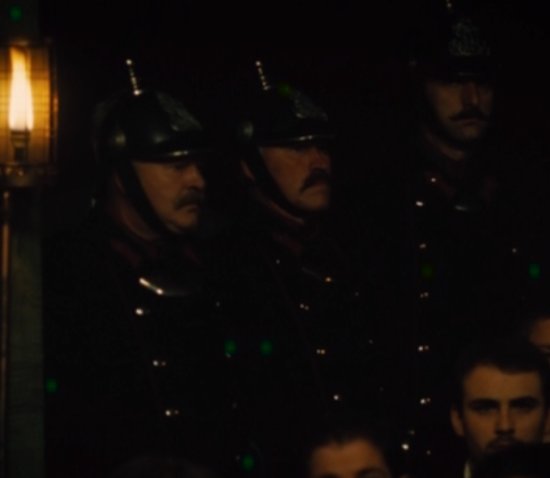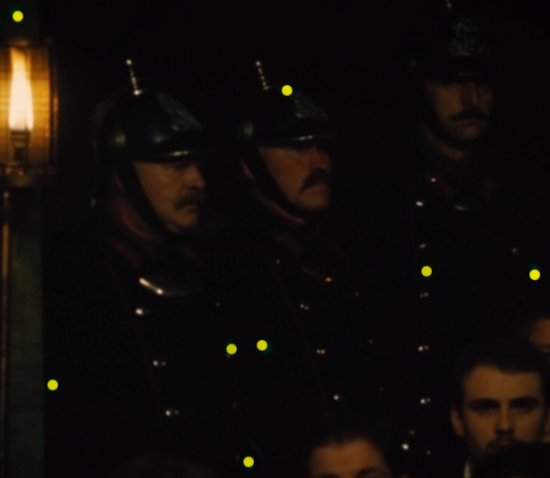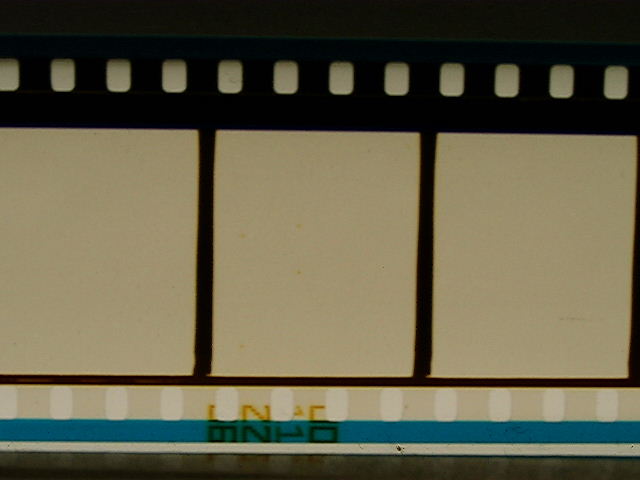
Maybe the CAP equipment senses how bright the frame is, and adjusts itself some how. So, if, say the 100th frame comes up and it is light, the dots are put on darker. I though they would be white, to make it easy to find even after poor videotape copies.
Pretty cool find, Carl.
*X-Files theme fades up*
Carl is gonna wake up in a brightly lit room telling his story to a craggly looking, stern faced man smoking a cigarette!!
Seriously, there is a reason that no-one has ever told the tail of the "cap code".
*To be continued*
*closing music fades up*
<grin>
Russ
Carl, was this a scope film by any chance? The leftmost column of dots seems like it would be off the edge of the frame for 1.66 or 1.85. I wonder if the four-digit block and accompanying dots are supposed to be centered in the frame instead of being a sprocket or so off as they are here.
Also, what if you removed every 100th frame or so. Not every frame with the cap code on it, but just enough so they couldn't put together the sequence? ie: remove every 1st frame of the cap code sequence. Make sense?
>>Traditionally this is reel 2, but "Dinosaur" featured the CAP code on reel 4 for some reason<<
This explains why this reel (and only this reel) has been running out of focus at one of my theatres! I watched it yesterday.
------------------
Better Projection Pays!
The CAP code does not have to be 100% effective...it only has to be effective enough to catch a few people, so the word spreads that there IS a way to track a print to a particular theatre.
Mark L.
I wrote:
"CAP Code is real, it has been in use for 18 years, and it is effective. That is the simple TRUTH".
It really hurt to hear something I helped invent called "CRAP Code"  . I would appreciate apologies from the skeptics out there who questioned my sincerity and integrity.
BUT, don't assume that CAP Code is always on a certain reel. It can be printed on any (or all) reels. It does not always have the numbers on the edge of the print to give away it's location. And what makes you think that this is the only type of CAP Code? I know that multiple coding schemes are used, sometimes all on the same print (for redundancy). You might make 1200 splices to remove the frames with this version of CAP Code, only to find you missed another, more subtle one.
------------------
John P. Pytlak, Senior Technical Specialist
Worldwide Technical Services, Entertainment Imaging
Eastman Kodak Company
Research Labs, Building 69, Room 7419
Rochester, New York, 14650-1922 USA
Tel: 716-477-5325 Fax: 716-722-7243
E-Mail: john.pytlak@kodak.com
------------------
John P. Pytlak, Senior Technical Specialist
Worldwide Technical Services, Entertainment Imaging
Eastman Kodak Company
Research Labs, Building 69, Room 7419
Rochester, New York, 14650-1922 USA
Tel: 716-477-5325 Fax: 716-722-7243
E-Mail: john.pytlak@kodak.com
Carl, it sounds like you've got more research to do! haha
My apologies to John Pytlak for the other CAP code thread. (You must admit though, it WAS pretty fun. )
Obviously, I am no longer a skeptic, and I apologize for any misleading or negative comments I may have said, but it was indeed fun! Admit it John, you had some fun, too (although probably not as much as some of the rest of us)!
I have been noticing CAP code onscreen for the last few weeks when I verify a new print. I can't stand it. John, I'll give people your phone number if they complain about print dirt that I can't clean
I was apologizing to John for my not just tossing all disbelief aside and believing him, not on behalf of Carl. I don't tend to just believe anything I hear or read.
Trust me Brad, I don't even read your posts!
Just Kiddin'
John: You have my humblest apologies for my part in egging-on the naysayers. BTW, thanks for the info on the reel 4- "Dinosaurs" business... I figured it was a convenient excuse.
I think most of the people here, myself included, have the utmost respect for you. You are held in the highest esteem. I believe we all realize the awkward position you were in with this topic. It is telling of your character that you're still frequenting the forum. I sure couldn't have made it through without getting mad.
We're all the richer to enjoy your company, your advice and expertise.
------------------
Better Projection Pays!
Many convicted film pirates THOUGHT they removed all traces of CAP code from their illegal product.
------------------
John P. Pytlak, Senior Technical Specialist
Worldwide Technical Services, Entertainment Imaging
Eastman Kodak Company
Research Labs, Building 69, Room 7419
Rochester, New York, 14650-1922 USA
Tel: 716-477-5325 Fax: 716-722-7243
E-Mail: john.pytlak@kodak.com
I assume the "AP" stand for Anti Piracy?
------------------
John P. Pytlak, Senior Technical Specialist
Worldwide Technical Services, Entertainment Imaging
Eastman Kodak Company
Research Labs, Building 69, Room 7419
Rochester, New York, 14650-1922 USA
Tel: 716-477-5325 Fax: 716-722-7243
E-Mail: john.pytlak@kodak.com
).------------------
John P. Pytlak, Senior Technical Specialist
Worldwide Technical Services, Entertainment Imaging
Eastman Kodak Company
Research Labs, Building 69, Room 7419
Rochester, New York, 14650-1922 USA
Tel: 716-477-5325 Fax: 716-722-7243
E-Mail: john.pytlak@kodak.com
I was building Big Momma's House and the depot or someone made a big to do out of reel 2 being Cap Coded. Reel # was written in big numbers, inspection label noted CapCode: 0 on label.
Sure enough, the number was printed on the edge just like the picture above. Most of the reel is dark but you will notice the white / brownish dots while watching the feature. I bet the scheme is like those binary clocks or message do-hickeys that use a row of 8 leds on a pendulum and swings back and forth to display a message. This same concept would display the reel number.
That's my take
Information on all the Kodak digital still cameras is on the Kodak website:
http://www.kodak.com/go/digitalcamera
You can also check out the entire line of Kodak digital products at:
http://www.kodak.com/US/en/nav/digital.shtml
For a discerning photographer like you, I wouldn't settle for less than one of the cameras in the PRO DCS Series, with 6 megapixel resolution. (Of course 35 mm film still has superior image quality ).
Remember, Kodak's business is PICTURES. We try to offer the best products to meet customer's imaging needs, be they FILM or DIGITAL or HYBRID.
------------------
John P. Pytlak, Senior Technical Specialist
Worldwide Technical Services, Entertainment Imaging
Eastman Kodak Company
Research Labs, Building 69, Room 7419
Rochester, New York, 14650-1922 USA
Tel: 716-477-5325 Fax: 716-722-7243
E-Mail: john.pytlak@kodak.com
Is the Photo CD spec of 3072 x 2048 as good as 35mm? I ask because if it's not, then why didn't Kodak make Photo CD as high res as 35mm? One of Kodak's main claims to fame on this now obsolete technology was that you could take your disc back in to the manufacturer an get perfect prints made from it, since it is basically just a digitized version of the negative turned positive.
I would settle for nothing less than 256 Terapixels! I think they sell those down at K-Mart for $199 (Kodak brand)
I still take pictures with film. If I need a digital image I just scan the print.
John, I checked my camera and it is loaded with Kodak film! (Sorry that I had to check, I'll be sure to buy only Kodak in the future). It was Gold asa 200.
Half of the fun of pictures is discovering what was on that roll of un-developed film that you found while cleaning out the car!
Russ
Scott:
It seems everyone still loves the look of Kodachrome film. Pretty good for a product that has been on the market for 65 years! Of course, it's been improved many times since 1935.
Russ:
What you are doing is very common practice. The "HYBRID" practice of shooting on film, and then transferring the images to digital is very common. That way you're not having to invest in the fast-changing technology of a digital camera, yet have the ability to use the images digitally.
------------------
John P. Pytlak, Senior Technical Specialist
Worldwide Technical Services, Entertainment Imaging
Eastman Kodak Company
Research Labs, Building 69, Room 7419
Rochester, New York, 14650-1922 USA
Tel: 716-477-5325 Fax: 716-722-7243
E-Mail: john.pytlak@kodak.com
We've all seen the stickers with the title, bar code, print number (um, yeah right), date/time of printing and so forth on them courtesy of Deluxe Hollywood as pictured below.
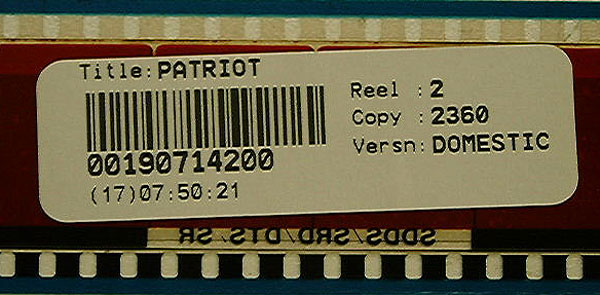
However, I noticed a little something odd on my second print of The Patriot. Check it out.
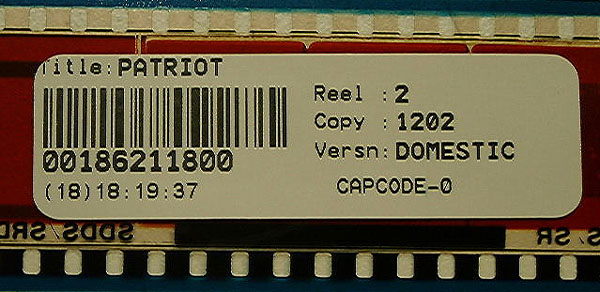
Yes folks, the first print had the annoying little CAP code marks on it...but the second one (noted by "capcode-0") did NOT!
What's up with that? Is this a courtesy toward bootleggers from Deluxe? I'm not getting the point here, but I find it awful funny. 
But what if we didn't switch? We could have been bootlegging film all night and giving out free copies to everybody on the planet, and the UA theater would have gotten blamed.
CAP Code rocks!
And John P., don't hate me just because I'm not a fan of Cap Coding. I do think it's obtrusive (dots on a reel of film, numerous times), but it is the best thing we have presently... Yet, be honest John, you gots to be working on something new to replace Cap Coding, right? The technology is here. Robust, undetectible watermarking in both the audio soundtrack and the visual image on screen (hint).
Anything for a better presentation.
THXfully Yours, Ted
CAP Code dots are much smaller than cue marks, and their position in the image is random, so most people don't pick up on them. Remember, it took me months to convince expert Film-Tech Forum members that CAP Code really existed! It needs to be visible in any video copy, but was designed not be be too visible or annoying.
------------------
John P. Pytlak, Senior Technical Specialist
Worldwide Technical Services, Entertainment Imaging
Eastman Kodak Company
Research Labs, Building 69, Room 7419
Rochester, New York, 14650-1922 USA
Tel: 716-477-5325 Fax: 716-722-7243
E-Mail: john.pytlak@kodak.com
------------------
It's the new small talk. You do it so awfully well! - My Fair Lady
------------------
John P. Pytlak, Senior Technical Specialist
Worldwide Technical Services, Entertainment Imaging
Eastman Kodak Company
Research Labs, Building 69, Room 7419
Rochester, New York, 14650-1922 USA
Tel: 716-477-5325 Fax: 716-722-7243
E-Mail: john.pytlak@kodak.com
------------------
John P. Pytlak, Senior Technical Specialist
Worldwide Technical Services, Entertainment Imaging
Eastman Kodak Company
Research Labs, Building 69, Room 7419
Rochester, New York, 14650-1922 USA
Tel: 716-477-5325 Fax: 716-722-7243
E-Mail: john.pytlak@kodak.com

------------------
John P. Pytlak, Senior Technical Specialist
Worldwide Technical Services, Entertainment Imaging
Eastman Kodak Company
Research Labs, Building 69, Room 7419
Rochester, New York, 14650-1922 USA
Tel: 716-477-5325 Fax: 716-722-7243
E-Mail: john.pytlak@kodak.com
I'm sure that you taped a reel to test the CAP code once you invented it. Did you do some hard time for that? Now that I think of it, don't most of the Video CD screener bootlegs come from Rochester? 
For instance, on Shanghai Noon they were smaller and darker. The movie was SCOPE, too so they were more oblong. On Big Momma they were big, blotchy looking things but they were yellow brown in color.
Also, some prints have edge numbers and others don't.
Does the CAP Code cover the entire frame? What if the bootlegger zoomed in to get a full frame picture on his camcorder? I assume that John Pytlak took all of this into account when he designed the CAP Code with Bevan Wright and John F Allen. The CAP Code is either centered (mostly) in the frame, or repeated on the left and right sides. Right? Either that or you only need a few of the dots located on certain frames in a sequence to determine the print ID.
I wouldn't assume that 2000 prints is still a limitation. The MPA and labs have had 18 years to expand and enhance the use of CAP Code, and it's likely additional or redundant coding methods are in use. Randy's observation of different patterns seems to support this.
------------------
John P. Pytlak, Senior Technical Specialist
Worldwide Technical Services, Entertainment Imaging
Eastman Kodak Company
Research Labs, Building 69, Room 7419
Rochester, New York, 14650-1922 USA
Tel: 716-477-5325 Fax: 716-722-7243
E-Mail: john.pytlak@kodak.com

He probably works for the MPAA decoding CAP Code now!
Either that, or the FBI brought  in for questioning.
------------------
John P. Pytlak, Senior Technical Specialist
Worldwide Technical Services, Entertainment Imaging
Research Labs, Building 69, Room 7525A
Rochester, New York, 14650-1922 USA
Tel: 585-477-5325 Cell: 585-781-4036 Fax: 585-722-7243
E-Mail: john.pytlak@kodak.com
Web site: http://www.kodak.com/go/motion
--jhawk
------------------
John P. Pytlak, Senior Technical Specialist
Worldwide Technical Services, Entertainment Imaging
Research Labs, Building 69, Room 7525A
Rochester, New York, 14650-1922 USA
Tel: 585-477-5325 Cell: 585-781-4036 Fax: 585-722-7243
E-Mail: john.pytlak@kodak.com
Web site: http://www.kodak.com/go/motion
How many other ways are there (other than CAP Code) and can you enlighten me with any examples?
The pirates usually find out they missed one of the ways when the FBI comes armed with a search warrant!
In this case, "inquiring minds" raise suspicions.
------------------
John P. Pytlak, Senior Technical Specialist
Worldwide Technical Services, Entertainment Imaging
Research Labs, Building 69, Room 7525A
Rochester, New York, 14650-1922 USA
Tel: 585-477-5325 Cell: 585-781-4036 Fax: 585-722-7243
E-Mail: john.pytlak@kodak.com
Web site: http://www.kodak.com/go/motion
I'm not an expert on this, but to answer Steven's question more specifically, I would think that virtually ANY defect in the print could be used against a bootlegger to track it. For example, let's say someone was to bootleg a print from a theater that was playing print number 855. Now let's say that print had a lab splice 500 feet into reel 4. Since lab splices are so random, a quick analyzation of the videotape with frame counting would show a matching lab splice location. Even if that frame was cut out and tape spliced back together, there is always a disturbance, most particularly with a tape splice that would show up even on video. Thus at that point I would think the MPAA could check a list of suspected theater's prints to see if one of those prints physically matched.
Maybe that same print had a tiny scratch in one of the reels, possibly even being from a lab. It isn't rocket science to take a batch of "suspected" prints to a rewind bench or projector and find out if one of them was indeed the source print.
So I would say that even anti-piracy techniques like the CAP code aren't necessarily the only thing that the MPAA has to go on. Sure it helps, but even a non-coded print should be able to be tracked down. It would just take more effort. Am I right John?
Now that that has been said, John if the MPAA ever decides to give a demonstration, now of *how* they can track down prints, but an end result *proof* that it can be done, I'd certainly like to play around with trying to screw with their system! Just imagine the sheer hell that could be created with the cooperation of about 2 dozen other Film-Techers across the country, all swapping bits of reels around, and then further "processed" by Joe with whatever he could come up with on his fancy video editing systems, including modified CAP coding. I'm not saying they still couldn't track it, which they quite possibly still could, but it certainly would have them putting in a LOT of man hours trying to figure it out! hehehe I would just want a contract in writing beforehand guaranteeing everyone's involvement to be non-prosecutable for the demo. Transferring a film to video isn't worth even one day in jail.
Such information, flowing down through the personel in movie theatres would go a LONG WAY in preventing piracy before it even starts. (From the theatre level, at least.)
BTW, didn't Harry Potter or Lord of the Rings recently come with a letter to store one can of the print in another room for security purposes? Did ANYONE actually do that? I highly doubt it. Letters are ignored because they are always saying the same thing. That's why no one reads the TAP pamphlets anymore. I'll bet that the vast majority of them never even have the envelope opened.
One other thing, what about the film delivery people? Let's say Joe Bob delivers film to 20 theaters in a given area. What is to prevent good 'ol Joe Bob from dropping off a theater's cans (let's say it was Steve Guttag's print that was destined to go to the Uptown) to his evil twin brother Bob Bob, who sits in the basement for a few hours doing a nice bootlegging job of it, carefully running it reel by reel so Steve won't notice it had been ran before...and then giving it back to Joe Bob to conveniently drop off at the Uptown. Then later as that tape hits the streets Mr.Vee and his goons at the MPAA track down the print as belonging to the Uptown and go arrest Steve for it. Steve had nothing to do with it! He may hate platters, but he certainly hates video even more. How does the MPAA deal with possibilities like that?
The projectionist would play a reel and then hand it off to his buddy who would whisk it out to the truck to be copied. The reel would be returned in 20 minutes, all nicely rewound, and put back into the can. Ostensibly, nobody would be the wiser.
.
From the story that I heard these guys were caught and got busted pretty hard. BUT it would be nice to get the information out there about HOW they were caught... Not the details of the system, mind you. Just that all films are coded for identification purposes.
------------------
Owen
(off to look for some CAP codes)
The massive security problem with 35mm film is, being a high quality analogue format, it is relatively cheap and easy to produce a high quality video master from it. A reconditioned Cintel can be easily obtained for around £10k and a Beta SP recorder for around £5k. Add to that bits and pieces for sound processing and a computer with a decent video capture card, and you can be turning out VHS and DVD copies of a film which are every bit as good as legitimate ones sold in the shops for under £20k, which for professional criminals is bugger all. That's why the industry so badly needs a system which enables them to identify the film element used in the illegal telecine process, because doing so represents the only real hope of catching those responsible.
With the content being distributed in the digital domain, there is less need to do this. If you are trying to pirate moving images and sound supplied as encrypted digital data, you have two options: (i) crack the encryption, or (ii) decrypt using legitimate technology and then capture the analogue image. The industry will be making every effort to ensure that the encryption mechanism of any digital delivery system which eventually gets rolled out is crackerproof - and if it is cracked, they'll change it, regularly if necessary.
As for the latter, well in reality this probably means pointing a camcorder at a cinema screen, with a resulting loss of image quality on the dupe. Sales of these poor quality videos are never going to threaten the legitimate market, as the pirate video craze of the early to mid 80s demonstrated. So I'd guess that being able to identify the source element from an illegal dupe is far more of a priority for the industry with film than it is with digital.
------------------
John P. Pytlak, Senior Technical Specialist
Worldwide Technical Services, Entertainment Imaging
Research Labs, Building 69, Room 7525A
Rochester, New York, 14650-1922 USA
Tel: 585-477-5325 Cell: 585-781-4036 Fax: 585-722-7243
E-Mail: john.pytlak@kodak.com
Web site: http://www.kodak.com/go/motion
Owen
quote:
BOOTLEG MOVIES
by TED SCHWARZARE THEY BEING MADE AND SOLD BY A CLEVELAND-BASED MIDDLE EASTERN CRIME RING?
"He don't talk like no cop. He called me on this phone about movies and DVDs. He ain't no cop... Maybe a minister... He sounds black, though... I see you took them off the counter." -- message inadvertently left on voice mail on July 9, immediately after a telephone call was placed to the Just Dollar store on Superior and Euclid asking about VHS and DVD copies of current movies.
Earlier in the day, bootleg tapes had been seen during a visit to the store. During the telephone call to the location, the person answering said they had neither tapes nor DVDs. A visit the following day found nothing on display. Cleveland is faced with what appears to be a new, seemingly innocuous organized crime group that is distributing and selling bootleg DVDs and videos of current movies.
The crime ring involves what is seemingly a group of largely Middle Eastern males working in independent dollar stores and food markets selling bootleg movies over-the-counter. To some, including entertainment industry experts, it seems like a relatively minor issue. But where is the money going? As of yet, nobody knows that answer.
Over the course of two weeks, the Free Times visited five stores that sold illegal bootleg movies. Bootleg videotapes sell for as little as $3 if the corresponding theatrical movie is about to be released on tape, to $7 for the recent Scooby-Doo movie as it was just beginning to be shown in theaters. One Just Dollar store with the best and the newest bootleg movies, located on Fulton Road near Memphis Avenue, offers bootleg videos of new movies for $10 each, three for $25. The DVDs sell for around $12 for the most recent pictures, such as Like Mike.
Copying usually starts with a hidden VHS or digital camera recording the screen during an early showing of a new release. Then, depending upon the technology used, it is copied either on a computer (digital) or video duplicator, such as those legally made by Go Video.
There are any number of ways for the art to be created. These include cut-and-paste work with posters and downloaded photo websites promoting the new release. The final creation can be cut-and-pasted (common with some DVDs found in various Cleveland stores) to offset printing of the boxes.
Finally, the product is shrink-wrapped (it's $100 for a small machine capable of low volume, up to $2,000 for a commercial unit) and sold to the stores where the tapes and DVDs are offered to the public.
How big a problem is all this? Bill Shannon, the director of U.S. Anti-Piracy Operations for the Motion Picture Association of
America, explained that the industry annually loses between $250 million to $350 million in the United States, and as much as $3 billion internationally. This means that at least 25 lower-budget movies, and as many as a half-dozen big-budget potential blockbusters, cannot be made because of lost profits from theft. The crime can also result in higher theatrical and rental prices. More important, the actions violate federal law, and can result in both a felony conviction for the bootlegger and a reward for the person who turns in the offender.No one knows the size of the Cleveland problem. Mention the bootleg videotapes and DVDs and you usually hear that they are "everywhere." But ask for specifics and you are usually referred to the handful of independent dollar stores and the occasional food store -- the ones we were able to confirm all are run by Middle Eastern males -- where these are sold.
And this is where the questions must be raised. Are the illegal tapes and DVDs being created by a group of friends, then sold where they work?
This type of situation was described by Bill Shannon, whose investigators have found groups dividing the effort among specialists. One handles the art, another the duplication, a third the assembly, and then the wholesaling is done from another locale, such as a rental-storage shed.
"A poster might be reduced to box-size and color-copied onto the cardboard," says Shannon. "Offset printing is rare, though we have seen it. And some put the art together, misspelling names and sometimes having the wrong story. Spider-Man might have the right pictures and the wrong studio and wrong artist."
Or is the creation and distribution being handled by an organized crime element? This seems more likely, given the variety of locations uncovered in the past few weeks.
Finally, there is the most important question, the one which Special Agent Bob Hawk at the Cleveland FBI office has expressed an interest in determining: Who gets the money?
If the bootleg video and DVD sales are putting money in the pockets of the people producing and selling them, it is an ordinary-enough crime, and will be handled accordingly. But in this post-9/11 era, where any illegal activities perpertrated by Middle Eastern males, no matter how small, are subject to increased scrutiny, suspicions also arise that profits are tied to more sinister purposes. Were such to be true, what might have seemed like a victimless crime could hold much greater import.
Among the independent dollar stores offering illegally created videos and/or DVDs that were either checked by a visit within the past two weeks or called on the telephone are:
9300 Wade Park
7415 Superior
13225 Superior (none showing the day after the telephone call)
4257 Fulton
Food Town Supermarket, Euclid Ave. near Superior Ave.
Problem is, the MPAA would be a lot more convincing if they would DOCUMENT how they are loosing hundred's of millions of dollars a year; how do they reach those figures? Does Valenti pull them out of a hat or elsewhere closer to his person? And how exactly do they figure that 25 independent films and 6 blockbusters can't be made, as a direct result of bootlegging? The article uses those MPAA numbers as facts, but then can't even tell you how many operations are out there, if they are small or large; the reporter asks plenty of questions that would have been a lot more interesting if he reported some answers to them.
He asks this ominous question (but not before saying that the bootleg copies are being sold in store run by men of Middle Eastern decent, "But where is the money going?" the report then asks. But instead of enlightening us with the answer, he says, "Nobody has the answer." Well, how about writing the story when you find someone who does. He asks, is it run by organized crime? Well, he doesn't know the answer to that either -- he just says it "seems likely." Wow....how's that for ironclad, nail-it-down reporting? So what it is -- organized crime or Middle Eastern terrorists?
Sorry, except for the Valenti's little new twist that bootlegging is bad because it somehow, in some vague, unexplained way, supports terrorism, there's nothing new here that we haven't all heard before.
Come on, Jack, do it for us, just one more time. Come on, say it.
Valenti: (clears throat, eyeing the red camera light to make sure it is rolling and says) "Motion Picture piracy is a cancer in the belly of the industry." Ah....thanks Jack; perfect soundbite for the 6 o'clock news.
As already pointed out, the majority of these pirates are noting more than guys pointing camcorders at the screen. So what if the cap code transfers to the print (along with the guy's head in front of the bootlegger). It only proves what print was taped in what theatre, but without other physical evidence, that's not going to catch anybody.
So why all this noise about piracy? I've always believed that the MPAA's main job in hawking this piracy theme was to grab headlines and basically give the studios a dramatic reason to continue to fund it. The MPAA was hastily founded as nothing more than a lateral punt to derail a Congress that was hell-bent on passing regulation legislation on the studios. The MPAA was the answer and Valenti was hired (although he knew nothing about the film business) only because he was well know on Capital Hill through his connection with the Johnson administration. It worked. To his credit, Valenti came up with the rating system that assuaged Congress's thirst for film industry regulation. So Mr. Vee earned his keep for the first few years; but how long can you keep tweeking the Rating system? He needed something new and exciting, so he hit on the anti-pirarcy theme and has been playing it like a virtuoso violist ever since.
His Washington insidership allowed him to enlist the FBI, and before you knew it, those FBI warnings appeared on just about everything that came out of Hollywood. The FBI insiders became miffed that the MPAA had made it look like they were the MPAA's own private police force, many times paying thousands of dollars for the FBI to mount sting operations manuvered by the security people in the MPAA. The MPAA always made it a point to inform the local media when FBI agents were about to uncover a priacy "ring" -- Joe Schmo with his video camera pointed at a movie screen.
Gotta stop -- FANTASIA in the park and I've got to get some sleep. As of this evening, the print is "lost in transit." Swank says they will have it for us sometime tomorrow. We go on the screen at dusk. I am not panicing yet. But talk to me around 3pm tomorrow.
Wish me luck
Frank
quote:
To battle the problem, in 2000, the MPA launched over 60,000 investigations into suspected pirate activities, and more than 18,000 raids against pirate operations in coordination with local authorities around the world.
If these numbers are to be believed, then there is a whole lot of bad stuff going on. My son, who was in East Asia last year, could see all our first run movies the week of, if not before, their release on DVD. Yes the MPAA is the strong arm of the studios (not to be taken necessarily in a positive light), but there is a problem here. It was a shock to me to see these types of videos (and CDs) being offered at a public swap meet, at a closed drive-in no less.
Now, I've seen a few pretty impressive ones, a friend of mine downloaded a telecine transfer of Spiderman where the full 35mm frame was transferred, so it would pop in and out of various aspect ratios throughout the movie. Still, no CAP code, and you couldn't see anyone's face unless it was a close-up.
Sometimes, they're entertaining. I saw your typical cam-in-the-auditorium job for a FOX movie where someone horribly coughed right after the fanfare and the entire audience laughed...
If these are the alleged bootlegs that are costing the industry millions (billions?) of dollars every opening weekend, then we can rest assured that quality doesn't matter to people anymore, and DLP is around the corner...
=TMP=
That's what I mean. Who can believe such numbers -- that's like what, a "raid" very 10 minutes of every day of the year? And if they are making these so-called raids and there STILL is rampant piracy, that means that pool of pirates are replacing the ones caught it the raids even FASTER than that! Where are all these skilled priates coming from? If you can believe this MPAA nonsense, every graduating college kid must be diving right into the bootlegging business; the pirate recrutment must be running overtime.
It would give the MPAA a lot more credibility if they didn't hype the numbers and put out these shock statements. Then immediately after telling you about the hundreds of millions that they loose because of these guys with the patches over the one eye and the wooden leg, they turn around and boast how the movie industry is the strongest its ever been with records opening records being broken every time a new blockbuster hits the screen. Well, you can't have it both ways -- either piracy is really hurting you, or you're making money hand over fist....decide which it is.
Given a choice, I'd rather be making the money.
Seriously, the film industry needs to make it difficult for pirates to get good copies of films. Theatres can:
* Be on the lookout for anyone attempting to copy a film with a camcorder. Post a notice offering a reward for any employee or customer discretely reporting someone in the audience using a camcorder. Prominently post a notice that camcorders will be confiscated, and then do it, and turn them in to the authorities. You're probably only catching "small fish", but word gets around.
* Limit print access. Leaving film shipments in publicly accessable areas is just asking for a print to be "borrowed" for telecine transfer.
* Get to know your print delivery people. Document shipping and receiving of prints.
* Limit projection room access. Use door locks that require a pass or personal passcode, recording the time of entry and exit to keep a log of off-hours activity.
* Report suspicious activity. Why would prints be delivered anywhere but a theatre or film exchange? Why are thousands of tape cassettes or DVD blanks needed at a back-alley "lab"? Why does that dumpster have scrap cassette or jewel case labels for a current movie? Why is the print on a different platter level than it was when the last show finished last night?
The MPAA anti-piracy awards program is real, and an incentive to report piracy:
http://www.mpaa.org/anti-piracy/contact/index.htm
------------------
John P. Pytlak, Senior Technical Specialist
Worldwide Technical Services, Entertainment Imaging
Research Labs, Building 69, Room 7525A
Rochester, New York, 14650-1922 USA
Tel: +1 585 477 5325 Cell: +1 585 781 4036 Fax: +1 585 722 7243
e-mail: john.pytlak@kodak.com
Web site: http://www.kodak.com/go/motion
Why is there a telecine projector setup in the booth?
Why is the print being picked up by a guy named Cheech in his SUV instead of the Airborne truck?
Why is your assistant manager always on the phone with a company called El Cheapo Film to Video Transfers Inc.
Why did you find a rack of computer equipment with a bank of three dozen DVD burners and two dozen VCRs in the basement behind the old standees.
And lastly, Why was your projectionist seen at the corner of 42nst Street and Broadway with a display case full of the DVDs of all the titles currently playing at your theatre yelling " Come and get em -- all the movies playing down the street on DVD -- any title $5, two for $9, except STAR WARS Episode 2 which is $1."
Frank
An aside: How times have changed. When I worked in a small town in Texas, we used to leave the film cans outside the lobby -- I mean OUTSIDE the theatre, totally unprotected. The pickup truck came usually within the hour of our closing, but still, being a native New Yorker, I couldn't quite get used to that. But, in those days, it jsut wasn't a worry; they never had a theft. The only trouble they had was once a bunch of Aggies go a cartoon and unrolled the film down the interstate.
Does this camera thing really happen? You couldn't exactly set up a tripod in the middle of the auditorium; I suppose you might be able to balance a camera on the back ot the seat in front. Hand holding, apart from the difficulty of keeping it still, would hardly be practical during a two hour feature. Surely, any use of a camcorder in the auditorium would be pretty obvious; wouldn't somebody notice, and grab the culprits on their way out - with the evidence.
Setting up a camera in the projection box might be a slightly better bet, but any chief projectionist, or manager who did this, or permitted it to be done in their cinema, would be highly likely to get caught, and would face instant dismissal, and prosecution; would they take the risk?
I have see a few pirate DVDs, and have been able to examine one closely. It was of 'Return of the Jedi'. To the best of my knowledge, there has never been a DVD release of this title, so it must have been a pirate. The disk was in an Amaray type case, of unknown make. The isert card, actually paper, was printed four colour litho, guite well done, no obvious moire from reproducing previously screened material. The text was in both English and Chineese, or some similar language. The style of the artwork was rather different to that which I am used to seeing here, but may be similar to legitimate material in the part of the world where it was made, I don't know. It had all the usual DVD, Dolby Digital etc. logos, and was probably assembled from scans of various existing material. The disk istelf was a DVD5 (single sided, single layer), a proper pressed disk, with screen printed artwork, not bad quality, but not quite up to the standard of a legitimate product. The copyright notice around the edge was in black, over a white drop out in the image. The registration between the two wasn't quite right, and some of the other printing was slightly blurred.
The sound was, as claimed, DD 5.1.
The video vas in 4:3 format with the picture letterboxed, I didn't measure the exact ratio, and had Chineese, or similar, subtitles burned in on the lower black border. Video format was NTSC, with composite video artifacts visible in places. The disk claimed to be region 6, but was actually enabled for all regions. The whole film was one chapter, and there were no 'extras'. Overall, picture and sound quality were very good. My best guess for the origin of this material would be an NTSC laserdisc, but I don't know for certain.
This DVD was clearly very different from something made by somebody pointing a camcorder at a cinema screen, and a fairly large run must have been made to justify the set-up costs, and would be a serious threat to legitimate sales, but surely, anything recorded with a camcorder in a cinema would be so bad that anybody tricked into buying it would have to throw it away, and buy a legitimate, or better pirate, copy.
There are a number or traders on the internet who openly advertise what are clearly pirate DVDs, and VCDs, for sale, imported from overseas. Surely it wouln not be difficult to take action against such obvious, and large-scale piracy, just look thrugh the DVD newsgroups go to the web-sites you see mentioned which advertise these products, order some, then prosecute them for piracy if the goods turn up, or fraud if they don't.
Surely, this sort of thing must be a much more serious problem than someone trying to record off screen in a cinema.
However, I did see a letterboxed VHS copy of TITANIC while it was still in the theatres and the quality was about what you would expect from a generation away from a legitimate release, with one exception -- cassette 2 had no soundtrack, although this might have been a fault of this one copy. In the black area below the image, was the text something to the effect of: "Preview copy. Only for AMPAS members. These are the fairly decent copies that are troublesome to the studios because they are good enough that people will buy them.
But it leads me to this thought: the industry might want to stop that knee-jerk reaction of always looking with a collective raised eyebrow at every theatre projectionist as if they were the source of all things pirated and look to some of their own Academy members for a possible source of bootlegged copies.
Frank
If it was a pressed disc from a glass master rather than a DVD-R then these pirates must have made serious numbers of copies. There can't be that many DVD pressing plants in existence - surely Mr. Valenti's FBI friends would be able to identify the facility which manufactured it from evidence on the disc, and then pursue the matter through (international, if necessary) law.
I have several DVDs of more than 82 minutes which are single layer. I don't know how long 'Return of the Jedi' is, I've never seen the film, apart from the few minutes which I watched on this disk. I only have a small television, but I would say that the quality was similar to laserdisc, and certainly better than VHS. My player can display the bit rate, but I didn't look to see what it was on this disk. I have just checked a few of my DVDs, and the bit rate seems to be typically about 6 or 7. These are all commercial releases, I have no exprerience of doing MPEG 2 encoding or DVD authoring myself.
"If it was a pressed disc from a glass master rather than a DVD-R then these pirates must have made serious numbers of copies. There can't be that many DVD pressing plants in existence - surely Mr. Valenti's FBI friends would be able to identify the facility which manufactured it from evidence on the disc, and then pursue the matter through (international, if necessary) law."
This was a pressed disk, and that's just the point I was making; a DVD pressing plant is not exactly something which somebody could set up in their bedroom. This is clearly large-scale commercial piracy, and I cannot understand how it happens. I couldn't walk into a any DVD production company in this country, and have them run off a few thousand copies of a major feature film for me. What happens in the Far East, are the pirates operating on such a large scale that they can set up their own production plants, or do the 'legitimate' plants not care, and are happy to do work for the pirates?
Also, how can organisations openly advertise the sale of what are clearly pirate disks, on the internet. Surely it cannot be too difficult to put a stop to this sort of thing, at least the distribution in this country, if not the production overseas.
If the industry is serious about putting a stop to piracy then they need to go after the people who are importing, and distributing this stuff on a large scale.
One thing to look for is these discs are almost always region 0 (zero). Another thing is the copyright notice will generally have a poor english translation - sometimes with spelling errors.
Now why these make it through customs I have no idea. Some vendors that sell them even claim they aren't bootlegs.
Steven Gorsky
This is because we kept complaining & his auctions were being cancelled.
We started to forward these onto the MPANZ but to little effect.
Now between the DVD user group we simply bid for these & do not complete the sale.
During the question and answer period with Kevin Smith, someone asked how he felt about his film being readily available for sale downstairs before its release. He said that he wasn't worried about them hurting sales and whatnot, and that he even wouldn't mind autographing one of the bootleg copies if someone wanted. He ended by saying, "...the film made millions of dollars, so it doesn't really bother me that someone wants to make a few bucks on the side." He actually found it flattering that fans liked the film that much.
Then you have someone like Lucas, when his low-definition mess of a movie was available in a choppy, 8-fps AVI file with the sound cutting out every 5 minutes a week before release, screaming and shouting that he will lose "Millions of Dollars" in opening weekend ticket sales. 
=TMP=
It has been 1842 days since the last post.
quote: Stephen FurleyAt some point in the last five years I read some article somewhere revealing that it's the former. China, The Philippines and Indonesia are apparently where most of these pressing plants are. They do a small amount of legit pressing to formally justify their existence, but the bulk of their output is of pirate copies of western films and music, most of them destined for Asian and Far Eastern markets.
What happens in the Far East, are the pirates operating on such a large scale that they can set up their own production plants, or do the 'legitimate' plants not care, and are happy to do work for the pirates?
![[Big Grin]](biggrin.gif)