This is topic CP650?? in forum Film Handlers' Forum at Film-Tech Forum ARCHIVE.
To visit this topic, use this URL:
https://ft-forum.com/ft/cgi-bin/ubb/ultimatebb.cgi?ubb=get_topic;f=1;t=001079
Posted by Raj Sheth (Member # 121) on 06-09-2000, 01:14 PM:
Has anyone here heard about the release of the CP650? I had seen it mentioned in one off the pamphlets from Dolby, but didn't think twice about it. Now a friend of mine says they are ready for release. Any news or pics? I'm sure this is EX ready. Any help is appreciated!
Posted by John Pytlak (Member # 331) on 06-09-2000, 02:39 PM:
Raj:I can't recall any announcement, and I can't find anything in a quick search of the Dolby web site. What did you hear about the features of the new processor?
I think a few Dolby folks "lurk" here, maybe one of them will provide details, if they are available.
------------------
John P. Pytlak, Senior Technical Specialist
Worldwide Technical Services, Entertainment Imaging
Eastman Kodak Company
Research Labs, Building 69, Room 7419
Rochester, New York, 14650-1922 USA
Tel: 716-477-5325 Fax: 716-722-7243
E-Mail: john.pytlak@kodak.com
Posted by Marty Hacker (Member # 485) on 06-09-2000, 02:50 PM:
You two boys better hide...they might already be sending people to come and get you. Think of the CP650 in "Roswell" terms for now. At least any important details that we'd all like to know about anyways.
Posted by Joe Redifer (Member # 3) on 06-09-2000, 03:20 PM:
Dolby is finished with the CP650, but they are going back in to add bugs and glitches to make us all nostalgiac for the CP500 
Actually, I know very little about the CP650. I just hope that it doesn't have a STUPID MENU SYSTEM like the CP500 does. I hate going through what seems like 20 very slow-changing screens just to adjust dolbytone. Also, the format switching on the CP500 seems slow to me, I hope they fix that.
Also, on the CP500 you must cue SK8 which must be set up as Dolby Digital to cue the SA-10 into EX mode. But I run those cues right after the policy trailer before the digital comes on, and it gives me a "Not Ready" and never goes into EX. I must change the auto digital targeting for every EX movie to avoid this. I like how the CP65 will try to go to digital, but instantly fall back to SR. When digital is restored, the EX will come on.
I do like the serial control capabilities of the CP500, so hopefully they retain that (I think that is the plan).
Posted by Mark Gulbrandsen (Member # 72) on 06-09-2000, 04:12 PM:
The CP-650 is reported to have room for the EX boards but it will not normally include the them with it. It will have less functions than the 500 but with the addition of some additional new ones. I was not told specifically what though. Hello Lonnie.......Are you out there lurking???
Mark
Posted by Brad Miller (Member # 2) on 06-09-2000, 04:53 PM:
Well I doubt this is where Dolby is heading with their design, but here's my two cents.Please lose the digital equalization. Nothing beats the good ol' cat64 cards for great sound. 
Also, let's get that external digital input configured directly for a DTS input. No more of this "pull these two pins for the subwoofer to work" nonsense. And where's the SDDS input? I'd like to be able to leave the SDDS eq FLAT and perform the equalization within the Dolby processor. This nonsense of the SDDS "taking over" the audio system is a joke. The CP650 NEEDS two completely separate digital inputs, although I would personally like to see three.
While I'm talking about external inputs, the dual non-sync was a fantastic idea. Please leave that.
Can we please get back to tweekers? I agree with Joe that going through a maze of menus is just plain annoying. It's not that it's hard or anything (I've learned how many times to hit what button and in what order, so the CP500 is always seriously lagging behind my commands), but what is the benefit other than being able to store the settings on a disk? Is it a cost issue?
Anyone given any thought to 1/3 octave eqing on the surround channels?
How about 70mm? The last good 70mm machine Dolby put out was the CP200.
The front panel needs more than 8 soft keys. I think 12 should suffice.
Posted by Marty Hacker (Member # 485) on 06-09-2000, 05:06 PM:
Brad,
1/3 EQ's yes yes yes!Ive noticed that the overall surround response using only full ocatves is very "peaky" for lack of a better term. The overall response is not a smooth curve like the screen channels but instead is one that looks like a NASDAQ stock profile. Although surrounds are for special effects, echoes, and other not so discrete type sounds one can argue that it would be more of a waste to include 1/3 ocatave eq or possibly argue that it is simply not needed. I say if SDDS and Panastereo do it...well then Dolby should as well. Ive always been a bigger fan of parametric EQ's over graphic EQ's and so if dolby insists on using ocatve EQ's for the surrounds with the CP650 then they should just go for parametric EQ's and leave it at that. The new QSC DCM is a perfect example of parmetric EQ usage. What do you think Brad?
Posted by Gordon McLeod (Member # 33) on 06-09-2000, 07:34 PM:
From the info in the latest BKSTS is as follows
EX standard in the box
1/3 octave Digital EQ on all channels
SR and A type NR in the digital domain (not good)
laptop interface (finally)
No 70mm capability (bring on the PanaStereo)
Posted by Kevin Crawford (Member # 469) on 06-09-2000, 10:57 PM:
I have heard a rumor that Dolby is testing one of these units in Dublin at the new Regal 20.Joe: and to anyone else that is interested. Dolby has a new version of software for the 500 it is 1.61. It is suppose to change to EX or SK8 when it sees EX. I ran into that doing a service in the small town of Willows. I could not tell if it was working right because MI2 was on that screen, but the boot up window says it was EX. I have not talked to Norm or Lonnie since then, but they should have it.
By the way I hear that Dolby has a tech page similar to the DTS tech page. Does anyone know where to sign up for it?
Posted by David Johnson (Member # 173) on 06-10-2000, 01:00 AM:
Bring back the CP100
Posted by Joe Redifer (Member # 3) on 06-10-2000, 02:18 AM:
Kevin: I am using software version 1.61EX. There is no auto EX detection. I asked Russell Allen from Dolby (Hi Russ, sorry if I spelled your name wrong) if they were working on any auto EX detection and he said "no". I asked him this on the very same day he personally installed 1.61 into my CP500's (and 1.61EX into my EX house that has an SA-10 and a CP500).The only difference between 1.61 and 1.61EX is that 1.61EX kills the EQ on the surrounds in the CP500 so they can be adjusted on the SA-10
DTS has had auto ES detection from the beginning. DTS kicks ass.
Posted by Scott Norwood (Member # 30) on 06-10-2000, 06:23 AM:
I'm scratching my head here trying to figure out how an EX-auto-detection circuit would work. Any ideas? Conceivably, any film with split surrounds would have "decode-able" information that could be played through the center-surround channel, even though it may not have been intended to be reproduced in that way.
Posted by John Walsh (Member # 168) on 06-10-2000, 07:49 AM:
I think the EX-auto-detection circuit works by a bit in the AC3 data. That is, you would have to have Dolby Digital in your theater. A signal comming out of the DA20 would set the EX feature in the processor. I can't see any way a "analog-only" installation would be able to detect it.By the way, does anyone remember the plugs on the back of a CP200 labeled, "TONE DECODE?" The signals (on the pins) went to the optical preamp. What were they for? I thought they might be an idea that Dolby was thinking about (but never implemented) where the format (01, 04, etc.) would be auto-slected. On our preamp pc board, the copper traces that connected those signals were cut, probably to reduce noise.
Posted by Steve Guttag (Member # 268) on 06-10-2000, 12:49 PM:
Yes the CP-650 is official! According to Dolby document S00/13164:"The CP650 represents Dolby Laboratories' latest generation of cinema processors. With a completely new design, it incorporates the latest technology for decoding digital and analog Dolby optical soundtracks. The processor fits in a 3-U rackspace (5-1/4" high).
All processing occurs in the digital domain. SR and A-Type noise reduction are achieved digitally, as is third-octave equalization for all playback channels. A digital parametric equalizer is also included for the LFE channel.
Setup and alignment can be accomplished via a dual-trace scope or Windows-based PC. All alignment connections and test points are available at the front panel of the unit to simplify setup and testing.
The CP650 has digital inputs for two projectors" <Yippie!> "supporting the Cat. No. 701 Dolby Digital reader, a six-channel analog input for external digital processors, two pairs of nonsync input connectors (RCA Style), a microphone input (balanced XLR connector) for P.A. use and B-Chain alignment, stereo PCM audio capability, and Dolby Digital for consumer applications (DVD and HDTV).
There are balanced outputs" <finally> "for eight auditorium channels: left, center, right, left surround, right surround, back left surround, back right surround, and a subwoofer output. The unit features a hearing-impaired output, and an Ethernet port to accommodate future control and monitor functions."
It apparently comes in two flavors:
CP650: 35mm Dolby Digital Surround EX and Dolby Analog soundtracks.. $11,500.00 List.
CP650-D: For 35 mm Dolby Digital and Dolby analog soundtracks....$10,500.00 List.
The CP650-D can be upgraded with a UEX/650.
Posted by Nicholas McRobert (Member # 205) on 06-10-2000, 06:42 PM:
Yep.... There's a full-page colour ad for the 650 in the latest edition of Cinema Technology Magazine, available from the BKSTS. Kinda looks like a Sony PlayStation probably will someday. 
Nicholas
Posted by Joe Redifer (Member # 3) on 06-10-2000, 09:28 PM:
It's 3U high? As I heard elsewhere:"Sounds like Dolby found another use for their CP-45 chassis!"
It does sound fairly cool, though. I would love to review one. Dolby? I shouldn't get my hopes up on this one, but we'll see.
Posted by Brad Miller (Member # 2) on 06-11-2000, 02:00 AM:
"All processing occurs in the digital domain. SR and A-Type noise reduction are achieved digitally, as is third-octave equalization for all playback channels. A digital parametric equalizer is also included for the LFE channel."Yet another example of that fabulous word that just isn't used quite enough these days..."digital". If it's "digital" then it absolutely MUST be better.
(Still I'm with Joe and would like to review it.)
Posted by John Wilson (Member # 269) on 06-11-2000, 03:34 AM:
Any idea when it comes on the market?
Posted by Martin Frandsen (Member # 74) on 06-11-2000, 10:12 AM:
We would love to see pictures of it!...anyone?I wonder if it will be better than the CP65 in therms of EQ
------------------
It's the new small talk. You do it so awfully well! - My Fair Lady
Posted by Steve Guttag (Member # 268) on 06-11-2000, 10:39 AM:
It looks to have a more Art Deco theme to it on the front rather than the traditional flat front. I believe we can start taking orders on Monday June 12, 2000 (tomorrow). How many can we put you down for?
Steve
------------------
"Old projectionists never die, they just changeover!"
Posted by Stefan Scholz (Member # 147) on 06-11-2000, 01:22 PM:
I could post a picture, but how to do that?
Posted by Brad Miller (Member # 2) on 06-11-2000, 02:03 PM:
Email me the picture to Flix@film-tech.com and the title of the thread it goes in.
Posted by Joe Smith (Member # 190) on 06-11-2000, 02:48 PM:
There's a picture in the July issue of Boxoffice on page 17..
Posted by Ari Nordström (Member # 288) on 06-12-2000, 07:52 AM:
According to our tech, the first public presentation of the CP650 will be at the Cinema Expo in Amsterdam at the end of this month.
Posted by Joe Redifer (Member # 3) on 06-12-2000, 02:11 PM:
Hmmmm.... The CP650 has 8 format buttons on the front. From what I can tell, they are only labeled 01, 04, 05, 10, 11, U1, U2, NS. They can be user defined, I guess. I just really wish they would say "Mono, A-Type. SR, Dolby Digital, DTS, etc..." I really hate the number sceme. It is old and outdated, and no longer useful on the newer batch of processors.Maybe next time Dolby will let me design the front of their unit Still, though, I'd have to hear it before I pass final judgement.
Posted by Ken Jacquart (Member # 369) on 06-12-2000, 07:43 PM:
The CP650 will support the following formats:01 Mono
04 Dolby A-type
05 Dolby SR
10 Dolby Digital
11 External 6-channel
13 Dolby Digital Surround EX
20 35mm Magnetic, 3 channel
22 35mm Magnetic, 4 channel
42 Dolby 70mm, 6-track
60 Non-sync 1
61 Non-sync 2
64 Public Address Center Channel
65 Public Address Surround Channels
66 Test Tone 320 Hz
70 Video PA (NS1)
71 Video Mono (NS1)
73 Video LCR (NS1)
74 Video Pro Logic no SW (NS1)
75 Video Pro Logic with SW (NS1)
80 Digital Input
81 Ext. Dolby Digital Surround EX
87 Ext. 6-channel with Surround EX
...and guess what, the fan is really really quiet!
ken
Posted by Joe Redifer (Member # 3) on 06-12-2000, 11:57 PM:
I don't care what the format numbers are. They mean nothing unless you have a CP200 or something like that. They will not assist me in any way in operating the unit. If I am wrong here, please tell me. All I care about is how it sounds and how many glitches it has.
Posted by Ari Nordström (Member # 288) on 06-13-2000, 03:12 PM:
Is there still a built-in RTA, and can you still locate the password to the setup by reading the brain file in a text editor? Not that I'm complaining...
Posted by Ken Jacquart (Member # 369) on 06-13-2000, 04:15 PM:
There are two available RTA's. Connecting your scope to a set of test points behind a front panel flap will turn your scope into an RTA. Also there is an RTA as part of the setup software.ken
Posted by Joe Redifer (Member # 3) on 06-13-2000, 06:52 PM:
Ari- You can get the password out of the CP500 a lot more easily than you describe. Since this is a public forum, I'll shut up now.
Posted by Scott Norwood (Member # 30) on 06-13-2000, 07:08 PM:
So why is the CP650 dropping support for 02 - mono with type A NR and 03 - Dolby A/no surround? Sure, it would be fairly easy to get these formats just by doing some creative switch-flipping on the amps, but it should have been easy enough to include support for them on the CP650.
Why do they bother with this half-assed support for 70mm? They should either support all formats or drop 70mm support altogether and let the 70mm people snap up the used CP200s. I don't get it.
(This isn't a rant...I'm genuinely curious. I'd be interested in seeing a CP650, but it looks like I'm stuck working with (mostly) CP65s, a few CP500s, maybe a single CP200, and a SMART box in the near future...
Posted by Aaron Sisemore (Member # 145) on 06-13-2000, 08:11 PM:
Ken:All I ask for on any new Dolby product with the LCD screens:
USER-EDITABLE FORMAT NAMES (even if only for the 'user' formats) Please??
Maybe a upgrade for the CP500 that allows this too? it would be WAY cool
Aaron
Posted by Russ Kress (Member # 461) on 06-13-2000, 10:21 PM:
Um, technically, if a processor is properly aligned, and no surround information has been encoded on the film, the surrounds will be quiet anyway.Formats 02 and 03, you are excused from these proceedings and may go. Thank you for your patience.
As for 70, we wanted to do it in Charleston, but the general consensus was that we would not be able to get prints even if we did.
The seventy mil formats are excused and may also go home with our thanks. (If you hurry, I think that 02 and 03 are still waiting for the cab and will probably share it with you).
As a company, it would seem to me that Dolby must, while respecting the past, also deal with the future. There is only room for so many keys on the front panel.
I think that they are basing the decisions on which formats to support on the formats that we are most likely to encounter in the field. Sure, there are some art houses out there who will need the older formats and I am sure that Dolby would provide them support as needed.
In a first run, commercial theatre, there is NO need for the Dolby-A/No surround format. I still have one CP-55 in operation and this button has never been pushed (except to enable the SR-A5).
I have not seen a CP-650 but I run a shitload of CP-500s. I like them. You can say that they are accurate and expensive and state of the art all you want to. I like them for the simple reason that every time I turn them on, they work. On the rare occasion that they did not, the fix was a quick phone call away.
Besides, if the 650 sets up like the 500, you can make any format you want to anyway! I think that they are just shipping the units in a configuration that will most likely be what the end user needs.
They are not saying that mono is bad. They are just realizing that no one is using it.
Dolby's original purpose was to provide lower noise levels in recorded audio. They got into cinema only because we were the "noisiest" guys on the block. Optical sound, in the early days, was pure crap compared with what it is today.
I guess if I was Ray Dolby, I'd be pretty pleased with the fact that the only complaints about my products were the menu layouts.
As for the folks that argue digital compression ratios, you are arguing differences that the human ear simply cannot hear. Don't tell me that you can. I'm human too. You can't.
We are in the business of amazing our audiences. Dolby Laboratories has in the past, and continues today, to enable us to do this.
They provide one of the very few elements in the booth environment that we can afford to trust when we are forced to deal with other issues that arise during day to day theatre operation.
To those of you that deal with projection only: I envy you! I, on the other hand, cannot stay in the booth. There are cashiers to close out, concession stock to deliver, and loud obnoxious people to be escorted out of the theatre.
I do not work for Dolby and they did not have any knowledge that I would post this!
They just build stuff that doesn't add stress to my life. I always appreciate that!!! *grin*
Russ
Posted by Ken Jacquart (Member # 369) on 06-13-2000, 10:59 PM:
Scott, As far as not including formats 02 and 03 in the CP650, to be honest, I do not know off hand exactly how many prints were struck in these formats during its day (I've only been in this particular biz since '86), but I would be pretty comfortable saying.. not too many. Therefore perhaps a decision was made to move forward, while still maintaining mag support. I do agree that on the surface of things, it seems simple enough to have included formats 02 and 03, but perhaps this marketing decision was made while realizing the odds of 02 and 03 playback in todays world. As far as 70mm, I would imagine that pretty much everyone who would utilize this format is already equipped to do so with their CP200 or whatever. Those that are not currently equipped for 70mm at least have an option to do so with the CP650. It was felt that the likelyhood of the need for 70 support was far greater than the need for 02 or 03... As far as all or none... I would love it all too!
Aaron,
I also think that it would be totally cool to have User-Editable Format Names in the CP500! I would imagine (don't hold me to it), that this will certainly come up in discussion while deciding any changes to the next software version.
ken
Posted by John Walsh (Member # 168) on 06-14-2000, 09:10 AM:
I feel that even though some formats are very rarely used, they should be included. I don't know exactly how CP500's or CP650's are designed, but since many of the processing going on inside is done in the digital domain, it should be fairly easy to handle any format. But, I must admit, I havn't seen any schematics to know.In the 'old' CP200 days, they used ICs to switch the audio channels around. While much better then a whole bunch of transistors, it was still a tough design job to 'direct' the analog signals to the right places.
In the digital domain, everything is just bits, and direction / processing a signal is done in software and digital signal processors (DSP's, which are really just microprocessors, but optimized for specific uses.) I don't know for a fact, but Dolby must have written a software model for A and SR type noise reductions by now. There are even programs that will analyze a signal and create a model for you.
So my point is 02, 03, and other formats could have been added, but Dolby simply did not want to spend the development time writing the software required. Dolby has lots of competition now, and sort of have to keep up.
This is why I thought that the way an SDDS unit handles signals was pretty cool (almost all digital.) Maybe the actual implementation is not so good, but I think Sony has what will ultimatly prove to be the right idea.
And as far as being able to hear the difference between digital/analog or levels of compression, I think the differences are very slight. Even the worst compression (SR-D?) still sounds pretty good. With people making noise, seats squeaking, slight echos and other auditourium noises it doesn't seem to make sense to spend money on reducing THD from 0.02% to 0.002% or increasing the sampling rate, etc.
I would really like the industry to stop scrutinizing sound and start looking for ways to improve the picture.
Posted by Mark Gulbrandsen (Member # 72) on 06-14-2000, 11:09 AM:
John, I absolutely agree with your statement that its time to get around to the picture problems out there. That is really a lab related thing in a lot of cases. The majority of the release prints sent out don't even begin to do justice to a cinematographers work. Irregardless of what John P. may think, the real world release print quality sucks!
I'm still amazed that all the studios went for the digital bug in the first place as doing such is against their number 1 rule. Hopefully the picture quality thing will happen some day and the way digital exhibition looks right now it will not happen that way for along long time either.
Mark
Posted by Marty Hacker (Member # 485) on 06-14-2000, 11:20 AM:
Who cares about mono? If a show goes down because of analog or digital problems I switch my cp500 onto bypass. Why settle for mono when you can at least have the sound comming from all 3 screen channels in bypass. Besides I payed for that bypass power supply and I want it to earn its keep every once in a while.
Russ is right about the proper alignment of an EX unit. There should be no sound translated onto the Bsr channel if the unit is properly set up. Dolby says that the mv outpit of the lft and rht surround chnnls should be 120mv +/- 20. I feel that what ever you have it set up at, that both left and right should be as close as they can be to each other. Remember cp45's?? They were notorious for having steering problems. An SA-10 is basically a stripped down CP45 and I believe it is very suceptable to steering issues as well as I have heard it. So...If you have 127mv on the left it should be 127 on the right. If the voltage output reads 115mv for the left then it should also be 115mv for the right. Only then can you gaurantee that information in the surrounds come out of the intended channels. Run a tone loop in digital off your CP500 with reversion mode set to digital only. With signal comming out of the surrounds, measure the voltage output on the back of the CP500 and just check to see how close the surrounds levels match electrically. I gaurantee most theaters out there are incorrectly set up or the voltages dont match as closely as they should. Most people probably like their EX system cause of all the extra information now present in the surrounds. Little do they realize that most likely, the sounds they like shouldnt be there to begin with. Anyone have an opinion on EX setup or am I just full of it?
Posted by Scott Norwood (Member # 30) on 06-14-2000, 11:39 AM:
Marty - as to "who cares about mono?" - I do! If I have a mono print! Contrary to popular (?) belief, films were made before the invention of Dolby Stereo and I would like very much for my processor to have the capability of reproducing them properly (either with the Academy rolloff or Dolby A, depending on the format used for the track). And what if you lose a screen channel due to a blown speaker, crossover, or amp?
I agree with those who have said that there aren't a lot of Dolby Stereo/No Surround (03) and Dolby mono (02) prints, but that doesn't change the fact that these prints and formats do exist and are used. My complaint was mainly that these extra formats would have been easy enough to implement that there's absolutely no excuse for not doing so.
Yes, I agree that a Dolby Mono print, when played on a properly set up system in format 04 will sound almost exactly like it would sound if played in the proper format (02), but in the real world this doesn't always happen. That's why earlier Dolby processors supported these formats, as should the current generation.
Posted by Jeffry L. Johnson (Member # 453) on 06-14-2000, 12:04 PM:
_The Rocky Horror Picture Show_ is Format 02. At least it was until Fox pissed off the fans by remixing the track and using Dolby SR NR._Quadrophenia_ is Format 03.
There were quite a few films from the 1970's to the early 1980's that are either Format 02 or 03.
Posted by John Pytlak (Member # 331) on 06-14-2000, 12:57 PM:
Mark ---I'm not saying release prints are as good as they could be. But they generally are pretty good, given the time and cost contraints the labs have to work under. Getting answer print approval, and making the master positive, duplicate negatives, sound negatives and turning out 3000+ prints in a matter of a few weeks is not a piece of cake. Kodak is working with our lab customers to continually improve the quality of the film, printing, and processing, given the "real world" of high volume releases.
We want to hear details about problems, so we can address them, rather than just complain about them. Specific information helps --- e.g., if a print is unsteady, are all the reels in that print unsteady? Are only a few prints unsteady, or is every reel printed from a particular negative unsteady? If an image is unsteady, are the print perfs "rock steady" while the image moves, or is the print film itself unsteady in the projector?
Unfortunately, we cannot all have wet-gate "show prints" made directly from the original negative. It's impractical to turn out thousands of prints at 180 feet per minute. But we can work together to improve the quality of the thousands of release prints that are made every week by labs that really do care about quality.
------------------
John P. Pytlak, Senior Technical Specialist
Worldwide Technical Services, Entertainment Imaging
Eastman Kodak Company
Research Labs, Building 69, Room 7419
Rochester, New York, 14650-1922 USA
Tel: 716-477-5325 Fax: 716-722-7243
E-Mail: john.pytlak@kodak.com
Posted by Ari Nordström (Member # 288) on 06-14-2000, 02:18 PM:
I totally agree with what Scott said about mono prints. I run them often enough and want to do it right.As for formats 02 and 03, I remember several Swedish titles from the mid-eighties that used 03. I really think that Dolby should take the time to implement both of these formats in any new processor. After all, as many here have pointed out, these formats are created in the digital domain anyway so it shouldn't be too hard to include them.
It also annoys me that Dolby didn't think it was necessary to continue supporting the 70mm Todd-AO sound format after discontinuing the manufacturing of the CP200. Their "flagship processor" (whatever model that is; currently the CP500, right?) should be able to handle this format AND all others. As it is now, those of us that want to screen 70mm as it was meant to need to locate a used CP200 or buy a Panastereo unit. I doubt Dolby likes the latter option...
Posted by John Walsh (Member # 168) on 06-14-2000, 02:46 PM:
My own feeling is that prints are not the real problem. Poor maintaince and uncaring operators at theaters are the real problem.But, (playing devil's advocate) let's look at print quality. In another post topic I asked about the THX grading scale for print quality. For the "B" catagory, it was said;
"B" = Minor negative or positive dirt. Reels given "A" or "B" grades are set aside for L.A./N.Y. select release prints.
So, I could infer that if I'm not in LA or NYC, I'm always going to get a print that is only one notch above "Reject" because I'm not important enough. No reason to change out those old Kollmorgens, I guess....
Even John P. has to state:
"... they generally are pretty good, given the time and cost contraints the labs have to work under."
And I'm sure they are, but increasing production- even at the cost of quality- is what studios want (I don't blame labs at all; in fact I compliment them for doing as good as they do. How can anyone drop off a negative and say, "Could I have 3000 of these in two weeks..?")
(Now, I was a little mean to the THX fellow and especially JP there, and I apologize, 'cause I know he's part of the solution, not the problem. But my point is it's tough for even respected industry people to get improvments. And I'm just as guilty- even more so- because I'm the guy chopping 6 frames off of reels to dummy-proof make-ups!)
I"m pretty convinced the problem is at the theaters. And I feel studios could help and they are not ("You're not helping, Leon!") I've already blabbed about testing materials and instruments that are too expensive for theaters, so I won't repeat myself. Same for lack of ELR's to save labor costs. TES wants their print five seconds after it runs out, so you have to break it down at warp speed on broken reels- but don't damage it...
And there is a solution to improve print quality- fairly cheaply, quickly, using established methods and equipment already installed in thousands of theaters. But it would make digital cinema look like crap, so studios won't use it. It begins with a "7" and ends....
Sorry for blabbing on, but this topic really gets me......
Posted by Joe Redifer (Member # 3) on 06-14-2000, 04:01 PM:
Question: Why don't we just build more labs? I've asked this question countless times before and it always goes unanswered. It would be in the best interests of everyone in the industry. That way we could spend more time with quality control and everybody would get a fantastic print. John P has mentioned numorous times how overworked the current labs are.Oh wait. That would require logical thinking by somebody in the industry. Oh well.
Posted by Mark Gulbrandsen (Member # 72) on 06-14-2000, 04:11 PM:
I really disagree with John P. on average print quality. The average print thats around in the mountain west usually suffers from one of these problems:
Image bounces on screen....however the projector is fine.
Color balance is way off between reels.
Lots of sideweave but projector is fine.
Bad sound track redeveloping resulting in noisy tracks.
Light struck film(dark, splotchy)within a reel as though someone opened the cover on the processing machine or turned on a light in the printer lab.
Image is not sharp....sometimes very soft. However the theater possesses all brand new Isco or Schneider lenses. Regardless of its being scope or flat.
John, These are real gripes, at least of mine. Average quality could come way way up in the world. It used to be alot better back in the 60's and 70's. Granted print production was lower then. Perhaps distribution needs to rethink how they distribute film altogether.
Posted by George Roher (Member # 91) on 06-14-2000, 04:14 PM:
John Pytlak wrote: "Unfortunately, we cannot all have wet-gate "show prints" made directly from the original negative. It's impractical to turn out thousands of prints at 180 feet per minute."John, why can't we at least have all the "regular" release prints printed on Vision Premiere stock? That would be a big improvement.
But I agree with John Walsh that the main problem degrading picture quality is the non-employment of professionals in the theatres. The labs could send a dye transfer print of a movie to a theatre with unskilled and overworked "projectionists" and a 16mm print of the same movie to a good theatre. At the end of the run, the 16mm print would look better.
Posted by Brad Miller (Member # 2) on 06-14-2000, 04:25 PM:
Last I heard the reason more dye transfer prints aren't being made is because unskilled projectionsts are COMPLAINING about them shedding! Yes, they shed like no tomorrow, but a quick coating of FilmGuard completely 100% stops that and DAMN they look incredible!!!The cost is supposed to be virtually the same from what I understand as well.
Posted by Mark Gulbrandsen (Member # 72) on 06-14-2000, 05:34 PM:
The simple answer to that is to pre treat all the Dye Transfer stuff with Film-Guard before it leaves the lab. I'm sure Brad would cut a good deal to Technicolor on a tanker full of the stuff.
Geez, we've gone from Dolby to Dye transfer all in one thread!
Mark
Posted by Scott Norwood (Member # 30) on 06-14-2000, 05:42 PM:
Brad--would Mark's idea work? Is a one-time-only application of FG effective? Or must it be constantly re-applied during the course of a film's run?
This sounds like a great idea if the idea works.
I'm not as knowledgeable as many of the posters here, but I'm not an "unskilled projectionist," either and I _did_ complain about shedding of the new IB prints. I have an R13 of "GWTW" here in my basement and it is _really_ bad (worse in Simplex X-Ls than in Centurys, tho). Admittedly, though, it had been seriously mistreated at some point in its earlier life. When I ran the 1998 reissue of "GWTW" on 20-minute reels, I could barely keep up with the show due to the heavy cleaning that the projector gates required between reels. I didn't dare try to run this on 6000' reels for that reason...
Posted by Marc Jones (Member # 29) on 06-14-2000, 07:10 PM:
I have heard that the CP 650 cannot be Bi amped?
Does any one know this to be true or false.Thanks
Marc Jones
Posted by John Walsh (Member # 168) on 06-14-2000, 08:23 PM:
I've run only two "new" IB features (13th Warrior and Bulworth) but that was enough to convince me that -currently- it will not fly. The shedding was terrible! And since I knew it was an IB print, I even dropped in on my nights off to ensure (with a cattle prod) the ushers were cleaning. After 4 weeks of Warrior, the shedding still built up so much, it pushed it out of focus. (Although, for two wonderful weeks it looked great.)I can't imagine what it would have look like at a place that cleans their projectors even less.
Mark, is there some way you could actually measure how much weave, bouncing, etc? And what happens if you try to complain or send a print back? (What, you don't happen to have a $15,000 3-color temperature meter in your closet!)
I posted a topic awhile ago (Measuring Lab Quality (for release prints) asking for a quantitative way to accept or reject a print, that can be done in the theaters. But no one seemed to have a solution.
Although, maybe we should listen to Marc J. and start talking about CP650's!
Posted by Ken Jacquart (Member # 369) on 06-14-2000, 10:57 PM:
Marc,The CP650 does not provide an option of bi-amp output as does the CP500 (with the Cat. No. 683 option card). There just wasn't that great of a demand for the bi-amp card with the CP500 due to the availability and excellent quality from other sources (amplifier and speaker manufacturers).
ken
Posted by Kevin Crawford (Member # 469) on 06-15-2000, 01:23 AM:
There really isn't alot of demand for the biamp card? My company, through the lousy advice of their equipment supplier, has gotten the biamp card for all of their 500's that are not THX. Actually, I am glad about the 650 not being biamped. Since I have not seen a monitor that can use a biamped signal for the processor.
When the equipment supplier does an install, they do not feel that it is important to set up the equipment to monitor the processor output. But they never have to troubleshoot anything.
Sorry, I just needed to vent.
Posted by Kevin Crawford (Member # 469) on 06-15-2000, 01:25 AM:
By the way Ken, are you the infamous Ken of the Ken and Lonnie switch on the SA 10?
Posted by Brad Miller (Member # 2) on 06-15-2000, 01:32 AM:
Scott,One good coating of FilmGuard will kill 90% of the shedding, and will last for a good while. Even if you took your old and severely mistreated reel and ran it through FG one time, you would find the same results.
"Bulworth" ran for 5 weeks in dye transfer at the theater I was at and "13th Warrior" ran for 4 weeks in dye transfer. (Why can't they print something really good in dye transfer?) The Christie projectors were only cleaned once a week, and they really didn't need it either. It is the easy solution, but I cannot see the Tech lab going for it.
On the biamping of the CP650, I agree it is a waste. Not implementing it brings the cost down...and that's a good thing!
Posted by John Pytlak (Member # 331) on 06-15-2000, 06:09 AM:
Building bigger or more labs to allow slower printing would likely drive print costs up considerably. Print film volume is very cyclical, with the busiest times being early summer releases and the Thanksgiving/Christmas season. Most businesses with cyclical demand size their plant and staff for the average demand, and work like crazy (overtime, multiple shifts) during the busy season.The choice of print stocks is usually made by the distributor. Kodak VISION Premier Color Print Film 2393 costs slightly more, and is usually chosen for the "look". AFAIK, most of the "Gladiator" prints were on 2393.
------------------
John P. Pytlak, Senior Technical Specialist
Worldwide Technical Services, Entertainment Imaging
Eastman Kodak Company
Research Labs, Building 69, Room 7419
Rochester, New York, 14650-1922 USA
Tel: 716-477-5325 Fax: 716-722-7243
E-Mail: john.pytlak@kodak.com
Posted by Oscar Neundorfer (Member # 458) on 06-15-2000, 06:29 AM:
Kevin Crawford wrote:
>>Actually, I am glad about the 650 not being biamped. Since I have not seen a monitor that can use a biamped signal for the processor.<<Kevin, SMART makes a monitor that can do that, the SMART MN610 (which will even do tri-amp) and we also have the PANASTEREO CX230-EX. Both of these also monitor the ex format channels.
------------------
Oscar Neundorfer
Chief Engineer
SMART Devices, Inc.
oscar@smartdev.com
Posted by Brad Miller (Member # 2) on 06-15-2000, 11:36 AM:
Orpheum Lichtspiele sent this picture in. 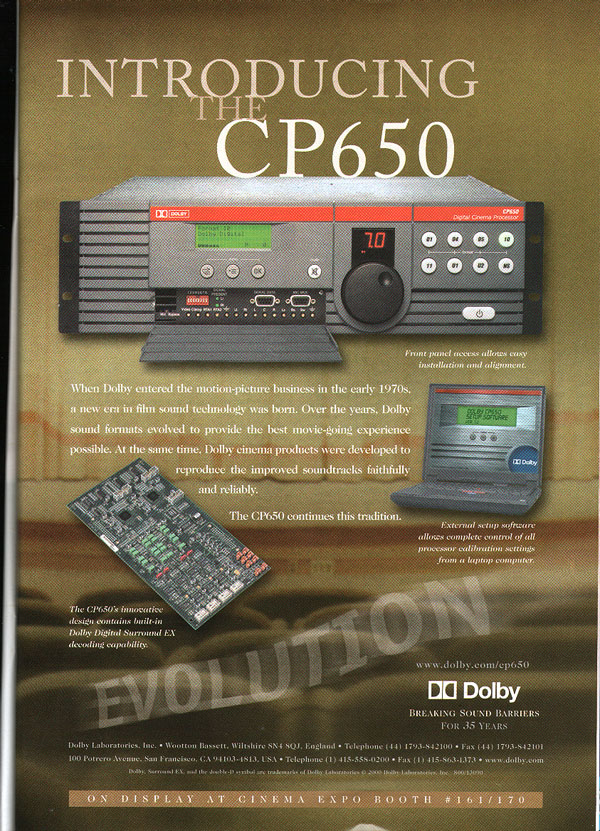
...and here's some more basic info on the unit. CLICK HERE TO DOWNLOAD
Posted by Ken Jacquart (Member # 369) on 06-15-2000, 12:56 PM:
Kevin,
Yup, that's me... although Lonny deserves most of the credit for that. ken
Posted by Ari Nordström (Member # 288) on 06-15-2000, 03:20 PM:
I disagree with the opinion that the bi-amp option for the CP500 is a bad thing. At our theatre, we have the Cat 683, and never once have we regretted spending the extra money. It sounds great! It has to be said, though, that our tech said it was the first 683 card he installed--there had not been any real demand for it... As for sound monitoring, we have two separate monitoring systems. One is tapped from the amp for the hearing impaired and thus is a centre-balanced mix. If everything seems to be working OK, this is what we normally use.
The other system monitors the outputs, after the power amps, of each channel. The LF and HF for each channel can be checked separately in this way. We also use meters for each amp, which is very useful for quick troubleshooting. This monitoring system basically does the same thing that a THX booth monitor does, except that they don't provide the meters, and we have better booth speakers.
Except for the lack of some 70mm sound formats (see my earlier posting on this subject), I really like the CP500.
Posted by Bill Purdy (Member # 202) on 06-15-2000, 03:47 PM:
Note to Kevin Crawford: our Model MS-100 monitor is available with bi-amped inputs which interestingly enough was originally made in answer to customers who asked for it for use with CP-45s. Talk about gilding the lily. In any case, it is a stock item.------------------
Bill Purdy
Component Engineering
Posted by Martin Frandsen (Member # 74) on 06-15-2000, 03:51 PM:
Thanks for the picture, why does the power on/off swicth have to be on the front panel? at least it must be that located on the lower right side of the front. Someone might by mistake hit the power on/off switch when adjusting the volume control 
Posted by Ken Jacquart (Member # 369) on 06-15-2000, 04:31 PM:
Martin,
The Power Button requires a good bit of pressure to be pushed, I don't think it would be possible to accidently push it...
If a fault is detected, it turns red and switches to bypass as it will do if the button is pressed.ken
Posted by Mark Gulbrandsen (Member # 72) on 06-15-2000, 06:57 PM:
I have used the CP-500 bi amp card on a number of occasions and I also like it alot. I ahve two more to install next month. The time align feature works well and the crossover performs flawlessly if used with the correct loudspeakers.
mark
Posted by Steve Guttag (Member # 268) on 06-15-2000, 09:07 PM:
Since Oscar and Bill have chimed in and I don't think USL has a rep on site....yet!Ultra Stereo also has a monitor that will take a post crossover low-level input (bi-amped) and that is the CM-60. You must move the links inside and used the DB-25 connector to use this option.
Of the things that Dolby could have dropped on the CP650 for cost savings, I can very much see the crossover card. It certainly was adequate but wasn't the best and added to installation time (needing to wire two lines from the processor to each amp and to the monitor). It's lack of CD-horn boost and screen loss correction are also minuses. Sure you can use the treble control to kinda make up for it but the Cat. 683 doesn't compare as favorably as other manufacturer's units.
I don't think most people here are getting that the CP650 isn't an upgrade persay to the CP-500. The CP650 seems to be built for the mainstream exhibitor that is running first run films. All of the user formats are "canned" rather than user creatable. This isn't necessarily a bad thing. There is a cost vs flexibility issue and the CP650 is cheaper than the CP500 for an exhibitor and will give them every thing they need to run today's films.
I have not been given any official notice that the CP500 (or CP65, or even the @$@#$ CP45) are to be discontinued as a result of the CP650s introduction. The CP500 is certainly more flexible. The jury is certainly out on how well they handled the digital implementation of the noise reduction. I'm waiting to see, feel and hear it. I do welcome the PC interface for tuning and the P1, P2 LEDs on the front panel.
Steve
------------------
"Old projectionists never die, they just changeover!"
Posted by Russ Kress (Member # 461) on 06-16-2000, 12:51 AM:
We use the CP-500 crossover card. We use the Component Engineering monitor as well.Ken is correct in the fact that the crossover can be made elsewhere by other components, but when setting up multiple systems at the same time, it is nice when the processor "just does it for you".
Now if I can only get them to send the tee-shirts that I was promised for filling out the warranty cards...
Russ
Posted by Kevin Crawford (Member # 469) on 06-16-2000, 01:38 AM:
When did the MS 100 introduce hi freq inputs for the processor? The last installation was with the CP 45. There was a hi freq for the amplifier side, but none for the processor.My company stopped buying those over two years ago. They took the advise of their supplier and starting buying the Big Sky crapola monitor that you cannot hear. A big mistake if you ask me. The MS 100 is a great monitor. Easy to fix, though you rarely have to do that, and you can hear it in the booth.
Posted by Bill Purdy (Member # 202) on 06-16-2000, 09:31 AM:
Thanks for your kind comments, Kevin. The bi-amp input is simply a different input panel which provides the terminals and internally mixes the inputs before they get to the selector switch. It's been around for about a year, but there has been so little interest that we haven't made much noise about it. We have shown it at both Showeast and ShoWest.We also make a similar input module for sampling tri-amped speaker systems.
------------------
Bill Purdy
Component Engineering
Posted by Mark Gulbrandsen (Member # 72) on 06-16-2000, 01:02 PM:
Steve, Ya gotta quit using those old Altec thingys and go to newer type speakers then you'll find that the screen loss is not really needed any more.
Mark
Posted by John Wilson (Member # 269) on 06-16-2000, 11:16 PM:
Thanks for the pic. I wonder, does it play VHS tapes too? It looks like a VHS machine.Any idea on costs yet compared to the CP500?
Posted by Scott Norwood (Member # 30) on 06-16-2000, 11:32 PM:
Hey, Mark --
Don't knock it 'till you've tried it. They're still using (upgraded) Altec speakers at the Uptown in DC (which, coincidentally, happens to be Steve's theatre). If anyone here hasn't been--go! It's one of the best-sounding theatres I've visited. Picture quality is pretty good, too, on a deep-curve Cinerama screen, though it's a bit dim for 35mm but nice for 70mm. They have five screen channels, too.
Does anyone know what's behind the screen at the Cinerama Dome in LA? That's another great-sounding theatre and it wouldn't surprise me a bit if they were still using A4s.
Posted by Kevin Crawford (Member # 469) on 06-17-2000, 03:17 AM:
Bill,Is there an upgrade for the older MS 100s. I think I could con my people into buying a few of them, if they are realatively cheap.
Thanks
Posted by Joe Redifer (Member # 3) on 06-17-2000, 03:18 AM:
Dolby just called me and yes, the CP650 DOES indeed play VHS tapes, and also S-VHS tapes in the psudeo-SVHS playback mode, in addition to providing all of your cinema sound processing needs. It also has a modem that dials Dolby up every night at 3:00am and tells them what tapes you are watching, so they can send you marketing material based on what movies you like.There are also rumors of an upgrade card to allow you to play PlayStation games. Sony is fighting it, however.
Posted by Steve Guttag (Member # 268) on 06-17-2000, 08:57 AM:
Scott, Scott, Scott....<sigh>Since I never mentioned that I used Altec speakers (on this thread, at least), lets just presume, for a moment, that Mark and I know each other and he knows I use Altec in some locations (where appropiate) and that this was a little jab for those in the know. Mark has even mentioned that he has been the Uptown (at least to see Gettysburg).
Sooooo, that said IT WAS A JOKE! Cuz, if using an "upgraded" Altec with Mantaray horns (constant directivity), they would need the same kinds of boost as say JBL. Futhermore, if the HF section was truely flat response, then putting a screen in front of it that attenuates anything above about 9KHz would attenuate ANYTHING (old, new or what have you). Of course you could start to measure perforation spacing on the screen to optimize the screen loss for the particular characteristics of your particular horn/driver combination to minimize the loss.
So Scott, do you see just how a joke fizzles when one has to explain it? God knows, I've stopped laughing about it already. <sulking>
This could have brightened my day :'(
BTW. The Uptown's Altec A-4s...are stock!<surprise> They are running with genuine Multicells (a pair of 1005 horns per speaker) and 515B bass drivers. When I "upgrade" an Altec, I retune/report the cabinet, switch the driver or recone it to a 515G series, change the diaphragm over to a 299 series and change the horn to a Mantaray. Now if you wanted to hear a partially "upgraded" Altec. The Senator is the place, they have JBL HF sections but the bass cabinets and drivers are Altec (515-16G). The Boyd in Bethleham, PA has fully upgraded A-4s. The Lyric is an example of fully upgraded A-5s.
Have a happy day :-)
Steve
PS, anybody reading this with the thought of anger is reading it wrong.
------------------
"Old projectionists never die, they just changeover!"
Posted by Curtis Barnes (Member # 471) on 06-17-2000, 02:25 PM:
I wish my name was Steve Guttag.
Posted by Mark Gulbrandsen (Member # 72) on 06-17-2000, 07:20 PM:
Of course Scott I was just taking a jab at Steve. Didn't you see the winkie eye face ? Actually I'm quite fond of Altecs and A-4's in particuluar. Fortunately Steve gets to do alot of work with them but in my mainstreem installations I don't. I do however get to work with the big JBL 3 ways on occasion and that more than makes up for my lack of Altecness. The 3-way JBL's are amazing!
Mark
Posted by John Wilson (Member # 269) on 06-17-2000, 08:33 PM:
JoeI don't suppose they mentioned whether or not it'd have a socket to play the old Nintendo games? I really miss that old Star Wars one.
If you look really carefully at the picture, you can see an old Neil Diamond 8-track cartridge showing on the left hand side. At least they thought of that... 
Posted by Martin Frandsen (Member # 74) on 06-19-2000, 07:37 AM:
Look's more like a HAM-radio to me ------------------
It's the new small talk. You do it so awfully well! - My Fair Lady
Posted by Bill Purdy (Member # 202) on 06-19-2000, 10:01 AM:
Kevin, yessir, you can easily upgrade. All of the new features are a part of the input assembly. You get the Bi-amp low level inputs (for L,C, and R) and the Tri-amp inputs for all stage channels. You should be able to do the conversion in less than an hour, without a soldering iron. Pricing will depend upon your supplier, but they are not expensive. It is called the "MS-100 Bi-amp input module".------------------
Bill Purdy
Component Engineering
Posted by Kevin Crawford (Member # 469) on 06-19-2000, 02:04 PM:
Thanks Bill.Now if only the company will buy them.
Posted by Stephen Jones (Member # 16) on 06-23-2000, 07:46 AM:
If anyone is interested the CP650 is now featured on Dolby's web site.As usual spec's etc are available for down load in pdf.Stephen
------------------