 If the heat sinks are too hot to touch (power off and discharged caps please!), the diodes will quickly become DIE-odes.
Nothing beats a good old fashioned Century projector. (That is, not weighing more than a damn car! hint, hint)
I have never had a Christie diode fail on me.
 but anyway the Xe-Tron just handles film much much better so much less tension in the travel path and the platter brains themselves just resist wrapping.
About your diode problem:
Check the ventilation on your lamphouse. I have a Christie console which used to blow a diode about once every 18 months. We finally found out that the vent fan on the roof was not operating; only the small fan inside the lamp. Fixed fan: No blown diodes for over 3 years now.
Mike
Similar situation to the problem Randy S. was having with the CFS consoles in another thread --- those heat sinks need air flow to keep the diodes cool If the heat sinks are too hot to touch (power off and discharged caps please!), the diodes will quickly become DIE-odes.
------------------
John P. Pytlak, Senior Technical Specialist
Worldwide Technical Services, Entertainment Imaging
Eastman Kodak Company
Research Labs, Building 69, Room 7419
Rochester, New York, 14650-1922 USA
Tel: 716-477-5325 Fax: 716-722-7243
E-Mail: john.pytlak@kodak.com

Also i have used the speco 271's. I hated those. they brain wrapped all the time at just the littlest hint of static so i invented an brainwrap stopper that has actually proved itself to be 99% effective at a cinemark 20-plex.
i have also used cfs 4500 and 7000 watt lamphouses which i did not enjoy. the diodes would go out and when one went out the others went weaker and on top of that they were in an inconvenient position especially if you blew one out in the back. oh yeah never put a christie bulb in there unless you want to have major flicker.
the best projector heads i have used were century's. the smoothest projector and picture i have ever seen compared to a christie fisher price rubber band projector that in my theory just tries to shake around the picture as much as possible. ugh.
i am now using strong highlight series 1 lamhouses. awseome design on the power supply but you cant focus them worth a crap as well as they are underpowered.
------------------
--"That's my story and i'm sticking to it!"--
On the Strong Highlight I's You should be able to get plent of light out of them, but they are difficult to align well, they were pretty notorious for that. Hoewever they still don't compare to the Christie SLC consoe for light output.
I too have always prefered the Century projector, after working with Christie, Simplex and Cinemacanica, I found them the easiest to maintain, and operate. And the projected image was far steadier than any of them. My favorite is still the JJ.
Rick
I have yet to talk to anyone that has worked with a Christie and not prefered it over any other platter.
Even Christie must admit this. But who knows--maybe they'll surprise us by coming up with an LED that never needs to be adjusted.
I have my least troubles with the SPECO LP-270.
I have worked with Christie's AW-1, AW-2 and AW-3 (plus the AW-35 and AW-370 varients). There are a lot of strengths in it. The concept that each platter is independent on all modes is it's biggest sell point for me. LED/Cell drift it probably the biggest continual attention (and it appears that problem is soloved with the new LED modules and driver boards). Generally, when a Christie comes out of time, resetting the LED adjustment will put it back without having to mess with the motor speed controls, though I find most techs go for the motor speeds prior to checking the LEDs.
I often find that the payout arm return spring is set too high from the factory causing the film to wrap a little since it can't pull the arm over.
The early black rollers couldn't turn true to save their lives. I have always used the clutch spring (when I was the operator) on the payout cluster but change it's tension depending on platter distance to projector. I can certainly understand, however yanking them when they can't be given regular attention. The feed fingers have always been a sore spot for me, particularly with 70mm. The hour-glass design can and has allowed the film's image are to rub and get "angel scratches", depending on how long the film has been running, how much heat is absorbed, how much curl is in the film...etc. The old guide posts on the dust plate certainly would rub the middle of the picture.
The bearings on the platter should have been rethought. The needle bearings are a great idea for where the platter rests, but the bronze bearings for the platter rotation suck. There is no method of lubricating them once assembled without removing the deck. Many times I have had the top bearing drop down and cause the platter to rock. They would have been better off using sealed ball bearings for platter rotation and kept the needle bearings under the deck.
The little ballpoint pen spring in the take up arm mech. is a bit fragile and often gets deformed quickly depending on the quality of operators (if they let the t-u arm pull back to the vert. post they will die. The T-U roller custer stop pins often die a horrible death at the heavy hands of poorer operators too.
Probably one of the biggest design flaws is the lack of fuse/circuit breaker in the system (and they got UL listing with this?). Sure, the current motor cards have fuses but I mean for the platter as a whole, and who hasn't gotten shocked when pulling a motor card with the power turned OFF? The lights should really have been fused from day-one. I have had several entire platter systems fail because the little 1822 lamps (that light the decks) short out and take the step down transformer out. More than once I have put double fuses on that line (one on each leg of the secondary that feeds the lights), particularly on the 5-deck platters since two screens are at stake (and because of Murphy, that is the most common place I have had this sort of difficulty).
There, now I have picked on the beloved AW-3. ;-)
As an operator I had no problems whatsoever running them (other than the feed finger issue listed above). Never lost a show with them, built up and broke down faster and smoother than any platter too. They don't have support ribs below the deck surface to create little wind storms (or catch your finger). Their current rollers turn true and don't chatter and would be welcomed in any booth I operated (that had platters that is).
Then again, I would take Christie's, Strong SCDC (a jewel of a platter, fastest install and no maintenence), Kinoton (if you can afford it, probably the best platter) or the SPECO offerings.
I generally find that once you reach a certain level of quality in a product (the thing HAS to be at least reliable, and not out and out damage film as a course of operation) that a good operator can make ANY of the products run well.
Steve
------------------
"Old projectionists never die, they just changeover!"
You've had an entire AW3 platter system fail on you yet you've never lost a show with one?
I have never had the motor card shock me even when I've pulled it in or out with the platter ON (with the deck disengaged) but I always have the power off anyway just to be safe. And I always wet my fingers first and make sure to touch the contact points as a rule.
Christie sends me special "Precalibrated for Joe Redifer" LED assemblies that are programmed to drift just to keep me on my toes. That way I look incompetant that I can't even keep a platter timed. It's a symbiotic type of relationship
First, yes I always turn the power button off before I go pulling cards, but I've never been shocked. I do agree, a fuse is a very good idea though.
Now back to my favorite topic...the leds! Three to four weeks ago I timed every platter in the building personally. That being said, last week I had to retime two decks, as they were running more than 10RPM faster than I had set them. Yes, I always check the led first (very important to make sure the thing is going to run "sluggish" so it won't toss a print) and it was absolutely dead perfect on one platter, so the card had to be adjusted. On the second platter, the led was way off and readjusting that put the machine back into time. Generally though, I do find that the led drifts very bad.
Beware of the clearance on that takeup arm "finger"! I have discovered it can catch on "the other finger" on the filter at it's edge and cause the feed arm to slam hard from -10% to it's limit, causing the takeup arm to perform complete stop/starts! Very, VERY bad for a long movie such as Gladiator. This is of course easily remedied, but beware as some machines are coming off the assembly line like this.
We have also found the Christie center rings to be, well, a bit weak as of late. Dwayne broke one of these things in half pulling it from a print a few weeks back! (Joe, you got a pic of that?) But the biggest problem we're finding is upon breakdown the ring will "collapse" slightly and cinch scratch the trailers and first reel of the feature as it is being broken down!!! Our temporary solution has been to stick one of those soft plastic DTS cd cases in the opening and it works quite well. Supposedly Christie has made some sort of latch for this, but we haven't received it yet.
I also don't like their new horizontal MUTs one single bit. If the traditional MUT has been discontinued completely, I will no longer push their platters. Otherwise, for the performance vs. dollars, the AW3 series cannot be beat!
Before I finish, I might note that until I started to work with Joe's AW3s that none of these problems have ever been an issue before. I too think he has either gotten "special" platters or quality control has gone down the toilet. These things are requiring monthly calibration and his complaints are valid. Still though, I don't like the Xetron, Strong or late model SPECO platters and the Kinotons are too expensive.
"I" have never lost a show due to having a transformer melt down while I was operating them since I have personally never had one melt down. But I do work for a service company now and in that relationship, I have had the transformer go as well as known of other transformers going while working for various exhibitors.
Brad. What comeback? That you had an instance where it was indeed the motor card causing the speed drift instead of the LED/sensor? I merely said that one should check the LED settings first and that most techs reset the motors first. The rest of your comments seem to be adding to the list of complaints on the AW-3.
There is no doubt that one could pick apart any platter or product and I could understand your position of desiring the AW-3 over the rest. I really like having independant platters. One of the nice things about the SCDC strong is that the payouts no longer reference off of the T-U and run independantly. There still is a common T-U assy. that can make life miserable if it goes cablooy. I will say that the Strong's SCDC never needs calibrating, it always works well.
Steve
------------------
"Old projectionists never die, they just changeover!"
I also agree having decks independent of each other is a GOOD feature, especially when utilizing the Goldberg retractable split-reel for trailer changes. When doing this you need the pay-out deck to spin slightly faster than the take up deck (12.5 " diameter of film vs. 14" diameter of ring)on start up. Trying this on a Xetron platter in not pretty. Good design by Cristie.
Yes the new Christie MUT is the funky one pictured below. I'm sure it can probably handle a 6000 foot reel, but try to load off of a 16,000 footer. I don't think it can be done. Besides, their new design FORCES you to splice ON the platter. That's just a plain stupid design in my book. It looks to me like a similar incident happened at Christie that Dolby went through with their CP45s. Dolby just turned their extra CP45 chassis into EX units and it looks like Christie took a bunch of overordered hand trucks and converted them into MUTs!
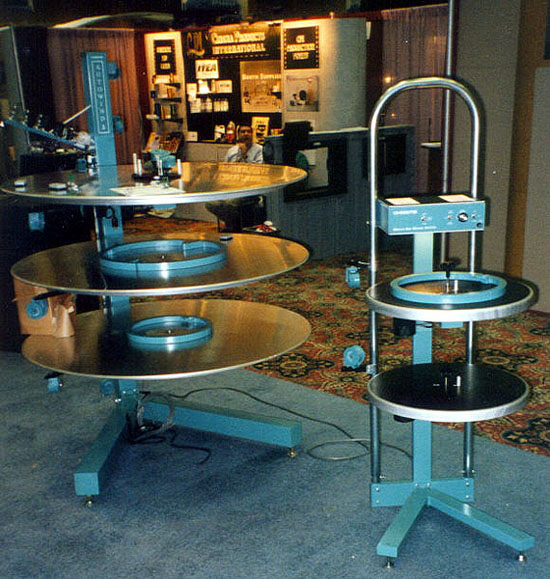
Steve,
The Strong SCDC runs too damn fast and the center ring is too small of a diameter to begin with. They need a larger ring (Christie's diameter or slightly larger) and it needs to be able to run just as fast as required to pay out...and no more! This should be a user adjustable setting. I know of no way to prevent a Strong platter from spinning faster than a certain setting (however fast that little teeny ring requires). Also, (at least on the older units, I haven't tried this on the new ones) you must manually brake the platter during breakdown with your hand. What a joke! This requires constant attention and if not done carefully will damage the film. Of course most people don't bother to think about that, since they won't play it again. Lemme see, what else. How about that little takeup elevator? Can't that be manufactured to be an extra 6 inches (at least) taller? And why must it be right at the floor? The film has to come all the way back up to the top anyway. How about putting it halfway up the post to make threading easier? Why are certain selected rollers missing a keeper bracket/roller of some sort? Why are the rollers so small? Why must the design be so the operator must go over an extra roller when taking up onto the top deck? Christie's got the best roller design hands down (green rollers). Let's lose the bearings. I've had those platters a measly 8 feet away from the projector and the bearings on payout spin so freely that the weight of the film will cause it to drop all the way down to the point of dragging on the floor. Can the center feed be redesigned so the film can be "placed" in the track like a Christie? If for some reason the show must be stopped, the film must be cut or finagled to such an extent it will leave a mark on the film. Let's also lose the braces (like SPECO uses) underneath the platter. Over time, the deck will warp and if the tuck is not ON TOP OF one of the braces, the tail will fly right out. This isn't even getting into the head injuries when one must work on a lower deck during a show. Finally, my biggest beef with the Strongs is there is no provision to adjust the final roller's alignment in respect to the takeup platter's surface. I've seen far too many prints get those characteristic "platter scratches" from dragging over the edge of a Strong deck. I mean really, the film should not come into contact with the deck until perhaps the last inch or two before it stands completely upright and wraps around the film roll. Most of these come from the factory where there isn't but 1/8" clearance at best. There's just no excuse not to have some method of making those user adjustable.
Sorry for the slams Pat, but I just hate the Strong platter design dearly. Correct what I pointed out above as well as making a vertical MUT and I'll be all for it. (And don't forget to add the two threaded holes like on a Christie to mount a film cleaner. )
The SCDC payout actually only really goes as fast as needed and, as I understand it, changes ranges thoughout the show so as to accomodate that it doesn't have to go as fast.
The take up ring can be changed if it such a big concern. That is more of feature thing than something that is inherent in the platter design. Having a larger ring would suit me just fine. Christie even came out with a Sooper ring for theirs.
The take up on the ground...got no defense for this one and don't really care. The extra roller for the top platter take up, so what? Haven't had any problem with it yet...though on the marvelous Christie take up I have had to replace countless stop pins that have sheered off or came out.
The take up rollers are adjustable (height) with slotted brackets.
Got no comback on the breakdown freewheeling thingy, but what do you expect from vaccume cleaner motors? The drive system with the two tires does need some work and how it engages the deck. But then again, I have changed countless Christie drive pucks with their constanly changing compound of the week or changing diameters.
The noise level of the Strong is definately higher than many platters, especially the Christie which runs quiet (with the right drive pucks that are round).
Sure the decks on the strong have those support ribs but then again the Strong is a significantly cheaper platter and based on one of the cheapest of them all (the Potts microswitch).
As far as the centerfeed goes...There is plenty of blame to go around. For the Strong...how many varients have their been? (Microswitch, carbon-pile, magnatronic (potts), optical (potts), phase-control, SCDC, and possibly others). Sure the film is captive but it doesn't unthread itself either. The Christie centerfeeds can and do unthread themselves if the curl of the film is right. On the main cluster it is only sprung from underneith causing the film to be pinched harder on the bottom and hense can be pushed right out of the top. This was a bigger problem with 70mm during the summer if emulsion in or winter if emulsion out. On of our operators put a plate across the guide posts to prevent it. Probably Kinoton wins the uncluttered centerfeed award...something like two rollers and no feedfingers and anti-wrap peelers.
Oh, and to the best of my knowledge, the "MK" make up table has no immediate plans for leaving us. It will be a market driven thing. The new gizmo allows for rewinding. They drilled in pins for a center ring so you can make up trailers right on it. There is talk of putting a clutch on the drive table so that in a pinch (when your #1822 lamps kill your transformer) it will function as a 6000' horizontal reel unit!
Oh, has anybody used Christie's new shutter design...the one that is half silvered half clear but with the same heat transmission on both halfs so the film doesn't get thermally shocked? I'm just curious as to how well it works (or doesn't)
Steve
------------------
"Old projectionists never die, they just changeover!"
Yes, there are people who have used Christie's new shutter design, like the guys who work at Christie. I have not used it, but will post a full review once it is available for the masses. Provided I get one, of course.
Ok, first things first, there is a link at the bottom of the reply screen for longer threads "click here to review this topic" that will help you out in the future.
Now, the SCDC payout does indeed run faster than is required. I think you are misunderstanding my words there. I didn't say the platter would overfeed film, just that the "capability" of the feed deck spinning faster than is "necessary" for startup is a bad thing. Make sense? For example, 22RPM is plenty of speed for an AW3 with it's standard center ring, yet every tech seems to like setting them between 30-52 RPM! (Yes, I've seen 52RPM) Rarely do I ever even find them set at a measly 25RPM. This is what causes most people's problems with "thrown" prints and wraps. If Christie would modify their cards to allow for a takeup speed and a payout speed, that would be fantastic!
The desire for a larger takeup ring is to minimize curl of course, but most importantly to make it so the platter need not run at Warp 5 to be able to start up. Again, this goes back to the above argument. Christie's new mega sized center ring only requires 15RPM for startup! Think about the end of a Costner movie and how much smoother it would run if 100% on the feed was ONLY 15RPM! At that speed, it would be virtually impossible to toss a print.
Strong's extra roller for takeup on the top platter IS a problem for many, er, ahm, "projectionists" today. Yes I know it wouldn't be a problem for you, me or most anyone here on this forum, but I think you know the type of operators I'm talking about. I go into these theaters and see them running onto the bottom platter threaded through BOTH rollers (can we say "scratch"?) and I see film being stretched onto the top platter sideways because the operator skipped the second top roller. Having two different threading paths is yet again, a very bad idea.
I've not noticed the adjustment on the takeup rollers, but I also don't have a Strong platter handy to check it out. Is it adjustable enough so I could actually over adjust it so the film wouldn't even lay on the deck? If so, then the problem here is the way they are coming out of the factory.
Christie has supposedly corrected their "silly putty" motor drive belt/pulley (whatever you want to call them). I do agree though the ones from the last few years are a complete joke.
I cannot argue the price thing on the support rib argument, but I would think it wouldn't jack up the cost "too" much for another sheet of flat material to be mounted on the underside to prevent head injuries and breakdown wind.
Centerfeeds. You must run a lot of really crapped up film, Steve. I've not had the problem with film flying out of the Christie brains.
The "MK" table. It may be here to stay (yak), but is the GOOD old fashioned model here to stay as well???
I've heard of the shutter design, but haven't had the chance to play with one yet. I hear it increases projected resolution. Still, until I try it, oh well.
I think the film coming out of the centerfeed thing is somewhat regional where humidity varies greatly.
Steve
------------------
"Old projectionists never die, they just changeover!"
Perhaps the film was not threaded 100% correctly, and when pulled it eventually just flipped out of the rollers.
------------------
Better Projection Pays!