This is topic Speaking of Failsafes in forum Film Handlers' Forum at Film-Tech Forum ARCHIVE.
To visit this topic, use this URL:
https://ft-forum.com/ft/cgi-bin/ubb/ultimatebb.cgi?ubb=get_topic;f=1;t=001154
Posted by Paul Konen (Member # 41) on 07-04-2000, 10:04 PM:
At Cinemark, we are using FM-35 failsafes.Tonight, Patriot in our big house continued to payout on the floor for about 10 minutes before the UB for that side noticed it and stopped the show. We did not get a chance to look at the indicator led's for the failsafe to see what it was seeing at that time.
It was interesting to see the film continue to spew onto the floor, running through the failsafe like nothing had happened.
I think what happened though was the takeup arm was wavering back and forth like the LED was unstable (Christie AW-3's) and it eventually went all the way back and stopped.
Paul.
Posted by Randy Stankey (Member # 64) on 07-04-2000, 10:23 PM:
I've seen FM-35s do that once or twice. Usually the film looses take-up tension but the film is still in the "groove".Make sure the film wraps at least 1/2 way around the black roller. If you lose tension, it'll "bubble up". (Set lower magazine roller back as far as possible.)
Second thought... Are you sure the FS wasn't bypassed? Some of our guys would do that when the FS sensor acted up. Instead of cleaning it, they'd bypass and not tell anybody. If you bypass and problem happens, the proj. won't shut off.
Posted by Brad Miller (Member # 2) on 07-04-2000, 11:53 PM:
I found on the Simplex XLs and FM35s at the Cinemark Hollywood if the cue detectors were positioned (as that fine chief installation tech did) in a certain position, they would NOT sense the difference in film running through to a takeup platter vs. film running onto the floor. A simple repositioning forward or backward completely solved the problem.
Posted by Bill Purdy (Member # 202) on 07-05-2000, 09:14 AM:
You are all on the right track, particularly Brad. What sometimes happens is that when the take up stops for whatever reason, the film will continue to feed straight down past the cue detector module and onto the floor while a non-moving loop of film hangs over the black roller. The solution we would love to have people use would be to incorporate the motion sensing into their automations. (This has also saved more than a few projectors from stripping gears.) The trouble is, most automations do not know what to do with this information, and getting them to do so usually takes some sort of kluge with relays and timers etc. Our TA-10, of course, does look at that information.------------------
Bill Purdy
Component Engineering
Posted by Gordon McLeod (Member # 33) on 07-05-2000, 11:39 AM:
Motion detecting failsafes are not new
I still find one of the most reliable was the one supplied by Esoldomatic with the cinemation. It was a roller that was filled with roller bearings that acted like a centrifugal switch they were usually very reliable
Posted by John Pytlak (Member # 331) on 07-05-2000, 12:26 PM:
Just to clarify, since there are two "failsafe" threads going:There are two types of "failsafes", and BOTH should be used in automated platter situations:
1. A film break / run out detector, often combined with a cue detector. These are usually located just as the film exits the analog soundhead. The film runs past a motion detector (like the Component Engineering FM-35) or microswitch roller (e.g., Kelmar), which detects when the film stops moving or has broken. This type of detector is useful to shut things down after the film has run out, if the film is not being properly taken up, or if a film/splice breaks upstream. They help avert the disasters of a broken splice in the projector causing a film pile-up in the projector, or running a feature onto the floor if the takeup fails.
2. A tension-sensing failsafe. If the film jams in the platter, or if the film fails to feed properly, this device senses a buildup in tension and shuts down the projector before the film can damage anything. In their simplest form (e.g. AVASK unit), they are simply a spring-loaded roller that trips a microswitch when tension builds. Other units use a film carriage (often on the platter column) that is pulled up by excess tension, tripping a microswitch or sensor. Tension sensing failsafes that use a carriage usually allow enough slack to have the projector coast to a stop without damaging anything. Tension-sensing failsafes are essential equipment when using polyester film, because if the film fails to feed properly from the platter, the film will usually NOT break, but the tension buildup will stretch the film and often WILL break something else.
------------------
John P. Pytlak, Senior Technical Specialist
Worldwide Technical Services, Entertainment Imaging
Eastman Kodak Company
Research Labs, Building 69, Room 7419
Rochester, New York, 14650-1922 USA
Tel: 716-477-5325 Fax: 716-722-7243
E-Mail: john.pytlak@kodak.com
Posted by Francis Casey (Member # 514) on 07-05-2000, 08:18 PM:
Gordon
I remember the Esoldomatic units, we had many of them in our circuit years ago and they were very realiable ; except when the projector leaked oil and they got gummed up , then i had to clean them out .Ocasionally i would loose a pin or two when reassembling them , very frustrating at times .
We still have a couple of Cinemations in operation to this day .
Francis
Francis
Posted by Christopher Seo (Member # 7) on 07-06-2000, 05:02 PM:
I have an old Christie 35/70 failsafe which has two pair of wires. One is for a microswitch connected to the roller arms that ride the film, and the other pair is stuffed into a separate roller, one wire on each side. Is this similar to the Esoldomatic design?
Posted by Gordon McLeod (Member # 33) on 07-06-2000, 05:06 PM:
No the essoldomatic is a single aluminum roller that the film just wrapped around and when it was turning at the correct speed it worked
The cue sensing was originally a blue cruzette prox and latter we converted most to micro switch or honeywell proxes
Posted by Kevin Crawford (Member # 469) on 07-07-2000, 01:35 PM:
I had a similar problem with the FM 35. I called Component, the guy I talked to D. Olson, said that the thing was aligned too well. I needed to make sure that it would unthread itself. Or I could put a piece of cardboard under the failsafe, so that as it came out of the failsafe, should the platter stop, it would pile off to the side and unthread the failsafe. I ended up moving the entire failsafe to the extreme left. This seemed to solve that problem. Good luck.
Posted by Joseph Pandolfi (Member # 223) on 07-07-2000, 05:59 PM:
We have Christie "dual" failsafes in our setup, which I believe our head projectionist thought of the idea and Christie followed up with a product. This is a setup of roller sensors that ride on each side of the film as it exits the bottom sproket. This would elimate what would be a disaster if the film would tear down the middie and one side of the film would wind up on the platter and the other side would pile up on the floor.
Posted by Ethan Harper (Member # 472) on 07-09-2000, 02:02 PM:
I too have used the FM 35's. I have experienced some wierd problems with those. I can remember a couple of times where it would shut off the projector but the film was still threaded through as if there was no problem. But, if we switched it out with aother projecotrs failsafe then it would be perfect. Then again i would alos like to believe that the old booth where i used to work at was haunted. Like this one time where a projector that was shut down powered itself up and shut down again. (trrue stroy i have witnesses). anyways that is beside the point. I have seen a couple where a splice would cause the film to jump off the sensors. The failsafes i am using now are a little bit different then what i have seen described. I use laserbarcode automation, so i have these old failsafes that came with it. The film runs on two bearings that hold these two flag looking things down. On the other side of the flags there is a barcode so when ever the film breaks, the flags swings upward and the barcode scanner reads the cue and shuts down the projector and sends off this most annoying chime.
------------------
--"That's my story and i'm sticking to it!"--
Posted by Brad Miller (Member # 2) on 07-09-2000, 03:36 PM:
Ethan,That's Strong SPA-5 automation with upgraded failsafes (courtesy of UA). You've got the original "A" version of them which can only handle 4 cues, but does scan each bar code 5 times. The later versions which could read up to 99 bar code cues only scanned each cue one time, so hope it doesn't miss! This was installed into UA theaters courtesy of Gary Stanley's design, built by Kelmar. Later this was replaced with a visible light and at that point it was an incredibly efficient and reliable system. Basically the cues tell the automation what to do, not the other way around. My only beef was those HUGE cues which left something to be desired on the screen as they passed through.
Here was my solution:
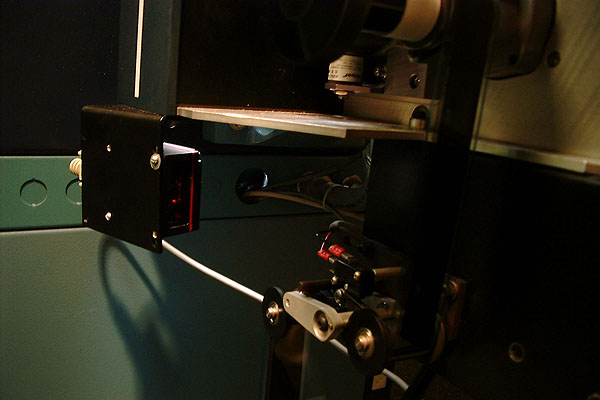
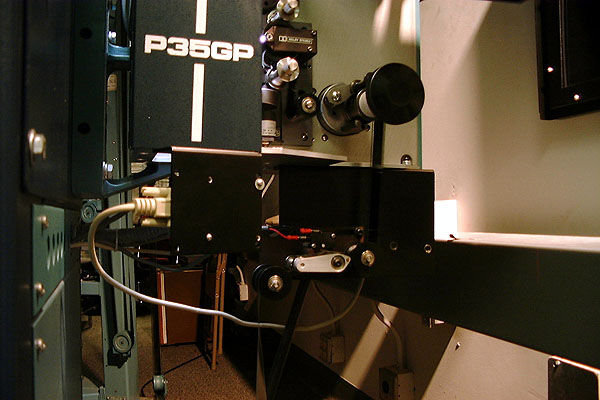
Basically I just modified the mounting bracket and had them set to scan the "S" edge of the SDDS track. It worked flawlessly and did not even shift the picture slightly as the cues passed.
Tip: to anyone using the older "cream colored" scanner boxes, if you get "NT Audio Visual" blue mylar framing leader (extremely common), you can put your head up against the scanner and look at the film with your hand behind it and clearly see the "invisible" led light to check alignment without that horribly expensive viewer. (Note: you MUST put your hand behind the film where you will be looking.)
Posted by Kevin Crawford (Member # 469) on 07-09-2000, 08:12 PM:
UA is responsible for those damn bar codes. It figures.Those things are a pain in the ass to get off of the film. The glue really sticks well.
Posted by Brad Miller (Member # 2) on 07-10-2000, 12:11 AM:
Good UA projectionists lay a piece of splicing tape on the film and place the barcode on TOP of the tape.
Posted by Dave Cutler (Member # 515) on 07-10-2000, 05:10 PM:
I worked at a UA once that used those Bar Code readers, never did like them much. They are much more intrusive than the simple cues I use with my FP-350's (Strong).
Posted by Jason Burroughs (Member # 68) on 07-10-2000, 08:45 PM:
Brad,
Who finally figured that out, putting the cue on top of the splicing tape? 
Posted by Brad Miller (Member # 2) on 07-11-2000, 04:33 AM:
Yes Jason, you get the credit. 
Posted by Jason Burroughs (Member # 68) on 07-11-2000, 02:40 PM:
Brad, I like what you did the with Barcode scanners there at the Galaxy, they work really well and are not noticable on screen. I suppose cost factors are the main reason UA has now switched to a simpler proximity detector failsafe and automation combo. I really liked that automation