
Has anybody ever seen or had to deal with a tail wrap ever?
I have never seen one until today when one of our projectionests called me up to help fix a problem with the projector. When I got up there I saw the tail of the film was pulled into the center of the film and wrapped around the paying out film over 30 times. Luckly he cought this early before it caused dammage to the film. To pull out the mess we had to cut the payout film to untangle it from the tail of the film. Then we took the 50 feet of tail that was wraped around the payout film and straightened it out and had to place it on the floor. Then we spliced the payout film back togeather. As the projectionest started the movie the other guy had to guide the tail back on the platter and place the suction cup back on the film.
Only 30 min of the film had gone though the projector when this happened. It took us about 5 min to get the film back in running shape and started again.
-Mike
If there is a very slight, brief resistance (e.g. residual joining tape causing a little bit of stickiness) then the device will absorb the shock without operating the microswitch. But if there is a very serious wrap, the roller will become detached from the magnet, rise up the column and operate the microswitch, which shuts down the whole system, raises the houselights and goes to nonsync. An alarm then rings in all the projection boxes (we have three, with a lot of stairs and corridors between each, and so cannot constantly be monitoring all our projectors) and we then go and sort the problem out.
This detector has been triggered 2-3 times now and has always shut the system down before any significant damage was caused to either the film or the feed unit.
Ours were supplied by a British company called Sound Associates, which also makes them for Christie platters. See www.soundassociates.co.uk. Sorry - don't know anything about US availability.
1. Take a scrap piece of film, wrap it around the outside of the film, tape it to itself and lable the film band as belonging to that print. Everytime the film is over, just place the film band around the print.
2. Bevan-Poo
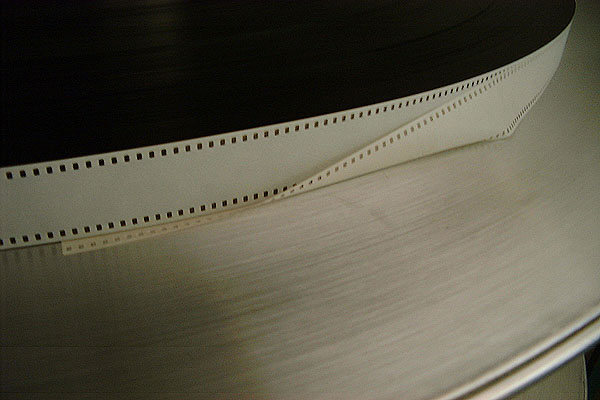
I have found with un-buffed platters that have developed a glaze on the surface, the following type of tuck (inward tuck) seems to be the only way to make them stay put. Note this tuck is NOT pulled tight. If it was pulled tight, the film would have a stronger tendency to straighten out and become untucked, causing a tail wrap over the edge.
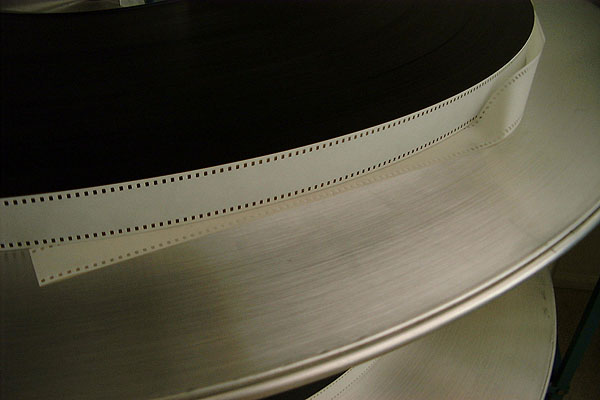
However, if the platter deck surface is not scuffed up or glazed, this type of tuck (outward tuck) is the superior method. Note this tuck IS pulled tight, for in this instance, the film will have a natural tendency to pull inward and stay put instead of flopping over the edge of the platter.
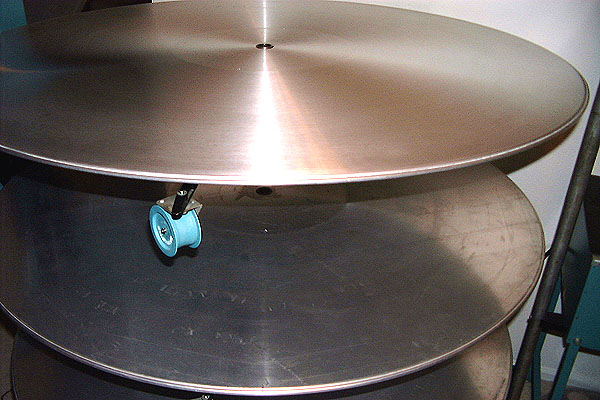
Here is what I am referring to when I say "buffed platter". Look at the middle deck in this picture. It is a platter that is less than a year old. Now look at the top deck. That is a "buffed" platter (as performed in the "tips" section of this web site) and was equally as disgusting as the middle platter before buffing. Buffing the decks places very tiny grooves in the surface, which work like grooves on a wet road to help you keep your car on the road. In this instance with even a platter timed not so perfectly, the film will stay put!
Regardless, labels should NEVER be placed on the last 5 feet of the tail. The tape makes the film too stiff and will in many cases cause the film to try to "straighten itself out", pulling the tuck. Also, labels generally have a tendency to catch on the final layers of film it is sitting under, also causing a wrap.
Operators using SPECO and other platters that use "braces" underneath the platter decks must be absolutely certain they put their tucks ON TOP OF one of these braces. The decks tend to "sink" between the braces and tucks will not stay put.
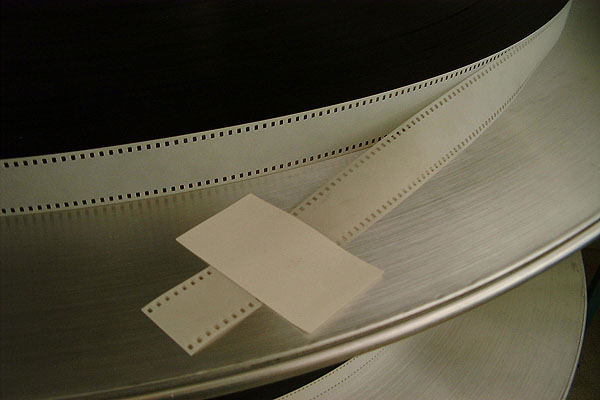
The picture below was simulated on a Christie, but will ONLY work on SPECO platters due to their magnetic decks. What you do is call your local pizza shop and ask for some "business card magnets". Then secure the tail like pictured below. This works ABSOLUTELY FANTASTIC on SPECO platters due to their sluggish start/stop motion.
Failing to add extra tail leader is a very bad thing for two reasons. First, the end of the credits tend to get scratched and chewed up. Second, the polyester stocks that are currently being used to print on are very stiff as opposed to acetate base film. Thus, they will act like having a label on the end of the print (but not quite as bad). This stiffer film likes to straighten itself out and once that happens, your tuck is gone. Large 1000 foot rolls of clear (or in this case white) leader without frame lines can be had for under $50 and will last an awfully long time. As an added bonus of using acetate tail leader, if those last couple of wraps of film get tangled (which is where it generally happens), the "extended acetate tail" will just break.
I'm not a big fan of suction cups, Stick-A-Poos or Bevan-poos (although if you prefer to use one of these, the Bevan-poo is clearly the best). My reasoning for this is the poos are only half as tall as the film it is trying to hold! If the tail end of the film has a warp to it, it can fly right over the poo. I don't like suction cups because the suction always wears out before the feature is halfway over. Taped down, the suction cups do a good job though, but can make that platter surface not so pretty. A major problem with the poos and suction cups is if the feed arm ever swings into full throttle and the platter jumps to warp speed, it will leave the print sitting still (kind of like ripping a tablecloth out from under a table full of dishes very quickly). When this happens, poo or suction cup, you will get a tail wrap. Another big negative with poos or suction cups is if the print should get off center for any reason (generally caused by an operator pulling the center ring out by one side, thereby pushing the film slightly off center by the opposite edge of the ring), what will happen is the poos or suction cups are no longer "against" the film roll and the tail is free to fly.
Film "belts" (where a loop of film is spliced together to be the same size as the outer diameter of the film roll and is then placed around the print) do work extremely well, but are a major pain to put on and take off. Also, as different platter decks take up with slightly different tension (most notable on the AW3s), the belt will need to be a different size.
All in all, the simple tuck is the easiest way to go and I've ran forever with them without any problems. Just make sure your platters are timed properly and you buff your decks...then forget about it. 


You can also make extra magnets out of (clean) plastic Coke bottle tops. (The screw-off kind from 20oz plastic bottles.)
Just get some donut magnets and glue them up inside. We have made a bunch of them.
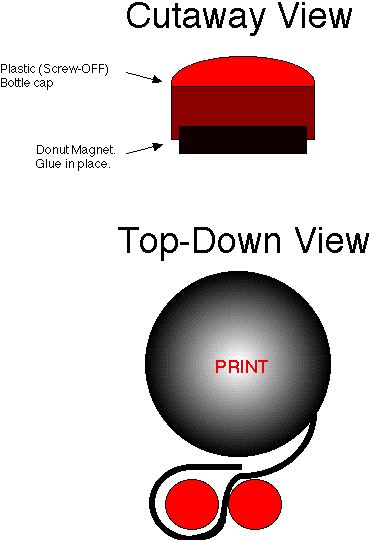
The only caveat is that you can't push the magnets too tight together. The film has to pull free from the magnets or you they'll get pulled into the brain. 
John
The worst tail wrap I've seen was when visiting a theatre I used to work for. "American Beauty" had wrapped so bad that the operators were cursing and yelling, and unraveling what seemed like 200 feet of film down the long booth. There was a new trainee running the booth who never checked on his shows after starting them. And they were having tail wraps with "American Beauty" on a daily basis! You would think that after it happens once to certain print, the operator would want to keep an eye on it during future showings. That print had a million repair splices in it and the head operator remarked, "by the time we're done with this movie, there won't be anything left." He was, of course, very frustrated with the people management was sending into the booth. As to securing the tail, I used to work in a theatre that cut 1 inch cores and used them to clamp the tail of the print to the edge of the platter. This is when I had my problems with the tail coming lose and wrapping. It is the worst method of securing the tail I have used. Stick-a-poos and tail tucks have given me little trouble. I've also used magnets on Speco platters which does work very well.
Kelmar Systems Inc. http://www.kelmarsystems.com has developed a non-slip anti-static "platter mat". Another device that helps prevent film jams and sliding film rolls is the Non-Slip Platter Disk (patent applied for), sold by Projection Technology, Inc. (phone: 516/576-0767). This unique invention by projectionists Stuart Boritz, Edmund Nardone, and Andrew Fetherman fits on the platter surface and helps separate the film laps if they stick together, and provides a non-slip surface so the film roll doesn't slide.
Other ideas were discussed in my article "Platter Patter" in the September 1999 issue of Kodak's "Film Notes for Reel People":
http://www.kodak.com/US/en/motion/newsletters/reel/september99/pointers.shtml
------------------
John P. Pytlak, Senior Technical Specialist
Worldwide Technical Services, Entertainment Imaging
Eastman Kodak Company
Research Labs, Building 69, Room 7419
Rochester, New York, 14650-1922 USA
Tel: 716-477-5325 Fax: 716-722-7243
E-Mail: john.pytlak@kodak.com
With one of these belts on, issues such as stiff tails aren't really a problem - the whole film is orientated the same direction (ie up  ) - this means you can always see the name of the print, on the print. Another thing we do is write the name of the print on a piece of tape, and stick that on the tail - the name is always easy to read and allows the members of our booth to get 'creative' - no problems like Joe was talking about in his July review.
Incidentally, I have a question to ask about that review; in the pic of the "me myself irene" tail - if the word "me" is at the head, and "irene" at the tail, and your platters spin counter clockwise, then it wouldn't matter if the soundtrack was up or down, right? The label would still be backwards.
And with all due respect Joe, shouldn't someone with your experience and versatility be spending less time complaining about the orientation of lettering on the tail leader and more time bagging out Christie?
For example, Item Number 9100 is FPC Blue Transparent Uncoated Polyester Film Support, 7.0 mils thick (regular print film base is 4.7 mils thick), and perforated with regular print film perforations (KS-1870). This leader is also stiff enough to use as a "straight edge" in aligning projector components. In 1000-foot rolls, it's less than 10 cents ($0.10) per foot.
This stuff is TOUGH! 
------------------
John P. Pytlak, Senior Technical Specialist
Worldwide Technical Services, Entertainment Imaging
Eastman Kodak Company
Research Labs, Building 69, Room 7419
Rochester, New York, 14650-1922 USA
Tel: 716-477-5325 Fax: 716-722-7243
E-Mail: john.pytlak@kodak.com
Where do you get that white leader? I checked with my supplier and they don't carry it, but if I can get a part (stock) number for it I can probably have them get it for me.
FPC also carries "FPC White Movie Leader, Acetate Base, Opaque (985) white leader suitable for leaders and trailers on release prints. Thickness 6.0mil." They also have "frameline" and "lightstruck" leaders.
CLICK HERE
------------------
John P. Pytlak, Senior Technical Specialist
Worldwide Technical Services, Entertainment Imaging
Eastman Kodak Company
Research Labs, Building 69, Room 7419
Rochester, New York, 14650-1922 USA
Tel: 716-477-5325 Fax: 716-722-7243
E-Mail: john.pytlak@kodak.com
FPC also carries "painted leader". Don't know if it's similar to the one you use:
CLICK HERE
------------------
John P. Pytlak, Senior Technical Specialist
Worldwide Technical Services, Entertainment Imaging
Eastman Kodak Company
Research Labs, Building 69, Room 7419
Rochester, New York, 14650-1922 USA
Tel: 716-477-5325 Fax: 716-722-7243
E-Mail: john.pytlak@kodak.com
I think Joe was trying to point out that with prints from Deluxe you can't simply put a piece of tape behind the title on the tail leader to have an nice professional looking label like this...
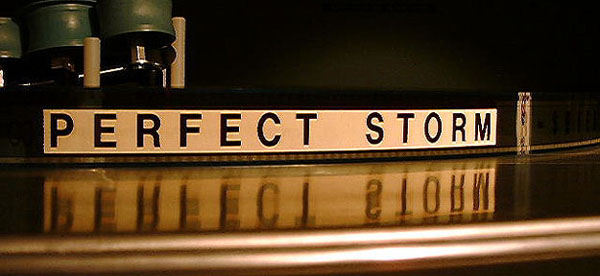
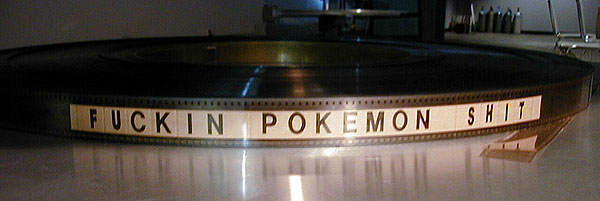
Of course, for those who like to "re-name" their prints to more suitable names, a little creativity with the splicer will still get the job done.

What is 'painted leader?' And what is the difference between it and acetate film stock? Will it break under pressure?
Sorry, I'm not familiar with the details of every type of leader FPC sells. I suggest going to their website, which has a brief description of each leader, and a way of asking for additional information:
http://www.fpcfilm.com/US/en/motion/FPC/fpc/fpc_main.html
My contact person at FPC is Christel Pareigis. Her e-mail address is christel@kodak.com Telephone: (323)468-5774
Not sure if all the leaders are available on both polyester and acetate base. Since some of the leaders are made on recycled print stock, I wouldn't be surprised to see more polyester base available.
------------------
John P. Pytlak, Senior Technical Specialist
Worldwide Technical Services, Entertainment Imaging
Eastman Kodak Company
Research Labs, Building 69, Room 7419
Rochester, New York, 14650-1922 USA
Tel: 716-477-5325 Fax: 716-722-7243
E-Mail: john.pytlak@kodak.com
When the film tails out the wrap is left on the platter and then re-wrapped around the film for the next screening. This eliminates the use of suction cups or having to tuck the end of the film under the edge of the main body of the print.
We have been doing this for over 31/2 years now and we have not had one tail wrap problem.
------------------
Also while I'm on here does anyone do this by labeling prints with all the information about the print. For example In Red Sharpie Pen Ink (For Scope) We would label as follows "SCARY MOVIE #2"(for multiple prints of the same title) -- Print #1234 -- Scope -- 5 Reels -- SR/SRD/DTS/SDDS -- 7/6/00 -- JJP (and after my initals comments like Reel 4 replaced or came from Mega Monster Plex in Your Town.) Curious if anybody else does that.
I make them put as so: "TITAN: DOA" "FLAT" "SR-D SDDS DTS" Big bold block letters.
We have people who work here only occasionally, and can't get used to what film is in what. Also, if the show shuts down for a problem, the automation brings the lens back to flat. They are usually in a panic, and restarts the show without knowing what the formats are (and the cues have passed, so the automation won't put it back.) Big letters let's them read both formats while spinning.
 (Got a lot of time on your hands or something...hmmm?)
 Welcome to the show, Michael. How's Townsville these days?
------------------
The Olympics are coming...RUN FOR YOUR LIVES!!! 