This is topic Is your booth too dark or too bright? in forum Film Handlers' Forum at Film-Tech Forum ARCHIVE.
To visit this topic, use this URL:
https://ft-forum.com/ft/cgi-bin/ubb/ultimatebb.cgi?ubb=get_topic;f=1;t=001259
Posted by Greg Pauley (Member # 503) on 08-03-2000, 12:08 PM:
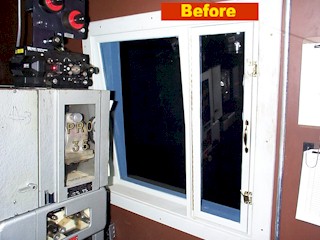
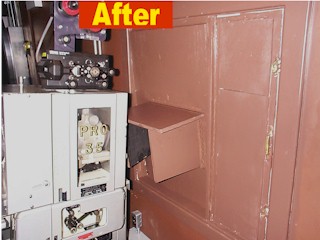
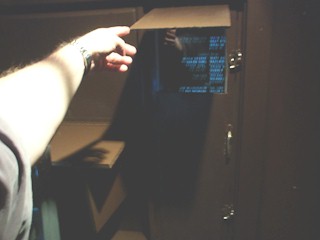
Most projection booths I've seen have a common problem, either poor lighting or too much light bleeding thru the port windows. We've all seen the poor guy sitting in the auditorium with his bald spot highlighted by the lights from the booth. I worked on an 11-plex project last year and was involved with the designing of the booth from the start with the architects. We did the traditional booth lighting with two swivel lights over the projector and platter with 4ft 4-bulb fluorescent lights for extra lighting during non operating hours. After we open the complex, I was not satisfied with the amount of light in the booth during operating hours. I wonder how many prints are scratched or problems over looked because there wasn't adequate lighting in the booth. Think about it, how many times have you seen a computer tech working on a computer or other technical work being done with the lights turned off. I started working on this problem and found a solution that works for our port windows. I have listed a web site below where I have posted pictures. First, I cut out a piece of 5/8 plywood to fit the larger window in front of the projector. I placed the plywood in place and started the projector and marked where the flat/scope hit the plywood and cut this area out adding a couple of extra inches. Second, cutout a top flap and left & right flap to enclose the image coming out of the lens. The flaps will need to be long enough to reach about 2-3 inches from the front of the lens and tall enough to cover below your cutout. I used piano hinges on the flaps so they could be adjusted to the image and for cleaning of the glass. The flaps are the key to keeping the light from reaching the glass. Third, on the small glass window that opens to the auditorium, I added a "flip up" flap using 1/4 material for viewing the screen during operating hours. We turned on the (4ft 4-bulb) fluorescent lights and now Russ Kress (member of this forum) needs to wear sun glasses in the booth with no leakage into the auditorium. This will also help a little if you are experiencing sound leaking thru your windows. There are a lot of different size port windows being sold today, but this could be adapted to work with most windows. Hope this can help someone. Does anybody else have any solutions to this problem? Lets hear from you!
Posted by Rory Burke (Member # 512) on 08-03-2000, 12:31 PM:
A booth that I worked at had excellent lighting with no bleed through into the auditorium. The booth was designed with a Tbar ceiling and not like a Cavernous AMC design so it had flourecent lights installed.
The only available light other that the flourecents was a simple incandecent light fixture between the projector and the sound rack(not a bright light for working)
The solution: We ordered a 100ft roll of this blue transparent gel/film/plastic that happens to come in 2 foot wide rolls. We took the flourecent lighting cover that you would remove to replace the light fixtures and cut the blue gel material to fit the cover like a template. We made about 40 pieces all together enough for all lighting fixture in the entire booth.
What resulted was a brightly lit blue illuminated booth with plenty of light to work with and no bleed through into the auditorium. This material is commonly used in recording studions, stages, concert control rooms, etc. Most any stage and lighting company will have this material available. If I recall properly we used the Rosco (lens tissue people) http://www.rosco.com/
brand of blue gels. I think it was even cataloged as Blue 150. I hope this helps you out.
Rory Burke
Posted by Tom Kroening (Member # 201) on 08-03-2000, 12:35 PM:
Not a bad idea! In fact you could probably make $$ off of that : P When I worked at a 9 plex in WI I usually had to do block the light with some old posters on thursday night while building up movies. Its funny how even when theres only two people in the auditorium, they sit right where the light shines... That whole assembly is removable for cleaning then? or just the part where the light shines through. Also, how does the other side look to the patrons?
Posted by Jason Burroughs (Member # 68) on 08-03-2000, 01:25 PM:
When I worked at a Loews theatre we had a similar problem althought we already had the blue gels in place, Light would bleed into the auditorims and onto the screens. As some may know the military uses red light for night operations because the light does not travel as far and is as visable as white light (or blue) so we changed the blue gels to red, the result, the booth kinda looked like a erie brothel, but no more light bleeding into the auditoriums.
Posted by Greg Pauley (Member # 503) on 08-03-2000, 01:37 PM:
Tom,
Sorry, but I don't have a picture from the auditorium side. The auditorium side of the wood is painted black so you really can't see anything except for the lens area. The flaps are on hinges and can be open for cleaning the glass. The whole assembly is mounted with 2 screws and could be removed if you needed to clean the glass behind the entire window area. I really don't think you need to clean any of the glass area except for the opening for the projection.
Posted by John Pytlak (Member # 331) on 08-03-2000, 01:46 PM:
The reason red lights are used in the military for nightime operations is that red light does not desensitize the rods of the eye. When exposed to white light, or light that is not red, your sensitive rod-based "night vision" is temporarily overwhelmed by the brighter light, and it takes several minutes to reaccomodate to low level light like moonlight or starlight. Red light does not have this effect. If you are a stargazer or astronomer, use red light (like a red LED flashlight) to read or adjust things at night, and you will keep your "night vision". In a paper on laboratory darkroom lighting I wrote several years ago, I recommended that hallways, locker rooms and break rooms in labs be lit with red light, so workers could return to the darkrooms without waiting for their "night vision" to return.
------------------
John P. Pytlak, Senior Technical Specialist
Worldwide Technical Services, Entertainment Imaging
Eastman Kodak Company
Research Labs, Building 69, Room 7419
Rochester, New York, 14650-1922 USA
Tel: 716-477-5325 Fax: 716-722-7243
E-Mail: john.pytlak@kodak.com
Posted by Rory Burke (Member # 512) on 08-03-2000, 02:45 PM:
We originally thought of using red gels before the blue gels but realized that with the red hue...you miss alot of the brightness that the blue hue emits. We have 0 bleed through problems with the blue gels. They had about 40 different types of blue gels with different light filter properties that can almost be customizable for your particular needs. Their web page looks like a make up catalog with all the different arrays of each color. www.rosco.com
Posted by Brad Miller (Member # 2) on 08-03-2000, 03:12 PM:
You can buy blue flourescent lights without having to mess with the gels. I've used them before and they work quite well, although it's interesting to look at someone else in the booth, as the color of their skin changes to something kind of odd.
Posted by Rory Burke (Member # 512) on 08-03-2000, 03:26 PM:
Aha yes blue light bulbs...the only reason we didn't go that route was when we had our yearly oilchange, re-certify for THX, change belts, clean and lube nights we could just remove the gels entirely or just let the cover swing down and we'd have real light to work with. Or in case I had to service just one projector I could just rid the blue gel for that moment. I guess I am a fanatic about those blue gels.
Posted by Gordon McLeod (Member # 33) on 08-03-2000, 04:23 PM:
I have often specified the overhead fixtures that are a no glare double black egg crate diffuser. These are made for T.V. Studio control rooms to prevent glare on the monitors
They work very well