This is topic HELP!! Black and blue bulbs in forum Film Handlers' Forum at Film-Tech Forum ARCHIVE.
To visit this topic, use this URL:
https://ft-forum.com/ft/cgi-bin/ubb/ultimatebb.cgi?ubb=get_topic;f=1;t=001498
Posted by Doug Fields (Member # 589) on 09-29-2000, 11:44 AM:
OK folks, I need some help here. I am currently experiencing a problem with one of my 4 lamphouses. They are all xEtron Maxi-10's. They problem is... at around 300 hours (for the LAST 3 BULBS)  they black, or blue out, causing them to slowly die until there is hardly any light making it to the screen. The reason this puzzles me is because everything seems to be within nominal ranges. I am running a OSRAM Xenon 1600W bulb. When I start things up readings are great. between 68 - 70 amps, and 18 - 20 volts. Right within specs. So why am I losing bulbs right at or around 300 hours? All connections to the bulb are tight, the bulb is focused on screen, I am truly baffled at this one! Any help would be greatly appreciated.
------------------
Doug Fields
Union Manager/Operator/Projectionist
Madison Cinema 4
Madison, New Jersey
Posted by John Pytlak (Member # 331) on 09-29-2000, 12:06 PM:
Sylvania/Osram published a very good xenon lamp troubleshooting chart, with photos showing lamps that failed for different reasons. It was republished in the February 1996 issue of Kodak's Film Notes for Reel People (H-50-38).If the lamps are turning totally black or clouded, it may be due to "operational air infiltration" caused by a crack in the graded seal typically caused by an overheated connector base. If the metal connector base is also discolored, this overheating is the most likely cause.
Lesser blackening may have a variety of causes, including poor operational current (ripple), improper magnetic stabilization, or improper forced cooling.
If you are returning the lamps under warrantee, OSRAM will usually examine the failed bulbs. If there is a problem in your operation, they will deny the warrantee and tell you the possible causes and remedies.
------------------
John P. Pytlak, Senior Technical Specialist
Worldwide Technical Services, Entertainment Imaging
Eastman Kodak Company
Research Labs, Building 69, Room 7419
Rochester, New York, 14650-1922 USA
Tel: 716-477-5325 Fax: 716-722-7243
E-Mail: john.pytlak@kodak.com
Posted by Bruce McGee (Member # 131) on 09-29-2000, 12:21 PM:
"Improper forced cooling..."Maybe the fans are clogged or the motor is slow due to lack of oil?
How about corrosion around the base causing a lack of heat conduction away from the lamp?
In the case of threaded lamp bases, would heat sink compound on the threads help at all? Just a question. I have not done it, yet.
Posted by John Pytlak (Member # 331) on 09-29-2000, 12:30 PM:
Bruce:
Although heat sink compound will provide better thermal conduction between the base and mount, I'm not sure it will help increase electrical conductivity and reduce oxidation/corrosion of the contacts. There are compounds sold to use on electrical connections (e.g., for aluminum-to-copper connections), but I doubt that they would withstand the heat without vaporizing and causing other problems. Best advice is probably simply to maintain clean and tight connections without additional materials being used.------------------
John P. Pytlak, Senior Technical Specialist
Worldwide Technical Services, Entertainment Imaging
Eastman Kodak Company
Research Labs, Building 69, Room 7419
Rochester, New York, 14650-1922 USA
Tel: 716-477-5325 Fax: 716-722-7243
E-Mail: john.pytlak@kodak.com
Posted by Rory Burke (Member # 512) on 09-29-2000, 12:56 PM:
Just in case check the serial numbers of all those bulbs in case they made a bad batch of them. Happened to me three years ago with bad 2k Osrams.Rory
Posted by Randy Stankey (Member # 64) on 09-29-2000, 03:28 PM:
My vote is for cooling. Make sure you have enough air flow. Is your 'plenum' blower running? Has some critter come and built a nest inside your ventillation stack? (It's nice and warm in there for them!  )
)
In my expreience, bulbs that have been overheated turn bluish black.
Posted by Ari Nordström (Member # 288) on 09-29-2000, 04:14 PM:
Check also for ripple from the rectifier. A bad diod might be playing havoc with your bulbs.
Posted by John Walsh (Member # 168) on 09-29-2000, 11:15 PM:
I would look at cooling, also.Just a note; the model "Maxi-10" refers to the automation controller, which can be mounted in a variety of Xetron lamp consoles. It is not the model of the lamphouse/console.
If it's a console, it's probably their "XCN" series lamp consoles. If so, what serial number is it? Serial no.s 3384 and onwards had an improved cooling method.
I think this lamp has a screw base; if so, is it being screwed in tightly? (you use the clear plastic cover as a tool to tighten the bulb.)
If it an older XH-x000 series, they didn't cool very well.
Many years ago, Xetron put their name on Cinemecannica/Zenith lamps.
Posted by Pat Moore (Member # 380) on 09-30-2000, 06:25 AM:
This does sound like cooling issues, something is doing a slow cook of a lamp seal. 1600W lamps aren't really that hot so something else is happening here.When you say they are going to a blue-black color, are you talking about the quartz vessel or the metal end fitting(s) on the bulb? If it's an end fitting, wich one?
Are the reflectors silver in color, or a yellow and/or bluish tint? The tinted ones are "cold" reflectors, dichroic coated to absorb heat energy of the lamp output and still reflect the light. If you lightly brush the surface of the reflector with a soft cloth, does the coating come off, producing little "sparklies"?
If they are silver, there may be an in-line heat filter to reduce heat energy getting to the film. It passes light and reflects the energy. It (or they) should be mounted at an angle so the energy isn't thrown directly back onto the bulb & reflector. The xetron design uses two rectangular filters side-by-side, if I remember right. Most of my experience was with the larger lamps and not 1600W.
Can you verify the amperage the lamp is running at? The meter might be off and you're running hotter han you think.
Cooling -- is there any air directed at the anode (positive)?
What's different about this one lamphouse? Is there a lot of operation with the dowser closed? Does it feel hotter than its mates in the booth? Check the position of the reflector and its working distance in relation to the film plane -- is it the same as the others?
Pat
Posted by George Roher (Member # 91) on 01-14-2002, 01:19 AM:
I'm bringing this thread back up because my theatre had a lamp turn blue and black a couple days ago. I have never seen this happen before. It's a 4k Osram and it was in a Strong Highlight 2 lamphouse. It had 137 hours on it when it failed. I realize that overheating would be a likely cause, but we don't have any problems with the airflow on that machine and this has never happened before. Previous lamps installed in that machine ran well beyond the warranty without problems. We have come to the conclusion that this was a defective lamp. I thought I'd post a picture here, since it's a very strange looking lamp. 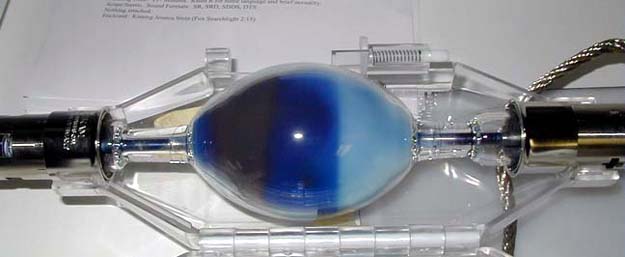
Posted by Paul G. Thompson (Member # 655) on 01-14-2002, 03:53 AM:
I have heard somewhere that a xenon lamp that is not properly focused will overheat because the infra-red is reflected right back into bulb. I don't see any dis-coloration of the metal ends on the lamp in the above picture. Is there a possibility this faulure could be attributed to an out-of-focus xeon lamp?
Paul
Posted by Leo Enticknap (Member # 534) on 01-14-2002, 04:19 AM:
I agree with Pat: make sure the meter is giving a correct reading. I had a problem with a Cinemeccanica lamphouse frying bulbs for over a year: finally and quite by accident a colleague discovered that the ammeter in the lamphouse was of totally the wrong sort and was giving a reading about 20 amps below the actual current.
Posted by Jerry Chase (Member # 660) on 01-14-2002, 02:20 PM:
Wow. I've not seen a lamp that color before. The blue looks suspiciously like cobalt blue. Does anyone happen to know the makeup of the electrodes in these lamps or have an idea why the blue color was deposited?
Posted by Wes Hughes (Member # 981) on 01-14-2002, 05:53 PM:
I have seen many lamps turn blue....they do that if the end seals leak.
Posted by Don Sneed (Member # 955) on 01-14-2002, 05:58 PM:
I can't agree with the improper cooling, I think a bad batch of bulbs, I just installed a 1600 watt bulb in a Strong consoles that date back to 1985, the exhaust was 400CFM, the blowers are cooling over the bulb as design, corrections are tight, rectifier is ok, & after 7-hrs the bulb turned black, put in another that & the same thing happen again after 300 hrs, install a old bulb with 3300 hrs on it and no problem, we remove this old bulb in the 1st place due to the hrs on it, but after no more spares we re-installed it, that has been 200 hrs ago & still going good.....so I can't agree with poor cooling, I think bad bulbs !!! well that's my two cents worth....
Posted by Gordon McLeod (Member # 33) on 01-14-2002, 09:18 PM:
The lamp in question has had a seal failure and that causes the cloudy blue black and the zoned colur shift
If one looks closly the stem of the electrode to the right has also turned blue in the photo and the end with the cable the end caps are goldish tinted which usualy points to that seel as being the one that failed. Also the discoloured section indicates it was hot. I have had problems with the anode end ( I assume it is to the right) overheating in some xetron lamphouses due to the focusing. There was a spider arangement to heatsink the lamp at the anode end if my memory is correct that was absent in the lamphouses inquestion
Posted by Will Kutler (Member # 770) on 01-14-2002, 09:22 PM:
I believe that the bulb elecrtrodes are tungsten.
Posted by Jerry Chase (Member # 660) on 01-14-2002, 09:53 PM:
What is the blue? I don't uderstand why a bad seal would cause a blue color. This is one of those questions about useless trivia that drive me nuts until I know the answer.
Posted by Tom Ruhling (Member # 1063) on 01-15-2002, 12:06 AM:
Here is some more info on the bulb. The previous bulb ran 1500+ hours before removal. The one that turned on George and I, as stated,
had only 137 hours on it. I will add that very only minor horizontal change in the bulbs focus was made after installation. It struck up and worked great for the first fifteen minutes prior to its failure. The failure happened almost instantly.
The 1500+ hour bulb is back in until I get a new one. It has loged an additional 43 hours and is doing fine.
Tom
Posted by Adam Martin (Member # 641) on 01-15-2002, 02:45 AM:
The blue deposits are probably tungsten oxide, which will be yellowish or dark blue depending on the amount of oxygen in the molecule.The degassed lamps I've seen have always been a hazy white color. I've never seen one with such a pretty blue color. Must have something to do with the amount of heat, as the blackened hotter end of the lamp would be inside of the reflector.
Posted by Jerry Chase (Member # 660) on 01-15-2002, 12:22 PM:
Thanks Adam. I've only seen the black or cloudy grey deposits myself.
Posted by Manny Knowles (Member # 1171) on 06-28-2002, 07:18 PM:
The lamp to which I am referring (in "Xenon - Premature Failure") doesn't have this pretty blue color, nor does it have the bands of color. Instead, it is just a general dark cloudy mess. I will take a picture of it tomorrow and post for your review.
Posted by System Notices (Member # 2357) on 02-17-2010, 12:44 PM:
It has been 2790 days since the last post.
Posted by Jeremy Jorgenson (Member # 2989) on 02-17-2010, 12:44 PM:
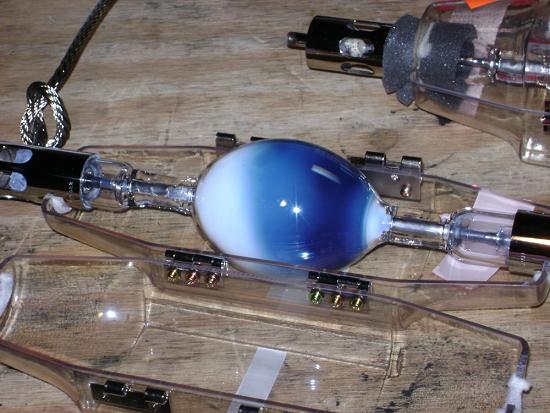
This happened to me last night. 5K Christie in a Neumade lamphouse. It had 318 hours.
Posted by Richard Hamilton (Member # 321) on 02-17-2010, 01:48 PM:
Smurffs making a comeback?
Posted by Jeremy Jorgenson (Member # 2989) on 02-17-2010, 02:03 PM:
Oh, maybe it's Avatar envy?
Posted by Demetris Thoupis (Member # 833) on 02-17-2010, 03:12 PM:
Solution is easy. Use Ushio! ![[Big Grin]](biggrin.gif)
Posted by Chris Slycord (Member # 4239) on 02-17-2010, 03:48 PM:
Unless Demetris is trying to be funny, aren't Christie bulbs made by Ushio? Most I've seen even have documents inside the box referring to Ushio
Posted by Louis Bornwasser (Member # 3063) on 02-17-2010, 04:03 PM:
Everyone has problems with leakers, especially at high wattages due to the large mass of electrodes.
UPS/Fed Exp is the problem. Louis
Posted by Jonathan Althaus (Member # 5042) on 02-17-2010, 04:23 PM:
Christie=Ushio. And we've had some issues incompany with exploding Ushio's/Christie's, but all at the 5k or higher range. From my limited experience, I've never had one of their bulbs fail to meet the warranty hours, but we only use 2.5 and 3k's.
Posted by Monte L Fullmer (Member # 2797) on 02-17-2010, 07:12 PM:
I've ran Christie CXL-60's at 145amps with no problems - just keep the ends below the maximum temperature and they run fine.
YET, had three of them damned Philips/LTI 3k Helios bulb POS's go blue on me in two months way below warranty hours in our digital units....
Posted by Demetris Thoupis (Member # 833) on 02-18-2010, 01:55 AM:
Christie lamps are completely different than Ushio. I have that very strongly confirmed but I cannot devoulge who did confirm it.
Demetris
Posted by Louis Bornwasser (Member # 3063) on 02-18-2010, 11:45 AM:
Same factory, Ushio owns Christie. Louis
Posted by Darryl Spicer (Member # 711) on 02-18-2010, 12:06 PM:
I have noticed lately on the Christie Boxes the words "made in the Philippines" on it. Ushio has their own brand and they make the Christie bulbs but I couldn't tell you if the same bulbs come down the same line or if they have dedicated lines for the two products.
Posted by Monte L Fullmer (Member # 2797) on 02-18-2010, 12:40 PM:
I just got my order of CXL-20R's and now say "Made in Japan" imprinted on the box and stamped on the collar of the bulb. Bulbs were made in fall of 2009 - dated by the inspector's writing on the card inside the box.
Prob those Filipino bulbs were made in 2007 and 2008.
Posted by Darryl Spicer (Member # 711) on 02-18-2010, 01:12 PM:
I will have to check the cards and see what the dates are on them.
Posted by Jonathan Althaus (Member # 5042) on 02-18-2010, 01:25 PM:
Our 07 Christie's and new Ushio's say Japan, but our other Christie's say Phillipines.
On a side note, one of our unused brand new Ushio 3k's was found completely shattered, still in its sealed plastic case after being received in good condition.
Posted by Jim Cassedy (Member # 4115) on 02-20-2010, 11:50 AM:
Definately a bad seal. Below is an example that happened to me a couple of years ago.
The seals on this 4K hulb leaked after the lamphous blower bit the dust.
The bulb acually got hot enough to melt the seal on the anode end
causing it to be knocked off-kilter as the pressure escaped, as you can
see in the photo.
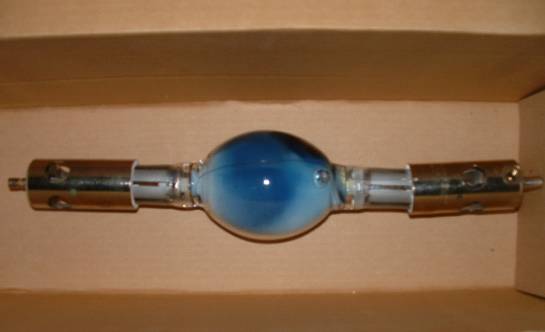
It did turn a really cool azure/cobalt blue though!
I used to have a car this color!
Posted by Monte L Fullmer (Member # 2797) on 02-20-2010, 12:40 PM:
looks like a classic "ORC/Perkin Elmer" bulb.. those were horrible bulbs...
Posted by Ian Parfrey (Member # 5122) on 02-20-2010, 03:55 PM:
Agree with Monte on this one.
Those dang foil seals are a dead giveaway. NEVER had a reasonable run with those lamps with every one barely making guaranteed hours. Ushio never had any problems.
Posted by Steve Guttag (Member # 268) on 02-20-2010, 08:32 PM:
ASL is the caretaker of the ORC lamps...they have done really well with them too. They changed most all of them over to graded seals, except the very small lamps (1Ks and I think 1.6Ks) They have also constantly tried to improve them...their lamps don't darken anymore and in some models will go lumen for lumen and hour for hour.
Steve
Posted by Gordon McLeod (Member # 33) on 02-21-2010, 02:31 AM:
UShio owns christie and they are the same lamp
Posted by Darryl Spicer (Member # 711) on 02-21-2010, 12:23 PM:
But can it be proven that they use the same material and process on the Christie Lamp and the Ushio lamp? You can have the same factory make the same bulbs but that does not mean they use the same line or material specs to make the two bulbs.
From some of the issues that I have heard about, the problems with bulb failure seem to be occurring more with the Ushio branded bulbs than the Christie branded bulbs. That leads me to think that the materials and specs on the ushio bulbs are different than that of the christies.
You have various sizes of bulbs to consider for each brand. The type of lamp houses that they can be used in. (CXL-30R) is the one for Rentec (CFS) the R stands for Rentec. They have different connection types on the positive and negative ends of the bulb.
All of these things make me believe that one side of the factory makes Ushio and the other side makes the Christies. Each line having their own materials and specs to follow.
Posted by Gordon McLeod (Member # 33) on 02-21-2010, 01:01 PM:
I have it on good authority that they are the same
Posted by Jeremy Weigel (Member # 4208) on 02-21-2010, 01:45 PM: