
My theatre, The Rialto Cinemas Lakeside, is running platters.
The Nugget Theatre in Telluride CO is running 2,000 foot reels with changeovers.
The Sebastiani in Sonoma.
The Park in Lafayette.
The Grand Lake (Oakland); Orinda (Orinda), the Oaks (Albany) are capable of running reel-to-reel but they have platters.
Who else... it'll come to me. I'll think of more.
The drive in at Coburg occasionally get to run changeovers (6000ft spools) when prints don't behave on the platters.
Then there are the major exhibition companies screening rooms that run changeovers. One for Village, One for Hoyts. The distributors also have their screening rooms, I'd be guessing, but would imagine that changeovers would be the go.
There may be a few more independant theatres running changeovers.
Frank
In rural parts of Hawaii, there are still old carbon arc houses, which I assume limits them to 2000' reels. I doubt they are open all the time either (i.e., matinee and evening every day), just due to low patronage. Interesting to see what will happen to them.
In the DC area, The Uptown is the biggest commercial theatre running changeovers and runs on the 70mm standard reel of 22" or 4500 foot.
The various Smithsonians of which almost all have 35mm film capability run on 2000' reel changeover with the notable exception of the Air and Space theatre (Langley) now running on a platter.
The MPAA screening room in DC is also on 2000' reel changeover.
Then their are the colleges and universities like Johns Hopkins that run 2000' reel closed magazine changeover and George Mason U also on 2000' reel changeover.
The Colonial theatre in Phoenixville, PA (remember THE BLOB w/Steve McQueen?) that pulled a platter out and now is on 2000' reel changeover (art house/special venue).
The National Gallery of Art runs primarily 2000' reel changeover (but has 6000' capability)
Dalke's theatres runs changeovers on all but one screen, including both screens at the "Family Drive-In"
There are others including some that physically can't run more than 2000' reels.
Steve
------------------
"Old projectionists never die, they just changeover!"
 ) and with the carbon arcs we would probably waste alot of carbon if we ran 6000's. Are we small, yes, but we are re-building our audience slowly but surely. I am getting comfortable with customers calling us "quaint and cute"! Carmike has the only other theaters in the county, a seven screen and a six screen, the seven has real projectionists, plus managers running one or two nights, I'm not sure about the other theater. Their senior projectionist has been over to see us, asking if he could bring in a few younger guys to learn how to do carbons and changeovers!
  go figure?! We would like to upgrade to at least a 1970's booth? and he wants to train people in our booth. My husband knew nothing about the equipment when we started the process to buy this 2 years ago, trained long and hard hours with the former owners and now he is one of the few people in the area that knows carbons/changeovers, but has had very little contact with platters and xenon lamphouses!
They ALL run platters - but most of the theatres are equipped with two projectors for what the projectionist who gave me the tour described "In case one of the machine f&*ks up."
At first I thought it was just the auditoriums that were original from the theatres construction... but then I found a pair of Century's in the #3 booth - a small addition tacked on at the Grand Lake. I think it's a nice idea to have a spare in case you run into trouble with the main machine.
I personally would love to be able to run changeovers so when we get a special screening for a film-maker... I wouldn't have to cut the heads and tails off.
I once built up a print of "Heartwood" for a screening at one of our theatres for the cast and crew. The director stood up next to the MUT with me and FLIPPED out when I cut a reference frame off with the leader. He asked me what the hell I was doing... and I simply told him I HAD to do it... and to get used to it because when the movie got released... other projectionists might do FAR FAR worse than cut off ONE frame.
Scott, you'd like my booth. We have two 35/70mm Zeiss Favorit70 projectors, a 35mm Philips FP6 projector, and a 16mm Bauer Selecton. It is actually my ideal booth, or at least pretty close. Have a look at: http://www1.tripnet.se/~adler/draken/.
(Hey Brad, shouldn't you add a link to the Draken pages?)
Actually 3-projector booths were quite common in the important theatres. It gave complete back up with NO inconvience. Also, in a 35/70 situation, allowed for 35mm previews on a 70mm feature without having to convert a machine mid-show....this could be an issue if the 70mm required raising the top masking (and hence you don't want to be adjusting the projector after the format change going from 35mm to 70mm).
Personally, I am all for four projectors in the really important theatres where shows must run perfect. We always get two prints for these premiers and such but it would be great if both prints were loaded and both running so that if one has a problem...any problem, a simple c/o to the other print keeps the show going on the backup. Normally, the second print just sits in the can waiting for a disaster.
Obviously this would be excessive the the typcial venue but for theatres that feature premiers and like, it would be quite handy. I do think it would also be handy to keep a projector on wheels for the plexes to move into place in the event of a theatre going down.
On the story of cutting off the ID frame...this topic is covered elsewhere in the foum (look for a locked thread). As Brad has pointed out one does NOT have to leave an ID frame and can still match up the leaders though careful observation. Be that as it may, if there was a concern about cutting up the print, the releasing company should have done a site survey and asked as to the mode of operation (changeover or platter) and chosen the process they prefer (sometimes it actually is the platter, more often than not it is changeover). If they didn't know you ran on platters and knew it had to be loaded in order to run the show when the got there, they should have either moved the show or sucked it in and dealt with it.
I once was handed a film maker's copy of a film and he instructed me that not only could the print NOT be cut but NO cue marks or other visable marks of any kind could be put on the print either! It ran on a pair of Century Cs and didn't miss one changeover (heck the editor and director were in the audience and would have let me know too).
Steve
------------------
"Old projectionists never die, they just changeover!"
I recently left a cinema which had no platters and the box was flanked by two cinemas on either side...sometimes we ran 2000' spools on either side simulateously! That keeps you on your toes! Now I work in a twin with platters AND automation. I still work in a theatrette with changeovers, though.
In a theatrette, I prefer changeovers. In an actual movie theatre where I'm running the same movie 6 times a day, I prefer platters.
One of the most important keys to being a sucessful projecitonist is being able to think on one's toes.
I put on click tabs....clear splicing tape outside of the picture area that would cause the gate to "clack" when they went through the gate and intermittent shoe...I put four in sequence at each point. When you heard "clack, clack, clack,clack...turn on the motor...at the next point...hit the C/O.
After the show, pull off the tape...invisable cues.
Now doesn't it suck when the magician tells his secrets?
Steve
------------------
"Old projectionists never die, they just changeover!"
Doesn't the Castro in SF run reels?
I believe the Fine Arts in Berkeley also runs reels and is a carbon arc house.
The UC in Berkeley also runs reels as does the Stanford in Palo Alto - in both these cases I believe they are running 2000's
At Radio City MH, if it's a high profile show, they will sometimes get two prints and run two projectors at the same time in case there's a problem.
When I was running "Alien" at the place, there was no Dolby processor- was "Alien" avaiable in regular 70mm? I know that Dolby would not record anything onto Le and Re if you asked for a regular 70mm, but I was wondering if "Alien" was availble that way, of if the place I worked at was "cheating."
I have heard that Sumner Redstones home theatre is this way also.
Don Olson
I run 6000' changeovers at the Center for the Arts (200 seat screening room...pictures coming). Strong 1600W Xenon and Century SA.
Shea's Buffalo (3100 seat proscenium theatre) runs carbon-arc changeovers. Century JJ 35/70s w/ mag penthouses. Big AC-DC generator recently replaced by rectifiers
The Riviera Theatre (Wurlitzer Organ house) runs 2000' carbon arc and is fully equipped and licensed to run nitrate (and sometimes does)
In nearby Rochester the University operates two houses w/6000' changeovers and the George Eastman house is also equipped for 2000 footers and nitrate.
There's probably more, but one can see changeovers are far from dead around here.
Paul
quote:
In nearby Rochester the University operates two houses w/6000' changeovers and the George Eastman house is also equipped for 2000 footers and nitrate.
Is that the big Eastman Theatre built in the silents days as part of the Eastman School of Music? I've often wondered if it is still standing and/or operating.
(Not many know that Eastman coughed up to establish the School of Music in order to train musicians to accompany silents!)
------------------
William Hooper
Junk drawer: http://www.geocities.com/hollywood/theater/3622
Theatre Empire: http://members.xoom.com/saenger.1
The Eastman Theatre (2200 seats downtown) is still operating. It has been really well maintained by the University although I don't think they screen films anymore. Organ works, though. The University operates two other on-campus theatres for films (both CO houses)
Those were the days when the 70mm prints opened BEFORE the 35mm prints. I think this happened on one of the Star Wars films, also...possibly Empire?
Variety had an ad for Alien that listed all of the theatres running 70mm prints...it was considered a big deal at the time. It would be interesting to see how many of those theatres are still in business.
Mark L.
------------------
"As a moral to young men who come down to the city, don't go round breaking people's tambourines."
The huge Eastman Theatre in Rochester is primarily used for "live" events, but Boston Light & Sound has come in to do several great film presentations with live accompaniment by the Rochester Philharmonic. There is a long-empty projection room high above the balcony in the theatre. My co-worker was instrumental in securing a pair of Norelco AA-II projectors from the Monroe Theatre (that fell on hard times and went the XXX bookstore/peepshow route), that hopefully will bring a permanent film projection capability back to George Eastman's wonderful gift to Rochester.
------------------
John P. Pytlak, Senior Technical Specialist
Worldwide Technical Services, Entertainment Imaging
Eastman Kodak Company
Research Labs, Building 69, Room 7419
Rochester, New York, 14650-1922 USA
Tel: 716-477-5325 Fax: 716-722-7243
E-Mail: john.pytlak@kodak.com
quote:
Shea's Buffalo (3100 seat proscenium theatre) runs carbon-arc changeovers. Century JJ 35/70s w/ mag penthouses. Big AC-DC generator recently replaced by rectifiers
Hmm..if William Enos is here or someone else remembers - what's the Byrd in Richmond using for DC?
I can see a couple of rectifiers for the projector lamps, but it's a struggle picturing a big battery charger behind the Brenograph for its carbon arc lamp.
------------------
William Hooper
Junk drawer: http://www.geocities.com/hollywood/theater/3622
Theatre Empire: http://members.xoom.com/saenger.1
The Sebastiani in Sonoma.
The Park in Lafayette.
The Grand Lake (Oakland); Orinda (Orinda), the Oaks (Albany) are capable of running reel to reel but they have platters.<<
The big house at the Crest in Sacramento just recently had an AW2 installed but can still run changeovers
The Mystic in Petaluma while no longer a movie theater (its now a very popular live music venue) has a completely functional changeover (6000' max) booth with Brenkert 80s and Strong X-16 conversions.
There is a completely functional carbon arc booth in the Fortuna Theatre that will, by the wishes of the district manager who wants to keep an old booth intact,be left in pristine condition, even though the rest of the building is being converted to a stadium triplex (the rear half of the building was twinned)...
>>Doesn't the Castro in SF run reels?<<
Yep. 2 JJ's with 6000' max capacity...
Aaron
The Wishek Theatre, Wishek ND,
Super Simplex heads,RCA 1040 soundheads,
Simplex high lamps, mono sound
Ash Theatre, Ashley ND, Simplex E-7's, SH-1000's I think, Simplex High lamps, Motiongraph sound system
both run 2000' changeovers
Josh
------------------
Bob Throop
(The Ogden in Denver Built in 1913 as a Vaudville house and turned into a Movie house in the twenties. Still standing as Denver's premier small concert venue.)
I don't know why it's called a MG Set. Here is my guess, Magnetic Generator.
They use to use little motor-generators for two-way radios (in cars and boats) in the 30's 40's and 50's. It was to generate the high voltage for vacumn tubes from the car's 12v or 6v battery/ generator (the high voltage was called the "B" battery.) Motorola used to call their motor-generators, "Dynamometers" if I remember. They made a nice one that fit in a 4" x 4" x 12" box.
Close. The little motor-generators (what 'MG' in 'MG-Set' stands for by the way) used in military and mobile equipment were called dynamotors.
What about the old exciter supplies in some of these places that used a pair of Tungar® argon-gas rectifier tubes... Boy I miss the changeover days...
Aaron
Josh
Gee, if somebody was in Greensboro, NC he could run over there & see what's in the booth, in the fly tower, behind the screen, & see how they're doing, maybe take a camera....
------------------
William Hooper
Junk drawer: http://www.geocities.com/hollywood/theater/3622
Theatre Empire: http://members.xoom.com/saenger.1
 ...
...I went to the Carolina Theatre today. I just got my digital camera today so I was dying to try it out. Here is what I found out.
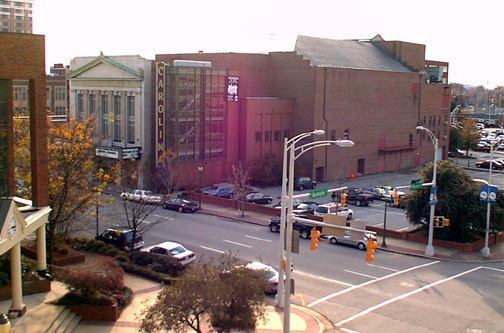
She's still there and looking pretty good for her age. (Built in 1927) -- Please ignore the lens flare!
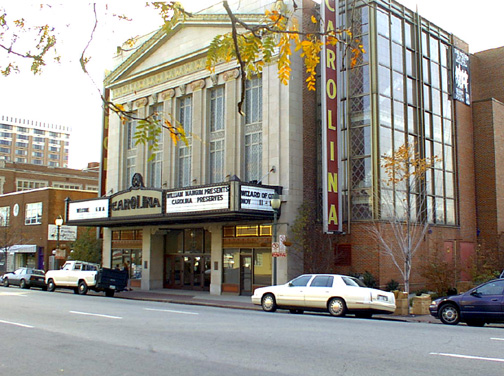
It's owned an operated by the United Arts Council of Greensboro. They run a full schedule of events there: Stage shows, concerts and last but not least, movies.
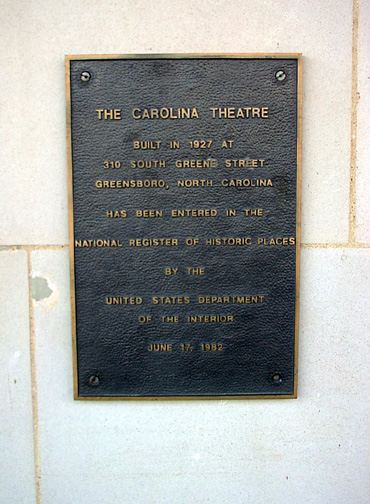
It is on the National Register of Historic Places and they are also a member of the League of Historic American Theatres.
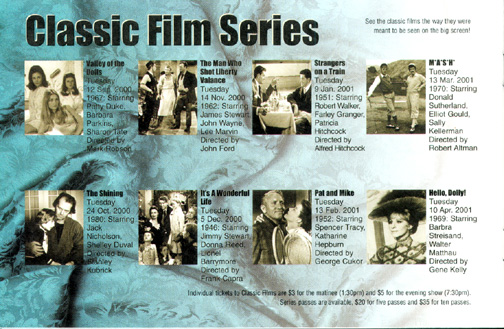
Here is the schedule of films for the 2000-2001 season. I missed The Man Who Shot Liberty Valance by one day. (Damn!)
You can also check out their site: http://www.carolinatheatre.com
I only got to talk to the girl in the box office today but I got the guy's name who's the operations manager. I'll try to call him up and get in to take a few shots from the inside.
------------------
William Hooper
Junk drawer: http://www.geocities.com/hollywood/theater/3622
Theatre Empire: http://members.xoom.com/saenger.1
quote:
The Hawaii Theater in Honolulu was renovated with new equipment for reel-to-reel, but someone forgot to leave enough space for 6000' reels, so it can only run 2000'. "Fortunately" it runs live shows 95% of the time. Another auditorium here (Honolulu Academy of Arts) can run 6000' but again is not a dedicated cinema.
This goes *way* back, but didn't the Hawaii somehow reconstruct the booth to make it 2-story? Something like projection equipment on the bottom & follow spots on the 2nd floor (or vice versa?)
I remembered that the mention that the booth was two-story, & wondered how it had been done, what it was like, & how it worked.
It's disappointing that both the film & spots seem to have suffered. I don't understand why these architects (some are called "theater architects", but have done many theaters & not done ONE well) don't notice that a projection both usually has only 2-4 holes in an otherwise solid wall. the thing to do would be hang a spot booth in front of the projection booth wall, leaving the ports clear. Might need a spiral staircase to get the operator in position, but it would be a useful, comfortable booth & not a vertical ladder & line, or a limited-use half-ass booth.
And you wouldn't lose a nitrate-safe booth. I honestly think that half the wild major work done in these old theaters is just for the governing bodies & architects to point at & say "look at the major thing I have done here, & marvel at me!", while omitting to say "although it doesn't work well & has screwed up 14 other important things including the acoustics & losing a revenue-producing stream!"
Uck.
I've been there twice when the screen flickered and died at the R2 > R3 change. The first time it was in Tough Guys (blaxploitation flick with Isaac Hayes). The second time it was for the 1998 re-release of Mean Streets. Both times it was in the same auditorium (#3). Could the lamp have blown when it was lit?
Footnote: I've been a Film Forum member since '92 but am letting it lapse in July.
Also, I could always tell the R2 > R3 change in that auditorium by the drop in sound level at the start of R3.
but can run 2000' or 6000' changeovers in my occasional screen (Theatre) on a pair of Century's