
My favourite projector is a Kinoton FP30. Next comes a Cinemecannica Vic 5.
Although you can't get them new anymore, Bauer come in at third.
There are no others that make it into contention
What do you all think???
Frank.
Stephen.
------------------
They both out perform in picture steadiness than those Cinemeccancia's!
Why anyone would like to name their favourite projector the Cinemeccancia V5?.
As for my favorite projector, it's the Favorit70, of course. Simply the best and most elegant machine ever built. Next is the Philips trio of FP5/56/6, but I like the Bauer U3 as well. And yes; I guess I should at least mention the DP70... 
My favorite booth is the one I work in. I've worked at many booths in my time but the Draken remains the best by far.
But for the "best at everything" I'd say a Norelco AA-II.
Frank P; If you like a V5, then you would have loved a V9. They both are about the same size, but the V9 had an oil bath and gear train (rather then the V5's belt.) Easy to clean, clean design, etc. V9's are no longer made, however.
Difficult choice but I would like to nominate Bauer B12 for 35mm and Philips DP70/Norelco AAII for 70mm/35mm as top of the bill.
Sorry for you guys who like the Italian projectors but German & Dutch projectors beat them on image steadiness every time !

Best platter. Cinemeccanica CNR-35N.
Sound Processor. Dolby CP-500.
Best digital format. SDDS.
Nick
Is there something about the machine that you first work on in depth. The very first 35mm I threaded ever was a pair of Bauer B11. Thoes two machines are still about here in Melbourne, and I see them from time to time.
I have worked with the Christie's. From what I have seen they have more problems than a Cinemeccanica, even after you are aware of all of the danger points. Then again, the service from the Christie guys was second to none - a credit to them. Then again, when you need to replace the heart of the machine so often you would hope that the service is good. Christie's come in fourth.
Stephen, I'm not telling who I work for, but it is one of the larger companies in Melbourne, it aint Hoyts, it aint GU and it (as you know) aint Readings. Naturally, anything I say is my own personal opinion and not that of the company bla bla bla...
Frank.
Nick, are you referring to the optical sound head or the mag ditto? 'cause the U3 was a fine projector in its day (noisy as hell but still a good one if cared for properly) but the original optical sound was an absolute disaster. Anything above 4kHz couldn't possibly pass through any of those, and if you put in a stereo cell, the cross-talk would be indistinguishable from the actual track.
If you threw out the original optical sound head, all of it, and installed a Dolby stereo cell and Cinemeccanica optics (V5, actually; it was entirely possible with a little patience), the results got a lot better. You could finally make use of that expensive Dolby processor. 
The mag head was fine, though, and performed flawlessly every time Ihad the chance to run 35 mag or 70.
Projector:
Kinoton FP 20 or FP 30
Philips DP 70 (AAII)
Cinemeccanica Vic 10 or 8
Philips DP75
Century
Super Standards (or Super 75's)
Platter:
There is only one, Kinoton.
Favorite booth.......
Melbourne Forum Vic 10, 70mm.
David
Nick
So sad that there are none left in Sweden. I hear they pulled the last pair out from a ferry(!) just a couple of months ago.
No U3's in all of Sweden?
We have over 40 alone on our circuit here in Australia along with over 20,000 individual new parts for Bauer. The Army and Air Force use them in many of their bases across the country as well (did you see the F1-11 with the flame out the back at the Olympics Closing ceremony?)
David
It's sad. There are no U2s either. The only Bauer projectors I know of are B12 machines, but there could be others.
Yup, I saw the grand finale of the Olympics. Beautifully done, and that includes all of the games. You all have something to be very proud of.
Stephen
------------------
)It seems that people generally have an aversion to the Cinemecannicas. Forgive my ignorance, but I've found them to be quite good. What are the things that you don't like? What would you change on them if you could???
Frank.
Century JJ (rock steady picture, very easy threading, very forgiving on poor threads, dual format 35/70, won't crack the foundatino and easy to move as well as service)
Christie SLC lamphouse (these babies crank light out, are extremely reliable and have a knack for getting extraordinary life span out of a Christie lamp. Alignment is also first rate without a hot spot.)
Christie AW3 platter (The new MUT leaves much to be desired, but the old MUTs are great. Some reliability issues over the last several years in terms of leds and motor drive wheels, etc, but all have since been rectified by Christie. Still the best overall platter without breaking the pocketbook.)
Dolby CP200 with Aux rack (A damn shame these are not still being made!)
Dolby DA20/DTS 6-d (Both are very reliable, although DTS has had some major problems with the Toshiba drives. SDDS is very harsh sounding thanks to their "digital eq" and the reliability issues with the format are pathetic. <vomits> )
------------------
Greg Mueller
Amateur Astronomer, Machinist, Filmnut
Stephen.
------------------
Brad I agree that the Christie lamphouses are pretty good. One thing that was missing from the manual when I used them was the placement of the exhaust cuttout switch. I lost the flap one morning and couldn't get my xenon going...eventually replaced it with a bit of Coke can!
Stephen, yeah I know where the B11 are, but that will remain a mystery for now, give me a call and I'll tell you all about them.
I have worked with Centurys in only a limited capacity. I'm not sure what model they are (David can you help on that one), but I found them harder to thread and frame. I agree about the location of the focus knob on both, and the Cinemeccanica lens turrets have one flaw, using a 240volt turret motor (at least here in Aus.) I think that the belts are easier to change than the central shaft should it break!!!
Vic 8's are a great machine and have that solid feel that you say the Century's have.
The meccanica's are heaps easier to clean!
Platters, Christies are pretty good to. An interesting theory was put to me the other day that the Christie platter have less film wraps because they lift the film up prior to entering the payout module, and gravity does a fine job of seperating the film layers.
Ari, what are the Favorit70's??? I've never heard of them. Is there a picture somewhere or info I could find?
Frank.
Favorit70 or rather, Zeiss, Favorit70, are license-built Prevost P70 machines (for both 35 and 70mm). They're great machines, very reliable and user-friendly.
You can find a couple of images of our booth at http://www1.tripnet.se/~adler/draken/teknik.html.
Lamphouse,I like Strong. Old X-60. I've been subjected to ORC (yuk). I thought it was cool until I learned better.
Sound,Smart MOD's are nice. I want to run a MODII DIT in my drive-in (when and if the time comes)
Chris
As far as the booths I've seen in my area it'd have to be the 5-screen in the Randolph Mall in Asheboro, NC.
It's got Xetron lamps, IREM rectifiers and a mix of old Century and Simplex. The platters are Christie Miniwinds. All of them have RCA sound heads and 4 out of 5 of the houses are mono. The big house has DTS, though. USL processor. The big house even has reel arms for for reel-to-reel. You could run shorts and stuff if you wanted to.
The automations were home-built by some guy in his garage. All simple relay and switch jobs.
Yeah, It's small, old and dingy-looking but I almost never have problams with that booth. If I do get a call, usually they really mean it. This stuff just works.
This is probaly the closest thing to a REAL 'projectionist's' booth in my whole area. There are one or two other booths in my area that are pretty nice but this one is my favorite.
The cheapest way to set up SRD from scratch is the CP650, I believe. CP500 comes second.
We've had the CP500 for ten months now, so far without any major problems. Not many minor problems either, BTW. Not that I've done an A-B comparison myself, so I can't really say if it sounds better or worse than an equivalent CP65 installation, but subjectively speaking, our installation sounds great! I've been very happy with it.
Philippe
------------------
Favorite projectors: 35/70, Phillips DP-70
35mm, Century SA/R-3
Favorite processor: Dolby CP-65, CP-200
Favorite Platter: Older AW-3's, Kinoton
Favorite Booth I service: Hindsale Theater, Hinsdale, Illinios: Had pair of imacculate DP-70's, one Hortson and one Prevost 16mm and a Strong Gladiator followspot. Booth was also very small. I had to leave my tools outside the door most of the time.
Brad,
Since when are JJ's forgiving of threading?? I don't know how many 70mm prints were trashed in Chicago on them by careless operators making the loops too big!!
Steady , Yes! But not forgiving of loop size at all.
Mark
On a Century in general (particularly the 35mm only SA model) you've got quite a bit of "forgiveness" there. On the JJ running 70mm I will agree that it doesn't quite give you as much leeway, but hey...what's that moron doing running 70mm anyway?
One MAJOR problem with 70mm I've found is the switch from acetate magnetic to polyester DTS. You absolutely can NOT thread them the same. The polyester loops will shake violently and cause substantial scratching from a loop that was ideal for older acetate 70mm prints. Just to be safe, I remove the 35mm pad roller from the upper loop when running these newer 70mm prints and make sure everyone threads the lower loop very small. The studios should send out a letter in those prints as a reminder.
From what I have heard between the CP65's analogue EQ and the CP500's digital EQ I think that they both do the job pretty well.
Personally, I think that the EQ's in a processor can best be used when they are under utilised - that is to say more is less. Having better speakers, amps, cabling and good acoustic design goes much further than trying to compensate for room ineffiencies by EQing the crap out the signal - regardless of which EQ you are using (Digital or Analogue).
The quality of the digital EQ is very good. I would challenge anyone to sit in a theatre watching a film and be able to say if it had been set up using digital or analogue EQ's without already knowing it. Please feel free to say that you can, but I will call you a liar
A bigger problem with the 500's is their general stability. They just love to do strange things!!! I'm sure we can all share 500 mysteries around the campfire one day...
Ari, thank for the info, I'll look it up.
Frank.
The Century's you speak of are DAW. That means in Century speak: D = Drive-in shutter (since modified for indoor use, A = A series projector, W = water cooled head for big lamps at drive-ins or indoor.
These machines were used to re-equip our drive-in circuit (40 strong back then)when Bauer went out of business in the late 1970's. The Centurys from new were not without there problems from the New York factory. Several drive shaft failures and one movement seized under warranty! The good ones have not skipped a beat in 20 years.
They are indeed difficult to frame, but so are most others that have there basic design dating back around 50 years, C & W, Super Standard, Simplex etc.
David
" The Century's you speak of are DAW. That means in Century speak: D = Drive-in shutter (since
modified for indoor use, A = A series projector, W = water cooled head for big lamps at drive-ins or
indoor."
The D stands for double shutter
ie a DAW is a double shutter model a with water cell
a SAW is a single shutter model A with a water cell
I wouldn't dream of doing that. I'm very happy with our CP500 EQs. but to bring up a related subject: how about the digital SR and A NR in a CP650? How are they when compared to the "real thing"? Does anyone have any comments or first-hand experience?
I believe that the 500 is still the cheapest way to get Dolby Digital, but the 650 is the cheapest way to get EX.
It is typical of Dolby to bring out a new processor that incorporates their latest product. CP65 incorporated SR, CP500's have SRD and now 650 has EX. What will be next? Inner left and right like SDDS? Ceiling channels? Subs in the seats?
Frank, nothing would make me happier in regard to Dolby processor development if they reintroduced the left and right extra channels. I'd recommend our management to upgrade, without doubt.
Hey Dolby, how about that AUX rack to the CP500?
Mark, I am curious as to whether the units you've installed have internal or external crossovers? I think the CAT 683 card has caused us more problems than any other card. We also have a few power supplys blow.
Are there any quirks that are inherent with the CP650's? How common are they these days?
The only quirks we have with the CP500 are the usual ones with the LCD display and the event logging. Nothing that affects the actual operation.
As I heard it, the reason why Dolby can't solve that annoying subwoofer level indicator problem is simply that the (damned good) computer is rather old by now. It doesn't have enough memory or computing power to have a subsequent software release fix the problem. Simply put, there's not enough room. That's what our tech says, anyway.
When I worked for H---- I didn't pay as much attention to what kinds of machines I worked with... 
First theater I was at had Christie P35GPs (not 100% certain on that detail), Christie AW3R platters, XeTron XCN consoles.
All in all, things ran pretty well there.
Second theater I was at had the same types platters & lamphouses as the first, but instead had Century projectors. I'm not sure which model, they did 35mm only, and were nothing but a big headache for me. Oily, greasy, gear driven machines with an affinity for wrapping and fusing film to the soundheads, and in general, munching on the film.
The both I am in now has Christie AW3R platters, ORC lamphouses, two Century JJ2 projectors and eight Christie P35C projectors.
Very few problems. 
Given what I was trained on, and have worked with, I prefer the Christie projectors. I don't even have to think when I thread, my fingers know what they are doing. I could probably thread one of those things blindfolded!
If there were some certain ammenities that I feel are lacking in the booth I am in now, it would be my favorite booth, given how well I know the quirks of the equipment and how to outfox them to avoid problems. I just have to keep my hopes up that one day the booth fairy godmother will appear and grant some of my wishes...
~The Purple-Tressed Booth B*tch
------------------
In some cultures, what I do is considered normal.
You right about being able to thread the machine you learn on blindfolded. I was taking a group of people through my first projection room and while showing off, I was blindfolded and threaded the projector...got it in frame too! (believe it or not)
Mmm, I've only worked with a few centurys (and a few Monee's - cheap Indian copy of a Century). Mmm, Oily, greasy - its all coming back to me now...
Sounds like most of you guys over there have Christies and Centurys everywhere (sucks to be you guys  ) Is that a consious effort to support the local economy? Is it because spare parts are easier to get? Is it because other machines (such as Kinoton or Cinemcannica) are more expensive to import? Or is it because in your oppinion they are better machines?
2. Which amongst those is your favorite?
I've mostly run Cinemecannicas and Kinotons here in Aus and Christies in other parts of the world.
I've also ran Bauers and Centurys, but in smaller amounts.
I've had the very recent pleasure of moving some Kalee heads around, man they are heavy!!!
I still think that Kinoton, Cinemecannica and Bauer projectors rank in my top three. What I've seen with Century, Monee and Christie has not been overly bad, infact, I have had generally good experiences with these machines, but only after I worked out the inticate quirk
Sound processors: CP50; CP100; CP55; CP65; CP500
2. Projectors: Favorit70; Philips FP5
Processors: CP50, CP100 (yeah, I'm a bit sick, why?), CP500
... Would not mind to get my hand on a DP70...sometime...my friend Per has two in his booth, but never runs c/o's??
For sound i like the Dolby CP65 with cat. 350 SR cards. Sound head is upgraded to redlight. For lenses i like Isco HD studio.
No digital in my room, at least not now, i think i am going for SRD at the moment.
, and it does handle 70mm pretty well, but the 35mm end of it is lacking abit on side weave plus it does not handle old, splicy, 35mm stuff very well. The V-8's however are built very well and run for years and years. Just too expensive for parts these days. Still can't figure out why the DP-70's were pulled from the Collesium in Oslo and replaced with V-8's. Pretty strange indeed. I once met some guys from Switzerland at THX school that hated DP-70's. They prefered US built machines over the DP-70.But why anyone would prefer it to the Favorit70 is beyond me.
------------------
Florian Pausch
projectionist and technician
Filmarchiv Austria,Vienna
www.filmarchiv.at
fpausch@aon.at
Ari, who are the Favourit70's sold through? Until you mentioned them, I'd never heard of them, and there aren't any dealers that I know of that supply them here in Australia.
Martin, have you seen the new Schneider variable prime lenses? We have them in one of our theatres that we recently upgraded. They are simply fantastic.
I know a lot of people don't like them. One of the problems they have is that they throw prints pretty easily. Well, I thought this solution was interesting.
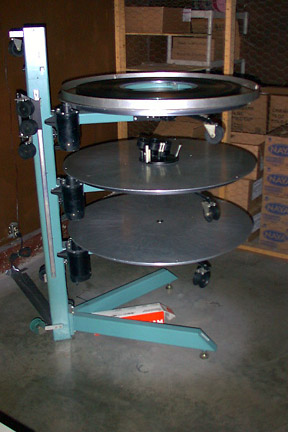
... and a closer view...
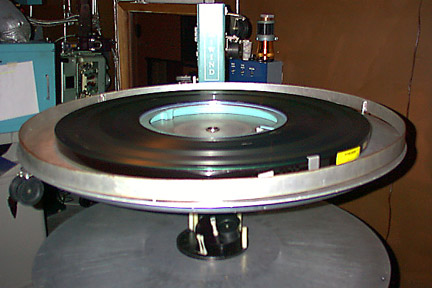
Appearently, one of the guys who worked there years ago decided enough was enough and went to town on the platters. It may look like hell but it worked. They haven't thrown a print in years. The only drawback is that you can't put as much film on them because of the hardware and the holes. That's rarely a problem, though. If a print is that big, they would probably split it in two anyway.

I like the MW3 platter as long as it is not one of the 'single board' models that are prone to failures that usually result in the mainboard catching fire, destroying it, and they [the single board MW3's] are no longer supported by Christie and the replacement mainboard is no longer available. The newer model MW3's have a modular chassis design like their big brother AW3 eliminating the mainboard and if something caught fire on the newer one just the part(s) that actually flamed out would have to be replaced.
Aaron
A retaining ring could be made out of flexible PVC pipe or heavy garden hose formed into a ring, and adjustable for various diameters around the film roll. Be sure to attach it to the platter surface, or use Stick-a-poos or "Bevan-poos" to keep it in place.
------------------
John P. Pytlak, Senior Technical Specialist
Worldwide Technical Services, Entertainment Imaging
Eastman Kodak Company
Research Labs, Building 69, Room 7419
Rochester, New York, 14650-1922 USA
Tel: 716-477-5325 Fax: 716-722-7243
E-Mail: john.pytlak@kodak.com
Sound heads? RCA MI-9030 and the Simplex SH-1000 were the best! (if you add a drop of oil now and then to the gear box).
Speaking of which----when you check the oil levels of the gearbox in the RCA's and SH-1000's and SH-1004's, please make sure you break the vacuum lock when you do it. Especially the RCA's. Then let the oil settle to it's true level and add oil as necessary. Then let it settle again....and again...I usually force feed them. If they become too full, all you will have is a mess on the floor the next morning. It is much better than a stripped gear and bearings that feel like someone poured Poly-Grip into them... 

BTW No carbon arcs at home. 
------------------
John P. Pytlak, Senior Technical Specialist
Worldwide Technical Services, Entertainment Imaging
Eastman Kodak Company
Research Labs, Building 69, Room 7419
Rochester, New York, 14650-1922 USA
Tel: 716-477-5325 Fax: 716-722-7243
E-Mail: john.pytlak@kodak.com
As for sound, we have installed quite a number of CP500s and probably 50% have had some kind of fault either on installation or shortly thereafter. However I am not surprised to hear other techs say they have not had any problems. Many of the CP500 problems are intermittent and therefore not apparent all the time and tend to get overlooked, or are not noticed, by projectionists and technicians because they do not get the opportunity to stay in the auditorium for very long at a time. It is the poor suffering audiences that have to cope with the annoying glitches.
Unlike analogue processors, the CP500 suffers from really weird stuff - like in one cinema the sound kept going to a delayed echo effect. When we took a closer listen, the centre was staying constant but the left and right screen channels would start to emit dialogue about 20mS delayed behind the centre. This would come and go throughout the movie. Really annoying. Maybe Dolby just send all their crap to Australia.
It is great shame that Panastereo is not widely available in the USA. Now THAT is a beautiful sounding cinema processor, but probably a bit too expensive for most el cheapo cinema chains in the USA. Also I think they are distributed in the US by Smart who would have to make the crappiest cinema processors since the Eprad. Not a good marketing move on Panastereo's part.
It was in a Simplex PR-1003. I never even thought about it until after I was done running it! Probably a one-in-a-million shot, though.
Actually, I tell people that this proves that my CRAPPY work is better than some people's GOOD work!
Anyway, last time I looked in my storage shed, I had a bunch of carbons. How good they are - I don't know. You pay the postage, I'll probably give them to you. (maybe) Ain't I nasty? 
There is one machine that is REALLY a pile of garbage - and those were the old military surplus Devry's. I can't recall the model No., but supposedly, was a "portable". All you needed was a pedistal to set it on and a lamphouse. Probably the reason they were portable is so the operator could carry them to the dumpster - That's where they belong! And, I think that's where they probably all are - in landfills. The last one I saw was about 10 years ago.
Jeff
Century
pro 35's
westar
simplex
I currently use the simplex 1050's with five star soundheads. speco platter systems and cfs consoles. (yes I work for Cinemark). I definitly like the simplex projectors. Platters run great. Consoles run good but I know they could be better. I use the older type consoles 11 years old so they don't have as many problems as the others. Here is a piece of advice for all of you who use these consoles. If your lead wires for the diodes still have the red and blue sleeves over them get rid of them. All they are doing is causing heat to build up on the diodes causing them to short out. This could greatly reduce your diode changes. Also if you are in the habbit of changing the power tap settings as the bulb ages try leaving it at one setting and stop moving it. We have found that it stresses the diodes among other problems.
Well, this is my first post. Hope I didn't ramble on to long.
I have had a lot of people look at me like I have three heads for saying I love the Strong MUTs and Platters, but they are faster for print work than any others I've used by about 50% and I haven't had major problems with them breaking down on me. The only complaint we had was the film would occasionally jump the guide rollers on the brains and cause a wrap, but we solved that by putting elastics around the rollers that would not obstruct the film path. Strong could solve this just by adding a couple inches to the roller height.
------------------
"The greatest thing you will ever learn, is just love and be loved in return."
Barry C. Martin
IATSE Local 182
I do agree with you on Strong lamps and platters though.
I have also discovered Kniesley can be as good as Strong for light output
-Aaron
Did you ever work a carbon light, Simplex XL, reel house where the schedule called for a slide intro to the spotlighted organ overture followed by a reel of trailers (flat) A scope short and "The Crunch Bird" cartoon (flat) followed by the feature in Scope? You might have a new appreciation for speed in loading and a fair knowledge of Chess is also helpful.
This was the booth we took all of our wannabee operators to visit before signing them on for training.
KEN
The "Crunch Bird" is 60 seconds long. Not much film on that reel!
I don't see where a Simplex XL is a harder machine to thread than others, but yes I have worked in "sort of" a similar situation. In college I ran a theater that did not have a splicer. The bottom line was we had to run each trailer INDIVIDUALLY with a changeover in between each one. We also ran a cartoon before the feature and had to operate a manual light board. We had to be very fast and when we had to run a 30 second teaser, it HAD to be the first trailer shown. We did also frequently run 60 second reels. Your scenario is nothing new to me.
However Kenneth, your points are off of the main point I was trying to make. My point was directly in relation to Strong's platter loading and unloading too fast to be safe for the film. This has nothing to do with being speedy in the booth in general, as the points were associated with platters.
Once I started hearing about inspecting film while building/breaking down I tried to implement it but the manager wouldn't go for it. This was when we had 2 people working each shift on Thursday (AM and PM) plus someone extra on midday for "print work". Shortly before the unionization we were cut down to 3 people on Thursday and only given a certain number of hours allowed to complete the work (12-8, the midday basically took care of builds, the closer generally took care of breakdowns (me)). So as far as preferring quality over quantity, I am with you. Unfortunately, the company that paid me (and I'm guessing most) are not. I am killing myself here because I cannot recall the exact model of Centurys used in the theaters I worked, because I only did a day or two here and there. It's on the tip of my tongue, but it's just been too long. Will check with some other guys to see if they remember. If anyone worked the Fresh Pond or Assembly Square theaters, those are the ones I am referring to.
------------------
"The greatest thing you will ever learn, is just love and be loved in return."
Barry C. Martin
IATSE Local 182
Unfortunately, most people think I am overreacting on this issue, as these marks will generally go unseen at *typical* theaters that do not run cleaners with FilmGuard, because even with daily cleaning with dry media or PTRs, the film WILL have projected dirt on it and the cinch marks tend to get hidden in the dirt. The brighter the screen illumination, the more obvious this becomes too. Unfortunately most theaters cannot even hit 16 footlamberts of light on the screen, further hiding the cinch scratches. But it IS there.
As far as breakdown inspection...what??? If the theater is ran properly and the films are fully hand inspected on buildup, there should be no reason to even consider doing this.
Be forewarned, many platter rollers are designed to NOT have a lubricant added. If you are doing so, you could be hurting the performance of the equipment.
Did someone really nominate the DP75 as a favorite ? Does this lead to a debate on drug use in the booth ?!
You are correct - nobody HAS mentioned the Ross GC3. You must have misread the topic of this forum - it's "favorite projector and booth". By definition the forum would have to exclude the word "Ross" !
How's Odius ?
Peter
How's Odius? [/quote
Peter,
Can you belive that there are people out there, who likes the Ross projectors, but that's not me!
Odius is fine
Favourite Booth. Odeon Leicester Square. Also Nigel makes a mean cup of tea !!!!
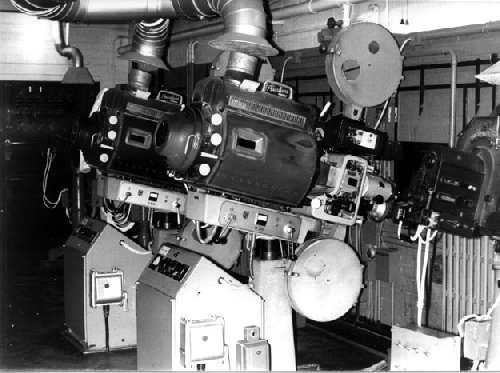
Philips FP7 projectors. Granada, Rugby 1960. Picture kindly supplied by Harry Rigby.
I can also stand the all hated ORC big butt orange 5-deck platter that I learned on and I can't stand any Christie. I think it just makes a big difference on what equiptment you were taught on.
I think magnarcs were made in Glasgow, Scotland.
Fedi Solo? Are you guys serious? I have the misfortune to service what I believe to be the last remaining Fedi still running in the UK, and what a clunker it is!
Lancaster got rid of theirs yonks ago, as did Edinburgh Filmhouse, replacing them with DP70's.
Never actually used a DP75. Only worked on them. They seem to be pretty well made to me, but those little plastic things that serve as pas rollers! Dreadful if like me you've got sizeable hands.
quote:
Were Magnarcs also produced in other countries or all USA origin?
They were also made in Glasgow, by Kelvin Somebody else and Bottomley, not certain of the third name, I should be, I've seen it often enough. Later became part of Smiths Industries. Also part of the same setup as Kelvin Hughes who make radar, and other marine navigation equipment.
Most of the ones over here were made in Glasgow, but you do find the odd American one, as well. They look very similar.
quote:
Fedi Solo? Are you guys serious? I have the misfortune to service what I believe to be the last remaining Fedi still running in the UK, and what a clunker it is!
Where is that? It's somewhere in Cumbria, isn't it? I'm sure we saw it on our CTA visit, but I can't remember where.
The Only other Fedi I've ever seen is at Bletchley Park, quite different, it's an automated thing with two huge spools on the base.
quote:
The bottom line was we had to run each trailer INDIVIDUALLY with a changeover in between each one. We also ran a cartoon before the feature and had to operate a manual light board. We had to be very fast and when we had to run a 30 second teaser, it HAD to be the first trailer shown. We did also frequently run 60 second reels. Your scenario is nothing new to me.
Brad, I don't think anyone will be able to beat 60 second reels, but some of the reels of 'The Jazz Singer' were very short, not much more than five minutes I think. The sections with sycronised sound were on separate reels to those with just music.
This film was on nitrate, of course, so it could not be kept in the projection room, at least not in England, I assume American regulations also required film not actually on a projector to be in a separate rewind room or film vault. After a changeover the old reel would have to be taken out to the rewind room, the next reel brought in, checked, the gate cleaned, the fim laced up, the carbons changed, the needle changed, the disk changed or turned over, the needle placed at the start mark on the disk, the machine inched down to the correct point for the changeover. All in about five minutes for some reels.
It might be fun to try it just once, but I wouldn't want to do it very often. One of my lecturers when I was at college had been a projectionist as a young man in those days, and had run sound on disk, but I didn't think to ask him how many operators they had to do it.
I don't suppose there is anybody here who is old enough to remember those days, is there? Dr. Zhivago is now just about half as old as the Jazz Singer, it's amasinng how much things changed between the two.
The one with the huge spools underneath is the Solo, or 'Monster' as it was known, much beloved of ABC/Cannon/MGM whateveryouwannacallthem, as it reduced staffing needs, supposedly. In reality it just chewed up film in my experience. I think the Bletchley set up is the only remaining such beast.
quote:
Stephen, that would indeed be a BUSY shift! I wonder, does anyone know if back in the early days of sound (Jazz Singer) if there was 2 operators on duty?
I would guess a lot more than two; well after sound on disk days A Chief, two operators and a rewind boy was quite normal. At least one more than this would seem propable if disks were being used, but I don't know for sure.
In many places, it was a requirement of the regulations to have at least two operators if nitrate was being run.
Some photographs I have seen of a large cinema, probably from the early '60s show at least three operators, all wearing white lab coats, I know one old chief who still wears one today. Apart from film projectors, most large cinemas had at least two follow spots, and quite often slide lantens and Brenographs as well. All this stuff needed operators to run it. Into the '60s Cinerama needed four or five operators, Bradford now does it with one.
Even today, two operators are often used for a complex show, e.g. where numerous clips are being shown during an on-stage interview, using several different gauges and formats of film, or where very old, shrunken, warped film is being used, which needs careful watching, and a projector cannot be left for even a moment while it is running.
Sound on disk was new technology in its day. New technology in its early days may well need extra staff to look after it. I have seen DLP twice, each time there were several people gathered around the projector.
In some ways things have changed greatly, but in others, are they really that different? Most projectionists no longer operate follow spots and Brenographs, but they now have to cope with automation systems, platters, digital sound systems, and even digital projectors, which the old ones did not. I would have absolutely no idea how to set up a platter (anybody in the London area care to show me?)
There may have been four operators to a single screen, but if that screen had four thousand seats, and most shows were sold out, that is only one operator to each thousand tickets sold. If one operator now runs ten screens, the biggest of which only seats a few hundred, and many of which are far from sold out, then the ratio of ticket sales to staff employed isn't so different to what it was.
quote:
Stephen, that would indeed be a BUSY shift! I wonder, does anyone know if back in the early days of sound (Jazz Singer) if there was 2 operators on duty?
There's a picture somewhere, Cinema Technology ? of two operators at the Plaza, London West End in 1929, one operator is threading, and the other one is setting up the disc. I would think that it was extremely likely that there was a third operator looking after the other running projector.
Up until 1960 there was always at least two operators running a show.
Most of the large cinemas had three on each shift. After this period single manning was slowly introduced. ABC Cinemas were one of the first in the UK to install an emergency projector shutdown device named A.C.O.P!
Sound-on-Disc days must have been a grind. I've run 2 projector 3D, but that wasn't too bad with 5,000' spools. To name three, the Odeon, Marble Arch. Davis, Croydon. Warner, Leicester Square - all had four projectors and changeovers for 3D. And the Warner ran 3D "House Of Wax" with stereo sound on seperate interlocked soundheads. 
quote:
In many places, it was a requirement of the regulations to have at least two operators if nitrate was being run.
Still is... or at least, it still was in 1992, which was when I last projected a nitrate print to a paying audience.
This is only a guess, anyone know for sure?
Can you imagine running a twenty screen multiplex with sound on disk? Interlocking could be rather interesting, how about a turntable with several pickup arms, each playing at a different place on the disk at the same time!
Come to think of it, how do you do interlocking with DTS? do you need a second set of disks?
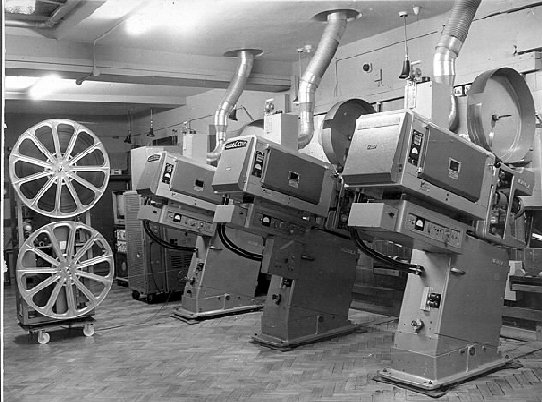
Gordon wrote,
Morganite made a lamphouse called the autoarc that used a set of rollers to advance the copper coated carbons through the jaws and supported longer carbons. It also autostruck and used a thermostat styled position sensor like the mighty90/futuraII
I always wanted to get a pair of those if any are kicking around cheap
Les Brock wrote,
Favourite Booth. Odeon Leicester Square. Also Nigel makes a mean cup of tea !!!!
Here is the Odeon, Leicester Square in the days of the Victoria Xs and
Elidophor television projector. The Auto-Arcs having been converted to xenon. One of the Victoria X 35/70mm machines has been installed in the projection room of the Projected Picture Trust's Enigma cinema at Bletchley Park.
www.ppttrust.org
JJ
I never worked at the Odeon, Marble Arch, so I can’t help you as to the size of the deep curved D 150 screen, which was later removed for the normal slightly curved type. Yes, unfortunately it is now carved into 5 screens.
I did work in the West End as chief projectionist at the Carlton Theatre, Haymarket 1968 – 1972. After which I did a freelance spell for 9 months at the Columbia, Shaftsbury Avenue, Philips DP70 projectors.
Leo - surely you could list York as a contender for favorite booth ? Air conditioned, carpet, CCTV view of the pretty young things on the floor plus a historic river view !
My favorite is the Bridgeway Auckland NZ - sits under the harbour bridge, booth opens up to the top of the canopy - perfect for a post-changeover bottle of the managers' home brew, watching the boats sail by and the sun set..
I think my favourite booth would have to be MOMI as was (now NFT3), for the sheer range of equipment in there, the variety of films we got to show and the general atmosphere at the South Bank before BFI political correctness made it all go nasty. Its only quirk was that (in those days), there was no motorised masking - you had to go down and adjust it with a pulley. As there were never any ads or trailers with NFT shows, this didn't really matter though.
Least favourite booth - the one behind a lecture theatre at Exeter University out of which the film society operated. It was about the size of two lavatory cubicles and contained two GK-37s, rectifiers, sound rack and a Westrex tower. The temperature would easily hit 35 degrees in there during a show (the lamphouses were ventilated, but the projectionist wasn't). Enough said.
I like NFT1, and will be sorry when it goes, I haven't heard anything about the new BFI centre recently, and there was certainly no sign of any construction taking place the last time I walked past the site. NFT2 is another matter, Just one asile down one side makes it difficult to get in and out, the front rows are too close to the screen, the screen is also too high from those rows, if you are sitting at the back, the ceiling is very low, due to the projection box jutting out into the auditorium, giving it a rather claustrophobic feel. The auditorium is rather long and narrow, but at least that is useful for showing 3D.
Then there is the projection box, because of way it's positiond inside the auditorium, the throw is short, it's not too bad with the 35mm machines, being in the centre, but with that platform on the right with the video gear etc, the 16mm machines have to be way off axis, it's equal to having six machines in that short a throw, the keystoning from the left-hand one, both vertical and horizontal is terrible, this machine is also very close to the left wall of the box, which, as it's a left-handed machine, must make access to it rather difficult. When I visited the box I couldn't believe the crazy angle this machine is at. Sadly most of the material I see at the NFT is in 2, and in the past a lot of it was on 16mm, today it's more likely to be on video.
What are the windows high up on the right-hand wall of the auditorium?
MOMI (now NFT3) is not bad, 70mm in there looked good, only having one 16mm and one sound follower did limit it somewhat, compared to the other two. It was the only one of the three to later have 1" C format installed. I'm not sure if it's still there, but I did see it used quite a few times.
Before MOMI closed there was a still from 'The Smallest Show on Earth' on the windows of the projection box. The acient projectos shown, I think they were Kalee 8s or 11s, or something similar, were probably about 35 years old when the film was made, younger than the DP70s which were then in use in MOMI.
I saw the Kalee 20s when they were still in place, but out of use, for the old NFT3, complete with mechanical interlock (metal bar) for 3D, they later went to Bletchley Park, but I never saw the auditorium, it had been converted to an office then. it must have been very small, how many did it seat?
It's a pity the gold shutters, I can't call them a curtain, in NFT1 are no longer used, they were rather noisy, but they were unique to the place. Whenever you see old photographs on intervies taking place on the stage those shutters are always there, and you know at once where it is.
The loss of the bookshop is also to be regretted. The NFT is not what it was, I am renewing my membersip this year, but this may be the last time, I am thinking about moving to North Yorkshire, in the not too distant future.
It was a pain in the bum having those 'EC' shows - we had to play pink noise and test every single pair to check that they worked. Thankfully I never had to do that for all 552 seats in NFT1...
The Alhambra Penrith has a mech or three for spares, and there's also stacks of Fedi stuff backstage in Perth. They were taken out a couple of years back but nobody could be bothered shifting the spares collection. The pedestals alone need about 4 bodies to move.
HI - the Mr Young machines were 35mm only, and whilst I remember the Cantebury machines with disused Penthouses I can't remember if there were any 70mm bits on them. Too busy mopping up the oil and trying to figure out the 10000 motor wires ! Picture is steady and they run quietly. Was quite an install - virtually untouched since installation from new in the 1960s. Billy Bell converted them from three to two terminal lamps about 10 years ago, and we put in a "state of the art" CP50 three years ago - prior to that everything was original, down to the cool RCA motorised faders and sound system.
Until it's refurbishment the Playhouse, Perth was still using the RAC speakers and crossovers. I a moment of genius/foolishness we ran the amp outputs from the Dolby rack into the crossovers in the RCA racks. Didn't sound too bad really.
When the refurb was complete, the chief was kind enough to give me the RCA stage microhpone, which is a huge ribbon affair. Never wired it up to see if it works, it sits doing sterling service propping up some manuals.
It has been 1134 days since the last post.
quote:.
Stephen, that would indeed be a BUSY shift! I wonder, does anyone know if back in the early days of sound (Jazz Singer) if there was 2 operators on duty?
![[Smile]](smile.gif)
![[Big Grin]](biggrin.gif)
![[beer]](graemlins/beer.gif)
quote: Matt FieldsCan't say that I have a favorite. Over the years, Brenkert, Simplex E7 & XL and Century... even the Wenzel Ace have been very good to me. I've seen very good performance from Motiographs, even recently. I wouldn't go out of my way to put a chain around a Pro35, even if it IS heavy enough to be re-purposed as a boat anchor for a medium-sized yacht (and it is). Some of you speak highly of models I haven't had the opportunity to try.
these all sucked:
ORC
quote:Wow now there is a legend. I remember having tea with him in 1994.
Billy Bell converted them from three to two terminal lamps
Although I am now dealing with Super Platters for the first time ![[uhoh]](graemlins/uhoh.gif)
quote: Cameron GlendinningThe Independent Camden Parkway, (ex Gaumont / Odeon) following closure for 3 years, was taken back by Odeon, and is now a five screen multiplex. I remember seeing the Vic 8s running during the former Odeon & Parkway days when a single screen. Also the Cinemation 50 x 30 pin matrix board.
Favorite Booths,
Camden Parkway, London Vic 8 (RIP)
quote: Tim ReedI believe in the final years of that drive-in they put in a large capacity reel system.
Favorite booth: Circle 25 D/I, Lexington, KY (RIP) This is the booth I learned in at age 12. Huge theatre (1,200+ cars), RCA Dyn-Arcs (Ashcraft Super Cinex's) running an 11mm trim, behind Century C's, and RCA 9030s.
You have a good memory, guy. Subsequent to Mid-States taking over the theatres there (and the drive-ins really went downhill quickly after that), they kept the #2 Century head at the Circle 25, and put it on a forward-only Sword system, along with an Eprad soundhead (yeeeuck!) and Kneisley Xenex I 4k lamp.![[Frown]](frown.gif)
![[thumbsup]](graemlins/thumbsup.gif)
quote: Bernard TonksI worked there in its final year, It was a 1100 seat (from memory) with a 60ft screen and probably the best sound I think I ever heard! personally lined up by Dion at Dolby. The second screen was 110 seat with 2 sets of curtains, in what was formerly a resturant. There was also the remains of a projectionist training school! It was a beautiful theatre. 70mm prints everywhere.
The Independent Camden Parkway, (ex Gaumont / Odeon) following closure for 3 years, was taken back by Odeon, and is now a five screen multiplex.
quote: Steve GuttagThx, Steve for all of this - greatly appreciated for this info and your time.
So given the shutter technologies you listed, the single blade large shutter is the best....the small bow-tie blade is the worst.
Then there are the 3-wingers...while they do not have the light output (half that of an equivalent 2-wing blade), they do have the least flicker and often have the appearance of a sharper image.
quote: Bernard Tonks
The Independent Camden Parkway, (ex Gaumont / Odeon) following closure for 3 years, was taken back by Odeon, and is now a five screen multiplex.
quote: Cameron GlendinningCan’t really help you with that now. I would think it was likely that the main auditorium was split into 4 screens. I would hope they have left the wonderful Art Deco foyer intact. I also remember the very attractive Art Deco created 2nd screen with two sets of curtains, but was spoilt with the most dreadful sightlines. No doubt Odeon would have corrected this.
I worked there in its final year, It was a 1100 seat (from memory) with a 60ft screen and probably the best sound I think I ever heard! personally lined up by Dion at Dolby. The second screen was 110 seat with 2 sets of curtains, in what was formerly a resturant. There was also the remains of a projectionist training school! It was a beautiful theatre. 70mm prints everywhere.
Just curious to know what remains? Was the main carved up into 4? Is the wonderful Art Deco foyer still intact?
![[Cool]](cool.gif) I forgot about Elementos ( Wassman ) which promotes Ernemann and Veronese / SAX / Cinemec....but their total production compared to Kinoton - Ernemann - Cinemeccanica - Proyecson is another story
I forgot about Elementos ( Wassman ) which promotes Ernemann and Veronese / SAX / Cinemec....but their total production compared to Kinoton - Ernemann - Cinemeccanica - Proyecson is another story ![[Wink]](wink.gif) .
.
quote: Mark GulbrandsenCurrently, only one cinema here in Iceland is equipped with digital projectors and that's "Kringlubio". It's equipped with both digital and 35mm projectors from Cinemeccanica in all three auditoriums.
I thought Iceland was all converted to Digital or mostly digital....?
quote: Steve GuttagYou can get that same "extra sharpness effect" by installing a high speed movement in an X-L. There is very definately much more sharpness than with a regular speed movement. No one here has ever been able to explain why this is.....
Then there are the 3-wingers...while they do not have the light output (half that of an equivalent 2-wing blade), they do have the least flicker and often have the appearance of a sharper image.
quote: Gordon McLeodYea, like those are being installed in world wide locations
Doesn't the Wassman and veronese machines still have a barrel shutter
![[Roll Eyes]](rolleyes.gif) .
. quote: Steve GuttagI agree thats got to be what it is. I knew I wasn't seeing an illusion nor were my customers although no one could really explain it. The difference is easiest to see when running white titles on a black background. The titles become very sharp with the HS movement.
It should look sharper because the film has come to a more complete stop in the gate before the shutter opens...Kinoton has increased the speed of their electronic intermittent 4-5 times over their standard electronic intermittent and claim that they too now see more resolution.
quote: Monte L FullmerI always got at least 25% more light on the screen but optics also introduce a limiting factor... some of the D.I.'s that I put them into had pictures very close to indoor light levels when running a HS movement. The problem is finding even just one today. Wolk used to have a bunch of them but I don't know if they still do or not. Another route that also works... the Technilight Kit at about 2500.00 plus labor, thats double but stop to consider that a good HS movment will run you a grand and if you pile it up its usually NOT repairable. All the ones I installed are still running just fine, over 10 years now. Estar made the use of them possible again... they tended to shred acetate especially if its dried out.
Would a Hi-Speed INT assembly do this screen justice, or just call it as it is with the present setup of the shutter being opened all the way?