I can not stand people winding at warp speed and having film spread out along the film bench.

Personally my main focus is at the workbench. Dirty & scratched film bothers me!
I can not stand people winding at warp speed and having film spread out along the film bench.
My rule is "The film should not touch the workbench at any time if avoidable!". I like my staff to handle film like gold!! But that's me!
Nick

I have seen the result of Nick's rule, and they do result in excellent on screen presentation.
I would also add that training your staff to have an empathy for presentation and to be focused (no pun intended) on what is going on to the screen and what is coming out of the speakers.
What Nick misses out on in his post, but includes in his booth is general cleanliness, respecting the film handling equipment, good routine equpiment maintenance, well aligned rollers on platters and consistent threading by all staff. Then we are half way there...
Frank
You've obviously never used FilmGuard. Once you do, I think you will agree that it IS "the key" to a fantastic presentation. Sure most people don't believe it until they use it, but I've not received a single complaint on it EVER and I've gotten hundreds of letters and emails that all say the same thing ("I was skeptic, etc, etc but this is the best thing I've ever used, etc, etc.") Prevention is great and careful film handling is great, but light dirt around the splices (and changeovers) is unavoidable, even if it is only minor. Also if static can be controlled to a level that's "good enough" so you won't have prints flying across the booth, that's great too. With FilmGuard there is no static so that means never a film transport problem, the film runs smoother providing better registration, the digital tracks (SRD and SDDS) never "wear out", and you get a true wet gate type of presentation unobtainable any other way. Finally, it will cover up minor misthreads, operator errors in film handling and scratches (not deep emulsion though).
To say "don't say FilmGuard" is pathetic. If you say that because your boss won't allow you to use it, then your boss is either cheap, or does not care about your presentation. If you haven't tried it then you fall into a poor situation with your boss or don't much care yourself to give it a shot. I don't know what the specific situation is, but it is available in Australia. I promise you that you will not quite realize all of the defects in your presentation as it stands right now until you start using it, for you just think you have a great presentation right now. That opinion of yours WILL change if you follow the recommended procedures with the product. You will never find anything else as helpful in the booth. I know I am biased, but if you're going to come on here and ask a general question to get answers from various professionals in the field, you should give a little courtesy by not restricting everyone's answers to what would've probably been the most popular answer.
Some examples...
"What's the best film stock? ...and DON'T say Kodak!!!"
"What's the best sound processor? ...and DON'T say Dolby!!!"
"What's the best sound system? ..and DON'T say THX!!!"
I treat the film like gold. It never touches the work area surfaces. I hand-inspect everything and if I feel any roughness along the edges of a print, I will stop and back-up to see whats up. Every splice is checked, and in the case of a new print for the collection, new tape after peeling and cleaning the old tape residue off of the cut ends.
I have always taken care not to cause any damage to the soundtrack area during the inspection and rewinding by allowing the film to just barely touch the edge of the reel opposite the soundtrack side (no bent reels here) so that the film is wound evenly and smoothly on the reels.
During the make-up, I dont leave gaps in the soundtrack at a splice. I have some blooping ink that is very old. I apply it sparingly after making half of the splice, allow it to dry, then make the other half. No problems with "pops" here!
Sloppy winding was my pet-peeve in TV, and I often re-rewound a film before it went back to the distributor because I knew that the edges of the film would be crushed as soon as UPS got hold of it.
I realize that this is unrealistic for theaters, but since you get the new prints alot more than I do, all you can do is be gentle and avoid any sudden starts and stops while loading your platters.
I try to be sure that there are no tears or snags along the edges of the print. In my years in TV and film inspecting, torn edges between the sprocket holes and the edge of the film were the 2nd biggest cause of on-air film breaks. Our production dept. was the first cause. 
Many times I can trim away the rough edges of the snag without using splicing tape. I've got alot of old IB stuff that were crushed on bad shipping reels. They run fine after the inspections.
35mm is more forgiving. I purchased a print after seeing it at a dealer's theater set-up. It looked great and steady on the screen. I got it home and found sporatic sprocket damage here and there in 2 out of 7 reels.
After an hour repairing the reels, it still looks great on the screen, but now I KNOW that the integrity of the print is satisfactory, and that my Holmes won't make dinner out of it. 
It is amazing how much you can feel just lightly running your thumb and index fingers along the edges of the print while you are winding through it...
Well Mr Miller. I don't know how you ever got the impression that I was bagging your beloved filmguard. All I was after was opinions from other members as to what they focus their attention on to give great presentation. I thought your reply was WAY over the top and now you have got me a little pissed.
For you to be so defensive and jump on your back heels so quickly is pathetic. To put your product in the same sentance as Dolby and Kodak makes me feel sorry for both you and your ego.
Can't anyone have an opinion?? I am sure film guard is great but this is exactly the point of this topic. I beleive my presentation standards do not warrent spending money on fluid. To refine your film handling techniques and procedures will ensure this. I can tell you that my spool joins are not covered with scratches and dirt. Sure after 1 month of running they start to develop but not enough to warrent spending buckets of money on filmguard. This forum should be about colaborating techniques to improve presentation. It is not just about clean film. Will film guard fix a poor splicing technique. NO, I don't think so. Splicing techniques among other things could have been mentioned in this topic but no, you had to ruin it. Could it be you don't want people to improve presentation without relying on film-guard?
You say filmguard ensures that digital tracks never wear out??? Might want to give Dolby a call as they are currently inform consumers of a average life span for digital tracks. Maybe you could get a plug in all their manuals from now on!
Anyway, before you close the thread as you do when someone opposes your opinion. Convince me. How did you produce film-guard? What qualifications do you have to come up with such a great product? What is in film-guard? Have you ever worked in a lab?
The answers to this will give us an idea if the product is relative to the price.
What amazes me is that all the geniuses at Kodak who revolutionised film stock today can't seem to come up with something better than film-guard?? Odd!
Brad, responses like this will continue to happen until you realise that people will have opinions (In this topic I wasn't even voicing one until you jumped on me)and until you accept that and chill out this will not cease to happen.
If you like you can create an alternate idenity to back you up on this topic like our good old friend 'Carl Weles'.
I don't know how you get on this website anyway Brad. There is a declaration at the entrance about people's opinions and stuff. There are to options. 1) I understand and agree. 2) I have no sense of humour and cannot handle this.
Since you are clearly option "2" I don't know why you keep accessing the forum?
As we say here in Australia. "Pull up you skirt Brad".!!
Now that I have that out of my system I feel better. I apologise in advance for my harshness Brad but I found your response to my innocent topic very insulting.
Cheers All!
Nick
I am Nick's boss. Cheap?, does not care about presentation? all because I have not bought Filmguard to this point???
Quality film presentation is made up of many things: dedicated and experienced projection staff, quality equipment maintained in good order, a flow of lights, curtains, sound fades etc, cleanliness in all areas of the projection room AND various film cleaners.
I have had available various chemical film solvents on our circuit for many years prior to Filmguard coming along including Kodak, Renovex and Filmrenew. To say I don't care about presentation because I have not bought Filmguard to this point is a little unfair.
When our current stock of film treatment is exhausted I will certainly consider the purchase of Filmguard. I do consider prevention better than the cure, therefore will always strive to have our projection rooms clean and organised. I am also fortunate to be in the position to reject inferior prints that arrive from distributors.
Nick can stand on his own two feet, but I read his comment re Filmguard as an innocent jibe to provoke more in depth discussion about the complexities involved in delivering quality film presentation.
David Kilderry
 .
.I too work with Nick, and know his dedication to presentation standards. All aspects of presentation, not just one small part. That is not to say that FilmGuard or any other film cleaning or protecting product doen not have its place. But lets all face it, any film cleaning product is useless until the rest of the elements are well refined. For example, if I use a cleaning product on a film and then misthread the film through the projector, placing a big green emulsion scratch down the centre of the film, which has the bigger impact on film presentation? Or if I use a film cleaning product and then neglect to corretly set the dolby levels on my CP65 (the best processor I have worked with) or incorrectly set the fader lever to fader 2, which has the bigger impact on presentation? If I clean the film with a cleaning product and then run the show with the incorrect lens, which has the bigger impact on the presentation? I think you get my gist, and you might be on the way to understanding Nicks point.
Training, cleaning, alignment, consistent threading, good film handling, correctly lit auditorium, correctly cooled auditorium and foyer, comfortable seating, good screen size, good sound, a well cut aperture plate and yes, good film cleaning techniques are all part of a good presentation. As Nick asked, what techniques do you use to help your on screen presentation?
Frank Prete.

Using FilmGuard does not preclude careful handling of film including careful and accurate threading (the technique of threading 'up' should also be adopted for optimum results).
Having used and seen FilmGuard in action, I can say this with absolute authority:
1) If one doesn't use FilmGuard, one cannot achieve *optimum* presentation;
2) Previous cleaners cannot compare because only FilmGuard doesn't evaporate from the film, thus providing true 'wet gate' projection qualities;
3) I am a real person expressing his own experiences and obervations independently.
Anyway, allow me to contibute to the original topic by saying that threading 'up' is a terrific technique in improving presentation quality...I'm glad I switched over! Now if only I could get everyone else in my booth to try it too...highly recommended!
I highly recommend it for polyester, but it works great on old tri-acitate prints also.
Brad is obviously proud of his product. I would be, too!
As for my presentation philosophy, one of the things I always stress when introducing trainees to the booth is a calm set of mind. There's nothing to be gained by running around in panic as soon as something out of the ordinary happens.
Another thing I stress is consistency when working in the booth. Establish your own routines and follow them, always. I've seen too many projectionists thread a projector differently every time and always wonder why.
Showmanship and common courtesy is also at the top of my list. Always respect your audience, because they are the ones that actually pay you, not the company.
Obvious little things, really, but I thought I'd mention them anyway.
I, myself am about to try Film Guard for the first time, tommorrow, when it arrives at my theater, and am excited after reading all that has been said.
However, there are still some basic things a booth needs before Film Guard can work in a cohesive team, with the equipment and operators.
If everything said about Film Guard is true, then it can be ONE key in your presentation, but it cannot be THE key. There isn't ONE key to it all, its a combination of things, and depends on your theater, and your company, and the different people who handle your film and your projectors.
One thing that's disruptive to any booth, theater, family, or community (which Film-Tech certainly is), is pointless bickering.
I'm not holier than thou, I admit, I argue with people I work with, and my family, and my friends, but the less people that see it, the better. Who wants to actually show their worst sides in public?
The thing about this internet thing is, you can't tell how something is said, or how something is meant. I'm sure Nick had good intentions, and I'm sure Brad, who's VERY proud of his product, and from what I read, should be, took some homage to it.
However, just because those two miscommunicated on something, shouldn't mean the next 50 posts are nothing but snide remarks to everyone else.
Now, back to keys about presentation:
Your operator is the most important part. A good operator should, will know whether or not your projector is a problem, or your rollers, or so and so forth. Your operator can prevent problems with the film, or fix them, as well as ENHANCE them (yes, that includes using Film Guard). Without properly trained operators (not commenting on union or non-union), you can't run a booth. A monkey could thread your projectors, its another matter whether they miss a roller, or don't close the film shoe, all the Film Guard, and all the best equipment in the world won't save that presentation.
So, its definitley the operators who make the difference. And you can't have the good operators with out "yoda-like" training (quote me on that one please).
Thanks-
<crossing fingers to avoid FLAMING>
------------------
If ya smell, what the Zach is cooking.
Zach Zagar, the most electrifying man in theater entertainment today.
Thank-you for your feedback. You obviously beleive that film-guard is an essential part of the booth. I do however beleive you are missing my point.(opinion) This topic was not about filmguard. I have never used it. It may work, it may not. I don't really care at this point. I never said film guard is crap or anything negative about the product prior to my attack.
The purpose of this topic was to find out what you as individuals focus your attention on more than any other aspect that relates to presenting a film. It could be training of staff, checking volume levels daily, monitoring your light levels etc. I simply wanted to know what you dedicate more of your time to. The whole "Don't say film guard" comment was simply to dismiss the obvious. Right there I gave the product a compliment. What I was getting at was "Don't bother to mention film-guard as it seems to obviously have quite an impact judging from everyone else's comments in the past."
I wanted methods,procedures. Things that you have come up with yourself. Not products. If I wanted products then the key to presentation would surly be the projector! Without that even film guard is rather pointless! Just a joke Brad. Calm down! Deep breaths. Count to 10!!
Greg said "Don't knock it till you try it". Hello?? Did you even read my very first post?? I didn't knock it. I did not even comment on it. All I did was say the words "film guard" and "don't" in the same sentance.
Zach, it is not "pointless bickering". If Brad had of written that sarcastic response to a topic you had posted and had taken it completly out of context i'm sure it would be a different story.
Bottom line. I have no opinion on film guard as I have never used it. I feel I have made that as clear as I can.
Nick
>>Personally my main focus is at the workbench. Dirty & scratched film bothers me!<<
If that is true, and I do not doubt that it is, then obviously Film Guard should be on your 'essentials' list of equipment for your booth.
Brad said something like 'you won't believe it until you've tried it'. That really is true. No matter how careful you are at the bench and putting it onto the plate etc...it will never...,never be cleaner than running FG.
We're runnig with Kinoton FP30's were using PTR's to go with it. We were at our 5th week of X-Men. I looked at it and thought 'Man, this print really does still look great considering the passes it has had (about 160). Then I installed FG and a Kelmar cleaner...the print was not running in the FG auditorium.
I went back to that print in its 6th week and I could not believe that I had even considered this print to be looking great. I noticed all the black spots of dirt (and the Kinotons are pretty kind so it wasn't like it was shedding or anything...it was just looking like it had been run 175 times.
We are now completing our run of our first 'new' print which has been FG'd from the beginning. After 130 passes, 'Pokemon 2000' literally does not have a mark on it. It looks better than it did when it first ran through the machine.
Brad is proud of his creation and I don't care what his scientific background may or may not be. This stuff works. I can understand his defence although he may look at it days later and think himself that he jumped the gun a little bit in his response, I don't know.
The bottom line is...there are SO many things that add to better presentation, but you can't say 'don't say Film Guard' for saying that makes the discussion incomplete.
John,
If your having problems keeping prints clean with an FP 30 then there is something seriously wrong. This is precisly my point of the topic. What procedures (that's PROCEDURES to all the idiot's) do people pay attention to.
John, filmguard may remove all that dirt and minor base scratches from your print but maybe you should be asking yourself before you put on filmguard, "why are my prints getting covered in crap in the first place". I assure you this is all to do with PROCEDURES. Things like people spinning out ads at excessive speeds, ad change techniques, cueing procedures etc. I am glad John that your filmguard is able to make up prints, do all the ad changes, write up the running sheets and so on because the way all you people are talking it seems to do the fricking lot. All I wanted from this topic John was to hear what procedures you have in place to improve things such as film make-up. I honestly don't know why you all keep going on about film guard. I have made it quite clear that my comment was not putting down film-guard. Just because Brad feels he has to defend himself I really thought that you would have the intelligence to understand what I was really trying to say. But a good thing has come from this. At least people have seen Mr Millers true colors.
You can all go ahead and quote me on and on but that will not resolve what has come out of this. Brad Miller is constantly hanging this web site over peoples heads to obviously gain exposure to his product.
His remark about film-guard running the web site is crap. The members run the website. If you have no members you have no web site.
And you know what that means Bradley. No $$$$$.
Anyone ever wondered why company reps post here less and less. Well, because if Brad can't work the thing it immediatly gets bagged. If you think my comments are ignorent I am glad. Now you know who Sony felt when some moron on this site with no idea gave them a bad review amongst other great products.
Anyway, this topic has ended my patience so your wish is granted. This is my last post.
Well done Brad, another person with an opinion you got rid of. Hopefully you can get rid of all of us then you can sell filmguard to everyone. (Look, it may work and I take those opinions of people who swear by it but that is beside the point. We are now way beyond the discussion of filmguard being effective)
Anyone that thinks there a profectionist projectionist is full of themselves. There is no such thing. Everyone makes mistakes.
Goodbye all,
I have enjoyed listening to your thoughts over the past 6 months and learned alot in the process.
Nick
Oh! One last thing. Great excuse about that vacation Brad. Did you spend all day thinking of that one. It was a little lame.
Brad, in regard to your passionate response to Nicks passionate response, I'm sure that anyone who takes enough time to read and comment on Film Tech understands that this site must take a large amount of time to maintain. I also know from personal experience that there are many valuable things that can be learned from this. Every time I log on I read of some new or different way of doing something, and that is a credit to this site and the subscribers who write here. No doubt with this topic alone, Nick and all readers have learnt or have questioned film handling techniques and the finer points of their own presentation. If this is so, you have achieved in what the site is meant to do.
Correct film handling in all of its forms is the most important thing in a projection room. And from this heated debate we all have learnt a little something about doing that better 
Frank Prete
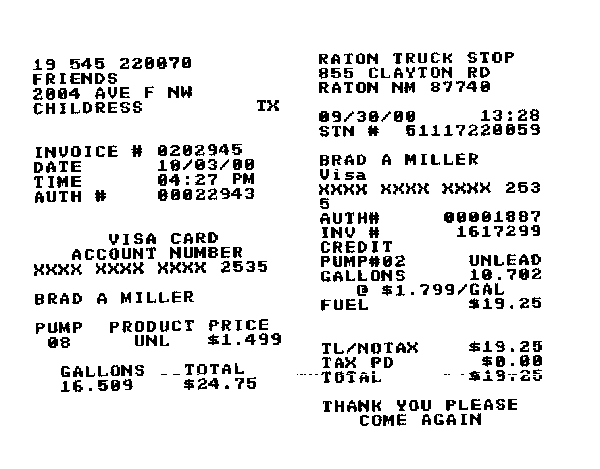
I never said I was a perfect projectionist, that was a nickname people would tease me with because I am so picky. I agree with you, there is no such thing. Also, it wasn't a "vacation". Did you not even notice I have been virtually nonexistent on the forum for the last 4 days? Hmmmm, yes I must be lying about being gone as a lame excuse then. Why I bother doing this to try and prove to you Nick I don't know, but here's a couple of the friggin' receipts for gas in New Mexico and Texas. Lots 'o trust here. It's so much appreciated. Perhaps next time I am on the road I should make a live webcam to appese you. My privacy of where I go and what I do isn't worth anything anyway, right?
Thank you Brad,
Great site with real content
It's not said enough.
Dennis
So before people go off half cocked that Filmgurad is uncessesary, let me say one thing. Washing your car isn't necessary but it certinaly helps it look better, and it will help the paint job last longer.
Sorry to be off-topic, but I used to fight this "the users own the site" nonsense back in the old text-based BBS days (yep...pre-Internet...when 300 baud was king!)
I can't stay silent on this. The website belongs to Brad...PERIOD. It could be a commercial site for the sole purpose of promoting his product. BUT, Brad has allowed the users to make this site THE source for information on motion picture presentation. A web site with this much material and volume costs a lot of money, and its all coming from Brad's pocket.
Thanks, Brad.
Now, back to the topic at hand...
Mark L.
------------------
"As a moral to young men who come down to the city, don't go round breaking people's tambourines."
As I stated, I honestly believed that my print looked great. The Kinoton is indeed the kindest machine I have ever had the pleasure to use. Obviously you think so too judging by your comments that there must be something seriously wrong.
There wasn't...but in hindsight, there was...
I hadn't tried FG at that point.
Nick, this is the last I'm going to say on this matter because frankly we are all in trying to achieve something here together and this bickering is not going to help anybody.
As I said, there are many things which make presentation better. However, I am assuming you actually do know how to make a correct splice without scratching the print.
You asked the question, remember? I'm not about to give you all the answers as there's plenty of us here able to add their two cents...but you did ask the question...
>>Since presentation is what most of us pride ourselves on I am interested to hear what you beleive is the KEY factor in providing great film presentation.<<
The 'key' in my opinion is Film Guard. You can do whatever else you like to think your prints are spectacularly clean...you will still not have a print that looks as marvelous as a new print straight from the lab after 130 passes as mine will. Hell, my print that has done 130 passes will look better than a 20 pass (or less) copy of an untreated print. And I only stop at 130 as that is the most passes we have done thus far with a FG'd print. I fully envisage that after 300 runs, it will look no different.
So my procedure... (I will now point out to you clearly that this is my procedure so you will not mistake it for a shopping list. Did we all really have to clearly add the word procedure so you would know what it was? Just because we know how to read and construct a reply post without stating the bleeding obvious does not make us all idiots, but for your benefit I will point out the fact as you seem to require it to be made abundantly clear to you)
...my procedure I now put in place is to make sure all prints are treated with FG. Got it now?
Nick, you asked a question and I gave you my opinion. Isn't that the reason people ask questions?
I am sorry that you are going, but that is your loss, not ours.
"Anyone ever wondered why company reps post here less and less. Well, because if Brad
can't work the thing it immediatly gets bagged. If you think my comments are ignorent I am glad. Now you know who Sony felt when some moron on this site with no idea gave
them a bad review amongst other great products."
Now I am a little pissed if this comment was directed at me. Yes I said the SDDS was crap, but never said a thing about other products they made. I have actual in the field EXPERIENCE with it, and that makes me QUALIFIED to give it a review (thumbs WAY WAY DOWN, in this case). I also said that how Sony handled themselves was piss poor, and I still feel that way. I believe in what I said and that is why I left AMC over the whole situation.
If that comment wasn't directed sorry, but it appeared that is was.
I was wondering what the long term benefits of film guard are? It seems that plenty of people think that it does wonders to new films that they run, but what about films that are treated with film guard and then stored for two or three years before screening again?
Alot has also been said about how Film Guard covers up or removes small scratches. How does film guard do this. I understand that you may have a closely guarded recipe for your product, but can you tell us why and how it works.
Finally, I stand by my comments that training is the ultimate key in presentation. i have seen presentations in booths that is sub-standard and the link has always been the training. Implement better trainging and the standard of the same booth, using same projectors has goon from being poor, to improving to excellent. Icing or no icing on the cake, if half of the theatres in the world could make this improvement then we would be alot closer to what seems to be all of our goals here, and that is getting better pictures onto our screens, which results in more repeat business.
Frank.
I've got films that have been stored for as long as 10 years, every 6 months or so new a new application is put onto them. Their counterparts (yes, I use identical copies of brand new trailers) are warped, shrunken and do not run well while the FilmGuarded copies still project as perfect as the day they came out of the lab. The only downside here is after 6 months to a year the coating DOES evaporate off of the film. For example, if you cleaned a print with FG this month and then stored it for several months, when you took it out to inspect, there would be no sign the FG was ever on the print.
FG can cover up the scratches in the same way true wet gate system do. In the simplest terms, the light must refract as it travels through the coating, thus hiding the scratches. Of course I completely agree with you that there is a problem if the print is getting scratched in the first place, but the main benefit of using FG in my opinion is the way the image looks as opposed to the way a typical "dry" film's image looks. Once you see how absolutely perfect the film medium "can" look, you will understand. Perhaps John Wilson would give you a tour if you are ever in his area.
------------------
"I luv the smell of napalm in tha mornin !"
Keep Smiling......Chris
Since we are on FilmGuard I have to say this. I don't use it in the exhibition of film. I use FG on all my test loops to enhance their durability especially after that millionth time that CAT 69t loops gets used.
I have old test loops that have excellent error correction ratings to date and are still in good condition. Same with RP-40. FG helps the splice in my test loops pass better and easier through the picture gate with out sounding like its going to pop out the next time it comes around. FG is a cleaner, polisher, buffer, lubricant, filler, anti-static, enhancer, refinisher, you fill in the blank. FG has earned its keep in my book and is used in conjunction with my work regiment.
Rory
I would be happy to. And that open invitation goes out to anyone down under. I have recently demonstrated its benefits to Paul Cunningham as well as others not on this forum.
Come and take a look. You will never again want to be without it.
Having read about FilmGuard on this site, my first reaction was that you should never get dirt or scratching on a print in the first place and so, in theory, it should be un-necessary. There's an English saying - if it ain't broke then you don't need to fix it.
But, thinking about this a little more, there are factors beyond our (i.e. a projectionist's) control. Firstly, any projection system involving a long-play device (be it a platter or a tower) means that large amounts of film are going to be exposed to the atmosphere for long periods of time. The atmosphere has dust in it, unless your cinema is willing to invest squillions in air cleaning plant, which mine certainly isn't.
Now I don't know this and I stress that I'm only guessing based on the information and comments I've seen on this site, but my guess is that FilmGuard contains some sort of organic solvent which suspends particles of crap, then evaporates, taking the crap with it. If so, then in a situation where you've got prints passing to and from platters all day long, possibly over a distance of several metres, I can't see how it can fail to improve the cleanliness of the print. As far as I'm concerned, long-term issues don't apply to release prints because they're just that, and not archival elements. I'm at a very recently opened (i.e. in January) cinema, and we're still really a building site. However carefully you clean everything in the projection box, a layer of dust will have accumulated there by the next morning. I'm all for anything that can help me keep that dust off the films.
Secondly - and as an art/rep projectionist, this is a particular problem for me - you might receive a totally buggered print one Friday morning. WE know how not to put a deep emulsion scratch on a film, but the person who sends it to you on crossover might not. If FilmGuard can do anything to lessen the impact of that scratch on screen, then I'm all for it.
I'd like to get a bottle of this stuff and test-drive it. If, after doing so, I find that it doesn't work as well as I hoped, then nothing is lost except the cost of a bottle. Problem is, no-one sells it in the UK. Brad - if you're interested in exporting, why not make contact with the following British companies, all of which supply consumables to cinemas:
www.soundassociates.co.uk www.jack-roe.demon.co.uk www.bell-theatre.co.uk
I know that Jack Roe imports a lot of stuff from the US and so they'd be a good starting point. Maybe one of these firms might be interested in distributing it?
to use filmguard as a cleaner, you will also need to invest in a Kelmar Media Cleaner, these cost around $500US. Without it, you will find it most annoying trying to apply this solution.
Believe me, you will not regret it.
Next time I'm up north, I'll drop in.
Where is 'in' that I'll dropping in to? You can email me if you want to keep it semi-secret.
Thanks for the invite!
Frank.