This is topic Change Your Xenon Power Supply in 30 Seconds! in forum Film Handlers' Forum at Film-Tech Forum ARCHIVE.
To visit this topic, use this URL:
https://ft-forum.com/ft/cgi-bin/ubb/ultimatebb.cgi?ubb=get_topic;f=1;t=001529
Posted by Greg Pauley (Member # 503) on 10-06-2000, 11:05 AM:
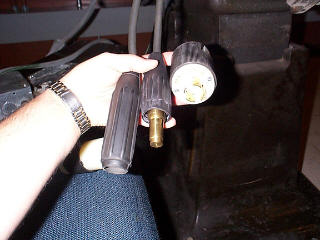
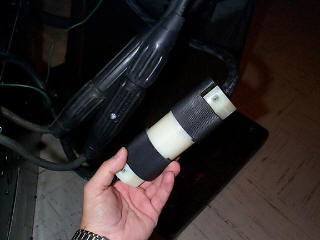
Ok it might take you a little longer if you don't have your spare power supply in the same booth, but you should be able to eliminate lost shows due to the failure of a xenon power supply. The story begins, I was managing a theater about 15 years ago that was using Strong 61000 xenon power supplies. These power supplies seemed to blow diodes every time I had a full house or wore my best suit. Even though I usually had a spare diode bridge on hand it still resulted in refunds for all or part of the audiences. As you know manager/operators have the luxury of not only having to fix the problems but then have to deal with all the angry customers afterwards, at least in my case. I thought if you can change out the bulb and save a show, why not find a way to change out the xenon power supply quickly and save a show. I found a very simple and pretty cheap way of doing this with arc welding connectors. Take a set of welding connectors (1 male 1 female) and install on the DC (+) (-) line coming out of the lamphouse. Take another set and place coming out of the DC (+) (-) line from the xenon power supply (make sure you don't cross polarity). I used a twist lock electric plug to run the 120v to and from the lamphouse again using male coming out of the power supply and female going to the lamphouse. I used a 220-dryer cord hooked up to the power supply and a 220-receptacle mount on the base for power to the xenon power supply. It's impossible for anyone, even the worst PJ working in your booth to hookup anything backwards. It will only work one way! . If you are worried about getting a 2000 or 4000 mixed up you can put different 220 plugs on each type to eliminate that worry. We have since replace all of these power supplies with strong switching power supplies and have all of our booths wired with quick disconnect that can interchange power supplies with any of our theatres. We now use a lot of these old power supplies as spares and have enough to keep a spare in each booth ready to go. I now supervise and train all manager for our theatres and have trained even the most rookie managers to change the xenon power supply. When was the last time you told a rookie assistant manager to change out the power supply? This also comes in handy if you have a problem and just need to eliminate the power supply as a problem. You just pull one from the next auditorium and plug it up for testing. We've been running these for 15 years and haven't had any problems with the connectors other than the occasional loose connection. You will need to treat the connectors like you would any high current connection and check the connections once a year. Hope this can help someone, check out the pictures below. 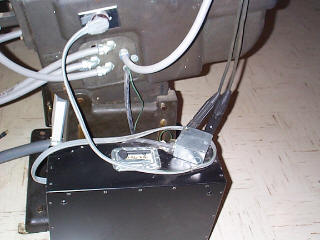
Posted by John Walsh (Member # 168) on 10-06-2000, 11:35 AM:
We thought of something simular awhile ago, and came to the conclusion that the existing DC plugs ("stage plugs", etc.) created too much resistance for larger (3000w and higher) applications.But the connectors you are using actually look better then the ones we tried. Who makes them?
Posted by Greg Pauley (Member # 503) on 10-06-2000, 11:39 AM:
John:It's been awhile since I purchase any of these plugs. We bought them from a local welding supply house. I'll find out and post later. The largest bulb we have used with these plugs are 4000wt. I do have a payment plan on anyone who uses any of my ideas. If I come to your town you have to buy me a beer or at least promise me one. My boss is up to 367 beer now, one night I'm going to burn the town down and stay awake past 3 beers! 
Posted by Greg Pauley (Member # 503) on 10-06-2000, 12:23 PM:
John:
Jackson Cable Connectors - model QNBM-2-BP
Jackson Products Inc. Belmont MI 49360Should be able to find these at most welding supply houses.
Posted by Jason Burroughs (Member # 68) on 10-06-2000, 12:27 PM:
The Loews Chisholm 5 in Plano Tx has a very similar arrangement, The have an extra (or 2) spare Christie powersupply mounted on wheels, whith a quick connect type connected on the back of the lamphouse, so that it can be used in emergencies. I don't know how long they've had that setup, but it appears to be for quite somtime, my guess is since they opened, or close to it.
Posted by John Walsh (Member # 168) on 10-07-2000, 12:03 AM:
I would love to "steal" your idea, but most of our theaters now have switched to using consoles, so the power supplies have to be unwired, unbolted and pulled out!At the time, we were using IREM power supplies, which were "free-standing" behind the projector.
But, what the hell, I'm thirsty.. I'll buy you one anyway...
Posted by Stefan Scholz (Member # 147) on 10-07-2000, 06:25 AM:
The idea works, the welding connectors are solid and cheap. (Home builder's / car freak shop) Price is around $ 4 each at the local tool shop. We have painted one of the rubber plugs and receptacles in red, to avoid misconnection, and use the males on the lamphouse side, but Greg's way to use 1 male and one female is even better. As theese connectors are available anywhere in different sizes, up to 1", there should be no problem with carrying high currents, even at 10 kW.
A spare 5 kW rectifier (IREM X3 N150) sells at around $ 2500 end user price, so every complex could theoreticly carry one spare unit on wheels. 2500 $ will pay for itself easily within a 2 - 3 failiures.I remember, when I came into movie business, the theatre we operated had 3 rectifiers installed for the projectors, with DC switches to select arc-lamp and rectifier, so that in case one rectifier failes, you could changeover to another one. This was installed in 1955, a time when equipment carried the same face value as today, and they knew why at this 750 seat theatre.
Posted by Stefan Scholz (Member # 147) on 10-07-2000, 06:28 AM:
John, even with console type you could keep a spare unit on wheels, all you need are the connectors to be accesible to connect your mobile power supply.
And this just means to add a little extra of No. 4 wire with welding connectors within the console.
Posted by John Walsh (Member # 168) on 10-07-2000, 07:08 AM:
Yes.. I didn't think of that... I have to think about how I can present the idea to management.I may end up owing that beer after all... !
Posted by Greg Pauley (Member # 503) on 10-07-2000, 10:30 AM:
First, find out what the cost of doing the conversion is going to be for your situation. We do all of our booth repairs in-house and the only cost for us was the parts. Explain what the cost would be and what the added benefits would be for this kind of backup. If you have lost a power supply in the past and it resulted in refunds to the public, then reminded them of what happened in the past. If they say no, then just keep it on the back burner until you lose a full house on a Saturday night and then make the sweet statement "I told you so!" Then you will get your backupP.S. My wife's sister lives just outside of Hartford and I was up to visit her for a week this last August. Does your company have any theatres in that area? Looks like Showcase is pretty dominate in that area.
Posted by Gordon McLeod (Member # 33) on 10-07-2000, 02:17 PM:
Camlock also makes a connector and there is a canadian company called Joy Connector that make a moulded 2 or 3 conductor 100 and 200 amp connector
Posted by John Walsh (Member # 168) on 10-07-2000, 03:07 PM:
Greg;Hartford is in the upper-center of Connecticut and yes, Showcase does pretty much own that area. However, we are moving in with a 19-plex about 10 min drive outside of Hartford. See the topic here; "Maverick Large Format Projectors."
We kind of own the lower Connecticut area, which is where I work.
I'll have a tough time pleading my case for connectors, because in the six years I have worked at the theater I'm at now, no power supply has gone bad at all!
But it's nice to keep track of these ideas, because (you are right) one day something will happen, and management will willingly spend the money. But you have to act fast, because after a while they lose interest.
Posted by Bruce McGee (Member # 131) on 10-07-2000, 05:43 PM:
I think this is an excellent idea!Not meaning to throw a damper on this idea, are there any local codes that would frown on such a set-up? We have a local electrical inspector that is known for turning down work for nit-picky reasons.
He condemned my new 100 amp power distribution box in my house because I had a single splice with a wire nut in the box. All wiring was 12 gauge copper instead of 14 gauge because I got 5 250' rolls for free! I had to move the short wire out of the box and into a junction box beside the main box and run a new line into the box to the circuit breaker and ground.
Not tooting my own horn, but...
Did I mention that I did all of the wiring in the house myself without the help of anyone, and this is all he complained about, besides that "heavy 12 gauge?" The old box had plug fuses and was installed in 1932!
Posted by Gordon McLeod (Member # 33) on 10-07-2000, 05:51 PM:
One other problem with the photgraphed connections
Our electrical inspectors would go biserck over having a male connection on the output of the rectifier. For two reasons
If by chance the lead that had the male end touched something and the rectifer was accidentally turned on and also it is possible to short the output by connecting the two outputs togather
Even the seperate camlocks are having problems nowdays as not all connections are made at the same time
On film shoots it is now common to find massive 4 and 5 pole 400amp connectors just to ensure that the ground is made first
Posted by John Walsh (Member # 168) on 10-08-2000, 08:25 AM:
Bruce;Having a wire-nut splice in an electrical panel box is a no-no almost anywhere in the USA. Of course, we know it's really not a big deal. But one thing that interests me is that your town allowed a non-licensed person to install a circuit breaker box (I'm asuming you don't have a license.) That would *never* be allowed where I am. If that's all the inspector complained about, you did indeed do a good job; those guys always like to "find" multiple problems when homeowners do the jobs themselves.
Posted by Greg Pauley (Member # 503) on 10-08-2000, 11:47 AM:
I can't speak for every district and every type of building codes, but I've never had a problem using the connectors. I spent most of last year on a 11 plex project using Boca code and didn't have any questions from the inspector. As a matter of fact, I have never had a inspector want to look at any of the equipment on any of the jobs I've been on in WV and Tenn. The most you get is "Is that your video projector?" I hate when they call it "Video". The inspector is trained to look at boxes, breakers and grounds, and by the time you start to install the equipment, the booth area has usually already been inspected. Most inspector wouldn't know what a xenon power supply was or really care unless you had a bunch of shotty wiring exposed or the job looked unprofessional. Since a lot of businesses use these connectors for welding on a regular basis, I can't imagine that you would have a problem with code. My suggestion is call your local inspector if you have questions. I don't worry about the plugs coming loose because they are twisted and locked in place. With a #2 or #3 wire attached you could probably tow your car and not pull the connectors apart. The pictures above were taken at a 4-plex with the power supplies sitting beside the base, but most of our other sites use VIP bases and the power supply is stored inside the base behind a door. Gordon had mention the possibility of someone plugging up the positive and negative coming out of the rectifier and causing a short. I really hadn't thought of that, but I think that falls under the "Don't stick your tongue in the electrical outlet" category. I'm sure that I have hired people that stupid over the last 15 years, but haven't experienced that problem yet (knock on wood). Bruce, a wire nut in the box prior to inspection is a no-no in most states, you have to wait until after the inspection for the wire nuts to go in.
Posted by Bruce McGee (Member # 131) on 10-08-2000, 05:39 PM:
Guys...I figured that it was a no-no to have a wirenut splice in the box.
Our inspector checked every box and looked at everything. He went into the attic and looked at all of the wiring up there, too.
Right, I am not licensed, but I have a healthy respect for 240v circuitry, and have done this work before in barns, utility buildings, etc. and NEVER as a business, or for profit. My house is the only residence that I have done. EVER.
Geez, you should have seen what the place was like before when the knob and tube wiring was in place. 4 plug fuses and 2 cartridge fuses for all lights, plugs, water heater, and stove! Now there are 20 circuit breakers (including 3 GFCI types for the kitchen and bathroom)
The only thing they nailed me on was the single splice. Other than the growling about the heavy wire, not a word was said. It's been running fine for 14 years. Only trip breakers when an experiment goes "phfft"
Posted by Matthew Bailey (Member # 601) on 10-09-2000, 04:14 PM:
I wonder how you can change out a lamp
power supply in 30 seconds on a Christie
CH console?
Posted by Greg Pauley (Member # 503) on 10-09-2000, 09:21 PM:
My company runs mostly strong lamphouses and I don't have any experience with the christie ch console. But, all xenon power supplies work in the same manner with positive and negative DC lines to the lamphouse and control wiring. Maybe if you show the picture and plant the idea in your tech's head they should be able to make it work on a christie. I think someone gave a suggestion about using in a console in a posting above.
Posted by System Notices (Member # 2357) on 03-08-2007, 01:54 AM:
It has been 2340 days since the last post.
Posted by Justin West (Member # 920) on 03-08-2007, 01:54 AM:
I have a couple single-phase high reactance Strong power supplies (model 61001) and I want to modify them with quick-disconnects in the event a problem arises (so I can "quickly" swap out a bad rectifier with a good one if during a show). The model 61001-11 comes modifiable using a Strong part (#61987) which has both male and female connectors along with the cables and wires soldered to the pins...but Strong no longer sells that complete assembly (this assembly is to go between the rectifier and the lamphouse). I can get the male and female connectors but I have to get my own cables and wires and solder them myself to the pins (whatta job). Is it possible that there may be a Strong Dealer somewhere who has NOS part #61987 in stock, so that I can get this preassembled? If you want to see what I am talking about, go to the Film-Tech "Manuals" section and read the pdf of the manual for the 61001 power supply and you will see in one of the parts lists, for the 61001-11 version, the description, "MS Connector and Leads Assembly" Part #61987. Thanks for any suggestions.
Posted by Tristan Lane (Member # 1169) on 03-08-2007, 02:55 AM:
Justin,
That seems strange. I would think that strong would continue to stock quick disconnect harnesses for the people that would like to upgrade their consoles or lamphouses. Or are you having a hard time getting the connector to put on the power supply side?
Did you contact anyone at Strong and speak with them about this?
Correct me if I'm wrong, but I think the connector that the quick disconnects use is a hubbell pin and sleeve connector with connectors for lamphouse power and interlock with the DC leads included. The QD switcher also has a male L630 twist lock receptacle for incoming AC.
Posted by Mark Gulbrandsen (Member # 72) on 03-08-2007, 07:17 AM:
Justin,
Soldering them is no big deal... I do them on a fairly regular basis as we have customers way in the sticks that also don't want to loose a show. All you need is a 150 watt soldering gun to solder the DC cables to the plugs and a snall one... 60 watts for the small gauge wires. Or go the welding connector route(Tweeco Connectors) as they don't require soldering... they attach with two allen screws to each DC cable. I had them opn all my portable stuff and used them for years with zero problems. Just be sure to put the female connectors on the rectifier side and color code them! Use a smaller locking Jones plug for the control leads. This route should cost you half the $$ than the other route costs via Strong.
Mark
Posted by Gordon McLeod (Member # 33) on 03-08-2007, 07:37 AM:
Almost all electrical codes stipulate that the panel is not a junction box
Up here a homeowner can apply for their own permits
Posted by Steve Guttag (Member # 268) on 03-08-2007, 09:02 AM:
Ayup...the load center is just that...there should be no splices nor even any pass-throughs...just wires landing on Circuit breakers, Neutral Bars and Ground Bars.
Strong could probably be asked to make that connect for any of their rectifiers...they are pretty much made to order, from what I can tell so it is a matter of pulling up the correct build sheet.
As for the lamphouse cables...those are most certainly available for the Super Lume-X and the Ultra-80...as such they can be adapted to most any lamphouse. The Ultra-80 cable is 2awg on the DC lines and have wires 7 and 8 for 230VAC plus all the wires that are in the Super Lume-X cable.
Posted by Richard Fowler (Member # 893) on 03-08-2007, 09:09 AM:
Tweeco for welding use is not "technically safe" for non professionals. We have been using color coded type 16 Camlock type of connectors for the past 30 years with great success. They have two types of panel mount receptacles and the cable connectors can handle 2 awg cable. We put many of these on Strong Switchers (middle 1990's) that had melted contacts on the D.C. side (who ever speced an A.C. rated terminal not rated for D.C. probably does not work for Strong anymore).
Mil-spec multipin plugs are great if you know how to solder. Cost from distributors such as Newark / Allied are outrageouse. Aviation supply distributors in major airplane maintinance cities like Los Angles / Miami, you can purchase these at 60% less....if you know how to purchase and assemble component parts to make a set.
Posted by Joshua Waaland (Member # 287) on 03-08-2007, 09:50 AM:
Those are just standard stick welding cable connectors. I see them a lot in shipyards. They make it easier to add extensions so a welder can move around the ship and weld. They are used on AC stick welding power sources. They are available at any welding supply place and are designed to carry high amperages. Praxair, Airgas, Linde, etc.
Posted by Justin West (Member # 920) on 03-08-2007, 11:31 PM:
Tristan: I am not talking about the power to the rectifier side, I am talking about the power and other leads between the lamphouse and the rectifier. Strong used to sell this with leads and cables attached to the multipin connector but no more...I will have to get the connectors then do my own cutting and soldering or other method to attach to the connctors still available...which is why I say to Mark and the others, "thanks!" I will have to digest what you advise and see if I can get the full picture on a project and proceed from there. ![[Smile]](smile.gif)
Posted by Tristan Lane (Member # 1169) on 03-09-2007, 12:49 AM:
I know what connectors and harnesses you are referring to, I just find it odd that you are unable to get them from Strong.
I know of someone who recently purchased a set of these to convert a number of consoles in a multiplex to quick disconnect. The theater was using QD switchers, but then converted to high reactance switchers. Rather than cut the QD connectors off to hardwire to the new rectifiers, the tech just ordered harnesses for all screens so that in essence, the new rectifier became a quick disconnect.
I can do more research on this if you'd like to get a part number.
Posted by Louis Bornwasser (Member # 3063) on 03-09-2007, 11:19 AM:
The reason those power supplies have quick connects is because they are also used on Super Trouper spotlights. Check your parts list on spotlights to get the correct numbers (Same electrical drawing and same bulb and lamphouse.) Louis
Posted by Mark Gulbrandsen (Member # 72) on 03-09-2007, 03:12 PM:
Be very careful running those Amphenol connectors with over 2kw lamps.... you are pushing the limits of them at 85 amps. Never run any connector, circuit breaker, outlet or plug at over 80% of its maximum rating or you will more than likely experience premature failure.
Mark
Posted by Richard Fowler (Member # 893) on 03-10-2007, 12:24 PM:
Completely agree what Mark said about a 2KW limit and most follow spots generally run in a 1 - 2KW bulb situation. There are similar Mil-type or Veam connectors that can handle higher D.C. loads with pins almost the size of your small finger for each pole. USHIO-UTECH have some of these connectors on their power
supplies.
Posted by Justin West (Member # 920) on 03-10-2007, 12:59 PM:
Well Louis, et al, I wonder if the 61001-11 model power supply were set up for the spotlights you mentioned...because that is the one listed in the parts manual for the quick-disconnect option. I, too, have seen these disconnects in use at a multiplex, using 3kW xenon but I want them for 2kW use. Strong customer service in Omaha has assured me they no longer offer the connectors with cables/wiring attached, however, they will sell me the connectors alone.
Posted by Mark Gulbrandsen (Member # 72) on 03-10-2007, 03:57 PM: