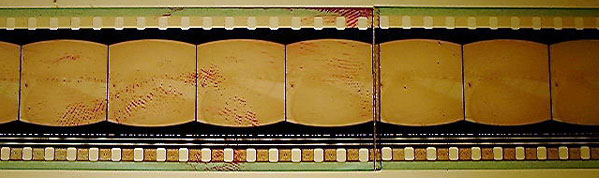
(Could there possibly have been a worse shot for this to happen in? It's almost completely clear.)
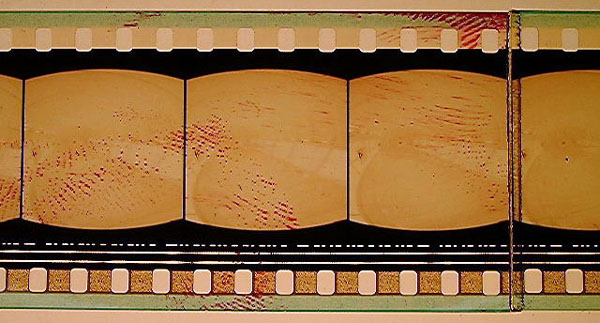
The labs use these huge machines that are 100 feet (or some ridiculously large number) long and run at 50 miles an hour (or some ridiculously fast speed). The raw stock film comes in 6,000 foot rolls.
One minute (or some ridiculously small amount of time) before the machine is about to run out of film, the lab guy has to mount a new reel of raw stock, weighing 50 pounds (or something like that) then cut the film in the machine, make a splice and get it all going again before the machine runs out of film.
All of this has to be done in a minute (or whatever time)... you only have ONE shot to get it right AND it all has to be done in the dark! (Or under dim safelights)
I know somebody else here will fill in the details but I think I've gotten across the main points.
(I'd like to visit a film lab someday, or at least see some good close-up pictures.)
My point is that this isn't as easy as splicing-up film on your workbench. I'm willing to cut the lab guys a LITTLE bit of slack.
I'm willing to check for lab splices and fix them.
I'm willing to see a few feet of fogged film. (OCCASIONALLY, like once or twice a YEAR!)
Maybe ONCE IN A BLUE MOON am I wiling to see some other mistakes like what Brad is showing us.
The thing is that this is NOT occasional.
This is NOT once or twice a year.
This is NOT once in a blue moon.
This is something like HALF the time!
We get jumpy pictures from running the machines too fast (and using the wrong pitch for the negative stock)
We get splices that are so far out of alignment that the film is in danger of breaking if you run it. (Or worse, damaging the projector!)
We get reels that are fogged for half their length.
We get soundtracks that won't play right.
We get so many other things I can't count them all!
Why don't those people that run those labs hire some competent help? Is it just sheer stupidity?

Whoever (whomever?) the culprit is, I've got an idea he would be easy to track.
Seriously, I worked in a still photography darkroom for a couple of years, and you're right, fingrprints like that on any film are either the mark of an undertrained rookie, or someone who just his pulled hands out of the soup to prevent some sort of total disaster.
Now you've started me wondering how much film is lost in the lab to accidents???
The example that Brad posted is most likely the result of some slob not washing his hands after gulping down that greasy cheeseburger. There is no excuse.
If you can provide the print number, I will be sure the appropriate people at the lab know about this unfortunate incident, so they can work with the person responsible to correct the poor handling practice.
When problems like this occur, you can request a replacement reel, and be specific in describing the problem. Hopefully, word and samples get back to the lab from the film exchange. Or, if you can provide photos like this, along with specifics like the lab, title, reel, and print number, I will be sure the people at the lab know of the problem, so they can eliminate it.
BTW, even simple sweat on the fingers can cause these fingerprints if unprocessed print film is mishandled. Gloves would usually be impractical and unsafe in this darkroom environment, so it's a matter of properly handling the film by the edges only that needs to be emphasized. The fingerprints are magenta because that's the topmost imaging layer on print film.
------------------
John P. Pytlak, Senior Technical Specialist
Worldwide Technical Services, Entertainment Imaging
Eastman Kodak Company
Research Labs, Building 69, Room 7419
Rochester, New York, 14650-1922 USA
Tel: 716-477-5325 Fax: 716-722-7243
E-Mail: john.pytlak@kodak.com

------------------
John P. Pytlak, Senior Technical Specialist
Worldwide Technical Services, Entertainment Imaging
Eastman Kodak Company
Research Labs, Building 69, Room 7419
Rochester, New York, 14650-1922 USA
Tel: 716-477-5325 Fax: 716-722-7243
E-Mail: john.pytlak@kodak.com
I agree that we need to work together to improve the quality of prints and how they are distributed and shown. Most of the time, the system works well, but "shit happens" occasionally, and these unfortunate incidents need to be addressed. This particular "fingerprint" incident is obviously a simple matter of a personal lapse in proper film handling practice that can easily be addressed by the lab.
But as far as digital being better, be careful what you pray for!  Digital Cinema still has alot of serious questions that haven't been answered -- that's why it is still in only about 35 theatres (out of over 100,000) in the world, and hundreds of people working on the SMPTE DC28 committees, and at Kodak, Technicolor, TI, JVC, Sony, Christie, Barco, Qualcomm and other companies. Digital Cinema will happen, but IMHO, it has a long way to go before it becomes widespread and cost-effective, and maybe as good as "film done right".
------------------
John P. Pytlak, Senior Technical Specialist
Worldwide Technical Services, Entertainment Imaging
Eastman Kodak Company
Research Labs, Building 69, Room 7419
Rochester, New York, 14650-1922 USA
Tel: 716-477-5325 Fax: 716-722-7243
E-Mail: john.pytlak@kodak.com
Your photo of the tape splice isn't posted yet, but it is probably an example of a tape splice some labs used to use to splice the unprocessed film prior to printing and processing. Because the emulsion of the unprocessed film was covered by the tape, it never got developed. In most cases, these unsightly splices were removed by the lab before shipping the print. A few did get into theatres, where they had to be remade.
Today, most labs making release prints use an ultrasonic splicer to splice the unprocessed film. We've discussed these "lab splices" in previous threads, as they are often discolored and not on the frameline, since they are made in the darkroom on unprocessed film. Unfortunately, they are an economic necessity, as labs cannot afford to discard "short ends" of raw stock without dramatically increasing print prices.
When projectionists find these lab splices during print inspection, they should be remade if they are discolored or in the middle of a frame.
------------------
John P. Pytlak, Senior Technical Specialist
Worldwide Technical Services, Entertainment Imaging
Eastman Kodak Company
Research Labs, Building 69, Room 7419
Rochester, New York, 14650-1922 USA
Tel: 716-477-5325 Fax: 716-722-7243
E-Mail: john.pytlak@kodak.com

Just a little reminder to do good work, lest one of YOUR splices get pasted up! 
------------------
John P. Pytlak, Senior Technical Specialist
Worldwide Technical Services, Entertainment Imaging
Eastman Kodak Company
Research Labs, Building 69, Room 7419
Rochester, New York, 14650-1922 USA
Tel: 716-477-5325 Fax: 716-722-7243
E-Mail: john.pytlak@kodak.com