
Only film on reels should be shipped in film cans.
Film on cores should be shipped in individual tins or at least in cardboard boxes with pieces of cardboard separating each reel.
How can I send this print back in order to make a statement?
I was thinking of shrink-wrapping each real and putting in cardboard separators.
The print is also dirty (Film-Guard® will come in handy here) with shoe polish and each frame marked as well. The last time it was built up they used white splicing tape.
The only other thing I can think of is to dump the entire film in one large garbage bag with a note saying, “Please, try again.”
Please don't tell me that someone shipped a print to you on cores in a regular octagonal metal shipping case, though! (Oh, wait, TES does that every week, but they make sure to include broken black, grey, or translucent plastic bits along with it...)
How to make a statement:
Fix it and fix it right...
Clean the film with FG. Get all the shoe polish and other crap off it and fix all the bad splices and chopped-up frames. When you're done running it, break it down right.... All heads out, CCW unwinding orientation, head and tail leaders on the right way. ie: Be a professional.
When you put it back in the can, make sure each reel is marked and taped down properly. Bag each real in a plastic trash liner and type up a little stick-on label on your computer that says something like, "This print inspectded by..." and then write your name and date on it. Stick one of those on each reel. (I use them in lieu of tape)
The people who do the kind of crap you describe won't be impressed with your rantings and ravings about how stupid they are. (They are too stupid to even comprehend) You will, however impress a few people by acting professionally. You can catch more flies with honey, so to speak.
If the print is really bad, the only other thing you can do is order a replacement. Don't even touch the print you have. Just put it back in the can and wait for the replacement. (Unless your "Go show" is imminent and you HAVE to use that print.)
Make the best of a bad situation, and fix and clean the print as necessary (unless you can get a good replacement print in time). Document the hours of work you needed to repair the damage, and send the exchange and distributor an itemized invoice for these services. They may not give any reimbursement, but it will be noticed, and give you a negotiating point when dealing with that distributor in the future.
Randy is absolutely correct: we should always act as the skilled PROFESSIONALS we are, and do all we can to have the best presentation quality. Don't make the audience suffer or risk additional damage to the print because of someone else's incompetence. But do "be the squeaking wheel" to draw attention to the problems.
------------------
John P. Pytlak, Senior Technical Specialist
Worldwide Technical Services, Entertainment Imaging
Eastman Kodak Company
Research Labs, Building 69, Room 7419
Rochester, New York, 14650-1922 USA
Tel: 716-477-5325 Fax: 716-722-7243
E-Mail: john.pytlak@kodak.com
The thing that really pissed me off was the film hadn't even been released yet,and already it was in poor shape.
I'd list the print number and everything, but I know that whoever had it doesn't post here, and in fact, wouldn't care.
John, how about a committee of some form to severely fine theaters that use anything other than splicing tape to rejoin leaders?
The best way to put the blame where it belongs is to report any significant print damage immediately, to BOTH the distributor and the film exchange. Even if the print is okay, but there is a problem (e.g., broken shipping reel, damaged case, loose winding, poor splicing practices, more than one lab splice per reel) you should report it. If significant effort is needed to repair/clean the print, document it. Ask for replacement reel(s) if there is damage or a problem that significantly hurts presentation quality. Follow-up any phone call with written documentation, including returning any damaged film, bad splices, etc. that needed to be removed.
Keep a print log for each print, documenting what you find on print inspection, any problems that develop during the run, and which equipment it has been run on (i.e., moving print between auditoriums, interlocking).
Here's the hard part: if you severely damage a print through accident or negligence (e.g., dumping a print on a dirty floor, misthreading that causes a bad scratch), admit it. Sending a severly damaged print on to the next theatre without reporting it is very unprofessional.
------------------
John P. Pytlak, Senior Technical Specialist
Worldwide Technical Services, Entertainment Imaging
Eastman Kodak Company
Research Labs, Building 69, Room 7419
Rochester, New York, 14650-1922 USA
Tel: 716-477-5325 Fax: 716-722-7243
E-Mail: john.pytlak@kodak.com

If the print had been here a week for a regular engagement I would have asked for a new print. Or I would have asked for reels to ship back on. This print was here for one showing only.
I was able to run it through Film-Guard once. I made shure the print was wound tight on the cores and I put a generous piece of white artist tape to hold the end from coming loose.
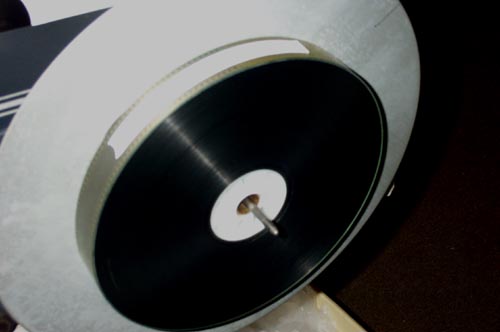
I placed each part in a trash liner before placing each part in the film can liners. This is a trick I learned from Brad Miller. I don't do it for every print, as he does.
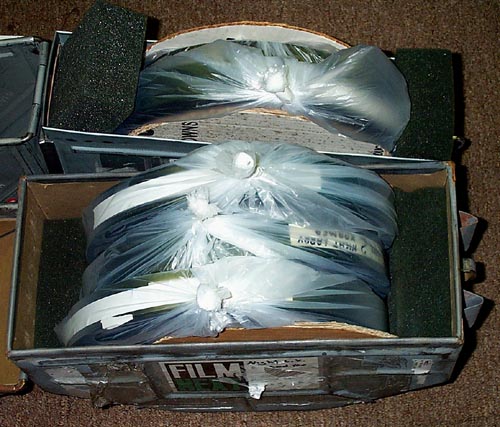
The foam rubber was part of the orgional packaging. I hope the next projectionist appriciates what I have done. More than likely he or she will open up the cans and exclaim, "What the Fuck!"
------------------
I love to smoke I smoke seventhousand packs a day and I'm never F*&ing quittin!-- Denis Leary
Using the clean trash bags to protect each roll from dirt, and using spacers to keep the rolls from dishing in the shipping case, is an effective way to keep the film from getting damaged. What a shame  that the owner of the print doesn't care enough about their property to provide proper shipping on reels or in individual cans.
------------------
John P. Pytlak, Senior Technical Specialist
Worldwide Technical Services, Entertainment Imaging
Eastman Kodak Company
Research Labs, Building 69, Room 7419
Rochester, New York, 14650-1922 USA
Tel: 716-477-5325 Cell: 716-781-4036 Fax: 716-722-7243
E-Mail: john.pytlak@kodak.com
The "best"  example of bad practise in film handling is when we receive our regular Bollywood blockbuster . To find a core in the centre of a part is a rarity so you usually receive nice egg shaped lumps of film which have to be manipulated so that you can insert a core so you can just get it on a spindle.
One idea to handle "core-less" rolls would be to glue a 1/2-inch (12mm) thickness of compressible plastic foam (e.g., the adhesive foam strips sold as weatherstripping for windows) around the circumference of a 2-inch (50mm) plastic film core. If you get a core-less roll, simply squeeze the foam-encircled core into the center of the roll, so it can be handled on a split-reel. Doing the same with a 3-inch (75mm) and 4-inch (100mm) plastic core would give a variety of diameters to suit the situation.
------------------
John P. Pytlak, Senior Technical Specialist
Worldwide Technical Services, Entertainment Imaging
Eastman Kodak Company
Research Labs, Building 69, Room 7419
Rochester, New York, 14650-1922 USA
Tel: 716-477-5325 Cell: 716-781-4036 Fax: 716-722-7243
E-Mail: john.pytlak@kodak.com
Is it any wonder that the beginning and end of each reel are sometimes full of dirt and cinch marks? "Doing Film Right" is simple common sense, which seems to be sorely lacking in some quarters. 
------------------
John P. Pytlak, Senior Technical Specialist
Worldwide Technical Services, Entertainment Imaging
Eastman Kodak Company
Research Labs, Building 69, Room 7419
Rochester, New York, 14650-1922 USA
Tel: 716-477-5325 Cell: 716-781-4036 Fax: 716-722-7243
E-Mail: john.pytlak@kodak.com
Relating to the discussion earlier on packing off etiquette, I tend to rejoin heads and tails to the picture on the base side only. The thinking behind this is that a tape join is necessary to prevent abrasion between the leader and picture when it is wound tight, but that 99% of future users will be running the print on a platter, tower or 6,000 foot spools, so joining both sides is pointless. Besides, anyone who is running single reels with changeovers will want to inspect the head and tail joins themselves, so they might as well make the type of join that works best with their projector (i.e. butt or overlap) while they're doing so.