This is topic Film-Tech Media pads in forum Film Handlers' Forum at Film-Tech Forum ARCHIVE.
To visit this topic, use this URL:
https://ft-forum.com/ft/cgi-bin/ubb/ultimatebb.cgi?ubb=get_topic;f=1;t=001747
Posted by Jason Black (Member # 684) on 12-19-2000, 11:28 AM:
Film Guard gurus, I need to know the recommended method of soaking the media rollers in film-guard. How do you do it? Do you use a small bowl? Spray it on? How? The directions I got aren't that clear, or maybe i'm just that simple and don't get it.. but either way, I finally got the media & assm'y & film guard for my booth and am ready to use it. I just need the recommended method from people in the field who are currently using it.
Thanks in advance...
------------------
The early bird may get the worm, but the second mouse gets the cheese!
Posted by Greg Mueller (Member # 17) on 12-19-2000, 02:16 PM:
What I do is start to wrap the media around the take up core in my hand so I have both the feed and take up cores in the same hand. Then I take the spray bottle and touch the tip to the feed roll and spray. You can see the media pad turn FG colored. I spray at different places around the circumference and then on the ends. I get them really soaked. Then I slide them on their respective spindles. If you don't hold the spray nozzle to the media it sprays all over the place. I get three passes with a 5 reeler and 2 passes with a 6 or 7 reeler.
Sometimes FG works too good. On my first application I tried FG on an old SciFi film from the late 50s. It had a number of black scratches. After a couple of passes the black scratches turned green! What had happened was the scratches were green the whole time but they had filed up with dirt. The FG cleaned them out and now they're green again. What an incredible difference the FG makes. The picture is much brighter and crisper and just plain cleaner looking.
It's amazing to see how much dirt there is on a film. ------------------
Greg Mueller
Amateur Astronomer, Machinist, Filmnut
Posted by Larry Davis (Member # 609) on 12-19-2000, 02:23 PM:
Hi Jason,
Place the nozzle on the bottle of Film Guard against the pad. Spray it evenly so the whole pad absorbs the Film Guard evenly and completely. I soak one spot then move to another, until the whole pad is soaked. I followed the instructions to the letter and spray until a drop or two drips of the media pads. Make sure the notched ends of the pads face you when you put the pads on the rollers. This way rewinding is a breeze.
< Oops, I din't see Greg had answered you already. >
Posted by Brad Miller (Member # 2) on 12-19-2000, 08:18 PM:
That's pretty much all there is to it. The only thing to make sure of is that you load up the dry pads on the cleaner and then press the tip of the sprayer against the pads to soak them. If you soak the pads before you load them onto the cleaner, your hands will be extra slippery for a few hours.
Posted by Paul G. Thompson (Member # 655) on 12-19-2000, 10:23 PM:
Brad, what devices will your media pads fit? We are always looking for high quality booth products.
Posted by Brad Miller (Member # 2) on 12-19-2000, 11:00 PM:
Click on the "film cleaning" link below and you will see a picture of a standard Kelmar web media cleaner. That is the cleaner of choice and the exclusive one we recommend. Christie also used to make virtually the same product, so you may be able to find some of those on the used market.Kelmar's web site is www.kelmarsystems.com
Posted by Greg Mueller (Member # 17) on 12-20-2000, 08:11 AM:
While we're on this topic....
In the box of pads are some black cores and the instructions say to wind the media onto the cores. I tried that once and it I was wondering what the suggested technique for this? Also after you run the pads through once can you flip them over and use the other side? So much dirt is coming of the film that I hate to rewind them and rub the same contaminated surface over the film.------------------
Greg Mueller
Amateur Astronomer, Machinist, Filmnut
Posted by Brad Miller (Member # 2) on 12-20-2000, 05:46 PM:
The pads come with two extra cores simply for using them as "takeup" cores. If you are buying Film-Tech brand media, you do not need to bother with winding anything. If you are using another brand of media, you will need to use the cores that come with the bottle of FilmGuard to wind the media onto and the third to use for "coupling" them together for rewinding.The media comes packaged without any special instructions and can be used wet or dry. The FilmGuard should have come with a very long two page instruction sheet. Did you get the instructions with your bottle?
You may reuse the same media over and over provided you are using FilmGuard on them. Don't bother with flipping them over. If you are running them (or any media for that matter) dry without FilmGuard, NEVER reuse the pads as you will scratch your films.
Posted by Greg Mueller (Member # 17) on 12-20-2000, 06:48 PM:
All I got was a single page instruction sheet. (both sides) I've had this kit for sometime and have just recently started to use it. As far as reusing the media... there's so much dirt coming off, I'd never run the same media over a film again. Even with FG, at least not at this point. I was just wondering if bith sides of the media are the same as far as texture is concerned. Is there and "A" side and a "B" side? Did the FG "kit" change since it was first distributed?Wait, I just poped over to the FG page and answered my own question. I see the media is blue now, mine are white. Hmmmmm
------------------
Greg Mueller
Amateur Astronomer, Machinist, Filmnut
Posted by Brad Miller (Member # 2) on 12-20-2000, 09:59 PM:
I wouldn't even bother flipping sides, as the dirty side would just wind up against the clean side and spread the dirt anyway.
Email me a picuture of what you feel are "dirty pads" and I'll let you know what I think. If you are running older prints that were very dirty to begin with, you may very well not be able to reuse the pads. I've ran pads this dirty before with FilmGuard and no scratching whatsoever (and that's me being real damn picky about it too).
Posted by Jason Black (Member # 684) on 12-21-2000, 05:46 PM:
I'm getting ready to screen one of our prints of Cast Away and will be using the FG on initial screening as recommended. I highly doubt that the one roll of media pads are going to last the entirity of the print as it's timed at 2:40 with trailers. I'll be using the blue FT media pads this go around as opposed to the white ones I have used already. FG has already been liberally applied to the media, so I should be good to go...Will report back later when I get back home...
------------------
The early bird may get the worm, but the second mouse gets the cheese!
Posted by Josh Kirkhart (Member # 1046) on 07-16-2003, 01:35 AM:
Ok, went to a older post as it has the topic needed.
I have recieved my first box of Film-Guard media pads. According to the pictures in the product section, they have changed a bit as mine are a white-golden color, instead of blue. Although that is not my question, was just curious. The pad I recieved felt a bit silky and was wondering is this:
A- Just soft material?
B- Already Film-guarded?
I did not smell any film-guard and although the residue from Film-guard is very unique(in a benign way) I could not tell which was the reason. I didn't see this refered to in any way anywhere here, so I am sure its just 'cuddly' soft, but thought I'd check. I threw Film-guard on them anyway. Great products by the way.
Posted by Joe Redifer (Member # 3) on 07-16-2003, 01:39 AM:
No pads currently come already FilmGuarded. It'd be pretty messy if they did.
Posted by Brad Miller (Member # 2) on 07-16-2003, 02:19 AM:
We switched from blue to white somewhere in 2001. People were complaining that the blue color made it harder to see the dirt on the media to judge when to change them out. Of course as soon as we changed to white, people complained they liked the blue color because when the blue turned a pale, light blue they knew it was time to change media or resoak the pads. Ya can't please everyone. ![[Wink]](wink.gif)
Anyway, from your description it sounds like you got a box out of a recent case. We just started shipping a higher grade of media over the last month or two and due to a special arrangement with the manufacturer of the cloth, we were able to keep the price the same. I'm not sure exactly what the pricing is on the competition, but I do believe when a dealer buys by the case we are either the lowest cost, or darned close to it. Plus you get 16 cores in each box which can be recycled and redeemed for more, definitely making it the best deal on the market. Later on in the year I'll bring back the ever-popular manuals on cd collection via the recycling program. This time it will either be a 2 disc set or on a data DVD. Click here for info ![[Big Grin]](biggrin.gif)
Posted by Carl Martin (Member # 1146) on 07-16-2003, 05:35 AM:
a little while ago when i was having beginners' trouble saturating my pads, i though it might be a good idea for them to be sold pre-soaked, in convenient lengths. they'd have to be individually wrapped, which would be ecologically insensitive, and the end would have to poke out to keep it dry for taping.
i've been more successful lately with my soaking. i do it before loading the media onto the cleaner, as it's easier to get all around the roll, and it seems to help if i keep the bottle vertical. i'm not entirely sure if that's a factor; i'm finishing up my first bottle and it may have a dodgy sprayer.
i'm still not too happy with the scotch magic tape i'm using. it'll hold if i make sure i wrap 2 revolutions of media around the takeup spools, but it could be better. the tape that comes attached to the film-tech pads seems good. what brand is that?
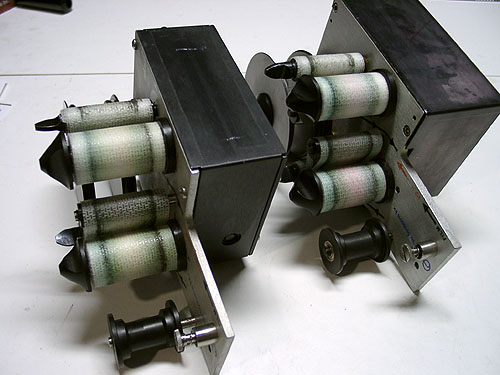
the media in brad's picture above seems to have an odd honeycomb texture. is that an older variant?
carl
Posted by Brad Miller (Member # 2) on 07-16-2003, 02:59 PM:
I have never found a good way to soak the rolls before loading to the cleaner. It's just too messy. The instruction sheets we have been shipping with FilmGuard kits now have pictures demonstrating the easiest way to saturate the pads. Basically I mount the cleaner on the platter or set it upside down on the edge of a table, then with the pads loaded and ready to run I pull 1/2 rotation of media from the supply side and saturate the "top" side. Then I roll it back and saturate the "top" side, which is really the other side. Repeat for the second roll. You won't lose a drop and it only takes about 15-20 seconds of time.
The media in the picture is an old pic of Kelmar media. (Note the dates on this thread.) We have been running experiments with a few different textured pads like that, and the results have shown that while the FG is applied moreso in streaks (it smooths out during projection so it's a non-issue) a textured pad does a better job of scratch protection with dirty film. Think about this, if the film is dirty and you are using regular flat media, a large clump of dirt has nowhere to go. While the print has to be pretty dirty for this to happen (first run theaters generally don't need to worry about it), the texture does provide extra protection and permits cleaning at higher tensions without risk of scratching. This is because as a large clump of dirt is wiped from the print, the dirt gets caught down inside the grooves of the media while the film safely passes overhead, further protecting the film from scratching while still getting the benefit of a wiping style of film cleaning.
The current media we are shipping is similar to the picture of Kelmar's textured media above, but is of a slightly higher grade and does not have the varying width issue and splices in the rolls like have been found in the Kelmar media. This fall we are introducing a new coupling core too which has it's own design benefits. You'll know it when you see it, because it says "Film-Tech on it. As always though, changes take a little bit of time to make it to the field, as many dealers have lots of stock in-house.
Posted by Manny Knowles (Member # 1171) on 07-16-2003, 08:25 PM:
Our cleaners are mounted atop the projectors. Actually we are still using PTRs across the board but we do have one Kelmar cleaner and some FilmGuard for special situations.
For some reason, our print of SINBAD was shedding very badly. One pass through the projector left dirt all over the place. FilmGuard sorted that out.
...back to applying FG to the web media...
I apply it with the rolls in my hand, making sure that I first tape the end onto the take-up roller (or else the tape won't stick).
I use latex gloves to prevent getting FG all over my hands.
Love the smell! Is that an additive or is that how it naturally smells?
Posted by Brad Miller (Member # 2) on 07-16-2003, 08:41 PM:
Doin' it the hard way, huh Manny? Guess it's coming time for me to make a video to show how easy applying it is.
The mix doesn't smell too great on it's own. You're smelling an additive.
Posted by Manny Knowles (Member # 1171) on 07-16-2003, 09:06 PM:
Leave me alone! ![[Mad]](mad.gif)
Please Brad...Make the video.
Posted by Dan Lyons (Member # 1454) on 07-16-2003, 10:00 PM:
Manny,
You should be using VINYL gloves instead of latex gloves. (if you want to wear them; this comment is more appropriate for those doing cleaning by hand)
Oil/solvent based film cleaners will break down the latex and cause it to tear.
Gawd, I feel like I'm giving a safe ![[sex]](graemlins/sex.gif) lecture.
lecture.
Danny
Posted by Manny Knowles (Member # 1171) on 07-16-2003, 10:06 PM:
Nobody panic!
The gloves come off long before any latex breakdown occurs.
Posted by Jack Ondracek (Member # 1466) on 07-16-2003, 10:18 PM:
I've had best luck putting the cleaner on a table. The magic tape issue is easily fixed by cleaning the takeup core with a little naptha. For that matter, you can also use naptha to clean enough filmguard off the end of a roll to get tape to stick.
We run double features at the drive-in. A white roll is long enough to run the whole show... and we're talking trailers, "T3", more trailers, then "Matrix Reloaded".
If I had any gripe about the process, it'd probably be the quality of the spray head itself. Everything else is first class!
One question, Brad. If this stuff will stay on a print for nearly a year before evaporating, how can you reapply a fully soaked pad weekly without a lot of accumulation? The media does seem to dry out over the week's time. Is there still sufficient solution on the print to accomplish it's purpose and still shield the print from accumulated dirt on the media? Is the print actually absorbing that much solution...... or ????
Posted by Brad Miller (Member # 2) on 07-16-2003, 10:45 PM:
A weekly rotation is what was found to be the best overall timetable. When it is said that it stays on the print for up to a year, that depends on the film stock, climate and is referring to completely evaporating to the point of not being able to tell it was ever applied to the film in the first place. Even though the pads start to dry out toward the end of the week, there is sufficient FG still on the print for protection. Most theaters don't have the luxury of a media cleaner per screen, so they hit a film for a few shows, then resoak and move it to the next one.
Posted by Mike Blakesley (Member # 26) on 07-16-2003, 11:32 PM:
How about selling the media pads "pre-soaked?" Given a choice, that's how I'd buy'em. They could be packaged airtight, like moist handwipes are.
What the hell, if they can sell "green ketchup" and cheese slices individually wrapped, then anything should be possible.
Posted by Steven Pickles (Member # 785) on 07-17-2003, 12:48 AM:
Mike,
I agree, that is a really good idea. Presoaked would be my preferred way to apply FG to a print... instead of having to mess with the cleaning rolls and applying the product myself.
Posted by Jack Ondracek (Member # 1466) on 07-17-2003, 02:15 AM:
It's an interesting thought. However, if the best method of application is to use a fully saturated roll, it would be much like a sponge. Any pressure would cause FG to press out of the roll. Shipping & handling might leave the roll quite a bit less saturated than it should be. Ahhhh... you say. Put the roll in a crush-proof plastic hermetically sealed container to prevent leaks and evaporation during shipping and storage! Good idea. How much extra should we pay for that????
The system is well worth the money... but it's by no means inexpensive. Brad's probably made a good compromise between efficiency and economics.
That's my vote, anyway. ![[beer]](graemlins/beer.gif)
Posted by Carl Martin (Member # 1146) on 07-17-2003, 02:49 AM:
i don't really mind getting the stuff all over my hands. i figure it's healthy. filmguard cures everything, right?
while we're talking about pre-soaked pads, it occured to me the other day to only throw away the spent portion of the media when unloading the cleaner. i snipped off the virgin ends that had never touched film, but were saturated w/ f-g, and put them in a baggy. now whenever i need to scrub off some tape gunk, i just reach for a pre-soaked wipe and don't need to further deplete my supply of "liquid gold".
carl
Posted by Brad Miller (Member # 2) on 07-17-2003, 03:39 AM:
Presoaked pads will never happen. This was an original consideration, but after a minimal amount of testing it was found that the boxes would end up having a specific shelf life forcing constant roatation and also it would have drastically jacked up the cost. Then there is the issue of the wet ends for taping to the takeup cores. Trust me, the current way is the only way to go.
Posted by John Wilson (Member # 269) on 07-17-2003, 06:39 AM:
I liked the blue pads.
Posted by Manny Knowles (Member # 1171) on 07-17-2003, 08:05 AM:
Yeah -- how the heck would you tape down a roll of media that had been pre-soaked? You'd go bonkers trying. (Trust me.)
Posted by Pete Lawrence (Member # 130) on 07-17-2003, 10:11 AM:
Brad,
Do I understand this right, your your changing the white media fabric to something a little courser. Is there any change in the length (that is run time) of the rolls? Please don't tell me you shortened them.
Posted by Bernie Anderson Jr (Member # 410) on 07-17-2003, 10:15 AM:
What's the best cloth to use when applying to older, dirty/oily prints by hand? I tried the 100% cotton Webril wipes, but they kept shedding every time I hit a tape repair.
Also, is it possible to put on too much Filmguard? I tend to change and re-wet the cloth about every 1000 feet, and the last print I cleaned had noticeable blotches on projection.
Posted by Pete Lawrence (Member # 130) on 07-17-2003, 10:49 AM:
I also hand clean the heads and tails of old prints during inspection and repair. The crud that comes off is incredible. The mechanical cleaners (running 2000' reels and changeovers) can then handle the interior of the reels.
I use a fabric called white cotton interlock. Looks like white undershirt fabric. You can buy it at any big fabric retailer. It's about 54" wide and costs about $3.50 a running yard. Very little shedding. Cut it up into 3" or so squares. Makes a big pile of cleaning pads for very little cost.
Posted by Mike Blakesley (Member # 26) on 07-17-2003, 12:32 PM:
Pete - The new white rolls of media are much longer.
Bernie - Methinks you are using too much.
Posted by John Pytlak (Member # 331) on 07-17-2003, 01:11 PM:
Manny Knowles wrote:
![[Smile]](smile.gif)