This is topic Drive-In Construction in forum Film Handlers' Forum at Film-Tech Forum ARCHIVE.


To visit this topic, use this URL:
https://ft-forum.com/ft/cgi-bin/ubb/ultimatebb.cgi?ubb=get_topic;f=1;t=001839

Posted by Barry Floyd (Member # 385) on 01-17-2001, 11:52 AM:
 
I know many of you have at one time or another have worked in/or at a drive-in theatre.

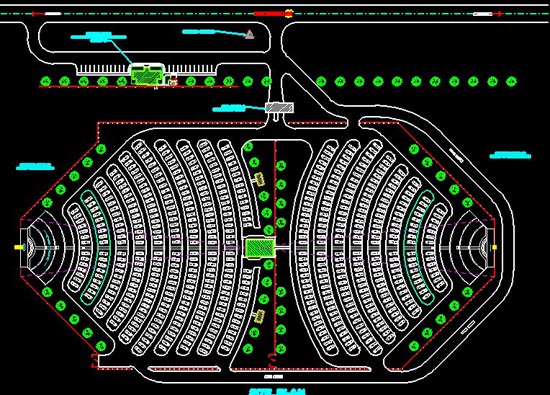
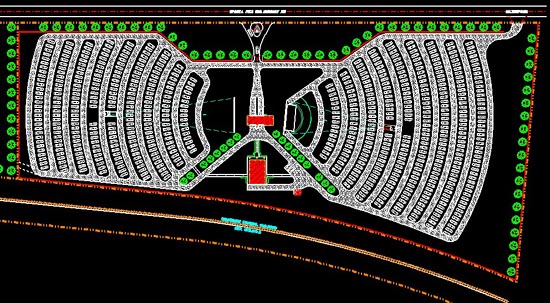
As we are proceeding with the "initial" layout and design of our theatre, I've got a couple of questions I need some answers to.

We are contemplating building "either" a two story concessions/projection building with projection ports in the front and the rear of the second floor

... or...

one centralized concessions building (between the two parking fields) and building two free-standing 10' x 10' concrete block projection buildings.
Any preferences / or technical limitations that would keep us from from doing either one?

Also, as we have driven around the south east U.S. and "scoped-out" the latest "new-builds" (primarily in Alabama, Virginia & Tennessee), we have noticed that they did NOT incorporate parking ramps in their design or construction. With today's trend of "high-profile" vehicles, wouldn't ramping be a necessity?

Keep in mind that we want to build our theatre "cost-efficient"... NOT "cheap".


Posted by Jerry Chase (Member # 660) on 01-17-2001, 12:18 PM:
 
Put the booth on the second floor of a centralized building. It is safer from vandalism and keeps kids from making 50 foot shadow puppets. It should cost less as well.

Ramps serve the added purpose of keeping speeds slower in the field. Speed limit with kids running around in the dark should be just above a crawl - 15 mph absolute max.

Dirt or paved field? I personally like the grassed over dirt fields. Terraced or ramped? A location with a slope works better.

Be sure to include a way to have a flea market. Preston Henn's 12 screen drive in in Sunrise Florida does an incredible flea market business, so much so that the drive in is just secondary.


Posted by John Pytlak (Member # 331) on 01-17-2001, 12:32 PM:
 
The single building to serve multiple screens puts the projection room behind the rearmost row of the drive-in. This may result in very long "throws" to the screen, requiring very long focal length lenses and being more subject to weather/airborne dust issues. Try to stay within the range of the most popular and efficient focal lengths available in today's modern lens designs.

IMHO, a drive-in without ramps is "cheap" and a poor design. It's hard to get good sightlines through the windshield (especially from the back seat) without tipping the vehicles slightly.

Radio sound is standard, but consider the "nostalgia factor" of having a few in-car speakers and poles.

With a 30 x 72 foot matte white (fresh paint) screen, 6000 watts should get you close to 8 footlamberts, which would be better than most drive-ins. Efficient dichroic heat filters and water-cooled gate are mandatory at this power level, unless you like burned fingertips, uncontrollable "focus flutter", and paying to replace heat-damaged prints.

------------------
John P. Pytlak, Senior Technical Specialist
Worldwide Technical Services, Entertainment Imaging
Eastman Kodak Company
Research Labs, Building 69, Room 7419
Rochester, New York, 14650-1922 USA
Tel: 716-477-5325 Cell: 716-781-4036 Fax: 716-722-7243
E-Mail: john.pytlak@kodak.com


Posted by Dave Bird (Member # 490) on 01-17-2001, 02:18 PM:
 
That's awesome Barry! You know I'm no expert, but during my own research I've figured that the old ramping specs should be
reworked for todays vehicles (ie-so that a car could see OVER an SUV - no sense having segregated parking if you didn't have to.).
Also, if you opted for the central screens, what about taking advantage of having them back-to-back as part of the same structure?
Could save a few bucks, maybe even combine the concession as part of the same building. A canopy and strategic lighting would shield your screens. Make your screen, snackbar, playground the "place to be". Are those the railroad tracks at the bottom?
 
Posted by Barry Floyd (Member # 385) on 01-17-2001, 03:18 PM:
 
You were correct in assuming about the railroad tracks, unfortunately that site is out of the question.

I had planned on "re-locating" a truss supported tower from a defunct drive-in somewhere. As many drive-ins that have closed, it shouldn't be that hard to find one. I know Selby still makes them, but I think they must be gold-plated - last quote I got was $55,000.00. I've estimated that it would cost about $12-15K to relocate and erect an existing tower, and add to that another $4k - $5k to prep and paint it. It's still way cheaper than new.

I too prefer grass instead of paving for the field.

6,000 watts ??? I was hoping to use my 4kw ORC, at least for the first year


Posted by Scott Norwood (Member # 30) on 01-17-2001, 03:43 PM:
 
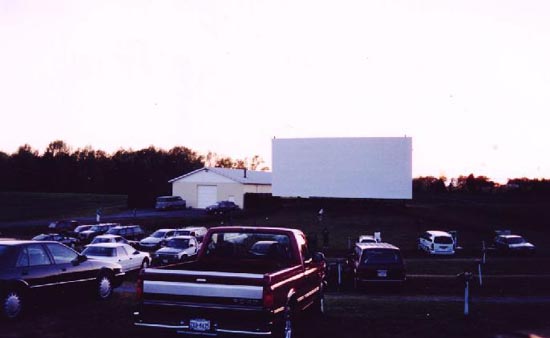
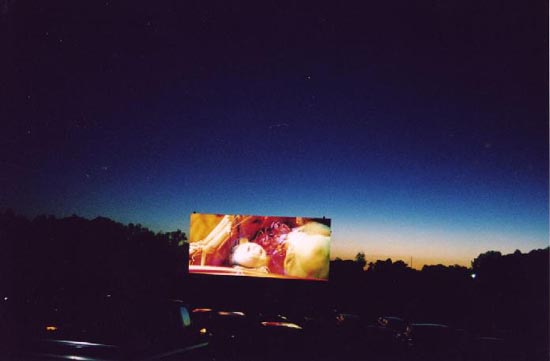
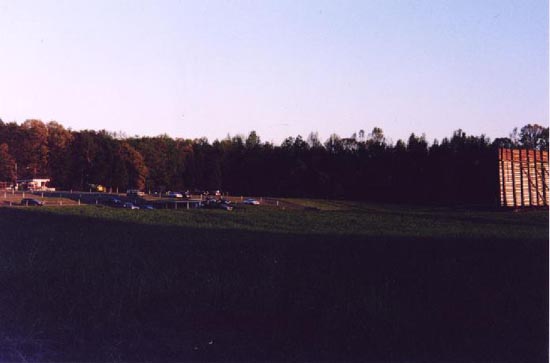
The best ramp setup I've ever seen is at the Fork Union DI in Fork Union, VA., which is located at least 30 miles from nowhere. It's worth visiting, though, just to see one of the better-designed DIs still in existence. The place is built on a hill, and the rows are terraced, much like a "stadium"-style indoor theatre. It's kind of hard to see how it works in these pictures (the first one taken from the road, and the second and third from a car position about mid-way back), but it really works well for a DI with a smallish car capacity. Note super-bright picture on screen in the third photo; the movie was "Bug's Life" being shown with Peerless arc lamps; the photograph is a time exposure, but the picture is still really bright on screen.


Posted by John Eickhof (Member # 323) on 01-17-2001, 03:45 PM:
 
The ORC 4KW wouldn't handle the job unless you stay under 350-400 foot throw and a screen under about 25h x 60w....Newer lamphouses have far better optical designs, even taking into account that ORC set the standards over 20 years ago! I agree with
John, 6KW would be the best bet!! And the shorter the throw the better!

------------------
John Eickhof President, Chief Slave
Northwest Theatre Equipment Co., Inc.
P.O.Box 258
Wendell, ID. 83355-0258
208-536-5489
email: jeickhof@nteequip.com


Posted by Darryl Spicer (Member # 711) on 01-17-2001, 07:19 PM:
 
In the mind the idea of the projection booth being in the center of the twin drive-in is an interesting one. However, if the throws are going to be long ones I agree with the other guys that you do not want to get into these long focal lenses. another thing to consider that if your snack bar is going to be centralized also in the same area as the booth think about how far that customer is going to have to walk from his car down on the front row. You could lose potent customers because they do not want to walk that far. I think the booth and concession stands should be located in the central part of the ramp area. You can use a 4000w lamp and make it easier on your customers to get to and from the concesions area. Also if possable I would make the exits designed to exit cars behind both screens and back onto the main road with seperate exits that way you do not have cars bottle necked.
 
Posted by Ken Layton (Member # 133) on 01-18-2001, 12:29 AM:
 
I tend to prefer the centralized booth/snack bar/ manager's office 2 story building because of less electrical wiring and plumbing that would have to be done. This all depends on throw and screen size. If the throw is too long, then I would have seperate projection buildings for each screen.

You must have a ramped field. None of this flat field crap. The theaters that have a flat field suck because you can't see the screen or over other vehicles.


Posted by David Kilderry (Member # 142) on 01-18-2001, 03:46 AM:
 
Barry,

A ramped field is a must. In one drive-in field we built in 1995, the low ramping and a low screen cause problems. All types of vehicles obscure the view of other cars every time it is a full house, which is often. Having no ramps is not a problem if you never plan to have more than 40% capacity.

I too have seen new drive-ins with no ramps but they never fill so don't have the problem.

Our best drive-in field is steeply ramped with a high screen and even the biggest 4 x 4's can park and not block the view of a Ford sedan behind.

You must go for a central projection booth. If you cannot afford an on-top version, then at least one that is back to back. It saves in so many ways and enables you to keep an eye on the presentation!

With a 200 - 300 car field you will have a good throw with the booth at the rear. Use the biggest lamp you can we use 6k and 7k on some screens. You will only need a 70 footer - move the cars closer to it, at a drive-in people love the front ramp!

Our 100ft screen on a 150 car field is overkill and we can't light it like we would really like to. The latest Strong, Kinoton or Christie lamphouses are so much more efficient with big lamps. You can always use an older Strong X60 C or D and with the right blower, extraction and filters run 6k - do you agree Pat? We run some with 5k and they handle it pretty well. Our 7k's are Kinoton.

Don't limit yourself to 2 fields, allow room to go to four. Take a look at what Century did at Anaheim Stadium (finished as 8) or Pacific at Winnetka (was 4 went to 6) in LA. You can take all desirable first runs with these screens. With two you will miss some big films as you have to play out the seasons on others.

Fork Union is an excellent natural amphitheatre and a rare find. Always have at least two rows of speakers, in our drive-ins they are the first places to fill!

David


Posted by Frank Rapisardi (Member # 435) on 01-18-2001, 05:16 AM:
 
About building a twin drive-in.If I could get land here in the Northeast;at the right price,I too would build.I would go with one building containing snack bar and projection booths. And YES;make shure that the field is ramped! When planning the buildings;make sure that you have enough room for the customers to be serviced in a fast manner.(They hate to wait) I would suggest cafeteria style(They take a tray and move along the snack bar,with a cashier at the end.Also;you shouls leave enough room in the snack bar area for an arcade(Those quarters and dollars add up fast)(Great way to generate a bit more cash!) If you can find a screen from another site;it may cost you more to relocate it to your site than what it's saving you.(This depends on how far it has to be shipped.I would go with new.We looked into relocating a screen once;buy the time we bought it,had it shipped,then erected and any damage fixed;it was actually going to cost us moe than new.Good luck,enjoy,have fun, and buy lots of aspirin!

------------------


Posted by Barry Floyd (Member # 385) on 01-18-2001, 08:19 AM:
 
Great responses... but we're still left somewhat confused.

Our goal is to open the theatre with one screen, then add the second screen the second season. Although we do have enough projection equipment on hand to build both booths, we wanted to "test the waters" before we invested the money on the second field.

Both layouts do have their advantages and disadvantages.

The centralized two story booth will keep everything in a single location which will help the costs of construction (i.e. electrical wiring), and give us the ability to monitor the operation of both booths from the same location. However, like many have said, it's central location between the two screens will result in "long throws", higher powered lamping requirements, and longer walks for the patrons to visit the concession stand.

The second layout with the screens "back-to-back", puts the concession stand in the center of the lot(off-center, but closer to the screens. When we've looked at other drive-ins, we've noticed that many patrons park as close to the screen as possible. Given this as a consideration, if the fields fill up from the first row and work their way back, it would put the greatest number of patrons closest to the screens and the concession stand. It would require two separate projection booths, long runs of underground 3 phase wiring, and no ability to monitor the screens from the concession stand.

We visited the "Fork Union Drive-In" in Virginia in July of 1999, and also consider it one of the finest examples of "stadium parking" around. The grounds were well kept and clean, but we were there during daylight hours, so we couldn't comment on the presentation. We ran into the owner at the gas station up the street, and he said we could "go look" at the theatre, but do not go inside the fence.

Dave Bird mentioned re-working the ramp layout for todays vehicle dimensions. Any ideas as to "how steep is too steep" for ramping?

------------------
Barry Floyd
Floyd Entertainment Group
Nashville, Tennessee
(Drive-In Theatre - Start-Up)


Posted by Jerry Chase (Member # 660) on 01-18-2001, 09:11 AM:
 
Your top drawing looks like it was done by a landscape designer, what with the frou frou in-between the two setups.

Shorten the distance to the screens by shaping the ramp areas like nested "L"s.

When you open as a single, the booth/concession will be in the middle of the field, but slightly off to one side. When you twin, cut the area behind and to the side of the building as shown. You will reduce the size of the first field, but that isn't always a bad thing. A full field might be used only two or three weekends a season.

This ASCII drawing looks bad unless you have fixed font size; cut-n-paste it into notepad to get a better idea of what I am saying.
<<<<<<<<<<<<<<<<<<<<<<<<<<<<<<<<<<<<<<
Road>>>>>>>>>>>>>>>>>>>>>>>>>>>>>>>>>>
-----------------------------------------
..Entrance Que.........................
Flush----------------Gate----------Flush
......................x...............
.....................x................
I....................x................
I Screen 1...........x................
...........xx booth xx................
...........x...............Screen 2 I
...........x.........................I
.........x............................
.......x..............................
--------------------------------------

The _slight_ offset of the booth can be compensated for by a combination of twisting the screens slightly and possibly using one of the offset lens mounts that are available for keystoning problems. You would have to be careful of losing light.

The important part of the concept, as you can see, is that only one side of the field needs to extend behind the concession, giving better placement of the booth and concession.

Whatever. Greg says I have to get back to work, and he's right.


Posted by Robert Throop (Member # 61) on 01-18-2001, 10:30 AM:
 
How long a throw are you talking about? A 30x72 foot screen can be used at a 396 ft throw with a 150mm lens for 1.85 and a 115mm backup with reverse anamorphic for scope.

------------------
Bob Throop


Posted by Barry Floyd (Member # 385) on 01-18-2001, 11:58 AM:
 
Actually - both drawings posted above were designed & drawn by me. I've got a degree in Architecture and have worked for an engineering office in Nashville for the last 11 years. I work with site plans, GIS contour mapping and site grading every day of the week.

The "frou-frou" stuff shown on the drawings is exactly that. The plans shown above were for a presentation we made to a local area Chamber of Commerce back in June, 2000. They wanted to know what type of facility we had in mind for their community. I added the landscaping items to the plans to "soften" the look of the overall site.
Sometimes what you show them and what you build are NOT the same thing.

Another "option" to be considered (however I don't like it), is to build a single story concessions/projection building in the center of the field for "each" screen.

There has to be a way to provide concessions service to the patrons without having to walk a mile to get it.

------------------
Barry Floyd
Floyd Entertainment Group
Nashville, Tennessee
(Drive-In Theatre - Start-Up)


Posted by Brad Miller (Member # 2) on 01-18-2001, 02:09 PM:
 
Simple Barry, hire yourself waiters!

Seriously though, the "movie grill" theaters that are popping up rake in an incredible amount of cash. As I understand it, a per cap of $10 a person is common. Maybe I'm completely crazy here, but have you ever considerd a drive in grill?


Posted by Adam Martin (Member # 641) on 01-18-2001, 03:03 PM:
 
When I re-opened a small twin drive-in for the company I used to work for, I set up a cafeteria-style snack bar and also used car hops to run around both lots from the centralized building. The customers didn't have to walk a mile and the kids made tips.

 
Posted by Chris Erwin (Member # 176) on 01-18-2001, 04:21 PM:
 
Barry,

Are you a member of the United Drive-In Theatere Owners Assn.?

If not, by all means join. The dues are reasonable, the info is priceless. You can join if you are in the process of planning or building. This organization can help save you time,money and headaches when it comes to planning and building a drive-in.

If you are interested, post back here and I'll e-mail to the address you have on file here at Film-Tech.

If you are a member, welcome to the group!
(I'm not listing in the member directory yet until my plans progress a little more-I looked for you in the directory and didn't see your name,but then I thought you might be doing the same)

Just let me know.
--Chris


Posted by Gordon McLeod (Member # 33) on 01-18-2001, 09:39 PM:
 
There are pictures in the warehouse of the century drivein in lindsay ontario that started as a single and twinned by buildin a new booth over the old one to service the two screens
 
Posted by Barry Floyd (Member # 385) on 01-18-2001, 10:18 PM:
 
Drive-In Grill??? Hmmm........
If you'll notice on the top drawing, there is a structure on the left nearest the highway. If money and budgets permitted within the second or third year, we have considered adding a diner. One of those stainless steel jobs. I found that I could order a 60 seat stainless steel diner complete with cooking & refrigeration equipment, tables & booths, all plumbing fixtures in place and even stocked with plates and silverware for around $160,000.00+/-. "Dinermite" (www.dinermite.com) builds them in a factory in Atlanta, ships them by truck to your site, and all you have to provide is the foundation pad, water, sewer and electricity.

It could give us "year-round" business when the drive-in season slacks off.

As far as the UDITOA, I've been invited to join as an "honarary member" once, and just recieved a packet of information from them last week. I wish I could make it to Florida in February for the conference, but unfortunately the day job prevents it for now.

------------------
Barry Floyd
Floyd Entertainment Group
Nashville, Tennessee
(Drive-In Theatre - Start-Up)


Posted by System Notices (Member # 2357) on 07-09-2004, 12:47 PM:
 

It has been 1267 days since the last post.


Posted by George May (Member # 1060) on 07-09-2004, 12:47 PM:
 
On a slightly different tack, I've been asked to screen some films in a large field just over one long weekend. It's to be a "drive-in party" for up to 200 cars. (It's a novelty - we in the UK don't do drive-ins).

I've fixed on the screen (40' wide in a frame to be hung from a crane), the sound and the projectors, but have no idea on how to set out the parking. No ramps obviously. But how many rows? How many cars wide? Does each row have the same number of cars? Distance between cars in a row, and between rows? How high should the screen be off the ground? etc

Have any of you any rules of thumb?

Thanks a lot.
 
Posted by Gordon McLeod (Member # 33) on 07-09-2004, 01:16 PM:
 
Depending on the gain of the screen position the rows of cars in a fanning out pattern on a radius and allow the width of a standard laneway between each road
 
Posted by Tim Reed (Member # 137) on 07-09-2004, 04:32 PM:
 
quote: System Notices
It has been 1267 days since the last post.
So? You're bringing it up just to bring it up?
 
Posted by System Notices (Member # 2357) on 07-09-2004, 04:47 PM:
 
People are stupid and cannot pay attention. It is my job to maintain order. No soup for you!
 
Posted by Gordon McLeod (Member # 33) on 07-09-2004, 05:39 PM:
 
Soup Nazi's must die [Big Grin] lets start a petition for a Joe to make us a flash animation of his execution [Big Grin]
 
Posted by System Notices (Member # 2357) on 07-09-2004, 06:00 PM:
 
NO SOUP FOR YOU EITHER!!! Come back 1 year.
 
Posted by Gordon McLeod (Member # 33) on 07-09-2004, 06:52 PM:
 
We should get our new mod Phil to ban the soup nazi
 
Posted by George May (Member # 1060) on 07-10-2004, 01:38 AM:
 
So, should I have started a new thread?

I'm still interested in some more answers to the questions I posed!

Thanks
 
Posted by David Kilderry (Member # 142) on 07-10-2004, 07:34 AM:
 
George, the old rule of thumb was a 90 degree fan shape from the screen centre with about 3 screen widths to the first row of cars. These rules have changed and many drive-in fields will rarely have cars spread as wide as 90 degrees.

At the Lunar Triple Drive-in here in Dandenong Australia we find that some cars like to get as close as they can i.e. about 1 1/2 screen widths, whilst others head for the back row (they do not necessarily watch the movie from there though!)

Given your small screen, park the cars as close together (side by side) as possible and allow about 4 car lengths between each row given the lack of ramps. Arrange them in a fan shape. 200 cars is pushing the good viewing limits of a 40 foot screen. We have a screen over double that width for a 200 car field.

Tall vehicles will need to park at the rear and you'll need get the screen height just right. It will be determined by the fall of the site.

Good luck

David Kilderry
 
Posted by Ken Russell (Member # 2491) on 07-10-2004, 01:48 PM:
 
Hi all. I have seen a lot about the longest possible throw in this thread. I too am toying with the concept of a new drive-in. I would pose this question... If I wanted screens 75 to 80 foot wide (for scope) what would be the shortest throw I could have given off the shelf lenses? Now, add to that the concept of rear-projection. What material could be used for the screen? I have found that the normal indoor vinyl material is only good down to 40 degrees F. My initial thought was mylar (good for something like -40 to 300 degrees). Does anyone have any experience with the loss (or possibly gain) involved in rear-projection with different screen materials? I have a lot more to consider and seek help on but will leave it at this for now. Will gladly take this to another thread if appropriate.

Ken
 
Posted by Adam Martin (Member # 641) on 07-10-2004, 02:31 PM:
 
For calculation of projection geometry, use the Schneider Lens Calculator. You can use a variable prime or Magnacom to further adjust the image size beyond the standard lens capability (subject to the loss of light and contrast).

For rear projection, you're going to need a screen specifically designed for that purpose. Vinyl, etc. isn't going to work because it's opaque.

The effectiveness of rear projection in an outdoor setting is questionable at best. Ambient light from behind the screen is going to kill your ability to accomplish this, unless you're planning on enclosing the area between the projector and the screen.
 
Posted by Steve Kraus (Member # 476) on 07-10-2004, 07:56 PM:
 
Forget about rear projection at a drive-in. What have you guys been smoking? Besides the usual problems created by RP such has hot spots, the huge wasted space behind the screen, and, in an outdoor setting, the ambient light issue, how could you create a screen which will resist the enormous wind loads a DI screen must withstand yet have NO supporting frame members crossing behind it?
 
Posted by Tim Reed (Member # 137) on 07-10-2004, 11:06 PM:
 
quote: Ken Russell
If I wanted screens 75 to 80 foot wide (for scope) what would be the shortest throw I could have
Seems like I wrote about this somewhere and had a formula worked out for laying out the field, taking into consideration maximum throws with f/2.0 lenses. Maybe it was here on Film-Tech, but...

It could've been here. Check it out.
Drive-In Workshop
 
Posted by John Pytlak (Member # 331) on 07-11-2004, 08:16 AM:
 
Really short focal length lenses will have more issues with "focus flutter" due to their shallow depth of focus, especially with the high power levels needed for large drive-in screens. Keep the throw long enough to use at least a 50mm lens for 1.85:1 "flat".
 
Posted by Tim Reed (Member # 137) on 07-11-2004, 11:00 AM:
 
John, don't you mean depth of field? My ramp formula also put the lens choices right in the middle of the "comfort zone" of available focal lengths, so you'd have some room to compensate for extenuating circumstances.

Wish I could remember where I wrote that...
 
Posted by John Pytlak (Member # 331) on 07-11-2004, 01:10 PM:
 
"Depth of Field": what is in focus when using a camera. Increases with shorter focal length lenses.

"Depth of Focus": what is in focus when projecting an image. Decreases with shorter focal length lenses.

[ 07-11-2004, 02:18 PM: Message edited by: John Pytlak ]
 
Posted by Tim Reed (Member # 137) on 07-11-2004, 01:51 PM:
 
I've never heard "depth of focus" used before. At least, I don't think I have. I may have used it myself, though.

Hell, I don't know. I've been out of this game too long.
[Razz]
 
Posted by Ken Layton (Member # 133) on 07-11-2004, 06:41 PM:
 
Rear projection at a drivein would not work because of the need to brace the screen not to mention the fact the plastic materials that makeup a rear screen would fly right off in a windstorm. And don't forget about how the ultraviolet rays of the sun deteriorate/yellow plastics and insects/birds would eat it.
 
Posted by Ken Russell (Member # 2491) on 07-12-2004, 08:21 PM:
 
Hi again. I understand the issues presented here. Tim, I find your pub on the drive-in workshop invaluable. John, your recommendation of a 50mm minimum on the lens a welcomed starting point. Adam, thanks for the lens calculator. The one I had was failing. Now, with respect to Barry's issue as well as mine, please allow me to throw out my issues and desires.

1 - I desire a family entertainment complex with daylight uses as well as movie presentation.
2 - I understand that multiple screens is desirable to be able to run multiple first run films.
3 - I see the need to have a screen running an "R" feature not to be visible from the field of one running a "PG".
4 - I feel that as much as possible concession and projection facilities need to be consolidated for cost reduction and reliability.
5 - I see the need to keep duplicated equipment (projectors and such) to a minimal number models so that spare parts can be kept to a minimum.
6 - The most efficient use of the land needs to be used.

My thought is 8 screens with the the fields laid out around the screens like the spokes of a wheel. Each field would be of a traditional form with about a 45 degree spread. My approach of rear-projection is to consolidate the facilities under the screens.

So, how can I attack and conquer the impossible here? Equally to the point, can any of this apply to Barry's situation?

With the 50mm guide a cluster of screens in a octagon form with each side being about 85 foot and a screen area of about 70 foot wide projected from 10 foot off the center comes close. The projector can be raised to a level that is exactly perpendicular to the screen to allow for the greatest image efficiency.

On the issue of UV toleration I know that Mylar can stand up to it where the purpos produced screen material can not. Does anyone know of another option?

Same thing with temperature (cold) tolerance.

The "Hot Spot" issue mentioned by Steve I don't have real answers for. The screen material will make a difference and intentionally offsetting the projection would induce other issues. Help.

Wind loading... Well Mylar has the lateral stability not found in other materials but 2400 sq ft of sail is still a bit much. What if a matrix of thin aircraft cable were placed behind it? Viewed from 75 foot plus would they even be visible? Anyway, Help.

I do see the need to box the throws to stop ambient light. I think this could be soft material but welcome other suggestions.

Forgive me if I seem to be flogging a dead horse but I have to believe that just because it isn't or hasn’t been done doesn't mean it can't be done.
 
Posted by Steve Kraus (Member # 476) on 07-12-2004, 09:11 PM:
 
I hope land is cheap where you plan to do this. Let's see a 70' width screen...and presuming that's Scope and that you are doing common height projection that gives you a 1.85 picture of about 56'. Using John's rule of thumb of going no shorter than 50mm you will need to have the projector about 133' back. And the projector on the opposite side of the booth needs to be 133' back from the opposite screen. (167' if you want to fill 70' @ 1.85) So your customers will need to walk not only the length of the car park area but half a football field beyond the screen to get to your central facilities. Which of course cannot have any illumination which will get up onto the screens.

Remind me again what advantages you hope to gain even if the problems were solvable. It can't be the central facilities...that can and is already done with projecting outward to distant screen towers.
 
Posted by Dave Bird (Member # 490) on 07-15-2004, 07:56 AM:
 
A rear projection drive-in was apparently tried - and FAILED - at the "5" in Oakville Ont. It was quickly converted to traditional. I've no idea why they tried it, it was a single at the time. The HUGE 100 ft+ long building now has two screens (one where the original was and one on the side). A central screen structure for 8 screens would be WAY bigger than you need, consolidate your concessions and projection, but fan your screens out.......
 
Posted by Barry Floyd (Member # 385) on 07-15-2004, 03:13 PM:
 
The last time I posted to this thread, I wanted to start a drive-in. Now... several years later, I actually built one. I can honestly say that our traditional Selby screen tower was one of the lesser expensive items we built. A little under $44k.. but well worth it. Tuesday night of this week we had 70 mile an hour straight-line winds blow thru the drive-in. We lost power, lost some fence panels, trash cans blew across the field like empty Coke cans, and our 8 yard dumpster was shifted off the concrete pad, but our screen stayed put. No damage at all.

While the idea of rear projection screens seems novel... from a business perspective, I can't see why you'd want to? You don't really gain anything.

What we actually built looks almost identical to the first picture I posted on the first page of this thread. We didn't do the "Diner" thing... instead focussd all of our attention on the theatre aspect of the development.

Here's a link to the "Construction Photos" of our theatre.
I don't claim to be a "drive-in expert", but this is what we did.


Powered by Infopop Corporation
UBB.classicTM 6.3.1.2