
 It appears to perhaps use a "hot melt" adhesive (the roll of white material) to make the splice. Since whatever is in that roll is used to make the splices, I wonder if you can still buy new material.
 It looks like something from the early 1950's? Buy it for historical interest, but stay with current technology if you want a splicer to work with.
------------------
John P. Pytlak, Senior Technical Specialist
Worldwide Technical Services, Entertainment Imaging
Eastman Kodak Company
Research Labs, Building 69, Room 7419
Rochester, New York, 14650-1922 USA
Tel: 716-477-5325 Cell: 716-781-4036 Fax: 716-722-7243
E-Mail: john.pytlak@kodak.com
Web site: http://www.kodak.com/go/motion

At $80, mimimum bid, (Plus shipping) it's an awfully expensive toy, though! DEFINATELY don't go over $90! People have a tendancy to get "bidding fever" on Ebay. If you don't watch your ass you could end up paying a lot of $$ for something!
I got a Neumade splicer which appeared to be in good condition last week on Ebay for about $138, which is a steal and not much more than I paid for the Ciro that I've been using (and will probably sell soon). There are some good deals out there (yes, even on Ebay) if you're patient).
For historical interest/paperweight use, there are better and cheaper choices, most notably the Griswold cement splicers which are totally useless with ESTAR-base film and which usually sell for $0-10 in junk sales, etc. and can often be found in attics of old theatres. Don't pay too much for these.
The Maier-Hancock 16/35 "hot splicer" (basically a fancy cement splicer) is still useful for cutting camera negative material and still expensive ($200+). I've been in the market for one of these for a while, but have never seen one go "cheaply."
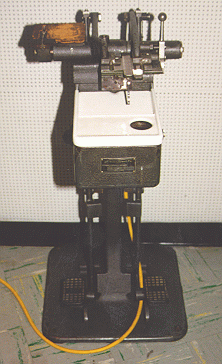
Perhaps more interesting is this 1950s-vintage Bell and Howell foot-operated hot splicer. I don't know the history of this, but it certainly looks cool.
Those Bell and Howell foot splicers are still the "workhorse" for negative cutters. Watching a skilled operator make splices (the foot pedals operate the heated plattens) is to watch poetry in motion.
Where did you photograph the B&H foot splicer?
------------------
John P. Pytlak, Senior Technical Specialist
Worldwide Technical Services, Entertainment Imaging
Eastman Kodak Company
Research Labs, Building 69, Room 7419
Rochester, New York, 14650-1922 USA
Tel: 716-477-5325 Cell: 716-781-4036 Fax: 716-722-7243
E-Mail: john.pytlak@kodak.com
Web site: http://www.kodak.com/go/motion
------------------
Martin Frandsen
Film crazy!, Big 70mm fan!
.