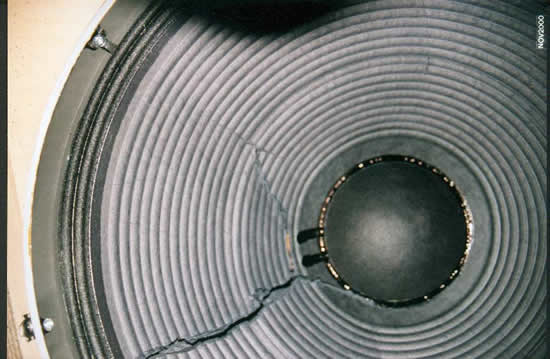
Very bad, isn't it?
Pls note that near the center of the woofer there is a "ring" different from the others: I think that that woofer is flyed out... 
The very very strange thing is that THE OTHER WOOFER IS INTACT!!!! And, of course, is physically connected to the one in the photo.
Perhaps JBL has put a woofer with a different impedance (I know that that woofers can be found at 8 or 4 Ohms)??
Bye
Antonio
It's funny.
Another tech said me that that SW is "more than theaters needs".
This tech has EQ'ed a theater with only one ALTEC subwoofer (1 woofer, close box): 1000 seats...
I can't understand why that SW has not flyed out of the theater yet...
I agree with you of course.
But why only ONE woofer has failed? Why not both??
Bye
A
The JBL 4688 is a TCB (triple chamber Bass) subwoofer and it isn't as efficient as other units of similar size and power handing. As such, it isn't surprising that where one might need two 4688s whereas only one of a different subwoofer may be sufficient. At my office, I have the specicfications on the JBL 4688 (and it's internal drivers) and will try to give you more information on the unit. One piece of information I will need is the length of your auditorium in feet or meters.
Next to your driver. you are correct in that if the driver fails in multiple driver system from overexcursion, then the other driver(s) also typically have similar damage. If the driver is driven to the point where the voice coil is bottomed out (hits the bottom of the magnet structure) or jumps out of the gap, the other drivers should be doing the same thing, further more, once the first driver fails (and typically opens), the remaining driver(s) will now take ALL of the signal.
All of the above presumes the failure mode was from being overdriven not for other types of abuse.
From your picture, the cone is cut and that doesn't happen from being over driven. That is a physical damage. It was either cut, rotted, or was defective in manufacture (JBL carries a 5-year warranty on defects, at least in the United States). I would need to see the cone in person to really make a determination on the cause of damage though.
I am an JBL, Altec and EV trained/certified warranty repair technician for their speaker products.
Steve
------------------
"Old projectionists never die, they just changeover!"
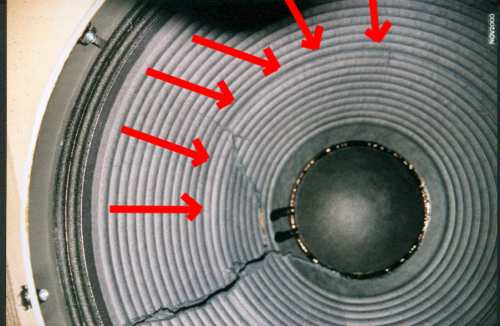
Pls note the orange arrows. It is clear that the cone has travel out of the gap.
If I push from bottom the cone with my hands, the cone will deformed at the ring when evidenced by arrows.
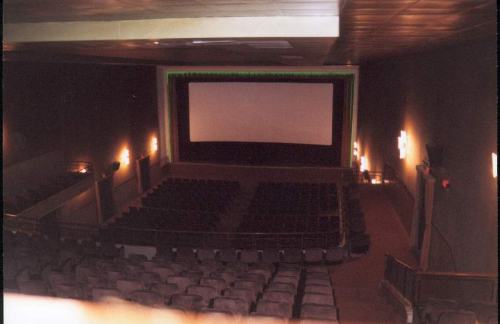
My theater is about 15 meters wide, 30 meters long (stall) and about 45 meters on balcony. It is about 10 meters high.
I think that it is about 6000 mq.
Last question: I've asked JBL italy about repairing that cone for the second time and they are in trouble to found out the model of the cone... Can you help me?
Thanks for your help!
Bye
Antonio
The drivers used in the 4688 are the JBL 2240...the 4688 was offered in two versions, the 4688 and the 4688-4. The difference was the impedance of the drivers. The 4688-4 used 4-ohm drivers (2240G) and the plain 4688 used 8-ohm drivers (2240H). Both drivers come out to separate terminals so you may wire them independantly or parallel. It is important that you observe polarity and verify that the cabinet was not miswired either from the driver to the input connector on the cabinet)... Because it is a TCB, can not easily see the drivers. They must be wired in proper phase to the amplifier also, as you have suspected...they MUST be the same impedance or you will drive one more than the other.
Steve
------------------
"Old projectionists never die, they just changeover!"
Thanks for your analisys. I agree with you.
Mark,
Yes, my manager told me once that JBL had a lot of problems with that type of subwoofer. Perhaps time is come to change type of subwoofer... :-)
Steve,
Sub terminal are connected togheter just outside the cabinet.
Polarity is OK.
We think that the first cone has been damaged for a factory defect (it broke just the coil) and that this time JBL change the cone with another with a different impedance.
I gave to JBL a copy of Subwoofer PDF but it seems that the 2240 are not on their price list.
About WHY my theater has only one Sub: unfortunately, many Italian techs think that "LFE channel" has the same power needs than the center channel. ALL Florence's theaters (as big as mine) as just only one subwoofer.
Bye
A
We have NEVER had a TCB ever fail and the 2240 driver was used in many more speakers than the 4688. Furthermore the 2240 was available as a raw driver for many years....I believe it's closest replacement today is the 2241.
The 2240 is only rated at 300 watts continious pink noise (the figure you have to use when judging for movie theatre subwoofer use)...as such the 4688 is a 600-watt speaker.
As others have pointed out, with a 97dB efficientcy, in your theatre, you would need over 10000 watts to properly handle the film's soundtracks (digital only)...even for SR it should require over 1000 watts. As such, you need more subwoofers.
Steve
------------------
"Old projectionists never die, they just changeover!"
Now what would it take to use 4688s in your theatre....you would need 6 units minium with 8 units preferred! This will reduce your power requirements to about 3600 watts...a much more reasonable figure.
Even if you only run optical soundtracks, you should have two units with about 1000 watts.
The JBL 4688 is a wonderful subwoofer in many respects...it is very flat in it's pass-band. It isn't very efficient and doesn't play very deep (-3dB at 28Hz). As you might have suspected, you might want to consider replacing this unit with a new set of subwoofers.
Keeping it in the JBL family a 4642A has a much higher efficientcy (100dB)...The JBL 4642A also has 1200 watts of continious pink noise power handling. This will drop your requirements to 4 units and 2400 watts. This just an example. I prefer the JBL 4645C (single 18"). This puppy has the JBL 2242H woofer that handles 800watts of continious pink noise. You would need at least 6 units at 3200 watts with 8 units preferred. If you take advantage of the B-6 tuning in either of the above units, the bass is incredible.
Anybody that has told you that cinemas only need one subwoofer (single or double 18" or smaller) today (in large auditoriums with 30 meter throws or longer) shouldn't be specifying sound equipment for theatres.
Steve
------------------
"Old projectionists never die, they just changeover!"
From my ancillary interest in pipe organs, I have heard that subwoofers are being used in some situations to electronically simulate the lower octave of 32' pipes. Not sure if it has been done anywhere in the world yet for 64' -- low C of a 64' stop is around 8 cps. It is a foundation and is felt rather than heard.
See this link for more...
www.acchos.org
64' on this instrument is very potent, and has recently been recorded, the CD is available. This CD is capable of considerable destruction, by the way and contains Warnings.
Steve G. I see you are a speaker specialist; two questions,
[a] what would you recommend for electronic low-end pedal simulation in a pipe organ, guaranteed it will be cheap compared with the cost today of building the actual pipes, so make the recommendation on the "best available."
[b] I have four Altec 15' LF units from way back sitting in boxes in the warehouse along with a number of others. These particular LF's are functional but could use new cones.
Are kits available and are the cones of today better than the older ones -- i.e. lower resonant frequency, etc?
And Mark G. I haven't forgotten you and I'll try and write the post about the Saga of the A2 in the porno house soon. It will have all youse guys ROFL.
Bye
Antonio
How did you calculate the need of power for my theater? Can you explain me?
What exactly "sensitivity" means?
Thanks
A
As one respected industry insider once said...in this industry everyone has two specialties....the first is SOUND and the second is what they might actually be a specialist in!
I would not call myself a speaker specialist and therefore wouldn't find myself necessarily qualified to make the recommendation you asked. My training is in Electrical Engineering and thus I can work the numbers given the background but in your case, I lack the "feel" to do the job right. In order to do 6Hz though there are physical contraints. To play in any appreciable size room at any particular level...it WILL be very large. This a long wavelength so any horn based system is likely to be bigger than the room which it will be played in and probably as costly as the pipe. There are the physical dynamics of the drivers themselves...most of the larger ones only move about .5-.75"...so the box that would house them (and I do mean them) is likely to be HUGE. I'm going to go out on a thin limb and say that maybe Servodrive speakers might be able to do what you ask but again, this really isn't my area. Fortunately, movie soundtracks are confined to 15Hz and up and most cinemas can't nor want frequencies below 20Hz.
As to the Altec woofers...lets presume your 15' (or foot) was really a 15" (or inch) drivers 
I (and others) can recone just about any Altec regular 15" speaker back to new or even to upgrade it to a different model in many cases. What I mean by regular is the 416, 515, 803, 421...just plain old drivers. Altec had some goofy ones like the "Bi-Flex" series (I think 420 was it's model number in the 15") where the cone was double stamped so as there was the 15" section but a 7" (or so) section was stamped in the middle to improve mid-frequency response. Also, some early 604 "Duplex" speakers can't be easliy reconed...starting with the 604C, things are available.
I can also get aluminum (and Pascalite) diaphragms for the 288 drivers in 8, 16 and 24Ohms. Likewise for the 800/900 series. The Symbioteks are no longer supported but I have a few NOS diaphragms in 16Ohm for the 808/908
Now to Antonio...sorry to keep you waiting 
The formulas do not translate into ASCII (text) well since just about everyting to do with sound involves logs and anti-logs (base-10).
The best thing to do, is get your hands on Dolby's "Technical Guidlines for Dolby Stereo Theatres" They have nomographs so you can look up the size of your room and find the sensitivity of your speakers so as to compute watts. I have found that Dolby's charts are excellent and really do tell the true picture.
Some things to keep in mind are what my old college professor would call "Kitchen physics"...that is some things that are easy to keep in mind to make calculations easy and good enough. First, with sound 3-dB is a magical unit...it usually means double or half. That is a 3-dB increase in power is double...or if you have a 100watt amplifier, a 3-dB more powerful amplifier is 200-watts. 10-dB is another one...with 10-dB increments (or decrements) one multiplies by 10 or divides by 10. So if optical plays 10-dB less than digital (not exactly but close enough for kitchen physics)....you need 10-dB less power.
So to speaker sensitivity...speaker manufacturers rate their speakers in a uniform way (nowadays)...that is how loud they will play if 1-watt of power is used with the measuring device 1-meter away.
A typical 2-way double 15" stage speaker today will have a 100dB/watt @ 1-meter rating. A typical single 18" subwoofer is typically less efficient and is closer to 95-97dB (depending on the lowest frequency). One thing to check in the specifications is the frequency range used to give the sensitivity, if multiple figures are given, use the one that matches YOUR use for the speaker.
Now back to our kitchen physics....one neat thing about speakers is something called mutual coupling...that is if two identical systems are placed in close proximity to each other, they will mutually couple and play like one larger system. The benefits are often better bass response and a 3-dB increase in sensitivity! This is a big deal on subwoofers. Take your 4688....you need about 19200 watts with one....but the figure drops to 9600 watts just by adding one more unit...it will be cheaper to add the subwoofer than to come up with the power and even if you could come up with the power, the drivers will explode because they can't take it. However to take the next jump, you don't just add one more, you add two more (ie this is a geometric progression)...so if you are up to 4 subwoofers...you are down to needing 4800 watts....certainly doable with a couple of amps but your drivers can only handle 2400 watts so arn't there yet..at about 6 units you have the sensitivity you need with the power handling you need....but 8 units is more desirable...running woofers near their rated power isn't desirable due to power compression as the voice coil heats up.
The rest is left as an homework assignment.
Steve
------------------
"Old projectionists never die, they just changeover!"
Just 2 questions:
1. Sensitivity: I didn't understand very well. For example, 4688 has 97dB, 1W, 1 meter. So if I have only 1 Watt of power on my subwoofer it will play at 97 dB at 1 meter??? 
2. Where can I found Dolby's manual you said? Is it on Dolby's website?
Again, many thanks! I was sure that there were some physic behind a sound system. Unfortunately I never saw any "qualified technical personnel (as DTS said!)" use that...
Bye
A
Yup, you pretty much have the idea....the measurement, in theory should be in an anachoic (sp?) chamber since you don't want to measure the room gain with the speaker being measured. The frequency range must also be specified for a meaningful SPL reading in dB. One thing to note is that, in your case with a 97dB speaker, a double 18" speaker of today typically has a 100dB sensitivity....that reduces the power required by half right off the bat! That is what I mean by keeping the 3-dB and 10-dB stuff in your head for quick number crunching.
As to where the manual is....they used to give them away at the training seminars and with the dealer binders...there are two that I know of...the early "draft" one had red covers and the later one was with grey covers.
I see Brad doesn't have them on the site yet...I'll check with Dolby and see if a newer version was ever made or if they have any problem with it being posted.
------------------
"Old projectionists never die, they just changeover!"
regards,
Christos
Thanks, it is very clear now!!
Unfortunately the subwoofer graph on c.e.s. is corrupted (!) I will ask to fix it.
Steve, I know a theater (well know around the world for its quality of presentation) in Italy, ARCADIA of Melzo, that in their biggest room have 4 Electrovoice TL880D with P3000 amplifiers.
Since that sub has 127dB sensibility, they are like 10 of my 4688, isn't it?
So, have 4 TL880D in my theater would be like have 40 JBL 4688??
I can believe, because when THX logo fall down (TEX trailer)at Arcadia you can FEEL bass frequencies and seats move itself... 
Thanks again
Antonio
Steve
------------------
"Old projectionists never die, they just changeover!"
EV: I have the PDF specs of TL880P (with integrated P1250). It says "Sound pressure level at 1 meter, maximum gain and amplifier at clipping threshold, 0dBu (0,775 voltsrms) into balanced input, Anechoic environment, swept sine wave 50-125 Hz: 127 dB".
Perhaps it isn't at 1 watt?
Today I enjoy myself checking my theaters sound system with diagrams on Dolby's tech sheet.
Unfortunately the SW datagram is corrupted on cinemaequipment.com link (can you post yours?).
Just to understand if I made all correctly:
Stage channels:
I have two 4638 and one 2446H for each channel.
My theater is 30/37 (average: 35) meters long (previous measures were wrong).
With datagram found on link above, I need 1250W for channel. Since my system is bi-amped, I need 834W (bi-amped system: 2/3 of 1250W) for HF since sentitivity of 4638 is 100dB.
What power should I consider on datasheet?
I have AES: 800W; Long term average per EIA RS-426A: 1000 Watts; Continuos program: 1600W.
I say that also at minimum power (800W) since I have two speaker for channel I have enough power for digital soundtrack, right?
HF: 2446 has 111dB on horn. So I need about 120W of power that in biamped system become 80W. On JBL datasheet I've found: 100W continuos program above 500Hz and 150W above 1000Hz. I'd say that they are ok...
I have trouble with surround channels.
I have 8340 (sensibility 96dB) and theater width is 16 meters.
With datagram I've found that I need approx. 200W for channel. 8340's power is 150W so two speaker should be enough (just for power needs, not for good coverage of all seats of course). Is it right?
However, Trying to calculate the same result with the equation provided I have a differen value.
I have Watts= 10^(Lp-Ls+20(logR/10)).
with Lp=100dB (SPL for each stereo surround)
Ls:sensitivity
R= distance from wall to centerline of the theater in meter.
What is wrong?
Sorry for this long post but since I was a projectionist I had the need to know the exact way to calculate the power of a sound system. You are helping me very much!
Hope that what I've wrote is clear.
Bye
Antonio
You are right. I found the correct EV pdf datasheet and sensibility of TL880D (without integrated amplifier) is 96dB.
Antonio
As you all can see I'm trying to understand better the "power requirement" problem!
I understand that "continuos pink noise power" is the value that has been to be considered making power requirement calculations.
You told me that I need 19200W in my theater and I need 6+, 8 preferred units. A 4688 SW is a 600W pink noise power (half than continuos program, isn't it?)
19200/8=2400W. This means that I have to give 2400W to each unit, right? But how can a 4688 handle 2400W of power if its "continuous pink noise" power is only 600W?
Again, you wrote 3600W (I suppose with 6 units). But 19200/6=3600W. Did you make a mistake in calculation or didn't I understand somethink?
Let's talk about the 4645C. It handles 800W contiuous pink noise. You wrote that I need 6, 8 preferred units. Since sensitivity is the same, power requirements are the same (19200). But 19200/8=2400W. Again, same question of above!
As you can see I'm abit confused...
Thanks for all of your help!
Bye
Antonio
Joe S,
It is funny you mention pipe organs and subwoofers. Did a test recently with one of our DCA amps and the Whise 616 subwoofer (from Austrailia). This is a huge hunking sub, a 4 foot cube.
The purpose of the test was to see how if it could reproduce sonically 32' pipes. The venue has 32' pipes and switching between organ and sub had same sonic qualities, as well as low level air movement.
This venue wants to add 64' pipes but does not have the room, hence, the Whise sub.
We only pumped 2,000W into the sub, though, the DCA amp never came close to clipping.
The only draw back, the Whise is mucho expensive.
When you add subwoofers, you increase the sensitivity of the system when they are closely placed. As such your needed power drops. In the case of the 4688, you would only need 3600 watts with six units and you would have 600 watts x 6 speakers or 3600 watts of power handing. Similar math applies to the 4645C.
Steve
------------------
"Old projectionists never die, they just changeover!"
I suppose that your calculations are made over a 19200 Watts power requirement.
When I add one unit I need half of the power, right?
So:
1 Unit = 19200W
2 Unit = 9600W
4 Unit = 4800W
6 Unit = 3200W
Where I'm wrong?
Let's make an example.
I have a theater with 4 4645B and the theare is 27 meters long.
Figure on cinemaequipmentsales.com is corrupted (they'll fix it today) but I suppose that a 28m long theater with 100dB speaker sensibility needs just 6000W of power.
So:
1 Unit = 6000W
2 Units= 3000W
4 Units= 1500W
1500W/4=375W to EACH subwoofer.
4645B can handle 800W so it is correct.
Right?
Thanks for your help!
Bye
Antonio
------------------
Bob Throop
>>"1 Unit = 19200W
2 Unit = 9600W
4 Unit = 4800W
6 Unit = 3200W
Where I'm wrong?"<<
You are not wrong. You have 6 units though that can each handle 600 watts or 3600 watts of power handling combined (the 3200 watts isn't what EACH unit must handle but the total power needed given the sensitivity of the ENTIRE SYSTEM). But at this point you only have a theoretical 400 watts to spare on long peaks (like during the Apollo 13 blast off)...spread out over the 12 drivers, you would be giving yourself only 33 watts per driver of head room). Since drivers go through something called "power compression" as the voice coil heats up, it probably better to get the two additional speakers (total of 8) and run everything well within range (it also makes hook up easier). You also want to make suure all off your connection are in parallel or direct to the amplifier, no series connection (I don't want to go into the science of it at the moment).
>>"Let's make an example.
I have a theater with 4 4645B and the theare is 27 meters long.
Figure on cinemaequipmentsales.com is corrupted (they'll fix it today) but I suppose that a 28m long theater with 100dB speaker sensibility needs just 6000W of power.<<
So:
1 Unit = 6000W
2 Units= 3000W
4 Units= 1500W
1500W/4=375W to EACH subwoofer.
4645B can handle 800W so it is correct.
Right?"<<
On the nose! (Note, you could also barely make it with just 3 units).
Robert:
No, the sensurround subs were removed (and destroyed for the most part) when the theatre was renovated just before the reissue of Vertigo in 70mm. We currently have 8 JBL 4645C subwoofer and two QSC MX-3000a amplifiers (with the SF-1 subfilter with B-6 tuning). My favorite comment was that "the system now sounds like it used to!" The old sensurround subs were horn/slot loaded and quite efficient. As such, the whole system ran on 400 watts (the typical Cerwin Vega A-2200 that was used in virtually all sensurrounds that I have seen). We now have somthing like 4800 watts!
Steve
------------------
"Old projectionists never die, they just changeover!"
Understood!!! Great! I've checked for fun many power requirements and I think that I have fully understand the thing! Many thanks!!!!
3 questions:
1. power spare head room. I understand that powering a speaker at its rated power is not a good tecnique. So I understand why I should have 8 SW instead of 6.
But you talked about "Apollo 13 blast" PEAK. So Digital Soundtrack are capable to go further than 103dB (113 for SW)? Or you mean just that have 6 unit running at maximum power for too much time is not good?
2. Surround speakers: In that case the 3dB sensitivity increase is not applicable because speakers are not near each others, isn't it?
3. Is it possible to have the math equations to make exactly calculations abut these power requirements? Can you post it as pictures?
Steve, you helped me much in this thread: many thanks!
Bye
A
In a blast off like in Apollo 13, the extreme subwoofer signal is used for an extended period of time...assuming that you have set up your system to spec and assuming that you only run things at "7" or lower with "7" being the reference, then no you shouldn't exceed 113dB 2/3 back in your auditorium.
Steve
------------------
"Old projectionists never die, they just changeover!"
Ok, so it is just a safe precaution!
My theater is an old style theater as you saw. Sound system was completely rebuild in 1994 with SR.D added and speakers changed.
Behind the screen I have 2 4638 JBL LF speakers for each channel.
Assuming that my theater is 35 meters long, I need 1250W for channel, 833 for LF units (It is a biamped system).
One 4638 can handle just 800W, with two unit the power requirements drop to 400W so that each LF should handle only 200W.
So, no problem. But why they've installed two 4638 instead of, say, one 4648? Perhaps in 1994 there were no JBL speaker with more than 800W for channels?
Having two 4638 instead of one (for example) 4648 could improve bass frequency response?
Bye
Antonio
Perhaps you missed part of my message: can you post (or send me by email) the formulas for exactly calculate the power needs of front, surround and subwoofer channels?
Thanks for your availability!
Antonio

Lets work through one....
Lets say you have a JBL 4675 stage speaker...it has a sensitivity of 100dB/watt @ 1-meter
Lets also say you have a 30-meter long room.
Therefore, you would need
103 - 100 20Log(20)
-------------------
10
10 = 798 watts.
Why did I use 20 meters? Because the power requirement is for 2/3 of the way back, not the full 30 meters.
For subwoofer, it is a bit more tricky...since sub tracks are normally sustained enough to have room gain contribute to the total sound, you can normally fudge thigns by about 3dB...more so in larger rooms where it is bound to be reverberant....therefore instead of 113dB for the subwoofer, Dolby only has you compute for 110dB...in most rooms this is ok...if the room is dead in the lower frequencies...you should use the 113 dB figure.
Steve
------------------
"Old projectionists never die, they just changeover!"
I have told them before that we abused their products, but they warrant them anyway. JBL is a good company.
I still have one sub that I have never re-coned.
It is made by SRT. They are not THX approved, but they look fine on an RTA.
http://www.hydrosonic.com
The added water weight also makes then un-attractive to sub thieves.
Antonio, you can show your picture with arrows to JBL and they will honor their warranty.
I've received subs back that had been blown out of their baskets with a thank-you note for using JBL.
JBL stands behind their drivers (no matter what we do to them!)
Regards
David
Since no one from JBL is jumping in...
I wrote the 5000 Series installation guide and I believe I did the last update on the JBL cinema install manual. The reason I recommended 800 watts into an 800 watt driver was in recognition of the fact that most theatre owners go for the minimum (or less!). It was my position, and still is, that you should try to use AT LEAST the rated maximum power handling of the driver in question. More is better, but practically speaking, very few owners will spring for an amp delivering 1600 watts into 8 ohms for a sub, or any other speaker for that matter. Just today, I heard from a customer who was putting 450 watts bridge mono into our sub (EAW SB284C) which wants to see at least 1600 watts (2 x 800 into 8 ohms). The amp was repeatedly going into thermal shutdown.
Thanks! Now I have all that I need!
Russ,
Do you really believe that JBL will repair my 2440 in warranty????
The speaker is 7 years old, but has been reconed less than 12 months ago...
I will ask our Italian agency immediately!!!
Bye
Antonio
So cool to talk to someone from JBL. So, in ideal conditions, what amp power would you feed a 4645C ? Let's say you have 4 of these, stacked 2 by 2. connecting bridged amps so as each woofy gets a clean 1500w for instance ?
I use 2 4645C in my home theater with a "small" 2x150w amp ( real watts ), forced cooled and with the signal cut at 20hz, AWG 8 wires, 1meter long ( very short wires thus and I can hear the subs like that!!!). the bass are fabulous. room is 6.5*2.45*12meters
regards and thanks
------------------
John P. Pytlak, Senior Technical Specialist
Worldwide Technical Services, Entertainment Imaging
Eastman Kodak Company
Research Labs, Building 69, Room 7419
Rochester, New York, 14650-1922 USA
Tel: 716-477-5325 Cell: 716-781-4036 Fax: 716-722-7243
E-Mail: john.pytlak@kodak.com
Web site: http://www.kodak.com/go/motion
Ok, power needs of that theater is not high so 400W is also enought, but I think that the bridge solution is better than THX one.
What do you think?
Bye
Antonio
We always recommend the max.power rating of the speaker. Like the JBL 4645C, our SB184C handles 800 watts, so we recommend an amp that can deliver 800 watts into 8 ohms. As a loudspeaker manufacturer, it is the most practical answer we can give - to recommend 1600 watts is unrealistic (although more power is ALWAYS BETTER), and to say you can get away with, for example 400 watts, without knowing the demands of the actual installations (room volume, dynamic range of the soundtrack, digital or non-digital) risks amp clipping and speaker and/or amp damage.
So basing on Dolby formula a theater 45 meters long needs 2 HF drivers?
I saw on JBL data sheets that their most powerful HF drivers can handle 75W above 500Hz.
I've calculated that for my theater (35m) I need 57W on biamped system.
So for a 40/45meters long theater we should install two HF drivers?
Bye
Antonio
Nope....JBL's specifications for drivers like the 2446 (used on the JBL 2360 Horn which in turn is used on the JBL 4675 stage speaker) is rated for 100 watts continious program.
Furthermore, looking at the JBL 2360 spec. sheet, the sensitivitiy is 115dB/watt at 1-meter above 1KHz....it is slightly less at 500Hz BUT at 500Hz the HF section is 3-dB down so that the LF and HF section will join seemlessly (both LF and HF being -3dB will sum to 0dB)...therefore essentially pick up the 3dB.
Therefore, using the formulas....
We see you need just over 57 watts. This will put you to less than 3dB of headroom but it should play fine at reference level. Note, you can use the "program" level on a stage channel whereas continious pink noise should be used for subwoofers due to the different types of singals sent to each channel.
As to the issue of adding a second driver....that is a VERY tricky issue. Altec was one of the only sucessful people (I am aware of) to do this with a Constant Directivity (CD) horn. They offered a dual throat on their MR94 (90 x 40 degree) and the MR42 (40 x 20degree). They had the drivers share the same horn (it was unique in that they had one driver working the top half of the horn and the other working the bottom half such that they worked like one BIG driver)....this was important.
When you add an additional horn/driver system....you WILL get lobing since your sound is now coming from two points and will have time alignment problems and the problem change through out the shared spectrum. In short, this is something you really don't want to do unless you HAVE to. It is like EQ...it is an addmission of failure, that is, your speakers and room are not perfect so you must fiddle with it and mess up the phase response to overcome frequency problems...it is a better of two evils situation. Same with going with a second (or more) horn/driver combination. Note, the need for the additional units may be for adequate coverage, not just power handling.
On the up side, we now have computer modeling available to us so in the event that multiple systems MUST be used, the results are much more predictable and can be optimized (just like EQ) to provide the best solution for a given situation.
But back to YOUR theatre. As I recall, you have an overhanging balcony. This might give you a good reason to use two HF sections without the nasty artifacts previously mentioned (lobing). One thing about the CD horns is that they have a pretty sharp cut off outside of their coverage area. You could use a horn like the 2360 (90 x 40) aimed to cover just the lower level (stall) and a horn like the 2365 (60 x 40) to cover the balcony. Since the balcony is further away, using the narrower width horn will not have you waste power (and sound reflections) on the walls getting the sound to the balcony. You could then tune the two sections independantly to optimise both rather than what most people do (make the lower section tune to spec whilst the balcony gets what it gets).
Steve
------------------
"Old projectionists never die, they just changeover!"
Steve
------------------
"Old projectionists never die, they just changeover!"
Ok for HF power.
Continuous program can be used also for LF stage speaker?
I have 2 4638 for each channels.
My theater is 35m long. So I need 1083W for each channel. 2/3 of 1083 (my system is biamped) is 722W.
If continuous power can be used, one 4638 should be enough, isn't it?
If two adiacent 4638 have the same +3dB "coupling" power increase, to have 103dB in my auditorium each speaker is powered by only 180W... I can uncover the theater...
Another THX theater of my chain has 4648A-8 and it is only 21 meters long. Should I consider 2400Watts for these speaker???
In that case that speakers are powered at 65W maximum!!!
Bye
Antonio
Yes, you can use program power for the stage channel LF section though I tend to favor using coninious pink noise for anthing bass due to the nature of film soundtracks...that is with effect, bass tends to be a continious thing, unlike music and speech.
Unless I am mistaken, the 4638 was only available as the 4638TH with a crossover. It only has the 2035 drivers inside which are less capable than the 2226. If you are using the crossover as the input for the bass (presuming it is indeed a 4638TH) then the system tops out at 600watts AES, vs 800 watts if the woofers are connected directly to the amplifier. I would recommend two bass sections in a theatre of this size (35 meters) for digital films to be played at spec.
For both theatres, play it on the safe side. For the bass section use continious pink noise as the rating and don't take the 2/3rds power handing...remember that the 2/3 amounts to less than 3-dB...not big enough to really make a huge difference in the sound level but enough to have a driver burn up. You should keep some amount of headroom in any system (normally 3dB is a minimum for safty).
Steve
------------------
"Old projectionists never die, they just changeover!"
On the back of my 4638 there is just "4638 4 ohm" and anything else.
As you can see,
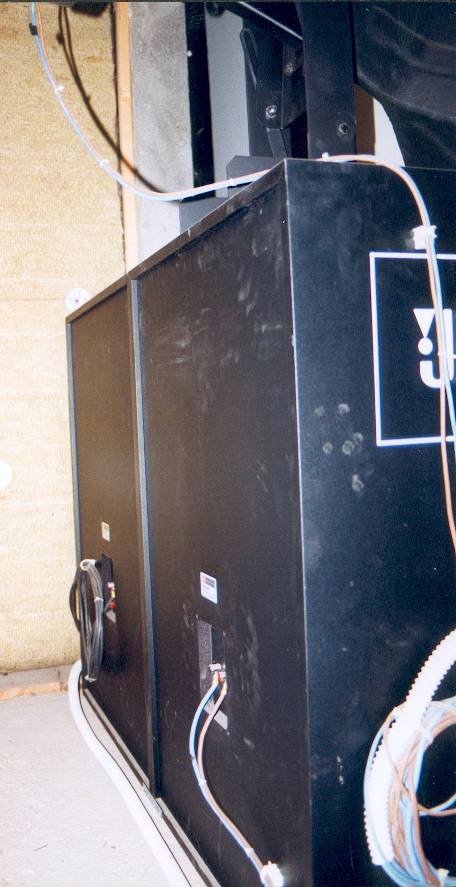
I have two only input for that speaker. Each speaker is connected to a Crown MT 1201, one speaker for each channel.
HF driver has its own amplifier too.
You said that for 35meters theater two LF section is recommended. But why not install just one LF section with more power?
Finally: someone told me that where 2 LF speaker are used, they should be installed one on the other and not side by side (like in my theater), what do you think?
On 4638 PDF I've noted that vertical coverage is less high than orizontal so I think that have two 4638 side by side is wrong.
Bye
Antonio
I must be drawing a mind blank....Perhaps the 4838 is a loaded 4508 cabinet with two JBL 2225 drivers...if that is the case, then you have less power handing...the 2225 was a 350 watt driver...dropping you down to 700 watts total per cabinet. With a 35 meter room, you should have about 1100 watts...even if you like to play things on the edge, you need 735 watts...either way you are coming up short. You should use two cabinets. Then you only need 550 watts for the system and each driver is only having to deal with 140 or so watts...they are loafing at that point rather than suffering from power compression....a much better design.
As to stacking the bass cabinets, yes they should be stacked one on top of the other...the directivity of bass systems is a bit wild but with a stacked array, the HF and LF directivity will be more closely matched in this case.
Steve
------------------
"Old projectionists never die, they just changeover!"
OK...I've traced down the 4638....yes it is loaded with the 2035...things must be different out of the states...That driver is only supposed to be used in factory-loaded systems with a passive crossover. It looks like the 2226 which is a pretty substantial driver 600 continious watts and built with a real nifty cooling system. The 2035 is supposed to be used in power limited applications wbere the passive crossover is the weak link.
Anyway, you are correct, you have 800 watts of conintious pink noise or 1600 watts of continious program. I would favor to use the 800 watt figure for cinema but you are probably safe using the 1600 watt figure...this means you would have to have an amplifier that goes to 1600 watts into 4 Ohms...I wouldn't push things too much though. Since you have a double bass system, why make it an issue? It is the smarter safer way to play it. I would be very surprised if you have any driver failures from power related issues.
Steve
------------------
"Old projectionists never die, they just changeover!"
Don't misunderstand me! I'm very very glad to have two 4638 for each stage channel!!!
It is just a thought: I've saw on an online price list that six 4638 cost 4128 USD. Just three 4648A will cost only 2307 instead with a difference of 1821 USD.
So, why install six 4638 instead of three 4648A?
Bye
Antonio
Steve
------------------
"Old projectionists never die, they just changeover!"
As you noted, my english is not very good..
I really didn't understand what do you mean with:
"First off...I would only get the 4648A, myself so you don't have to sell me on it".
However, let me explain you why I'm making an inssue about my double 4638!
I'm just a projectionist, I'm not a manager. But I can realize that our techs are not "qualified" as I would.
When I've calculated the power needs for my theater, I wonder why they've installed two 4638 instead of just one unit with more power. That's all!
I fully agree with you about install speakers with adequate power, I told you that I'm very glad to know that I can project movies with no fear about overloading stage speakers.
Since "I"'ve blown up two subwoofer, I also made these calculation to realize if the problem was just in the subwoofer channel or if the entire system is inadequate.
So, in a theater 35 meters long, would you install one 4648A or two 4638?
Last thing, for all Film-Techers: sometimes I write something that is not what I think. If someone read something "wrong" or wrote in a bad way, probably is not what I ment, was just my poor english! I apologize for that in advance!
Bye
Antonio
What I mean is that I would only use the 4648A, never the 4638 (regardless of the quantity). I am a fan of the 2226 driver, it has to be one of the best 15" driver I have ever seen, inside and out. The 2035 is a lesser driver made to "look" like the 2226. This is what I mean that you don't have to "sell me" on using the 4648A. If I were desiging the sound system for your theatre using JBL stage speakers, then I would use two 4648A bass sections for each channel.
So you have given me a choice of A or B, and I have given you a response of C! Don't you just hate people like that?
Steve
------------------
"Old projectionists never die, they just changeover!"
Thanks for the explanation. So in my theater a 4638/4648A stage channel should handle at least 722W in a Biamped system. 4648A speakers have 1200W continuous pink noise power, 2400W continuous program.
With one unit we have 478W headroom for each channel, 239W for each woofer.
With Two unit headroom raise to 2039W for the system and 1019W for each speaker (right?).
So, you think that 239W for each woofer is not enough and you prefer to install two unit. Right?
So, how much "headroom" should I have to consider when I have to project a sound system?
Bye
Antonio
If you go with two bass sections it pays off in dividends, you can now use a smaller and less costly amplifier, your drivers are not being taxed and your distortion goes down overall. I think if you priced both systems out, you would find that the cost is similar (include the amplifier cost in your comparision) and the double bass system will out perform.
Heck, if you looked into JBL's 3-way systems (The 5000 series) you would find that the system for your theatre would be the 5674 and it HAS 4-2226 drivers in their "diamond-quad" configuration. This is the system that have effectively replaced the "academy speaker" for JBL The academy speaker was a JBL 4675 with two 4648A bass sections.
Steve
------------------
"Old projectionists never die, they just changeover!"
Ok. Thanks for all your help, it was a nice chat!
Bye
Antonio