This is topic Screen brightness in forum Film Handlers' Forum at Film-Tech Forum ARCHIVE.
To visit this topic, use this URL:
https://ft-forum.com/ft/cgi-bin/ubb/ultimatebb.cgi?ubb=get_topic;f=1;t=002153
Posted by Antonio Marcheselli (Member # 373) on 04-13-2001, 08:51 AM:
Hello everyone.Can this device be used to measure my screen luminance?
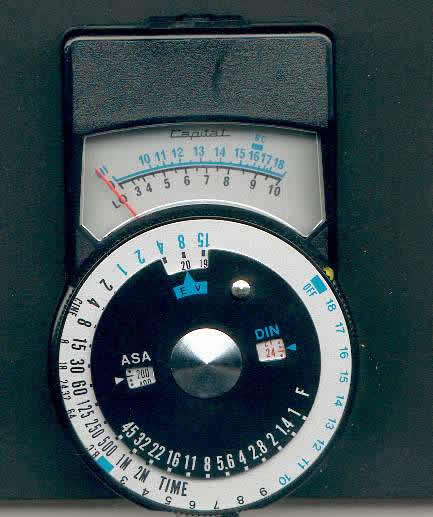
Thanks!!
Bye
Antonio
Posted by Mark Huff (Member # 480) on 04-13-2001, 06:14 PM:
I would say no you could not. It looks likes some type of amperage meter. The only way that you can check your screen luminance is with a light meter pointed at the screen. Unless you are a old school tech and it just comes naturally. I have seen some tech's actually look at screen and tell you what the brightness is. But they have been doing this for 25 to 30 years.
Posted by Rick McCluney (Member # 642) on 04-13-2001, 06:25 PM:
Actually that is a photographic light meter. I have heard that they can be used with some type of mathmatical conversion but that it is not a very accurate measurement.Rick
Posted by Antonio Marcheselli (Member # 373) on 04-13-2001, 07:18 PM:
Yes, is a photographic light meter.
Anyone knows a way to convert the unit measures?Also if inaccurate, it could be a good point to start.
Bye
Antonio
Posted by Scott Norwood (Member # 30) on 04-13-2001, 08:39 PM:
I believe that there _is_ a conversion chart between footcandles and footlamberts, but your meter doesn't appear to measure footcandles, so that isn't really relevant unless you can dig up a footcandle meter.
I do have an old file that suggests this: set your meter for 100ASA, 1/50th second and take a reflected-light reading off the screen with the projector running without film. If you are getting 16fl on screen, the meter should read f/3.2. (This method was posted to the CML mailing list a while back.)
This "might" be useful to get a ballpark figure, but I suspect that you will want to beg, borrow, or steal (not really) the proper type of meter for this job, since the above method doesn't really take into account the evenness of illumination and many other factors. It would probably work better with a spot meter, and would probably not work at all with a digital meter (which would likely find the flicker to be disagreeable).
Posted by John Pytlak (Member # 331) on 04-14-2001, 06:15 AM:
To measure screen luminance, you need a meter that reads light REFLECTED from the screen. An incident light meter (that measures light falling on the meter) will not measure the effect of screen gain. Incident light is measured in FOOTCANDLES (or candelas). Reflected light is measured in FOOTLAMBERTS (or candelas per square metre).Standard SMPTE 196M specifies a screen luminance aim of 16 footlamberts, with an allowed range for theatres of 12 to 22 footlamberts.
Here is an article I wrote about measuring screen luminance:
http://www.kodak.com/US/en/motion/newsletters/notes/june2000/pytlak.shtml
------------------
John P. Pytlak, Senior Technical Specialist
Worldwide Technical Services, Entertainment Imaging
Eastman Kodak Company
Research Labs, Building 69, Room 7419
Rochester, New York, 14650-1922 USA
Tel: 716-477-5325 Cell: 716-781-4036 Fax: 716-722-7243
E-Mail: john.pytlak@kodak.com
Web site: http://www.kodak.com/go/motion
Posted by Josh Jones (Member # 447) on 04-14-2001, 10:25 PM:
So if the flicker on the screen is obvious, you have over 16fl? 
Josh
Posted by Steve Guttag (Member # 268) on 04-15-2001, 12:17 AM:
Not necessarily Josh...how the shutter is desinged...I recently did a theatre where the norm was 22fL and it looked better than most theatres with 16fL...I attribute this to the single bladed shutter spinning faster. There are other ways, like increasing the shutter frequency (like 3-blades).
Steve
------------------
"Old projectionists never die, they just changeover!"
Posted by John Pytlak (Member # 331) on 04-15-2001, 06:54 AM:
Perception of shutter flicker is subjective, and sensitivity to it depends upon the person. Flicker is more noticeable with peripheral vision, and less noticeable when you are looking directly at something. Generally, shutter flicker is more noticeable at high levels of screen luminance. The SMPTE standard allows up to 22 footlamberts for theatres. Steve is correct that going to a 3-blade shutter almost completely eliminates flicker perception at any light level. Higher frame rates can also be used. Todd-AO ("Oklahoma!", "Around the World in 80 Days") wisely used 30 frames per second to minimize flicker and strobing on very wide screens (peripheral vision), but the extra cost and need for compatibility with general release prompted a return to 24fps. Many theme park presentations and "ride films" still use higher frame rates (30fps, 48fps, 60fps) to minimize flicker and strobing and achieve greater realism on the screen at very high screen luminance.
It is very important that the power supply to the xenon lamp be very well filtered. Even a small amount of AC current ripple can reduce lamp life, and leads to visible flicker as the power line frequency "beats" against the shutter frequency.
------------------
John P. Pytlak, Senior Technical Specialist
Worldwide Technical Services, Entertainment Imaging
Eastman Kodak Company
Research Labs, Building 69, Room 7419
Rochester, New York, 14650-1922 USA
Tel: 716-477-5325 Cell: 716-781-4036 Fax: 716-722-7243
E-Mail: john.pytlak@kodak.com
Web site: http://www.kodak.com/go/motion
Posted by Bob Maar (Member # 763) on 04-16-2001, 07:03 AM:
Saw this post over the weekend. I had asked this question and I was told that as a rule of thumb, I should:Take the number of lumens times the screen gain and divide by the screen area would give me the footlamberts.
In reverse: Footlamberts times screen area divided by screen gain would equal lumens.
Can anyone run a test?