This is topic "Cinema Paradiso" and Cinemecchanica in Italy... in forum Film Handlers' Forum at Film-Tech Forum ARCHIVE.
To visit this topic, use this URL:
https://ft-forum.com/ft/cgi-bin/ubb/ultimatebb.cgi?ubb=get_topic;f=1;t=002155
Posted by Joe Schmidt (Member # 822) on 04-14-2001, 12:54 AM:
This marvelous film released in the US by Miramax is a 4**** ++++++++ film about a projectionist in a tiny country theatre in Italy. Anyone on this forum who hasn't seen it should Run, don't walk to the nearest video store and rent it.I have two copies of Paradiso in the library, one in Italian with subtitles and another English dubbed.
I see that Antonio M. from Italy is here and a key element in the earlier scenes in the booth was a Cinemecchanica arc projector of an ancient vintage, or so it seemed and it looked historically accurate to me, unless I have this wrong which is possible.
But there was only ONE projector and we all know you can't run a complete feature on such a system this way unless you stop periodically to rethread. Yet, the old movie house certainly looked very authentic and in some shots where the kid was looking back at the booth from inside the house there was only one porthole done up with an ancient Grecian mask and the light beam shone out through the open mouth.
I'm wondering if due to very limited finances country houses in Italy might have run with just one projector, in which case the audiences would be used to the stoppages for rethreading, which might be similar to commercial breaks in awful American television. Or did they all have two projectors and the movie was filmed with just one as it was easier that way and it would be reasonable to assume the audience wouldn't know the difference anyway.
Other areas of technical confusion in the film were aspect ratios not consistent with the period where everything would have been 1.33:1 ratio.
Antonio, can you enlighten us?
Thanks!
Posted by James R. Hammonds, Jr (Member # 673) on 04-14-2001, 02:49 AM:
Unless you plan to show that video to someone who can't read, I think you should burn that dubbed video.
Posted by Christos Mitsakis (Member # 143) on 04-14-2001, 02:57 AM:
Joe,
Actually the projectors in "Cinema Paradiso" - before and after the fire - were PREVOST, another MILAN produced projector very similar to Cinemeccanica.
I don't know the whole story but as I've been told both companies shared the same "father".
Antonio is the most eligible to tell us their history.Regards,
Christos.
Posted by Demetris Thoupis (Member # 833) on 04-14-2001, 04:31 AM:
Hmm. Actually, sorry Christo but I strongly believe that the projector is Victoria 8 projector with Carbon Arc lamphouses. And as for Joe's question of one projector. YES. It is possible and it is done not only in Italy but in other countries too. Some cinemas still use one projector. As for the other question. They put half the film on one big reel ( I am not sure, I think 6000) and the other half on another and they have an intermission in the middle of the film. In my country, Cyprus, most cinemas still do it. Hope this answers your question.
Thank You
Demetris Thoupis"FOR STRENGTH AND HONOUR"
Posted by Antonio Marcheselli (Member # 373) on 04-14-2001, 05:52 AM:
Humm...
I can't tell you much more because I've saw "Nuovo cinema paradiso" many many years ago when I wasn't a projectionist!
I have to watch it again!
About having only one projector, in Italy we usually make an intermission between two parts of the film. Actually every film (US also) come with an "INTERVALLO" leader printed at the end of part 3 or 4, depending of the lenght of the film.
If you don't need intermission, just splice part togheter (platter use) or have a changeover before the leader.
Pls note that in Italy platters are rare.
We use two projector with automatic fast rewind. Cinemeccanica, prevost and Kinoton makes them.
For example I have Cinemeccanica V5 "MI" (Marcia indietro) that, after changeover, starts rewinding the film at 31fps and stops automatically.
There is one theater in florence that has old Victoria 6 without rewind. They have to split a big film (2h+) in 4 parts:Part 1 -> Proj 1
-Changeover-
Part 2 -> proj 2
[in the meantime the projectionist thread part 3 on proj 1]
-Intermission-
Part 3 -> Proj 1
-Changeover-
Part 4 -> Proj 2
:-)
I'm young (23) and I really don't know old tecnique. But I agree with demetris: to save money you could install only one projector and show the intermission that, for Italian films, was planned by film's director!
With US films I think that intermission is a bad tecnique. But sometimes, if a Bar is present in the theater, managers prefer to have a little stop to let the audience spend some money... :-)
AND, there are a lot of people "asking" for an intermission!!!!
I don't have a need to make any stop (We don't have a bar!!) and often when I inform people that there is no intermission they are not very happy... 
Cinemeccanica-Prevost: I didn't know that they have the same "father" and I don't think so. If you put one Prevost's tech and one cinemeccanica''s tech into the same room, they will kill each other within few minutes... 
I will investigate AND I will again "Nuovo cinema paradiso"!!
Bye
Antonio
P.S. Am I the only guy writing from Italy???
Posted by Mitchell Cope (Member # 32) on 04-14-2001, 07:16 AM:
I read a report that Miramax was going to celebrate their anniversary (15th, 20th?) by having a re-release of their classic films, "Cinema Paradiso" being one of them. If I remember correctly, CP will have some new scenes in it. Can't wait!
Posted by Greg Mueller (Member # 17) on 04-14-2001, 09:21 AM:
I watched it a couple weeks ago and they had a close up of the characters threading, and Prevost is clearly visable. Never seen this film on the screen, only on the tube. Sure would like to.------------------
Greg Mueller
Amateur Astronomer, Machinist, Filmnut
Posted by John Walsh (Member # 168) on 04-14-2001, 09:32 AM:
Can't remember the exact model of projector in Cinema Paradiso, but I know it was not a V8.The V8 was designed in the middle-to-late 1950's. When does Cinema Paradiso take place?
(quote) " If you put one Prevost's tech and one cinemeccanica''s tech into the same room, they will kill each other within few minutes... "
Ha-ha! That was great!
Posted by Jerry Chase (Member # 660) on 04-14-2001, 10:40 AM:
Just a reminder, the earliest films were generally one reelers (ten minutes) or two reelers (twenty minutes). To the older audience that grew up with this, the idea of intermissions in longer films would have seemed much more logical than it might to us.I just got reminded that speeds were more like 16 frames per second on the early films, which would increase the time to 15 minutes or 30 minutes, the standard time for a featured act in vaudville and English music
halls.
By the time sound rolled in, speeds had inched their way up.
Posted by Steve Guttag (Member # 268) on 04-14-2001, 03:08 PM:
As to the projectors in CP...they were most certainly Prevost, not Cinemeccania though it is easy to get the two confused if you haven't seen them much. The screen in the film certainly seemed to be nearly 1.37:1 and that would make sense on the pre-fire scenes and probably correct for post-fire as well.
As to the subtitles...I generally recommend hearing the dubbed version of subtitled films at least once. They normally do a better translation but the voices don't match. Then I can watch the film with subtitles and put the words right. When I used to run a bunch of french films (with subtitles), I once had a trainee that was fluent in English, French and German (among others)...he started laughing during a scene that I didn't find funny and I asked why...he pointed out that the subtitles were mis-placed so as to even change the meaning of the sentances. On subsequent viewings, I became more aware of such things. Das Boot has this problem on some of the subtitles as well. One of the nice things about the dubbed version of DasBoot is that the bulk of the actors (almost all of the main characters) did their own dubs so the voices matched the actors in timbre.
Back to CP...I believe many scenes with Toto's girlfriend were cut in the domestically released version....I believe that Mirimax is going to be releasing the Director's cut that might have them put back.
I agree that CP should be required viewing by any projectionist or movie theatre lover.
Steve
------------------
"Old projectionists never die, they just changeover!"
Posted by Paul G. Thompson (Member # 655) on 04-14-2001, 06:29 PM:
Yes, Steve and Greg - it was a Prevost.Joe, are corect. It is a marvelous film! I have that in my VHS collection. I wish it was on DVD.
Antonio - The Italians know how to make a good movie. Too bad we can't. The past 8 months or so proves that.
Posted by Scott Norwood (Member # 30) on 04-14-2001, 06:44 PM:
Actually, the Italians do a remarkably good job of dubbing films for different languages. This is apparently because most Italian films are (or, at least, historically have been) shot MOS (no sound recorded on set), with all dialogue dubbed in later. Thus, Italian film-makers have gotten very good at dubbing dialogue, and producing a foreign-language track is just an extension of the typical postproduction process.
The original-language versions of these films really do show how well these films have been dubbed for their original releases; a typical Fellini (for example) title might have a couple of scenes with noticeable sync problems, but otherwise looks completely convincing.
Posted by Mitchell Cope (Member # 32) on 04-14-2001, 08:06 PM:
Paul,"Cinema Paradiso" is on DVD! I have a copy.
Posted by Paul G. Thompson (Member # 655) on 04-14-2001, 10:57 PM:
Thanks for the info, Mitchell. I'll have to track one down.
Posted by Stefan Scholz (Member # 147) on 04-15-2001, 07:06 AM:
As far as I remember, the first projector in "nuovo Cinema Paradiso" was a Victoria 4 type, early after war model. The new projector was definitively, and claerly visible a Prevest of Milano projector.
It was very common to run just 1 machine with 6000 ft (Nitrate!) reels. At the time beeing in the 30's to 50's normal films (non special engagement) tended to be around 9000 ft in length, so they had 1 intermission. Most theatres of the time, I have been to some years ago, when they were still running, used to have lighted display, indicating 1. half (primo tempo) or second half (secundo tempo) over the box office. Even though owning a Kinotone FP 30A and ST 200 platter, a friend of mine is still making an intermission at the movie's half. Not as bad as in other European contries, where they even tend to show commercial advertising, but still an intermission with concession sales.
In Italy it was a matter of rural areas not beeing very rich, so they had to work as economical as possible in those times.
In Germany, and many other European contries Nitrate film use was limited to 900 ft, later 2000 fett reels, so there was a neccessity to run 2 projector changeover, with 3 projectionists in the 30's (2 running machines, 1 rewinding). Also German "Reichsstandards" did not allow to make an intermission on films of any length, unless purposely foreseen by the director.Therefore it has never been general practise in Germany to make intermissions. I do know some bottom of the barrel "projection rooms", which purposely make an intermission, as they just want to ripp off arthouse film buffs. They fight every possible investment, and use portable Cinemeccanica "Portacine" with 4500 ft reel capacity, halogen lamp projection.
Theese are not situated in the country or poor regions (like Italy), but in major, rich cities. In my eyes poor projection quality is fraud.
Posted by Gordon McLeod (Member # 33) on 04-15-2001, 10:40 AM:
The first projector in Paridisio was either a Fedi or Micron as it had a distinct barrel shutter
Posted by Adam Martin (Member # 641) on 04-15-2001, 12:26 PM:
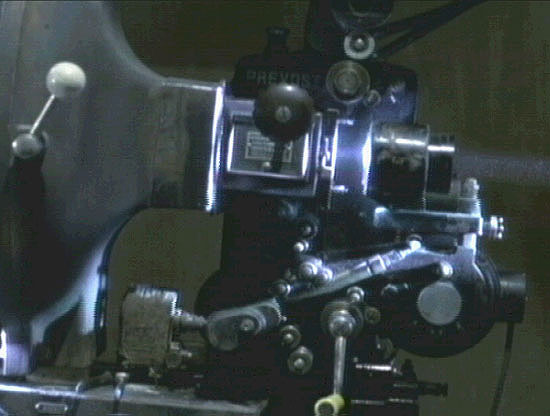
Okay, folks, here's a capture of the first projector. The scene is "La Cabina" and is at 0:34:46.
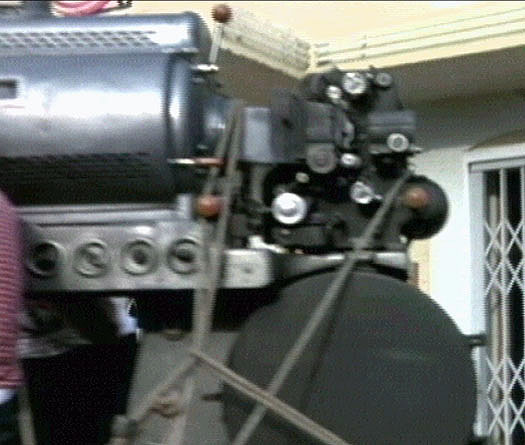
As for the second projector, the only good closeup I could find quickly was when they were moving it to the Arena for the summer. The upper magazine was removed, so there was no nameplate. Sorry for the blur, the cart was moving across the screen as the camera was zooming. "La Lettera" at 1:29:12.
Posted by Gordon McLeod (Member # 33) on 04-15-2001, 12:35 PM:
Well the top one defintely says Prevost
The bottom one looks a bit like a V4 but the framer that is above the gate is missing and the site box seems more fedi
Posted by Joe Schmidt (Member # 822) on 04-15-2001, 03:40 PM:
Many thanks to all for the many informative replies on this thread. Judging from our assorted guesstimates on what make the "early" projector was this has been a "Stump the Experts" as well!Here, lifted from IMDB are some of the dvd details:
Aspect Ratio(s): Widescreen anamorphic - 1.66:1
A new one on me. I didn't know there is such a thing as widescreen anamorphic @1.66! Guess I've been a Wetired Lunatic too long. <g>
Discographic Information:
DVD Encoding: Region 1
Layers: Single
Available Audio Tracks:
Italian (Dolby Digital 2.0 Stereo), Italian
(Dolby Digital 2.0 Mono), English (Dubbed) (Dolby Digital 2.0 Mono)
Available subtitles: English, Spanish, French, Italian
This has been on my list of dvds to acquire but if a full director's cut reissue is pending I'll hold and wait for the dvd of that. I think dvd's are generally quite overpriced considering the cost of mfg. one is less than a vhs tape; but it might be just a matter of being patient and waiting as I expect the coming imploding collapse of the economy [caused by the doubling/tripling + of winter heating bills wiping out all discretionary spending capabilities of millions of families -- i.e. the utility bills gobble up ALL of the money] will bring most dvd prices down to 1/2 or less of what they are now.
In the early days of pre-recorded VHS tapes the prices were astronomical and the quality abysmal. Collectors like myself building huge libraries quickly learned that pristine tapes could be had by recording direct off-satellite to good blank stock, such as Maxell HGX-Gold; and so I have only a tiny handful of commercial VHS tapes.
As an aside, DVD players are selling like hotcakes in Billings due to the carmike cinemas disaster. Like drugs, the word around is "Just Say NO -- Don't Go!!!" Our local costco outlet which offers highly competitive dvd prices with no "shipping" add-ons, is hard pressed to keep recent titles in stock and video rental stores with growing dvd libraries are quite busy. I can't understand how DirecTV thinks a payperview price of $3.99 can possibly compete with 3-day dvd @$2.97; plus you can run off a tape. People do this all the time and swap tapes around; a VHS blank film is under a dollar. PPV on cable is $5 a pop. [!]
But who are we to fathom the machinations of the all-Omnipotent Corporate-HQ mindset.
Posted by Mitchell Cope (Member # 32) on 04-15-2001, 05:07 PM:
Joe,I hate to burst your bubble, but DVD prices may be going up. Hollywood is real happy with the existing pricing on DVD, but Blockbuster Video is not. BV is putting pressure on Hollywood to raise those prices so that people will first rent before buying. BV has the clout (if you haven't noticed) because they're paying rental fees to the studios in exchange for cheaper DVDs and tapes in the stores. All these little deals are running all the Mom and Pop outfits out of business. It wasn't too long ago you could rent a VHS video for a $1 at the supermarket. The convenience of BV, not necessarily a low price, and these little deals are giving BV a nice little monopoly type situation.
Posted by Joe Schmidt (Member # 822) on 04-16-2001, 12:39 AM:
Sure, Mitch, but is the CONSUMER happy, and will it buy at even higher prices?Well, they can all do whatever they want on the dvd prices, this consumer won't be buying. Not a necessity of life, you know! As always, Greed has to work its way thru the system.
Besides pay-per-view, a limited-length window, competition for dvd is in the 35 or so movie channels on satellite which more or less are mostly showing reruns of all the same recent features. There's more variety on the old-movie channels.
The studios eventually discovered with vhs tapes that after the quality was improved and prices drastically reduced, sales went up dramatically. The same will happen with dvd. And those with the technical expertise CAN dub them to vhs very successfully right now.
Ignoring yet another problem, do we really want to? The critics are saying the last year has produced the worst crop of movies in decades. Amen!
Posted by Peter Berrett (Member # 672) on 04-16-2001, 04:49 AM:
Cinema Paradiso is a classic film with an excellent performance by veteran French Actor Phillipe Noiret (by the way see Grosse Fatigue' with Michel Blanc & Phillipe Noiret - another classic film but for different reasons).I was surprised to hear my french teacher tell me recently that all English films are dubbed into French in France. Ditto for Italy where the dubbing is of a very high standard.
Unfortunately I can't say I have ever seen a film where the dubbing into English was very good. In fact the efforts I have seen & heard thus far have put me off dubbing completely. I think the problem is that the outfits that do the dubbing do so on a shoestring budget. (Note however that most foreign films I watch are comedies). To cut costs they have one person do several voices and as you would guess the soundtrack ends of sounding like a whole series of 'funny voices' a la Mel Blanc. If Mel Blanc had been doing the dubbing the soundtrack might have been tolerable however the results are just dreadful. One might almost be tempted to say that Hollywood deliberately destroys the soundtrack to ensure that the film is not commercially successful.
THese days I will not watch a dubbed film or video. I insist on subtitles which is the only way to guarantee that some cut price editing company has not destroyed the film.
Incidentally I would be interested to hear how American audiences view foreign films. Is there much interest these days? I understand that in the 70s interest in foreign films was much higher than at present which is a shame as the French in particular do make many good films. La Cage Aux Folles is still one of my favourite films.
Here's hoping we see a resurgence in interest in good european films but pleeeeeez ... no dubbing ok?
cheers Peter
Posted by Bill Carter (Member # 156) on 04-16-2001, 03:09 PM:
I have seen a few films that were very well dubbed. "Das Boot" comes to mind. But "Cinema Paradiso" has to be one of the worst dubbed versions I've heard. The film is one of my favorites, but the voices used (especially Toto as a small boy) sound like something out of a cartoon.The "director's cut" has been around on VHS, but is a little hard to find. I recall it being a half-hour or so longer than the US version.
Posted by Leo Enticknap (Member # 534) on 04-16-2001, 04:37 PM:
Stefan - are you sure that 6,000ft reels of nitrate were regularly shown in Italy? That sounds like suicide to me. In the UK the 1921 Films Act specified a limit of 1,000ft per reel. By the 1956 act this had become 2,000ft (presumably a small number of nitrate prints were still in circulation at that stage). I guess that running 'double' reels became legal at some point during the intervening 35 years, though (as yet) I haven't been able to find out when.The one cinema I know of in the UK which still regularly projects nitrate (the National Film and Television Archive's preview theatre) has a limit of 1,000ft reels and will split 'doubles' if necessary. The National Film Theatre used to, but I was recently told that they had to remove their fire-resistant spoolboxes in order to fit digital sound readers.
I've seen a 100ft roll of nitrate burn, the thought of 6,000ft going up is terrifying.
Posted by John Pytlak (Member # 331) on 04-16-2001, 08:35 PM:
Just a reminder of Rick Shamel's excellent videos of three different kinds of nitrate fire in the "Videos" section of Film-Tech.I agree, 6000 feet of nitrate in one roll is asking for disaster. 
------------------
John P. Pytlak, Senior Technical Specialist
Worldwide Technical Services, Entertainment Imaging
Eastman Kodak Company
Research Labs, Building 69, Room 7419
Rochester, New York, 14650-1922 USA
Tel: 716-477-5325 Cell: 716-781-4036 Fax: 716-722-7243
E-Mail: john.pytlak@kodak.com
Web site: http://www.kodak.com/go/motion
Posted by Philippe Laude (Member # 79) on 04-18-2001, 04:59 AM:
Antonio (and others),
incidentally I will play Cinema paradiso in my private screening room next week.
I just can't wait. I've only seen it partially on television.
The version I'll play is dubbed in french, which may seem a crime for Italians, but belgian people know very well Philippe Noiret's voice and would barely hear him speaking Italian with an alien voice!------------------
Posted by Joe Schmidt (Member # 822) on 04-18-2001, 05:55 AM:
Well, in Cinema Paradiso there was a nitrate fire, it burned down the theatre and the poor projectionist lost his eyesight trying to fight the fire -- which should NEVER be attempted. (Let it burn, drop the fire shutters and GET OUT.) As much as I love this film this is always very upsetting to me and I wish the story had been told differently.Something I used to do occasionally to teach people of the dangers of nitrate was unwind a length from an old junk reel and stretch it out across a parking lot area with a rock on each end, then light one end: whooooooosh!
Very Frightening. John P -- have you ever done a demo like this?
As to nitrate projection, it may be reasonably safe IF in good condition, IF the projector has a water-cooled gate, IF there is a heat shield between the lamphouse & the proj, and IF the light source is somewhat low intensity like under 1KW. A lot of IF's but a little preview screening room would meet them.
I worry about the UCLA archive's print of Phantom/Opera of 1943, it really shouldn't be projected any more but used for a television master / new internegative / and otherwise held in retirement. Irreplaceable.
Posted by Randy Stankey (Member # 64) on 04-19-2001, 02:26 AM:
Yeah, when I first saw the movie and it came to the part where the proj. caught on fire and Alfredo went to open the upper magazine I just went, "NNNOOOOoooo!!!"I say opening the door is what spread the fire. The way I understand thing is that if he left the door shut the fire would burn itself out in a while. Sure the projector would be trashed but the fire wouldn't have spread, or at least it might have been kept down to a "containable" level.
Anyway, if it hadn't been for that there wouldn't be a whole 2nd half of the movie, would there?
PS: I used to keep an 8 X 10 picture of Alfredo on the wall in "my" booth. In Pennsylvania we had to keep a copy of our projectionist license posted in a "conspicuous place". I used to keep the license copy(s) inside the frame with the picture. Nobody ever understood the reference, although I tried to explain it to people several times.
Posted by John Pytlak (Member # 331) on 04-19-2001, 11:15 AM:
Randy --- a nitrate fire will burn even with the magazine door closed.Remember what Joe Schmidt said: "...trying to fight the fire -- which should NEVER be attempted. (Let it burn, drop the fire shutters and GET OUT)." Losing a roll of film or damaging the equipment isn't worth risking your life or that of the audience. 
------------------
John P. Pytlak, Senior Technical Specialist
Worldwide Technical Services, Entertainment Imaging
Eastman Kodak Company
Research Labs, Building 69, Room 7419
Rochester, New York, 14650-1922 USA
Tel: 716-477-5325 Cell: 716-781-4036 Fax: 716-722-7243
E-Mail: john.pytlak@kodak.com
Web site: http://www.kodak.com/go/motion
Posted by Bernard Tonks (Member # 809) on 04-19-2001, 03:54 PM:
Cinema Paradiso - The Special Edition had a theatrical release in England I think 5 years ago. The same version on video followed in a limited edition box set with a book which I have. The previously unseen full length version is in widescreen ratio with English subtitles. The additional footage is 50 minutes making the total running time 167 minutes.
To quote from the video case "Cinema Paradiso - The Special Edition" continues where the original ended and audiences will finally discover what became of Toto's first true love.
Well worth seeing if you can obtain a copy, or better still in a cinema.
My first posting. I find Film-Tech extremely interesting and informative. I run a small country cinema, perhaps I should do a posting with the equipment details which is very old and most reliable. Almost 50 years in the trade and still willing to learn and listen to others.
Bernard.
Posted by Leo Enticknap (Member # 534) on 04-19-2001, 07:16 PM:
To back up what John, Joe and others have said: once ignited, you cannot extinguish a nitrate fire. You can contain and manage it, which are what spoolboxes are designed for.That is why all well-designed projector spoolboxes are not airtight, but have an 'lip' directed away from the operating side of the projector so that the flames don't hit the projectionist in the face. As an added precaution, restricting the amount of film per reel to 1,000ft will limit the amount of toxic fumes generated if a reel goes up. With adequate air extraction capacity in the projection box, enough of the fumes will be sucked out to prevent the projectionist from being overcome before he or she can escape. But all this depends on the projectionist not attempting to fight the fire and following the rule that John and Joe have both stated: get out, then let it burn out.
As for the wisdom of attempting to project nitrate at all, I wrote a paper about this when I was a film archiving student. Having spoken to people at all the cinemas in Europe I could find that still do it (a grand total of four, two of which are archive preview theatres), the rules which everyone follows are:
1. Don't do it if the print shows early signs of decomposition (i.e. if it is sticky).
2. Don't do it if the print is significantly shrunk. The NFT used a 'shrinkometer' gauge to measure linear and width shrinkage, and up to 5% on either was considered acceptable.
3. Don't do it if there is any significant perforation damage.
4. Only project 1,000ft reels at a time. If necessary split up 'double' reels and add leaders, tails and cue marks as needed.
5. Never, ever attempt to project a preservation element. The only nitrate prints suitable for projection are 'surplus' nitrate release prints acquired by an archive, i.e. better quality elements and of a closer generation to the camera negative are already preserved.
If all these criteria are satisfied and in a box with the proper safeguards (spoolboxes, adequate air extraction, fire shutters on the ports, at least two separate exits from the projection box leading to different parts of the building and a separate storage area for the nitrate reels with a fire resistant door seperating it from the main projection box), then you can do it.
And it's well worth the effort - nitrate prints have a sharpness and density which I've never seen in any acetate or poly print. I don't care about the fact that, theoretically, there's no technical reason why they should look any better - they just do! And my generation is almost certainly the last that will ever see a nitrate print projected - sad in a way.
Posted by Randy Stankey (Member # 64) on 04-20-2001, 12:49 AM:
I'm not saying that there was anyting that Alfredo could have done once the thing caught fire. I meant that once the magazine was opened the fire was allowed to spread. Had the magazine been left shut, maybe the fire would have gone out by itself once all the film was consumed.There was a part in the film when he was teaching Toto and he said that if the film caught fire you could take a pair of scissors and cut the film. (Ostensibly to keep the fire from going up into the magazine.) Although that makes sense, logically speaking, it just seems pretty darned unrealistic to me.
If it were me in a situation like that, you could bet dollars to donuts that I'd be out the door in a heartbeat!
Posted by Paul G. Thompson (Member # 655) on 04-20-2001, 01:12 AM:
That's why they had steel fire trap rollers between the magazine and projector head, as well as between the soundhead and magazine. If the nitrate film caught fire in the projector and sound head, the rollers would quench it before it spread to the magazines.
Hydrogen Peroxide was used to clean up the mess in the projectors and soundheads. But, if it spread to the magazines, you tripped the porthole shutters on your way out of the booth.
They had a common trip - usually by the exit door. You didn't have too much time to get out. The fumes were very toxic.
I think some booths had heat fuses to drop the steel shutters in the portholes in case the projectionist could not get to the main ripcord.
Posted by Gordon McLeod (Member # 33) on 04-20-2001, 08:29 AM:
Starving the fire of Oxygen by smothering it in an airtight spoolbox actually increased the exploson hazard and also created the enviroment to produce a version of Phosgen gas (mustard gas). In a article in the 40's smpe jurnal (notice the T is missing) was expounding the merrits of the european magazines that had screened air vent in them to allow a vent and air intake in the event of a fire and some very interesting test photos. THe issue it was in I have long ago forgotten.
In the design of the GK21 it contained a built in pryne extinguisher in the head to extinguish the fire automatically
Phillips and several others had a guncotten fuse and trip switch that had a cutter in the magazine trap to cut and seal the entrance to the magazine in the event of a film pile up or gate flash
Posted by John Walsh (Member # 168) on 04-20-2001, 10:22 AM:
Of course, we're talking about a film, which means reality is put on hold, at least a little.It could be reasoned that Alfredo was just a small-town projectionist, but without the benefit of knowedge that a big-city operator would have. He didn't get to hear or see the things that would happen to big-city operators, who would tell their fellows at the local watering-hole. He didn't have Film-Tech!
Posted by Leo Enticknap (Member # 534) on 04-20-2001, 01:15 PM:
I wish that today's projector manufacturers would ressurrect the cutter in the magazine trap - it would be ideal for cutting polyester film in the event of a platter wrap to prevent it from pulling rollers out of alignment or moving the photocell.
Posted by Paul G. Thompson (Member # 655) on 04-20-2001, 02:47 PM:
Leo, there are film tension sensing devices available that mount on the platter tree which will shut down the system in event of a pay-put head wrap.
Posted by Paul G. Thompson (Member # 655) on 04-20-2001, 02:53 PM:
I am under the impression that Carbon Tetrochloride was a good agent to fight and extinguish Nitrate film fires. Can anybody address that issue?
Posted by Gordon McLeod (Member # 33) on 04-20-2001, 04:41 PM:
Yes carbon tet did put out nitrate wery well but caused genetic changes in future generations
Posted by Leo Enticknap (Member # 534) on 04-20-2001, 04:45 PM:
Paul - in my experience platter 'wrap detectors' often fail to operate until the wrap has put the film under quite a lot of pressure between the feed unit and the projector. When used in conjunction with a wrap detector, a cutter (operated either by the wrap detector itself or a motion detect sensor) would surely increase the chances of relieving this pressure before serious damage was inflicted. After all, this was the built-in safeguard with acetate - when put under any significant pressure, it just broke.
Posted by Aaron Sisemore (Member # 145) on 04-20-2001, 06:38 PM:
I agree, by the time most tension failsafes engage, it's already too late (the time the motor takes to wind down to a stop will damage the film anyway in most cases), especially with Christie and NeuTronic platters, which don't have the rollers around the perimeter of the brain...Aaron
Posted by Paul G. Thompson (Member # 655) on 04-20-2001, 09:29 PM:
OK, thanks for the info. The lack of parameter rollers around the pay-out head = a disaster looking for a place to happen! I forgot about those sytle platters. You would think by now a retro-fit kit for those machines would be available.
Personally, I really never really believed in those wrap detectors. Most of the wraps occur because of improper threading, the tail came loose and snagged the pay-out, or a sticky film or a shitty splice doubled up and sucked itself through the payout head as well as a button or switch being in the wrong position. And, true - some designs leave a lot to be desired.
Of course, equipment failures do happen, but I don't think (percentage wise) it is the main cause like everyone says it is. As with any piece of equipment, it will fail if abused, neglected, or operated outside the machine's specifications.
Yes, Gordon - Carbon Tet is some very nasty stuff! Supposedly, it is illegal in the US, but I don't know about other countrys.
Posted by Randy Stankey (Member # 64) on 04-21-2001, 01:03 AM:
When I volunteered at the local Warner Theatre, that booth (originally built in 1932) had all the shutters, etc. Each shutter had its own hold-up wire with its own fusible link. Also there was a "main" fusible link that would drop all of them at the same time. Yep! The handle was right by the door. (Actually, there were two handles. One by each door.)The exhaust fans for the carbons were pretty huge, even by "old-time" standards. They were in a seperate room. (Per fire code) One for each projector. They were giant squirrel cage blowers, each about 3 feet in diameter. Once you got them both going they could cause a draft strong enough to almost suck the door shut. There were "bypass" dampers you could use to regulate the flow of air out of the lamphouse. Judging from what you all are saying I bet the overkill was done on purpose as an attempt to suck out any fumes in case of a tragedy.
Posted by Steve Guttag (Member # 268) on 04-21-2001, 03:35 PM:
Kelmar did (and probably still will) make the "CHOPPER" and later the "CHOPPER II"It did as you say...as the tension increases, it would draw a blade across the film (like scissors) to cut the film as it entered the projector.
Better designed "wrap detectors" use a "yo-yo" system like on the take up so the projector can run down without increasing the tension. Neumade, Big-Sky and SPECO have this type of sensor (and probably others). Another big thing to remember is to have the wrap detector shut the automation down...some are designed to merely turn off the take up platter so when the take up roller drops (or runs out) the normal failsafes will take over....the problem is, in a high tension situation, the take up roller won't drop.
Steve
------------------
"Old projectionists never die, they just changeover!"
Posted by Leo Enticknap (Member # 534) on 04-21-2001, 03:46 PM:
All the platter wraps I have had at this cinema have been caused by a build-up of static causing layers of film to stick to each other, and so two or more layers of film get sucked into the feeder simultaneously, then... crunch! Our platters (Cinemeccanica CNR-35s) do have rollers around the feed unit perimeter and these will fend off mild static attacks, but they can't cope when a print gets severely charged up. As for the wrap detectors, their funamental design flaw is in the magnet which holds the roller on the bottom of its shaft. If you make it strong enough to only release the roller in the event of a serious wrap, then by the time sufficient pressure has built up to lift the roller off the magnet and hit the microswitch which tells everything to stop, film will already have mangled in the feed unit, and usually in the projector as well.On the other hand, if you decrease the strength of the magnet you'll get shows stopping unnecessarily.
This is why I feel that a cutter might be a better solution. The kind of thing I have in mind is an assembly which sits on top of the platter tree consisting of a motion detect roller and a spring-loaded cutter blade held back from the film path by an electromagnet. If the motion detect roller says no motion, then power to the magnet is switched off (as well as power to the platter and projector) and the film is cut as near as possible to the feed unit. That way you'd relieve the pressure caused by the projector mechanism pulling at jammed film straight away.
The downside would be a cut in the film, but if it's a choice between that and several mangled feet (which would need two cuts to remove from the print anyway) then I'd suggest that one cut is by far a lesser evil.
Posted by Ben Wales (Member # 92) on 04-21-2001, 05:54 PM:
Leo - Do you have fitted to your CNR 35 Platter feed module the two wire guards that screw on the feed arm?.the older ones where never fitted with these, several years ago we had the same problem with "Wraps" on CNR Platters, but improved greatly with these guards.
Posted by Leo Enticknap (Member # 534) on 04-21-2001, 06:06 PM:
We've got them on one feed unit. They help a little, but they certainly don't stop the problem.
Posted by John Pytlak (Member # 331) on 04-23-2001, 06:30 AM:
Carbon tetrachloride was once used as a fire fighting agent. I believe it acted by cooling the fire (it was a fast evaporating non-flammable solvent) and by smothering the fire by the fumes it generated when it contacted the flames. However, the fumes were very LETHAL, and included hydrogen chloride, chlorine, and phosgene (used in gas warfare):
http://hazard.com/msds2/mf/cards/file/0024.html "CHEMICAL DANGERS: On contact with hot surfaces or flames this substance decomposes
forming toxic and irritating fumes (hydrogen chloride, ICSC # 0163;
chlorine, ICSC # 0126; phosgene, ICSC # 0007). Reacts violently with some
metals such as aluminium, barium, magnesium, potassium, sodium, with
fluorine and other substances, causing fire and explosion hazard. Attacks
copper, lead and zinc."
AFAIC, if used to put out a fire, it was more likely to kill you than the fire.
------------------
John P. Pytlak, Senior Technical Specialist
Worldwide Technical Services, Entertainment Imaging
Eastman Kodak Company
Research Labs, Building 69, Room 7419
Rochester, New York, 14650-1922 USA
Tel: 716-477-5325 Cell: 716-781-4036 Fax: 716-722-7243
E-Mail: john.pytlak@kodak.com
Web site: http://www.kodak.com/go/motion
Posted by Leo Enticknap (Member # 534) on 04-23-2001, 12:57 PM:
Then I can't see how it would extinguish a nitrate fire (given that it can't be smothered), unless it cooled the source fuel (i.e. the nitrate film stock) to below the temperature at which it can ignite. I guess that the amount of chemical needed to achieve this would depend on the size and intensity of the blaze.In any case, the stuff sounds as dangerous as nitrate fumes, if not more so.
Posted by Randy Stankey (Member # 64) on 06-04-2001, 07:49 PM:
I just watched C.P again a few days ago. This time I saw in on DVD so it was easier to freeze frame the movie.I said earler that Alfredo opened the magazine and tried to fight the fire.
Well, on closer examination, it turns out that he literally THREW Toto out of the booth and then went over to the projector (I assume to shut it down or something) At this point he gets his legs tangled up in a pile of burning film. As he's trying to free himself from that mess, the magazine bursts open (from the pressure, I guess) and the flames spew out and hit him in the face.
Next, Toto comes back up the spiral staircase and drags Alfredo to safety by the pantlegs.
Just thought I should clear up that little mistake I made earlier.
Posted by Dave Bird (Member # 490) on 06-04-2001, 11:19 PM:
I read somewhere about the old projection booths, they referred to a "dead man's door", but didn't really explain it. I'm thinking of some kind of fire door that either the projectionist had to close on the way out or had only so long before it closed so as to protect the audience. Was there such a thing, or is this urban legend?
Posted by Leo Enticknap (Member # 534) on 06-05-2001, 02:17 AM:
English law specified that every projection box had to have two separate exits, one of which had to lead directly to the outside of the building. Under the 1956 Cinematograph Act that is still a condition for any theatre being granted a licence to use nitrate on its premises (of which only 2 that I know of remain).So if a "dead man's door" was one that closed automatically, then there wouldn't have been any point in having them on doors which lead directly out of the building. If anything you'd want that to stay open in order to let the fumes out. Because burning nitrate produces its own oxygen, there's no point in attempting to control the fire by restricting airflow, so you might as well let the fumes out.
But I can see that a fire-resistant, automatically closing door would have been a good idea for any interior (partition) doors leading out of the projection box, since it would prevent the fumes from affecting other parts of the building. The projectionists(s) would escape through the exterior and down a fire escape staircase.
Posted by Steve Guttag (Member # 268) on 06-05-2001, 10:36 PM:
My personal favorite theatre in DC was the K-B MacArthur...The booth doors were automatic in case of fire...they had the same rigging as the shutters over the ports...if the link was melted a very heavy weight would pull the inside doors shut and with a rather heavy bar would hold them shut. These doors were rather heavy and clearly designed to take a fire. The doors that actually opened into the hallway were standard metal doors so in effect you had an air-lock between the booth and the exiting hallway. Since the theatre was built into a hillside, the booth had an "at grade" exit even though it was on the second floor.Steve
------------------
"Old projectionists never die, they just changeover!"
Posted by System Notices (Member # 2357) on 05-26-2004, 07:21 PM:
It has been 1085 days since the last post.
Posted by David M. Dorn (Member # 2298) on 05-26-2004, 07:21 PM:
I just my copy of the new release. I did freeze frames on the pre fire projector scenes, 'PREVOST" can clearly be seen on the projector head. In the after fire scenes, the head looks similar but I could not see a name. What intrigued me about the post fire scenes (new version) was the sound system (?) box on the wall. In one scene the projector is running and you can see the lights flashing. It is the same color as the projector and lamphouse. Did Prevost make sound equipment?
The new version from Miramaxclassics contains BOTH the original international version and the new director's cut. Interstingly, I found out that the original Italian release has a length between the international version and the director's cut.
Does anyone know if the original Italian release is available on DVD. It should have a running time of 155 minutes vs. 123 for the International release and 170 for the Director's cut.
David
Posted by Mark Gulbrandsen (Member # 72) on 05-26-2004, 08:08 PM:
"If you put one Prevost's tech and one cinemeccanica''s tech into the same room, they will kill each other within few minutes..."
_________________________________________________________________
Bwahahahhahah... That is absolutey hilarious! Somehow I missed that line. That would make a great T-Shirt for sure. Of course the Cinemecanicca guy suffers from Parkinsons and can't tell just how bad the lateral shake is in his projector and the Prevost tech suffers a learning disability and a low IQ.
Over here in the U.S. if you put a Simplex tech and Century tech in the same room they will get each others parts mixed up and end up with the others parts in the opposite projector
!
Mark
Posted by Paul Trimboli (Member # 1509) on 05-29-2004, 07:54 AM:
I watched Cinema Paradiso, and that second machine is a Cinemecannica, it said it on it on one of the scenes, will have to find which scene it was and post it.
Posted by Giorgio Volpi (Member # 1182) on 05-29-2004, 10:15 AM:
Hi,
this is a Prevost's short history, from their web page:
Prevost cinema equipments are well known by everybody who loves cinema: not only experts of the field, but also movie lovers. The name Prevost evokes the fascination of the movie technique, of the "montage" (cutting and splicing) and of the projection.
Prevost is the projector that symbolically went up in flames in Giuseppe Tornatore's film "Nuovo Cinema Paradiso" and Prevost is the film editing table in Wim Wender's "Lisbon story", where the protagonist saw again his friend vanished in the nothingness.
At the end of this millennium, the weekly magazine "Panorama" included the Prevost projector among the symbol-articles of the XX century. The Prevost family has French origins and is inseparable from the movie world. Pierre Prevost, at the end of the seventeenth century at Paris, is "Panorama teacher" (an artist in the middle between the landscape painter and the director-performer of nowadays).
Pierre is also guide and motivator of the great Daguerre, who in 1822 created the diorama (a kind of theater with special effects, without actors, elaborated and sophisticated pre-cinema entertainment) and later the Daguerrotype (first example of photography).
Attilio Prevost senior (1890-1954), who since he was a young man showed a great passion for filming, founded the Prevost Company at the beginning of the XIX century.
In 1910 Attilio created the first model of Prevost Cinecamera and joined the Italian expedition to Libya, where he filmed with the new equipment the first documentary. In the 1915-1918 war Attilio Prevost was sent to the front as official filmmaker and filmed historically exceptional images of battlefields, which are now conserved in the Italian state archives.
In the following years Attilio and his nephew Attilio junior dedicated themselves exclusively to the manufacture of cinema film equipments and to their exportation all over the world.
The name Prevost became very soon a myth, a basic reference point in the cinema history. Orson Welles, every time he began a new film, ordered a Prevost customer made film editing table; Herbert von Karajan wanted a Prevost three-way Cine-camera for the filming of his extraordinary concerts; Federico Fellini and Dino de Laurentiis have been among the most loyal customers and appreciators of the company.
Today Prevost is going on developing continuous updating of their professional "classic" projectors, supplies special equipments for the last generation of multiplexes cinemas, and produces the very new ultra-light portable projectors to bring the magic of cinema even in the most inaccessible and adventurous places.
Definitely the CP projector is a Prevost ...
Giorgio.
Posted by System Notices (Member # 2357) on 08-11-2008, 02:21 PM:
It has been 1535 days since the last post.
Posted by Demetris Thoupis (Member # 833) on 08-11-2008, 02:21 PM:
Well after checking the pictures again I apologise for stating the projector is a V8.
It can only be one of these models
V5R or V6.
The V6 has a soundhead design like a V10 which is completely removable from the projector. I am leaning more toward the V5R model but it could be a V6 as well.
Posted by Louis Bornwasser (Member # 3063) on 08-11-2008, 07:43 PM:
Check with Cinemeccanica. They still have these machines in their museum. They are very proud of their particpation in the film which is historically accurate as far as the machines go. (Saw them about 14 years ago with Tom Brenner & Victor Nicelli.) Louis