This is topic Parallax error in changeover setups in forum Film Handlers' Forum at Film-Tech Forum ARCHIVE.
To visit this topic, use this URL:
https://ft-forum.com/ft/cgi-bin/ubb/ultimatebb.cgi?ubb=get_topic;f=1;t=002176
Posted by Josh Jones (Member # 447) on 04-19-2001, 02:18 AM:
is this a huge concern? I am trying to determine how far apart to put my two machines. An old RCA installation manual says 3 feet from lens to lens. is that right? I know that the longer the throw, the less of an issue this is. but since I dont have a lot of throw or width to screw with, I am currious. Thanks in advance,Josh
hurray! it was 62 degrees here today! Heatwave 
Posted by Randy Stankey (Member # 64) on 04-19-2001, 02:37 AM:
NEC (National Electrical Code) says that there is to be a minimum of 36 inches of free space on all sides of a projector, with the following exceptions:1) Of course the front of the projector doesn't need to be 3 feet from the wall becasuse the only thing there is the lens and you need to keep the distance from the proj. to the port window to a minimum.
2) In a 2 machine set up, the 36 inches counts "concurrently" between the two. ie: You can have them 3 feet apart instead of 6 feet.
They also have to be installed in their own "permanent" enclosure which separates them completely from the audience. There has to be glass in the port window too. (I think there's an exception for the glass if the port is less than 12 inches square, but I'm not sure on that one.)
I don't know if that makes sense to you but that's what the code says. I don't think it necessarily applies to projectors set up in the home, excepting that all the other usual electrical codes need to be met.
A lot of the NEC for projectors seems to be throw-backs to the nitrate days.
If it were me, I'd have the projectors close enough together so I could reach both machines from the middle without having to take more than a step or two... Just enough room to manuver comfortably.
Posted by Paul G. Thompson (Member # 655) on 04-19-2001, 03:08 AM:
Josh, what Randy says is a good guide. At the station theater at NAS Whidbey Island, the distance between the projector lense was about 5 feet or so, maybe a little less. At changeover, if done correctly, the only thing the audience might have noticed was a color temperature difference because the arc target drifted a little while I was waiting for the cue marks. Sometimes, the carbon arc lamps had a spasm that could not be corrected until after the change-over.
Once you position yourself for a change-over in a carbon arc house, you stayed in that position. You did not reach around and scratch your butt, look at your target image, or whatever. You just stayed there until either the itch went away by itself, or the motor cues came by. I had hand operated sound change-overs, and foot operated picture changeovers in that booth. (A complete Brenkert booth.) You just concentrated on the upper right hand corner of the screen hoping the itch would go away.....
(now that should bring back some fond memories of you old carbon arc'ers)
And, if it was a major itch, it might be time for the annual flea-dip, or time to visit your "friendly" neighborhood Proctologist... 
OK - I got carried away....but I think the angle offset of the projectors was 3 degrees maximum each, or maybe 6 degrees. Can someone verify the correct parameters on that? It has been a long time....
It was a 986 seat auditorium, with a 105 foot 4 inch throw.
Posted by John Walsh (Member # 168) on 04-19-2001, 09:01 AM:
I worked in a theater that had a 100 foot throw with the projectors 8 feet apart. The parallax distortion was clearly noticable.
Posted by John Pytlak (Member # 331) on 04-19-2001, 11:03 AM:
The closer together that optical axis are, the better. But do leave enough room to comfortably service the machines, and stay within code. Of course, the ideal is perfectly perpendicular to the screen center. In practice, try to keep the angle to less than a few degrees to minimize keystone distortion.Some have tried using mirrors to keep the beams of two projectors on centerline (e.g.,"Ultra-Vision"), but IMHO, this is overkill, and brings in a whole new set of concerns.
------------------
John P. Pytlak, Senior Technical Specialist
Worldwide Technical Services, Entertainment Imaging
Eastman Kodak Company
Research Labs, Building 69, Room 7419
Rochester, New York, 14650-1922 USA
Tel: 716-477-5325 Cell: 716-781-4036 Fax: 716-722-7243
E-Mail: john.pytlak@kodak.com
Web site: http://www.kodak.com/go/motion
Posted by Joe Schmidt (Member # 822) on 04-19-2001, 11:52 AM:
Well, we have threads going now which discuss the ultimate or ideal situation.Having discovered the Goldberg platter reel, in the spirit of trying to use the best of current technology, I wonder if a 3-projector booth or a 1-2-X where a projector is in the center position might not be preferable as from here there is -0- error?
In a film-collector's private screening room, for all ordinary prints, I think a platter on the center projector would work quite well. All prints not in use on the platter would be stored horizontally in some sort of suitable enclosures.
Posted by Scott Norwood (Member # 30) on 04-19-2001, 01:35 PM:
This is an interesting thread. The "old" SMPTE projectionist book has booth plans that suggest something like 6 feet between lens axes, although I don't remember exactly and don't have the book handy. They also suggest wide portholes, although most booths that I've seen have standard 12" square ports. Maybe someone can look this up and post it. Some states may have codes for this, too...I vaguely remember that the Massachusetts projectionist license exam had a question about this on it.
I would think that in most cases, the side-to-side keystone issue would be far less than the issues related to extreme tilt angles, since precious few theatres have a completely straight-on path from lens to screen. There's also the issue of xenon setups where theatres don't replace the lamps at the same time, so the picture becomes more or less blue every 20 minutes, which is not a pretty sight, even with long throws. On the other hand, vertical keystone is less objectionable to most people (me included), probably because most of us are just used to seeing it and can mentally correct for it.
I have noticed definite keystone issues in theatres that put the 35mm machines equally off center in opposite directions and then put a 16mm projector to the side of one of the 35mm machines. The 16mm image tends to look obviously keystoned. Oddly, I've also seen some theatres that put the 16mm machine _between_ the 35mm projectors; it seems like this wouldn't be a very desirable booth configuration, though.
Posted by Paul Mayer (Member # 355) on 04-19-2001, 01:38 PM:
One could also mount the lenses in PC (Parallax or Perspective Correction) collars and use them to shift the image where needed (within the limits of those collars obviously). That way the machines can be set up perfectly square to the screen (film plane in parallel to the screen plane). This technique won't work if there is a large keystone angle to overcome, but even in such cases the amount of keystone will be reduced. Of course this technique requires the use of good lenses with excellent optical performance at the edges of their fields, since the lens longitudinal axis will be shifted off of the axis running through the center of the aperture (though in parallel with it). Snaplites need not apply for this job.
Posted by Steve Guttag (Member # 268) on 04-19-2001, 10:48 PM:
Paul is on the money on this one. Though I don't think parallax is the proper term for this one. Generally parallax referrs to someone mis-judging a 3 dimentional object due to the spacing between the various levels (I'm sure someone will produce the dictionary definition). The most common situation for techies is when viewing an analog meter (like the ammeter on a lamphouse)..depending on the angle of sight, one might misread the meter. Better meters use a mirrored scale so parallax distortion is eliminated.What I think you mean is Keystone distortion. Perspective change adapters or the eccentrics used in some projectors (eg Century SA) can be used to reduce or eliminate this sort of distortion.
Steve
------------------
"Old projectionists never die, they just changeover!"
Posted by Phil Hill (Member # 371) on 04-19-2001, 11:24 PM:
Although some keystone can be corrected by offsetting the lens in either the horizontial or vertical, doing it will introduce linearity distortion in the image. The greater the offset, the greater the linearity distortion. A real problem in dual projector 3D presentations.A correctly designed theatre would minimize the off-center projection angle (down and horizontal angles), the lens offset (a large pupil lens to minimize vignetting), and the screen tilt.
>>> Phil
Posted by Phil Hill (Member # 371) on 04-19-2001, 11:30 PM:
Oh, and Josh, Hopefully the 62 degrees you mention was the related to the weather and NOT the projection angle.... J/K >>> Phil
Posted by Randy Stankey (Member # 64) on 04-21-2001, 01:14 AM:
Here's one of those silly things I always think about late at night...If you have a two machine setup, why couldn't there be such a thing as a "backwards" projector? The right hand machine could be made up so that it threaded up from (what is normally) the off-operator side. That way you can operate both projectors from the middle without having to run around to the other side.
Okay, you'd have the soundtrack on the inboard side of the projector and the reels and sprockets,etc would have to go backwards. Furthermore it would be a real bitch to remember to do one side backwards from the other.
It's just one of those things it's fun to noodle around with in your head. 
Posted by Paul G. Thompson (Member # 655) on 04-21-2001, 01:55 AM:
This might sound a little silly and wild, but there was a theater in Oakland, California that had the projection booth underneath the stage. There was basically a hole in the floor, and two rather large mirrors at about 45 degrees each (take or leave a few degrees) were used to get the picture out of the basement and on to the screen. The booth had Cinemachannica (sp) V-4 machines. I was surprised how nice the picture actually was....Seems to me that the very short-throw large-screen houses with the booth up in God's country could use this technique to fool the system so the screen has a more of a head-on shot. It might be worth it just to reduce the obnoxious keystoning. I am sure the mirrors would be a bitch to clean, but if it works without too many problems, maybe it could be an answer, especially if the mirrors are made from optical glass.
Another wild thought - maybe a set of mirrors for each projector in a 2 projector operation might be practical in reducing side keystoning?
A bigger xenon bulb might be needed to allow for losses, but what the heck? If it works, it works!
Has anyone actually tried this? What were the results? Or, am I just dreaming? I'll almost bet some engineer who specialized in optics could throw in Finnigan's Finagling Factor and make it practical.
Posted by Phil Hill (Member # 371) on 04-21-2001, 03:20 AM:
Randy:
Actually my 3D systems (35mm & 5/70mm & 8/70mm) use a "normal" right-hand projector coupled (mechanically or electronically) to a left-hand (mirror image) projector to form one machine with 2 independent (7kW or 15kW) lamphouses. My 15/70 designs use a moveable projector scheme that provides about a 60 inch inter-occular.The big plus is that the inter-occular distance in only about 30 inches compared to the normal 60-72 inches. The result is a fantastic 3D image with minimal horizontal keystone distortion especially in short-throw theatres.
>>> Phil
Posted by John Walsh (Member # 168) on 04-21-2001, 09:16 AM:
Randy;THere was a Norelco 16mm projector that threaded on the left side. But that's the only one I ever saw. Not a bad idea, though; car manufacturers design cars so the steering wheel can be placed on either side. Why not projectors?
Posted by Scott Norwood (Member # 30) on 04-21-2001, 09:37 AM:
Hortson and Philips 16mm projectors also have left-hand-thread designs. I don't think I've ever heard of a 35mm projector that was designed this way, though.
Posted by Jon Bartow (Member # 241) on 04-21-2001, 10:12 AM:
Randy, If you're going to have mirror image projectors, why not have them back to back (i.e. film on the outside) so that the lens-to-lens distance is minimal? Kind of like what Phil is doing except not 3D.
Jon
Posted by Gordon McLeod (Member # 33) on 04-21-2001, 10:54 AM:
One of the Bauer machines in the B serries and the U2 were available for left hand operation
Posted by John Walsh (Member # 168) on 04-21-2001, 12:08 PM:
Oh, I forgot: I was on a cruise ship with a movie theater... it had a pair of Norelco/Phillps machines (I reconized the style, but I don't know the model number.) They ran regular 35mm on the right side and 16mm on the left.
Posted by Jeffry L. Johnson (Member # 453) on 04-21-2001, 02:25 PM:
_Kings of the Road_, the Wim Wenders film mentioned in another thread, shows a booth with one "normal" and one "backwards" projector.
Posted by Florian Pausch (Member # 708) on 04-22-2001, 05:59 PM:
Left-handed projectors were more or less common in Europe.
Following (german and austrian) builders made such pieces: (from: Herbert Tümmel: Deutsche Laufbildprojektoren, Berlin 1986)
AEG: Euro M, 1936-1939; Euro G, 1938-1944.
BAUER: M 5, 1925-1935; B 5, 1938-1953; B 11, 1957-1968.
ERKO: Erko II, 1927-1935.
ERNEMANN: Imperator/E I, 1914-1933.
FRIEDL-CHALOUPKA: FC I, 1936-1970.
FRIESEKE & HÖPFNER: FH 66, 1949-1954; FH 77, 1953-1961; FH 99, 1954-1961.
NITZSCHE: Saxonia V, 1927-1933.
ZEISS-IKON: Ernemann II, 1929-1935; Ernon IV, 1935-1940; Ernemann IV, 1935-1944; Ernemann VII B, 1937-1944.Working with "left" projectors is really funny, because everything is in the reach of your arms - no running around the apparatus for the c/o. Usually the amplifiers were situated between the engines on the front wall, the rewind bench in your back.
The running gag of these booths is (was) to explain some greenhorn, that the left projector stands on the right side, the right one on the left.
------------------
Florian Pausch
projectionist, cinema technician, collector
Filmarchiv Austria, Vienna
Posted by Randy Stankey (Member # 64) on 04-22-2001, 10:24 PM:
Gee. I guess you can't think of anything, nowadays, that hasn't bee tried at least once or twice, can you?Yeah! I bet trying to explain the "right" projector and the "left" projector to a newbie could end up looking like an Abbott and Costello movie!
Abbott: "The RIGHT projector is on the LEFT."
Costello: "Right!"
Abbott: "NO! LEFT!"
... etc... etc...
Posted by Dick Vaughan (Member # 540) on 04-23-2001, 02:41 AM:
In my ever useful 1943 edition of "The Complete Projectionist" by R.Howard Cricks there is a picture of a Philips projector with two mechanisms mounted one above the other keeping both on the centreline.The spool boxes are mounted in line behind the mechs. Here is a scan of that picture.
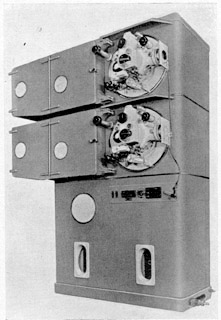
Also somewhere deep in Canyons of My Mind I recall seeing a projector with two 35mm mechanisms back to back .mmm!
Posted by John Pytlak (Member # 331) on 04-23-2001, 06:50 AM:
Page 8 of the old (1969 edition) SMPTE Motion-Picture Projection and Theatre Presentation Manual shows the "Optiverter" mirror system used in the "Ultra-Vision" system to minimize geometric distortion when using two projectors.------------------
John P. Pytlak, Senior Technical Specialist
Worldwide Technical Services, Entertainment Imaging
Eastman Kodak Company
Research Labs, Building 69, Room 7419
Rochester, New York, 14650-1922 USA
Tel: 716-477-5325 Cell: 716-781-4036 Fax: 716-722-7243
E-Mail: john.pytlak@kodak.com
Web site: http://www.kodak.com/go/motion
Posted by Larry Shaw (Member # 388) on 04-23-2001, 05:09 PM:
The Philips/Kinoton 16/35 machines were FP-26 (earlier, FP-20 + FP-16) and FP-38 (later, FP30 + FP-18). Probably a few 36's and 28's snuck through too.16 side was on the back door which had a cute little mechanism to hold the door open at the correct angle to correct keystone.
They were available with either one LH and a flipable mirror rig, or two LH's. I don't think hardly any were sold in NA with the single lamp.
The current 35/16, FP-38E, is electronic with dual gauge sprockets. No more seamless changeovers from 16 to 35.
Posted by Florian Pausch (Member # 708) on 04-24-2001, 06:39 PM:
Dear Dick,
Nitzsche of Leipzig made a "double projector", named "Saxonia ZSV" from 1927 onwards, which had a right and a left mechanism mounted back to back on one base, and only one lamphouse.
Kunert of Wilhelmshaven made a similar model, "Gigant", in 1947.
Hahn-Goerz produced a "twin projector", two right mechanisms on the opposit ends of a special base, which could be turned around the single lamphouse.
Erko, Berlin, made a twin apparatus, "Erko II", similar to those of Nitzsche and Kunert, in 1927.
Since it seems, that there was only one lamp mechanism in all types, which slided between head 1 and 2, operators had to be "kings of carbons" to play films longer than three reels.