 I'm glad Mark filled in for me.
------------------
Greg Mueller
Amateur Astronomer, Machinist, Filmnut

------------------
Mark DeLettera
Eastman Kodak Co.
Worldwide Technical Svs.
Rochester, NY
mark.delettera@kodak.com
716-588-4189
quote:
What is the proper way? Some sort of roller guides on the way over the edge?
Dave, I'm far from an expert and I'm sure you'll get many proper responses about how it's supposed to be done, but:
The MUT I'm familiar with has a post/shaft on one corner of the table with several rollers on it. One of the rollers should be aligned with the surface of the platter you're loading so that the film just barely touches (or doesn't touch at all) the surface of the platter at the outer edge. The film has a twist in it as it comes off the MUT roller toward the center of the platter so that it doesn't touch the edge of the platter. As it straightens out toward the center of the platter it will rest on the platter surface. Wish I had a picture of this for you..... It's easier to understand with a picture.
Joe
I just returned from the emergency room of the hospital after my heart briefly stopped. They revived me with a xenon lamp ignitor. I'm glad Mark filled in for me.
"Film Done Right" is a matter of GOOD COMMON SENSE! As Mark said, Kodak VISION Color Print film is very durable and hard to scratch, but there are limits!
A well-designed MUT has adjustable guide rollers that can be positioned to guide the film onto the platter without rubbing the image area surface of the film. At the very least, there is usually a separate guide roller for each level of the platter. Ideally, the film should be guided onto the platter so the film EDGE just touches the platter at the point of windup.
------------------
John P. Pytlak, Senior Technical Specialist
Worldwide Technical Services, Entertainment Imaging
Eastman Kodak Company
Research Labs, Building 69, Room 7419
Rochester, New York, 14650-1922 USA
Tel: 716-477-5325 Cell: 716-781-4036 Fax: 716-722-7243
E-Mail: john.pytlak@kodak.com
Web site: http://www.kodak.com/go/motion
Now I have to go the the hospital myself since Dave ripped my heart out by revealing that this travesty in film handling was at a DRIVE-IN! Just kidding Dave I often see very professional film handling in drive-ins but you can sometimes find some not so great handling in outdoor theatres, just as you can in any kind of cinema. In the end it all depends upon how much pride the projectionist has in his or her work and how willing they are to try to learn to be the best at what they do. Of course I'm preaching to the choir on this issue!
With the AW-1 you can only build and off-load from the center platter. The MUT has a horizontal "turn-table" in which the film is pulled from the MUT over to the platter.
My MUT turntable was about 2 inches lower than the center platter, and the film would just scrape along the edge as it wound onto the center ring. I knew that couldn't be right. Once I got the manual, I figured out how to "adjust" the leveling feet on the bottom of the MUT and raised it to it's proper height. It no longer scapes the sides, now it just blows the circuit in the basement.
------------------
Barry Floyd
Floyd Entertainment Group
Nashville, Tennessee
(Drive-In Theatre - Start-Up)
I will take pictures tonight of the many wrong ways to align that and the right way and post them here. What's that saying, "a picture is worth a thousand words"? 
Which side is the emulsion side? I'm assuming that this is the more delicate side.
------------------
John P. Pytlak, Senior Technical Specialist
Worldwide Technical Services, Entertainment Imaging
Eastman Kodak Company
Research Labs, Building 69, Room 7419
Rochester, New York, 14650-1922 USA
Tel: 716-477-5325 Cell: 716-781-4036 Fax: 716-722-7243
E-Mail: john.pytlak@kodak.com
Web site: http://www.kodak.com/go/motion
Tim Sherman
Aut-O-Rama Twin Drive-In
North Ridgeville, Ohio
------------------ http://www.autoramadrivein.com
come on out to the drive-in and spend a night out with the stars"
ME!!
Properly set up MUT with the roller as close as possible to the platter deck.
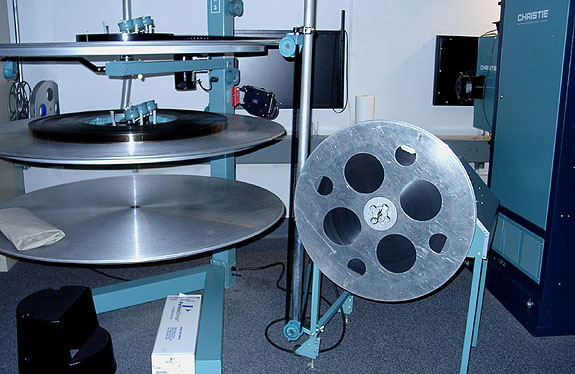
Properly aligned MUT roller. Note the film does not actually touch the platter until it has turned completely vertical.
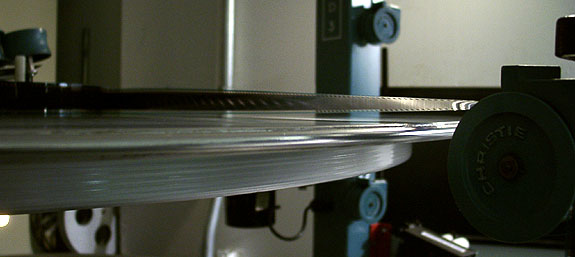
Incorrectly aligned MUT roller. While this alignment will not scratch the film if there is no bounce from the reel, most MUTs do in fact have a certain amount of bounce to them. Thus, this roller is positioned too low against the platter for common safety. In this picture, the inboard edge of the film is touching the platter from the outer edge all the way to the center. This should always be avoided.
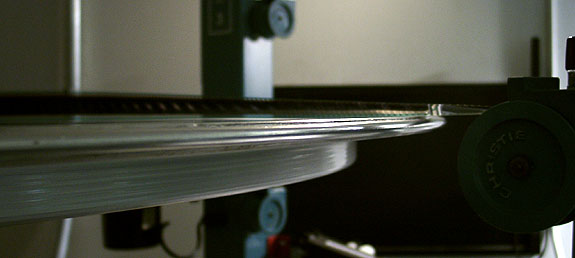
Incorrectly twisted film loading onto platter. (Note: this is the correct twist for breakdown.) This puts the emulsion at great risk of severe scratching if the film bounces during the loading process.
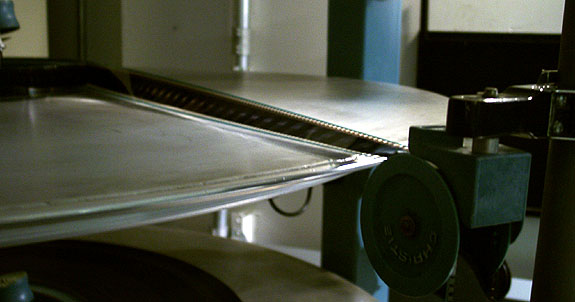
Incorrectly positioned MUT. This MUT is way too far away from the edge of the platter. The more distance there is from the center ring to the roller on the MUT, the more any inherent bounce will be increased and thus as the film pulls tight and then slackens scratches can result. (Pic taken at slackened point of the bounce.) Always position MUT as close as possible to the platter to minimize the bounce and to force the film to twist more quickly from the point where it leaves the roller.
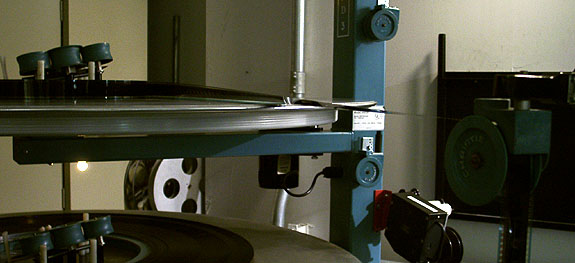
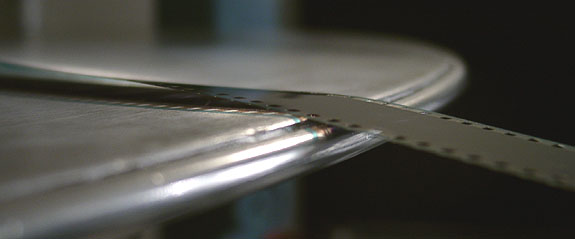
This final pic is a closeup shot for anyone who still does not see a problem with the warnings above on how "platter scratches" can happen. Note: the rollers on the platter tree should be checked for this sort of thing, as many makes of platters come from the factory aligned too low to begin with. Couple that with the bendability of some of the brackets used and those horizontal and diagonal scratches can easily happen. Always make sure the film does not touch the platter's deck until it is standing straight up against the film roll on takeup and never take up the film soundtrack down against the surface of the platter if it can possibly be avoided. Running soundtrack down puts the emulsion at a greater risk of scratching if a roller is not aligned properly and puts the emulsion against the brain (many platters not quite tweeked to their "optimum" performance drag the film around the brain).
Also, the practice of holding backtension on the reel of film while loading to the platter is very much undesirable. If done with too much tension, the film can become cinch-mark scratched and regardless, the film roll will not be wound with the same tightness as simply letting the MUT do it's job without human interference. Erratic payout is very common with a roll of film wound with varying tension, which is also why reels of film should always be spliced together onto the largest reels possible before loading onto the platter.
A very clear illustration of how to avoid "platter scratches". Sorry to say, these diagonal scratches happen all too frequently due to careless operators. Avoiding them and "doing film right" is simple common sense.------------------
John P. Pytlak, Senior Technical Specialist
Worldwide Technical Services, Entertainment Imaging
Eastman Kodak Company
Research Labs, Building 69, Room 7419
Rochester, New York, 14650-1922 USA
Tel: 716-477-5325 Cell: 716-781-4036 Fax: 716-722-7243
E-Mail: john.pytlak@kodak.com
Web site: http://www.kodak.com/go/motion