
I just want to know which way is efficient to maintain a great presentation of the film.

Running the soundtrack edge downward, toward the platter's surface puts the film at many potential risks, including severe horizontal "platter scratches" and emulsion side scratches should the film drag around the brain. Running soundtrack down can also cause focus problems and erratic payout of the film.
Preo and Yavitz documented a significant improvement in screen image quality when 35mm theatrical release prints were wound, used and stored consistently in an emulsion-in orientation, including minimal focus drift and a much lower tendency toward flutter and in-and-out of focus. BUT, their work was based on the performance characteristics (e.g., curl, core-set) of TRIACETATE base film, using small-hub (2000-foot) reels. Unfortunately, a similar study has not been done for today's POLYESTER print films which have different curl and core-set characteristics, or with platter performance.
That said, many on Film-Tech have noted that POLYESTER prints usually perform better when wound emulsion-out (analog soundtrack up) on a platter. With platters, the effect of winding orientation on focus flutter is much less important. Compared to a core or reel, the hub diameter is much greater, so there is little "core-set". The preferred winding orientation on a platter depends mostly upon the curl of the film, which in turn, depends upon the relative humidity in the projection room. Use the orientation that gives the best winding quality, and the least tendency for "static cling" in your situation. It may vary with the humidity.
------------------
John P. Pytlak, Senior Technical Specialist
Worldwide Technical Services, Entertainment Imaging
Eastman Kodak Company
Research Labs, Building 69, Room 7419
Rochester, New York, 14650-1922 USA
Tel: 716-477-5325 Cell: 716-781-4036 Fax: 716-722-7243
E-Mail: john.pytlak@kodak.com
Web site: http://www.kodak.com/go/motion
Does the film sometimes drag around the brain partway? If it is soundtrack up there is no need to let this worry you, for there isn't enough pressure against the base side to matter. However, if you are running soundtrack down having the emulsion drag around the brain will start making light scratches that are visible after a certain number of runs.
All polyester film comes with a negative curl. Lay a short strip of film emulsion down against the surface of a flat table. Note only the edges touch the table. Now lay the film emulsion up, away from the surface. Note that the edges of the film no longer touch the table, but the center of the film does. This sort of curl will be magnified if the film is stored emulsion in (soundtrack down) and will cause focus issues in some projectors. Winding the film emulsion out will help the film to "flatten out" as it stays wound that way.
Remember that report was made 36 years ago! Polyester film wasn't even a consideration when that little tidbit was written. Polyester film also has the exact opposite curl than acetate film did (in which the study was based on). Keep it "up"!
SMPTE is out of touch.
I just wanted to know if there was more to this. I do know that many theatres do have emulsion-out, but were never really given a great description of WHY. Thanks for all your information.
I noticed that others have brought up Steve G. Would that be Guttag? If so, I was also interested to hear what he would say, besides that my projector is running. 
Soundtrack-Up, so it will be. But I have always been annoyed with these polyester static problems. I have tried many items from humidifiers to just plain "babysitting". Guttag introduced me to FILM-GUARD (well, the company) and we have not really had the usual brain wraps as before. It could also be that we recently moved from our old location to a newly built theatre.

Still, I think any good projectionist should take a good, hard look at his setup and decide which way is best. Who knows, you may have some difference in your system that demands the film be run a certain way. No matter what your decision you have to get everybody on the same page as far as threading and running goes. Everybody MUST thread the film exactly the same way. Loop-for-loop... Twist-for-twist... carbon copies!
I have been to so many places where the people all thread different ways and that has caused me no end of grief! It is nigh-on impossible to fix things when a film problem (like a wrap) occurs because you have to decode some kid's threading pattern before you try to fix it. Furthermore, when somebody calls me and asks about some problem (the film getting scratched, for instance) I have to spend 1/2 hour questioning people about the way they thread before I can even begin to help them. The first thing I usually end up asking is, "Who's in the booth tonight."
Now multiply this by about 10 people per site who are threading projectors. Multiply that by as many as 20 sites (that I might be called to) and you can see what kind of nightmare I can be faced with. 
"All polyester film comes with a negative curl. Lay a short strip of film emulsion down against the surface of a flat table. Note only the edges touch the table. Now lay the film emulsion up, away from the surface. Note that the edges of the film no longer touch the table, but the center of the film does."
Not always the case. Curl depends mostly upon the relative humidity tha film is equilibrated to. Film emulsion is mostly gelatin, which expands as it absorbs moisture, and contract as it dries out. Polyester film base is very stable as the humidity changes, so when the humidity changes, the film's curl will change as the emulsion shrinks or expands relative to the base.
Processed print film is designed to lie flat between 50 and 60 percent relative humidity. As the humidity gets below 50 percent RH, the emulsion shrinks more than the base, causing the film to curl inward toward the emulsion. This is termed "POSITIVE" curl, not negative as Brad described. In really damp conditions, the gelatin emulsion may absorb enough moisture to expand and cause the film to curl toward the base side -- this is termed "NEGATIVE" curl:
Definition of Curl
Description of Curl
Under very dry or very moist conditions, there may be enough positive or negative curl to cause winding difficulties (e.g., spoking, roll taking the form of a polygon rather than a circle). Use the winding orientation that give the best winding quality and least tendency to pull in with "static cling":
Platter Patter article
------------------
John P. Pytlak, Senior Technical Specialist
Worldwide Technical Services, Entertainment Imaging
Eastman Kodak Company
Research Labs, Building 69, Room 7419
Rochester, New York, 14650-1922 USA
Tel: 716-477-5325 Cell: 716-781-4036 Fax: 716-722-7243
E-Mail: john.pytlak@kodak.com
Web site: http://www.kodak.com/go/motion
The SMPTE reviews and revises standards and recommended practices on a five-year schedule. It's likely the last review of RP39 was done before there was sufficient experience with polyester prints to make a change. It still does apply to triacetate prints.
------------------
John P. Pytlak, Senior Technical Specialist
Worldwide Technical Services, Entertainment Imaging
Eastman Kodak Company
Research Labs, Building 69, Room 7419
Rochester, New York, 14650-1922 USA
Tel: 716-477-5325 Cell: 716-781-4036 Fax: 716-722-7243
E-Mail: john.pytlak@kodak.com
Web site: http://www.kodak.com/go/motion
OK, it makes no difference what side you use with SDDS, but I have noticed Dolby digital tracks failing where the soundtrack side has been heavily edge-marked and heard increased distortion on variable area analogue sound. So that is one of two reasons why I mount prints track down.
The other is that our projection boxes have split-unit air conditioners which dehumidify the air as well as cool it. This results in very low humidity in the boxes (so low in fact that my mouth starts to feel dry after working in one for an hour or so) and so after 2-3 days the prints start to take on a noticeable positive curl (as described by John P).
I have taken on board Joe's point about the emulsion catching the platter surface on take-up and scratching, and Brad's point about the risk of damage during start-up, but I still believe that the potential problems caused by distorting the stock in such low humidity are a greater risk.
I do agree totally with Randy that you have to standardise on one method of mounting and lacing up, and then stick to it. Once people start doing their own thing it vastly increases the chance of someone making a mistake which causes a presentation cock-up (e.g. lacing the projector back to front).

Ok for clarification to anyone else (like me and the couple of others that emailed me just now) who had this terminology backwards:
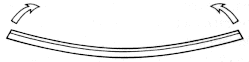
The picture above represents a piece of film as viewed lengthwise as it lays on a flat surface with the emulsion side up. This is POSITIVE CURL.
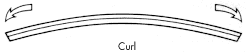
The picture above represents a piece of film as viewed lengthwise as it lays on a flat surface with the emulsion side up. This is NEGATIVE CURL.
"Positive" and "negative" curl is just defined that way. Neither is "bad" or "worse". (Quoted from John Pytlak)
So my statement should read "I have never seen a polyester print with a negative curl". Acetate base film is of course, a completely different ballgame.
------------------
John P. Pytlak, Senior Technical Specialist
Worldwide Technical Services, Entertainment Imaging
Eastman Kodak Company
Research Labs, Building 69, Room 7419
Rochester, New York, 14650-1922 USA
Tel: 716-477-5325 Cell: 716-781-4036 Fax: 716-722-7243
E-Mail: john.pytlak@kodak.com
Web site: http://www.kodak.com/go/motion
------------------
John P. Pytlak, Senior Technical Specialist
Worldwide Technical Services, Entertainment Imaging
Eastman Kodak Company
Research Labs, Building 69, Room 7419
Rochester, New York, 14650-1922 USA
Tel: 716-477-5325 Cell: 716-781-4036 Fax: 716-722-7243
E-Mail: john.pytlak@kodak.com
Web site: http://www.kodak.com/go/motion
At 21 degrees, you must wear woolen mittens and mukluks when you handle film up north across Lake Ontario.
------------------
John P. Pytlak, Senior Technical Specialist
Worldwide Technical Services, Entertainment Imaging
Eastman Kodak Company
Research Labs, Building 69, Room 7419
Rochester, New York, 14650-1922 USA
Tel: 716-477-5325 Cell: 716-781-4036 Fax: 716-722-7243
E-Mail: john.pytlak@kodak.com
Web site: http://www.kodak.com/go/motion
Happy film.
Most typical changeover houses wind their supply reel emulsion out and their takeup reel emulsion in.
Of course in a camera, the emulsion of the negative faces the camera lens. When an emulsion-to-emulsion contact print is made of the negative, the image is flipped, such that the print emulsion must now face AWAY from the lens to project properly. Even when a duplicate negative is used to make the release prints, the normal negative ---> interpositive ---> duplicate negative ---> release print printing system maintains the correct print orientation.
Here is a link to some really good Kodak information about printing and film systems:
http://www.kodak.com/country/US/en/motion/support/h1/printing.shtml
------------------
John P. Pytlak, Senior Technical Specialist
Worldwide Technical Services, Entertainment Imaging
Eastman Kodak Company
Research Labs, Building 69, Room 7419
Rochester, New York, 14650-1922 USA
Tel: 716-477-5325 Cell: 716-781-4036 Fax: 716-722-7243
E-Mail: john.pytlak@kodak.com
Web site: http://www.kodak.com/go/motion
35mm and 70mm theatrical prints normally have the emulsion face AWAY from the projector lens. Some IMAX 3D prints may have emulsion to the lens.
------------------
John P. Pytlak, Senior Technical Specialist
Worldwide Technical Services, Entertainment Imaging
Eastman Kodak Company
Research Labs, Building 69, Room 7419
Rochester, New York, 14650-1922 USA
Tel: 716-477-5325 Cell: 716-781-4036 Fax: 716-722-7243
E-Mail: john.pytlak@kodak.com
Web site: http://www.kodak.com/go/motion
First off...Gordon:
Your projectors are running!....
Sound up or down on the platter...
The purpose of running soundtrack down on the platter is to keep emulsion in wrap. The reason for this was to keep focus flutter and variation throughout the show to a minimum. The reasoning is that with emulsion-in wrap, the emulsion is kept under compression rather than being stretched. This way, when the film (and the emulsion in particular) hits the gate, it is pulled taught. Note, I only refer to the emulsion on this one, not the base.
I have tested this theory (and RP) and can only support it's findings for either acetate or polyester base since keeping the emulsion from tension is the purpose. So my recomendations are: I'm not finished yet!
In reel-to-reel operation, the hub diameters are from 4" (shippers) on out to about 8" for standard reels...and some venues work straight off of 2-3" cores. In these situations, emulsion-in is proper, there are no down sides and only benefits. I have done some rather extensive testing on running the film both ways over extended runs...after about a month of continous shows, you will start to see the benefits of emulsion in wrap. For those that are curious, the Uptown is running emulsion-in to this day.
Now to platter houses....
Here there are many other criteria to consider. First is the static situation. In a related topic listed above is curl. Sure focus is an issue too and then there is abrasion from loading/unloading, starting/stopping and general alignment.
Even platters with a small take-up ring are at 12 inches...factoring a house reel as only 15"...one can quickly see that the affects of emulsion-in wrap with respect to focus are minimal, best.
The benefits of emulsion-out wrap are a plenty..., the emulsion isn't presented to the platter deck, the above mentioned curl and its affects on paying out are minimzed...heck even labling the film is easier with emulsion out since most tails read correctly that way. All emulsion-in wrap has going for it is negligable focus improvemnt (to which I haven't see any). Therefore, I teach emulsion-out (aka soundtrack-UP) for platter houses.
Now back to Gordon....(and your projectors are still running )
The theatres you work for have their history back to a company called K-B Theatres (which is where I started). K-B was an early adopter of platters and was very much into consistancy. Every booth should function essentially the same as the others. In as much, a policy was issued that all theatres were to run soundtrack-down (mind you this was in the '70s). The reasons were muli-fold...for one, the supervisor of the time was an emulsion-in person, the potential for focus improvements were there, the automations of the time used inboard cues for feature and or credits (lights up)...as such they were clearly visable (they were the type of cues that had metallic tape wrapped around the edge of the film).
I can tell you, we NEVER had a problem with scratching or focus and generally we had the best shows in town...but this was another era where "projectionist" was indeed a job and every theatre had projectionists (they were actually hired by K-B not the individual theatres themselves, another reason for consistancy...an operator might have to pull a shift in another (not his/her regular) theatre.
Occassionally, humidity extremes would force a change in emulsion-in/out operation but that was an exception, not the rule. I distinctly remember running _Indiana and the Temple of Doom_ in 70mm on an AW-3 where the film would unthread itself from any of the three centerfeeds stictly due to the interaction of the curl of the film and how Christie tensions the cluster rollers (they are spring loaded at the bottom so they would pinch the film out). It must have been a humid summer!
Back to threading in general....a projectionist/operator, particularly nowadays...needs to access the situation presented to them. Even if tradition is to do something one way, if a better way is happened upon, be it by a change in the technology (polyester, for instance) or just a superior way one hadden't seen before, adopt it!
I've been showing movies now for quite some time (measured in multiple decades now) and you will see me thread very consistantly BUT some projectors I thread bottom to top, others top-down...it all depends on the machine I'm working with and which goes best.
Switching between something like soundtrack up or soundtrack down shouldn't really a big deal for a projectionist but for some reason, it can.
So there you have my rather lengthy response...
Reels: Emulsion-IN
Platters: Emulsion-OUT (track up)
Steve
PS: If I ever get a print that simply won't run track up, you can bet I'll switch track down for the duration of the problem.
------------------
"Old projectionists never die, they just changeover!"
Thanks again everyone. But feel free to tell me more about your ideas.
Oh, BTW, Steve... Thanks for making my projectors run.