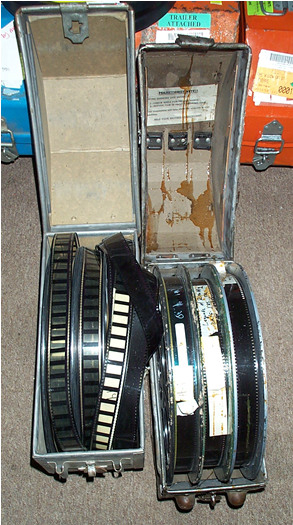
It had the following note in the can.
4-17-01
To whom it may concern,
"I have been a Projectionist for 30 years and this Print is without a doubt the worst (although most unique) mess that I have ever seen. The film itself is in good condition, but whoever ran this print before me, spilled what appears to be a cup of cappuccino in the cans holding reels 1, 2 and 3. (It now resembles molasses) They also neglected to clean up the mess, I tried but without success because it is so thick. Fortunately the film ran OK and did not stick together but it is a problem. I hope they realize that there is a special hole in hell reserved for those who screw up a print and leave it for the next unfortunate sot to sort out.
I wrote this note to emphasize that the damage was done PRIOR to the film arriving at Allegheny College, and also to alert you to the problem
Gary Williamson
Projectionist
Meadville, PA"
He not only wrote this note, but he called Kino International to complain. They knew about it. Yet almost a month later, they sent it to me.
So immediately get on the horn to Kino and demand another print. They tell me there aren't any others available, so I have to live with this.
I am spitting mad. I haven't touched the print yet. I guess I will try to build it up tomorrow. I will try Film-Guard on the print. But what I really want to do is tell Kino that the engagement is off and I will not show this print.
What would you do?
Besides, most of the time when I hear the phrase "that is the only print", another one appears the next day. In these situations, they do not care and do not want to have to deal with you. It's "to hell with Ian's presentation" in their minds.

Some labs offer the Kodak "Rewash" process RW-1 that may be useful in removing any stains and in rejuvenating the print:
Kodak Rewash Process RW-1
------------------
John P. Pytlak, Senior Technical Specialist
Worldwide Technical Services, Entertainment Imaging
Eastman Kodak Company
Research Labs, Building 69, Room 7419
Rochester, New York, 14650-1922 USA
Tel: 716-477-5325 Cell: 716-781-4036 Fax: 716-722-7243
E-Mail: john.pytlak@kodak.com
Web site: http://www.kodak.com/go/motion
I would also put an "A frame" poster out front explaining to my patrons why they are not seeing the picture advertised.
I'd verify that, then trash the offending can, reels and leader when it came time to return the film. I'd ship back on cores in whatever box was handy. Only if the print itself were in fact damaged, would I refuse to run it as was suggested.
In a case of a missed showing, when the print is in good condition, you are only punishing the customer. Always try to  on the correct party.
------------------
John P. Pytlak, Senior Technical Specialist
Worldwide Technical Services, Entertainment Imaging
Eastman Kodak Company
Research Labs, Building 69, Room 7419
Rochester, New York, 14650-1922 USA
Tel: 716-477-5325 Cell: 716-781-4036 Fax: 716-722-7243
E-Mail: john.pytlak@kodak.com
Web site: http://www.kodak.com/go/motion
Verifying something before taking action only takes a second and can keep the embarassment level down. As I mentioned, I wouldn't run the print if it were damaged.
 is in the business of running a theater, not a film inspection depot or AFI's film restoration department. I'm sure he has enough bombs being dropped on him from other sources. Can you imagine if Technicolor sent out films like this? Okay, bad example.
Personally, I would have a look at the print. If it's okay, I'd run it and send it back and tell Kino that I'll never book with them again, thank you very much. (Even better if the film does well!) If it's not okay, I'd cancel the booking and (after re-reading my booking agreement) send Kino a bill for all of the marketing, etc., I did for the film that I couldn't play. They are responsible for providing useable product.
But then again, I'm an a-hole. 
They are sending me reels 1, 2 & 3 from the DVD mastering print. (Do you think they have scanned it yet?)
I pulled out reel #1 and the other two were stuck to it like a unit. The film was sticky through the titles. Thank God I don't have to use it.
But once again, I get to build up a print early Friday morning. 
For a major Hollywood distributor like Warners or UIP, losing a print thanks to the moron who poured a cappuccino all over it is no big deal. The number of prints struck of a mainstream title will vary from a couple of hundred to several thousand. After the opening weekend, a significant proportion of these will probably never be used again. A print written off by a coffee accident is one less they have to pay to send to the recycling people.
For an art or rep distributor, this could well be a catastrophe. These figures will probably not be relevant to the US system, but they do illustrate how much work is done by such a small number of prints over here:
'The Low Down' - UK release with 2 prints
'Bread and Roses' - 20 prints (and that was probably only because of Ken Loach's involvement)
'Sous le sable' - 5 prints
'The Wind Will Carry Us' - 2 prints
'Mildred Pierce' (rerelease) - 2 prints
The several hundred pounds per copy (a lot more if it is laser-subtitled) represents a major investment for the people who distribute these titles. They do not have seven-figure 'P & P' (prints and publicity) budgets, and often struggle to break even. I can well believe that when a projectionist calls in and reports that one of these prints has been trashed, that there is no replacement readily available.
What makes this situation worse is that the kind of places showing these films (e.g. university film societies, community arts centres with miniscule budgets) are precisely the places that are likely to have very little money to spend on equipment maintenance and projectionist training, and so are going to be most at risk of inflicting greater wear and tear and/or damage on the prints they handle. But the distributors are not in a position to say 'OK, we've had enough, you're barred from renting any more of our prints' because they depend on these places for their income.
So really the art and rep circuit is a catch-22 situation in which greater print damage is the result. The fact that these prints tend to do shorter runs in a larger number of venues (hence more making up and packing off) exacerbates the problem.
None of this in any way justifies spilling coffee all over a film. But if I received a film like that, I would probably have a go at cleaning it before making the distributor suffer from a cancelled booking. But if it were a print of 'Star Wars' then I wouldn't lose a minute's sleep over rejecting the print.
For those filmmakers, electronic cinema will be a no-brainer because of problems like this. Art and independent of 35mm will be a fondly remembered glory. Who do we have to thank but careless and poorly trained film monkeys? A pox on those who don't care for prints. May their finest life work be spilled on by God's golden stream. (Sorry, this is an issue that I can't believe should even be an issue. I can think of few things so disrespectful of the creative mind.)
The same "jerk" and "brain-dead drone" will screw up Digital Cinema too. One will probably spill coffee into the server, and the other permanently kill a few thousand pixels by hot-spotting the lamp.
------------------
John P. Pytlak, Senior Technical Specialist
Worldwide Technical Services, Entertainment Imaging
Eastman Kodak Company
Research Labs, Building 69, Room 7419
Rochester, New York, 14650-1922 USA
Tel: 716-477-5325 Cell: 716-781-4036 Fax: 716-722-7243
E-Mail: john.pytlak@kodak.com
Web site: http://www.kodak.com/go/motion
The thing you have to remember is that these companies often don't actually stock the prints. They are continuously circuited. Nobody at the "home office" actually sees this print. Kit Parker was the WORST offender.
I happened to like New Yorker Film the best. I spoke to the guy in their shipping department a couple three times. One one or two occasions Max just told me to ship it off to Film Treat when we were done with it.
Our strategy in cases of crummy films was to complain, complain, complain. (My boss was good at that!  ) He has actually succeding in getting discounts or even a total refund in one case.

I had a problem once from Films, Inc. on a 16mm print of Willy Wonka. The print literally had hundreds of splices in it and was falling apart in my hands. I called Films, Inc. and we had a brand new print drop shipped straight from the film lab the next day! A week later I get a letter from the company president of Films, Inc appoligizing for the bad print. He stated that the bad print was destroyed and our film rental was FREE. That was the only problem I ever had with them. Their prints were usually excellent.
The Kit Parker depot is like a torture chamber for films. Good film goes in...junked print comes out. During college I got lots of films from Kit Parker and ALL of them were complete shit. In the last several years I have had the displeasure of having to run prints from that depot because they were the only ones with a certain title and just as before, every single print was shit! If you dare to call and complain you will just be told that you caused the damage and then be threatened with either playing it or paying for it. Now just to make sure that my point is being made, I am not saying that a print from Kit Parker is not up to my personal guidelines for a good print. I mean that no one in their right mind would ever play any of the shit prints they sent me. Someone please bomb that building. Talk about "film done wrong"!!!
Kodak's screen check is great for making sure the equipment in a theatre and the presentation on the screen is complying with the SMPTE guidlines. However, you can have the best equipment in mint condition and you receive a bad print....well guess who they are going to blame for a poor presentation.
When you receive a bad print let everyone know that it is not acceptable. "Film Done Right" means it's your reputation in the line. Just had to insert my $.02.
a print in the theatre meant running through a rag wet with some solvent film cleaner. Triacetate and earlier polyester film often developed enough static charge to attract dirt particles from a distance.Today, polyester prints are very durable, and many would argue TOO STRONG and unforgiving. Kodak VISION Color Print film has a conductive antistatic backing that virtually eliminates the static charging that attracted dirt and gave nasty shocks to the projectionist when winding the film. Platters have reduced the tension on the film, and minimized the handling required. But more importantly, a major film release often numbers thousands of prints, so the chances of a small town theatre getting a brand new print are much greater. Most prints are retired within a few months after visiting only a handful of theatres, as the "window" before video release shrinks to a few months. Many theatres have film-cleaners, and a few use them for every showing.
So, if the film and equipment are so much better, why do prints get damaged? The discussions on Film-Tech provide some answers. Hint, just look for the LONG threads with lots of icons. In most cases, the problems can be traced to being Cheap, Careless, or Clueless, or some combination of the three.
------------------
John P. Pytlak, Senior Technical Specialist
Worldwide Technical Services, Entertainment Imaging
Eastman Kodak Company
Research Labs, Building 69, Room 7419
Rochester, New York, 14650-1922 USA
Tel: 716-477-5325 Cell: 716-781-4036 Fax: 716-722-7243
E-Mail: john.pytlak@kodak.com
Web site: http://www.kodak.com/go/motion