
The first occured a couple of weeks ago when I was showing a 70MM print of '2001: A Space Odyssey'. There was another projectionist on that shift to run the other five screens while I ran the 70MM one. He told me that a patron had stopped him in the foyer during the intermission and asked if he was the projectionist. He said that he was one of them, and the patron said something to the effect of, 'Let the other projectionist know that the presentation of 2001 is excellent!'. The next day, I was talking to one of the ushers who was on during that same shift and without prompting her, she mentioned that there was a general 'buzz' about the presentation as patrons came out for the intermission. She overheard many of them discussing not only the film, but the high quality of the presentation itself, and some of them stopped to mention it to her. While I did go to some lengths to ensure the timing of the lights/curtains was as good as possible during the overture, etc. (it's a manual booth), I would have to say that the 70MM format must take the majority of the credit for this, because I cannot imagine receiving the same level of positive feedback for a 35MM print of the same movie.
The other instance occured earlier tonight. I went to the theatre I work at to see 'The Mummy Returns' with a friend. I built this print on Thursday (the film opened here one week after the US). The onscreen image was extremely bright, sharp and literally free of any visible artifacts. Although not in the industry, he mentioned - within minutes - how pleased he was with the brightness of the image! Later, during the forest/pygmy scene which takes place at night, he once again remarked how wonderful the colors were, and mentioned the rich, powerful reds (the costume worn by one of the villains) and the green of the foliage.
(I should also add that I am particularly pleased with this print. It has not shedded one bit and the projector is spotless after each show - there is nothing to clean! Although it has only had about 25 passes on it thus far, it looks the same to me as when I first ran it straight from the lab on Thursday morning, and I predict that it will look pretty much the same weeks from now (I would have said months, but I don't know how long it will remain popular). It is printed on Kodak 2383 Vision stock.)
So, these two situations reassured me that quality is perceived and enjoyed in a very real, conscious way. What instances have others experienced which back up the case that patrons can tell the difference? A special mention must go to John Wilson who made the vast majority of this possible. He must take the credit. Without him, (to name but one thing) the auditorium in question probably wouldn't have those wonderful 5K Xebex lamphouses!
Thank you for your testimonial to "Film Done Right"! Kodak continues to invest many millions of dollars annually to make the quality of film even better and improve presentation quality.
To paraphrase our friends at THX: "The audience is listening...and watching."
Splendor of 70mm Part 1
Splendor of 70mm Part 2
Technical Data for Kodak VISION Color Print Film 2383
------------------
John P. Pytlak, Senior Technical Specialist
Worldwide Technical Services, Entertainment Imaging
Eastman Kodak Company
Research Labs, Building 69, Room 7419
Rochester, New York, 14650-1922 USA
Tel: 716-477-5325 Cell: 716-781-4036 Fax: 716-722-7243
E-Mail: john.pytlak@kodak.com
Web site: http://www.kodak.com/go/motion
 The good thing with the CP 65 is that you can mess with the levels until you personally are satisfied with the whole sound. THE EAR always gives better results rather than reading instruments (osciloscope e.t.c). I strongly believe this because two or three months ago the film got stuck on the projector and the sollar cell was completely dispositioned. Our company could not afford for a Dolby Engineer to come down and I personally reallinged the sollar cell with no instruments, and just my ear. And when we do a changeover when playing a non digital film, my boss can always tell the diference whether is the first projector which is playing or the second. (I realligned the second projector). And always I hear that the second projector "sounds" much better. What do everyone think?
Demetris Thoupis
"FOR STRENGTH AND HONOUR"
More and more people these days are exposed to high tech things inh their own home like digital audio, HDTV, and when attending 70mm Imax and other fine things. This exposure only makes the general public more aware of how good it can look and sound when it is done right. Hence when it happens correctly there is audience reaction to it positively.
Mark @ GTS

If your sound system was set up and balanced properly and everyone still says it is "too loud", turn down the fader. But you need to factor in whether the complaints are personal preference of just a few sound-sensitive audience members, or just a "hot" mix on a particular trailer or feature.
------------------
John P. Pytlak, Senior Technical Specialist
Worldwide Technical Services, Entertainment Imaging
Eastman Kodak Company
Research Labs, Building 69, Room 7419
Rochester, New York, 14650-1922 USA
Tel: 716-477-5325 Cell: 716-781-4036 Fax: 716-722-7243
E-Mail: john.pytlak@kodak.com
Web site: http://www.kodak.com/go/motion
Im sure you have several articles on your
site explaining it.
I believe the problem relates to the two following examples...
PERFECT examples
Trl Pearl Harbor. (got to love ver1 dont you)
Feature Mummy Returns
Both are VERY loud.
That said, I like how loud they are.
I'm amazed there have been been no complaints from the audience, Im happy for that, the 'it's too loud' only seem to only come from clueless floor staff, via 2-two way to to projection, which is mainly ignored.
Regards Bill.
That said, I really like "loud" soundtracks, too, for as long as the sound is good. (And yes, "7" is fine for the majority of the films we show.)
I've _never_ had a complaint about sound quality or volume when running something in mono (which, of course, I've only done with mono prints or in weird emergency situations). I've gotten a few complaints about volume level when showing films in Dolby A or SR (which, more often than not, were "turn it up"). I've received tons of complaints when showing films in any of the digital formats, almost all of which were "turn it down."
Admittedly, most of the mono films I've run have been art or repertory films and all of the digital presentations that I've run have been mainstream "blockbuster" stuff, but it's still interesting to see how digital generates more complaints even on systems which are generally aligned properly.
Oddly, I have never heard a complaint about "it's not in digital" when running a mainstream film in a digital-capable theatre in SR (usually because there were no DTS disks or because an SR-D unit had failed).
Compression in the mixing stage of a soundtrack goes a long way to giving the illusion of "loud". Most trailers are loaded with it. Also, selective eqing of the tracks before they are mixed together on the dubbing stage can make things sound "loud" regardless of the fader setting.
The point that I was trying to make though, is that most problems I see in respect to "it's too loud" and projectionists running the fader at a lower setting stem directly from poor EQing. If the sound tech sets the dials and then packs up without tweeking the final result by ear when listening to a lot of different reels that he is familiar with, you need a new sound guy. Some auditoriums based upon their size and acoustics require more or less treble, bass, and various specific frequencies. Just setting the eq "to the reference line" is a guarantee for crappy sound that will end up being played at 5-6 on the fader to avoid ear fatigue. Actually another good way to see if the eqing was done well without listening is to just look at the dials. Anyone who has large differences between adjacent frequencies is obviously just looking at his RTA. So to clarify the point again, you can take the most perfectly mixed film and run it in an auditorium that was not tweeked well and it will still sound like crap (and need to be played at 5-6 on the fader).
Getting back to the Mummy Returns, that film has a poorly mixed soundtrack from the start (aka "a loud track"). In comparison, the original Mummy feature's soundtrack was the worst I've ever heard. I think many will agree with me on that one. By the way, Gary Rydstrom is one of my favorite mixers. All of his tracks are top notch!
Interesting side note: Does anyone else get a laugh out of that occasional sound tech who comes into a theater to EQ an auditorium, yet seems to be about 100 years old and can't hear worth a flip in day to day life? (They are always easy to spot, for they speak VERY LOUDLY and never seem to understand anything you say to them. Another tip is a tech who just gets "too close" and invades your personal space in an attempt to get closer to your mouth to hear what you are saying.) I actually was at a theater when one of "those guys" stuck his head out of the port window for about 20 seconds after EQing the auditorium and said "that's the best sound I've ever heard". He was basing that judgment on not only 20 seconds of audio, but from the port window with the projector clattering away right beside him and as if that wasn't bad enough, it was a trailer he was listening to as a reference. His end result sound was very shrill, had no low end, was incredibly dull in the upper frequencies and got us a LOT of customer complaints. He probably couldn't even hear above 5k anyway, so maybe it DID sound great to him. 
Check out this chart of hearing loss in amplitude vs. audio frequency. Note how severely the upper frequencies are lost as the average man ages.
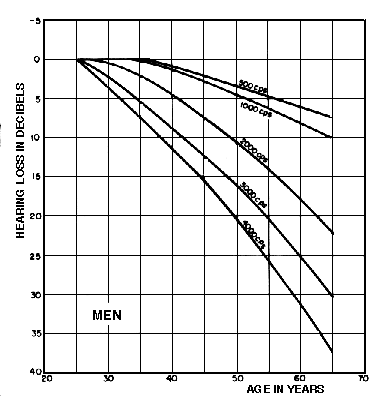
Just look at that chart. By the time the average man hits 60 years of age, his hearing at only 4000hz is lost 30 decibels! A frequency like 8000hz or even 10,000hz is off the chart. Add to that the all-too-common remark I hear from the senior sound techs of "bass scares people" (so they roll off all the low frequencies) and you've got yourself one hell of an extremely harsh and shrill sound system that must commonly be played at "5" on the fader to prevent from killing everyone else's hearing. This certainly should be taken into effect and I have always been amazed that most people (including THX!) toss this fact aside.
Disclaimer: No offense intended to any of the older techs. I'm talking about the ones who have lost a huge chunk of their hearing due to age or another cause, yet still align sound systems. There really should be a detailed hearing test performed as a requirement before a tech is allowed to alter a sound system. If someone who is 60 can still pass the test with flying colors, then by all means break out the RTA. If someone at 30 can not, he should not be touching sound systems. My only point here is that hearing loss from age alone is a proven fact of life and should be tested. Unfortunately, this is not the case and these are the same techs that when listening to a defective print (or misaligned reader) in the SDDS format, simply can not hear the switching back and forth between SDDS' primary digital tracks to SDDS' backup (and lower quality) digital tracks. Some techs can't even tell when the digital on any system defaults to analog and will argue the point until hell freezes over that there is no problem...and these guys are actually tuning sound systems. Perhaps THX will consider making a comprehensive hearing test every few years a requirement. It is very much needed.
I was shocked. 
I projected that movie for at least one month and I have just 1 (ONE) compliant by a crazy woman.
So, if you receive a LOT of volume compliants just think about the quality of your EQ and acoustic.
Bye
Antonio
When Star Wars Episode 1 came out, Lucasfilm required that a projectionist (and only a projectionist) watch each print and verify quality (Kudos to Lucasfilm for doing that, by the way). The print I watched sounded very good. But another projectionist had to turn his auditorium (in the same complex) down to about 4.2 on the volume fader. And this was a guy who loved things LOUD. He started his print after mine, so I got a chance to listen to it. It was very shrill and harsh sounding.
Now I don't have an RTA, but I do have a good SPL meter. So I reset the levels (they weren't very far off at all, actually). And then I proceeded to adjust the EQ of each channel BY EAR until it sounded good, using the auditorium I had just watched the same movie in as a reference (one had a CP500 and the other a CP65). This took awhile and required a lot of trial and error. After that I reset the SPL levels again. The movie opened to a wild bunch of Star Wars fanatics and the volume played at 7.6 for a week, and then dropped down to 7.2 as the crowd shrunk. The guy who originally watched the movie in here at a volume level of 4.2 was amazed at the difference.
I was complimented three times by random customers for having the best sounding auditorium in the state. They were all from the #1 auditorium (the one which I adjusted). I thought that the #16 auditorium (the one where I watched my print) sounded perhaps a bit better, but it just goes to show that EQ is VERY important!
Joe, nothing wrong with the sound in Ep1.
But I hated the movie itself.
Ep4 so far is the best.
Hopefully Ep2 WONT have opera music blasting away during sabre sword fights.
Bill.
And my personal favorite piece of style in a presentation is a trailer curtain as well as a main curtain!
One would assume they have seen it or they wouldn't be asking for so much from it.
Bill, I'm with you on version one of the trl...my favorite.
------------------
Children really brighten up your life...they never turn off lights.
(I'm almost 53).Private pilots tend to loose their high frequency response early in life, due to the roar of the airplane engines (and maybe air pressure changes with altitude). Likewise lumberjacks, jack-hammer operators, shooters, and fans of loud music tend to loose the highs early (unless they wear hearing protection).
If the person who shows up to EQ your theatre wears a hearing aid, be VERY afraid! 
------------------
John P. Pytlak, Senior Technical Specialist
Worldwide Technical Services, Entertainment Imaging
Eastman Kodak Company
Research Labs, Building 69, Room 7419
Rochester, New York, 14650-1922 USA
Tel: 716-477-5325 Cell: 716-781-4036 Fax: 716-722-7243
E-Mail: john.pytlak@kodak.com
Web site: http://www.kodak.com/go/motion
One side of my family has members who have had fairly extensive hearing loss as they aged. I have an uncle that is stone post deaf, and had another that used two hearing aids before he died. The other side of my family has hearing that is amazingly sharp. If you averaged the group, the drop-off would look terrible, even though some in that group could hear the proverbial pin drop.
A major cause of hearing loss is the breaking off of the cilia in the inner ear that pass the sound to the nerves. Essentially, after a certain amount of flexing, the tiny hairlike strand breaks from material fatigue, just like bending a bit of metal back and forth. The more noise and sound you are exposed to, the fewer working cilia you have.
Knowing my family history, once I got past my early twenties I began noticing loud environments hurt my ears, and worked to avoid them. My hearing is still sharp, the noise of television and computer equipment still bothers me, and I still have close to perfect pitch, so I've lucked out or my noise avoidance has paid off. If a movie is too loud for me, I walk out.
Bringing this ramble to a point, sound is a personal experience and each individual has the graphic equalizer in his head set at different levels. By tweaking systems to what sounds right to you, you subject the audience to your personal taste - which may be a different flavor of sound than the director and sound crew intended. Is that a bad thing? Based on the trailer volume problems we've had in the industry, I don't think anyone can say with certainty that it is, but it is still troubling to me that previous posts give the impression that such tweaking is a good thing.
Given the wide variety of hearing abilities and listening skills, tone deafness, and other factors that make up an individual's sense of sound, I'm more inclined to trust an unbiased measured tweaking of a sound system by a pro with meters and scope than any off-the-cuff tweaking - except that done by a piano tuner or first chair violin. Some folks, like Joe, might get away with it and even get compliments, but it isn't as easy to get it right as it sounds.
I agree that objective tuning with a RTA is probably less subject to bias than strictly "by ear". Few of us have the proverbial "golden ears" of a gifted musician or sound mixer. But I also feel that common sense says the tuned system should "sound good" to most people, without undue harshness, bass, treble or "holes" in the frequency response. Any well-designed system is unlikely to have huge gaps in response, so if you see large deviations in the EQ required between adjacent 1/3 octave bands, something is probably wrong in your procedure. And as Brad said, your ears will also tell you this.
An analogy might be a piano tuner. Today's piano tuners have wonderful electronic tools to speed up the tuning process, but in the end, a really good piano tuner does the final "tweek" by ear, and then goes on to play some real music.
------------------
John P. Pytlak, Senior Technical Specialist
Worldwide Technical Services, Entertainment Imaging
Eastman Kodak Company
Research Labs, Building 69, Room 7419
Rochester, New York, 14650-1922 USA
Tel: 716-477-5325 Cell: 716-781-4036 Fax: 716-722-7243
E-Mail: john.pytlak@kodak.com
Web site: http://www.kodak.com/go/motion
Four words:
Jerry Bruckheimer, Michael Bay.
In many peoples opinions the kings of excruciatingly loud sound mixes...
BV is going full-out for 'Titanic' style hype and praying for like business from this. If it hits, it will give Bruckheimer powers with studios that currently only people like Lucas, Speilberg, Cameron and Coppola have.
If it 'Kamikazes'... I see Bruckheimer going back to doing 'Coyote Ugly' and 'Remember The Titans' knock-offs, and Michael Bay returning to doing 'Got milk?' commercials... Not to mention the huge dent in the Disney empire's armor...
Aaron
2) Taking these recordings and mixing them to the images on the screen and getting them to sound as good as possable in the perticular mixing studio that they are using.
3) then encoding them to the optical negatives for analog and digital processing.
4) then it is the theaters turn to take those recorded sounds and process them the way they should be done. Using the best equipment they can get or using whatever they have to do the job. It is important that the A-chains are alighned as perfect as they can be. If that is not done then sound will be effected. I think the B-chain curve is harder to achieve acurately because we have added more obstructions to the auditorium.
Biggest being stadium seating. How many mixing studios are set up with stadium seating.
I think the B-chain can be set up accuratly with the analyzer but familiar film should be played and listened to at proper fader setting of 7. If the sound sounds bad then u should tweek it while u still have equipment hooked up. Once u get the sound the way u want it make notes of where the anylizer is reading so it can help aid u in the next auditorium. Then do the same thing there.
Maybe the curve needs to be reevaluated for todays type theaters. Better systems now than when they were in the day the curve was developed.
The tuning should definitely still be done with the multiplexer and RTA running. Tone deafness is something I did not get into in that earlier post, but it is a very valid argument. This is why it is ideal to still have the RTA running for visual aid. Also, when adjusting the final tweeking by ear, only very minimal adjustments should be performed. The idea here is to smooth out what the RTA could not catch and the actual rolloff of the curve is never the same as auditorium sizes and acoustic designs change. Ideally only cut should be used when tweeking by ear...and of course AFTER the system is aligned as best as possible with an RTA. Still as I said earlier, my point was that a hearing test should be performed for sound techs. It doesn't matter if you are 30 or 60. If you can't pass the test with flying colors, you should not be touching a B-chain, regardless of age. The chart I posted earlier is an average, of course, but still is a very good ballpark to go by with respect to age. Maybe you are that incredibly rare exception to the rule. Most people do not like to admit hearing loss though, which is why I bring up the hearing test point.
Next time you need an aperture cut, hire a tech who wears glasses and make him do the job without them. Just how good will that aperture be?
I have used the R-2 for quite a few years now and I have gotten results that are so consistant its almost scary. Anyone other than a sound mixer that actually worked on a given mix should never tune a system any other way. Simple as that. If its tuned any other way then it simply tuned to that persons taste and hearing. Unfortunately there are other sound systems that are installed new this way as well. One never knows what to expect of these.........typically they sound boomy and like you are hearing sound from a horn.
A technician friend of mine that works with Edwards once told me that they tune the system with an RTA, and then tune it by ear and color the sound. I have to admit that the sound in their theaters is no where near as good as if it had been tuned with just the use of an R-2 and set to industry standards. It definately reeks of coloration and IMHO is pretty substandard sound.
Mark @ GTS
No one is saying that an EQ should be performed without the proper equipment. But R2 or not, rooms which are EQ'd to spec on the RTA and that's it, never ever sound as good as one where the tech went back in and actually listened.
This is all well and good, but who defines what sounds good. Good to one person (even with '20/20' hearing) may not be good to another. Why not 'tune' all sound systems by ear, eliminating the need to buy expensive analysers, or even better get the mixer to inject pink noise through the play heads of the theatre after he mixed the film, observe the trace on the RTA and send that out to theatres such that the same settings may be replicated..... just a thought.
Steff