
I have just read your article 'Caring about Composition' in the March 2001 issue of Kodak Cinema Notes. I totally agree with your comments, scope should ALWAYS be wider and bigger than flat. Unfortunaletly this is in the hands of the exhibitor at the moment and the humble projectionist can only work with the tools he has been give.
I was just wondering whether you have ever had any feedback from exhibitors.
There has been a recent trend here in the UK to build wall-to-wall flat screens and then drop the masking for scope films. I can see the exhibitors point of view for not wanting to waste any space at the side of the screen, but surely this space should be reserved for CinemaScope. Or maybe we should rename it Cinema-Shrink-to-Fit.
Cheers, Tom.
------------------
I've talked to the VPs of projection for several major circuits regarding this unfortunate trend. One indicated that "Yeah, I know it's the wrong thing to do, but that's what they want, so I do the best with what I am told to do".
When shown with a common image HEIGHT, the less efficient 1.85:1 "flat" format is usually slightly less bright than 2.39:1 "scope". When projected with a common WIDTH, the "flat" image will typically only be about half as bright as the "scope" image, with excessive magnification of any graininess or unsteadiness.
------------------
John P. Pytlak, Senior Technical Specialist
Worldwide Technical Services, Entertainment Imaging
Eastman Kodak Company
Research Labs, Building 69, Room 7419
Rochester, New York, 14650-1922 USA
Tel: 716-477-5325 Cell: 716-781-4036 Fax: 716-722-7243
E-Mail: john.pytlak@kodak.com
Web site: http://www.kodak.com/go/motion
C'mon Regal -- Get your act together and upgrade those screens at Hollywood 18 (screens 3, 4, 5, 6, 7, 8, 11, 12, 13, 14, 15, 16) and Madison Square 12 (screens 3, 4, 5, 6, 9, 10, 11, 12) here in Huntsville, AL so both the scope and flat formats can be shown without cropping! You're giving your customers a defective product and if you can't afford to fix this, then sell the theatres to a more capable company! The problem is not going to go away on its own.
"Stop The Chop" :
... and Adam Martin's gem:

My other composition pet peeve is misframing. Few theatres can consistently get their flat films framed properly, since they can be misframed significantly without creating black areas on the screen or making the frameline be visible. I wish prints had the words "If you can read this, then the movie is misframed. Complain to your projectionist." printed across the image just above and below the 1.85:1 standard image area. Framing problems like this would quickly go away if this were the case. 
------------------
Evans A Criswell
Huntsville-Decatur Movie Theatre Info Site
quote:
Framing problems like this would quickly go away if this were the case.
Unfortunately, the response the customer would most likely get is, "That's the way the movie was made." Considering the "operator" never looked at the screen in the first place (and doesn't particularly care about it).  We can throw in showing films with the wrong lens and showing scope films _on_ flat masking and sound systems so far outta whack the dialog comes out of the surround speakers. I really shouldn't get started.

All flat movies should be printed in hard matte but the black part of the film between the frames should alternate between two funky colors like red and green.
If there is a misframe you would be barraged with 9,000,000 complaints from customers who have epilleptic seizures!
Brad's idea of making the non-projected area clear (I'd recommend doing it outside the 1.66:1 area), or Randy's idea of an irritating alternating color combination that would get anyone's attention. If one of these practices were adopted, framing problems would diminish.
The "projectionists" in my area frame flat films using two different methods. At Carmike theatres, the "The management of this theatre, in cooperation with the state fire marshall's office..." trailer, being first, is used by centering the "EXIT" sign on the screen, with varying degrees of accuracy, or by using some other part of that image at the edge of the screen. At Regal, it's more problematic since the first thing shown sometimes is a commercial that is full-frame and by the time the commercial is finished, the operator has walked away. A green band works pretty well if the text is centered.
------------------
Evans A Criswell
Huntsville-Decatur Movie Theatre Info Site
If I have a 32ft wide auditourium, I should make flat be 24 ft wide? That just doesn't seem to make sense. Of course, for the sake of this discussion, I'm assuming everything else is within reasonable standards (no cropping, framed correctly, etc.)
One might say, "Well, than don't make a auditourium only 32ft wide." But if you don't have the number of auditouriums the bank tells you to make, they might not lend you the money to build.
I worked at a theater that had an original Cinemascope installation set up like that. It really just looked kinda stupid. If top masking was the only "cheap" thing done, I'd still be happy.
This is the best tack to take when fooling around with front-projection home video as well.
On second thought, I'd recommend this technique more in smaller auditoriums where screen sizes are likely to be less than 30 feet in width. It would prevent "flat" movies from having such small screen sizes. Hmmm.... 27 x 13 screen masked to 27 by 11.3 for scope and to 24 by 13 for flat. Flat would be 24 by 13 instead of 21 by 11.3 if a 27 by 11.3 screen were used with just side masking. I rounded the original screen size a bit to the nearest foot, so the areas are off by about 6 square feet, but it's close enough for government work. Isn't it odd to hear a mathematician say that?
------------------
Evans A Criswell
Huntsville-Decatur Movie Theatre Info Site
But since 2.39:1 "scope" is usually INTENDED to have greater "impact" than 1.85:1 "flat", I still prefer common height images with adjustable side masking.
------------------
John P. Pytlak, Senior Technical Specialist
Worldwide Technical Services, Entertainment Imaging
Eastman Kodak Company
Research Labs, Building 69, Room 7419
Rochester, New York, 14650-1922 USA
Tel: 716-477-5325 Cell: 716-781-4036 Fax: 716-722-7243
E-Mail: john.pytlak@kodak.com
Web site: http://www.kodak.com/go/motion
Carmike used the common-height approach with side masking in all of their local theatres. Some of their auditoriums are only 30 to 32 feet wide, which makes flat images very small (only 16 feet in width in some of the houses), but I don't complain, since at least I get to see all of the image regardless of the format.
But anyone trying to fill a screen wider than 50 feet with a 1.85:1 image will be challenged to do it properly. For a 50 x 27 foot 1.85:1 "flat" image, you would likely need 7000 watts and a high gain curved screen to get 16 footlamberts --- really "pushing" the 35mm system to its limits. Much better in this case to fill a 50 x 21 foot screen with the wide "scope" image, and use adjustable side masking to show a 39 x 21 foot "flat" image.
------------------
John P. Pytlak, Senior Technical Specialist
Worldwide Technical Services, Entertainment Imaging
Eastman Kodak Company
Research Labs, Building 69, Room 7419
Rochester, New York, 14650-1922 USA
Tel: 716-477-5325 Cell: 716-781-4036 Fax: 716-722-7243
E-Mail: john.pytlak@kodak.com
Web site: http://www.kodak.com/go/motion
This carelessness will continue as long as flat movies are printed using significantly more image area than is projected. There needs to be some sort of framing indicator on the print that is visible if misframed more than a certain percentage.
I still think something like the following would work well:
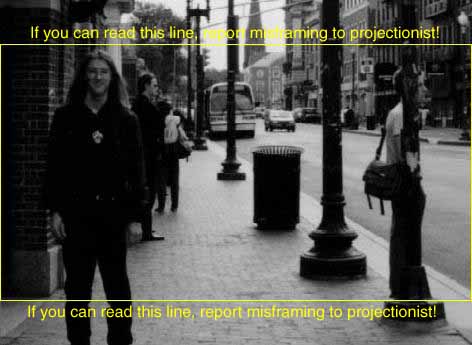
(without the yellow rectangle illustrating the aperture for 1.85:1 flat, which was already on the picture before I added the text)
Such indicators would only need to be on theatrical release prints and should not be used on prints used to make video transfers since many flat films are transferred open matte.
------------------
Evans A Criswell
Huntsville-Decatur Movie Theatre Info Site
------------------
John P. Pytlak, Senior Technical Specialist
Worldwide Technical Services, Entertainment Imaging
Eastman Kodak Company
Research Labs, Building 69, Room 7419
Rochester, New York, 14650-1922 USA
Tel: 716-477-5325 Cell: 716-781-4036 Fax: 716-722-7243
E-Mail: john.pytlak@kodak.com
Web site: http://www.kodak.com/go/motion
------------------
John P. Pytlak, Senior Technical Specialist
Worldwide Technical Services, Entertainment Imaging
Eastman Kodak Company
Research Labs, Building 69, Room 7419
Rochester, New York, 14650-1922 USA
Tel: 716-477-5325 Cell: 716-781-4036 Fax: 716-722-7243
E-Mail: john.pytlak@kodak.com
Web site: http://www.kodak.com/go/motion