This is topic Is Kodak ScreenCheck dangerous? in forum Film Handlers' Forum at Film-Tech Forum ARCHIVE.
To visit this topic, use this URL:
https://ft-forum.com/ft/cgi-bin/ubb/ultimatebb.cgi?ubb=get_topic;f=1;t=002275
Posted by Leo Enticknap (Member # 534) on 05-14-2001, 04:34 PM:
I've just received some advertising material for the Kodak ScreenCheck programme. This included a reprint of an article which originally appeared in the March 2001 edition of 'Cinema Technology' (a magazine published by the British Kinematograph, Sound and Television Society). The article described inspection visits by a Kodak engineer to two theatres in the south of England.
It included this picture:
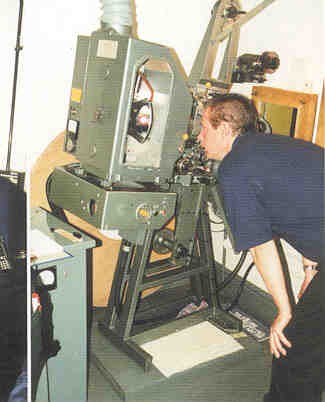
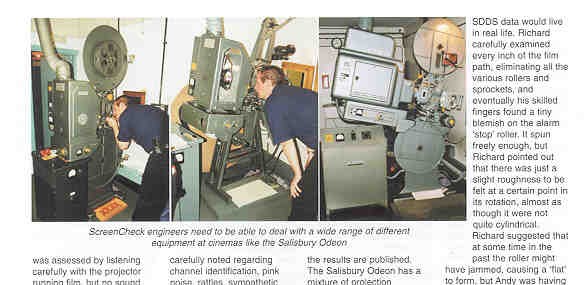
Now there are two possibilities here. The first is that he is looking at an empty lamphouse (i.e. there is no xenon bulb in there). If so, then IMHO, the caption should have made that VERY clear. As you can see from this scan of the magazine page, there is no such caption.
The other possibility is that this picture depicts an Eastman Kodak engineer standing about a metre away from a xenon lamp without wearing any protective gear whatsoever. If so, might John P be able to tell us if this guy is still alive, and if so to give us the address of the hospital we should send the get well cards to (assuming he still has any eyesight left to read them with)? 
Furthermore, he's not just putting himself at risk. The photographer who took that picture cannot have been more than 2-3 metres from the lamp (note the reflection from the camera flash on the side of the lamphouse mirror).
I find it hard to believe that a representative of one of the world's leading motion picture technology corporations is pictured in a prominent film industry publication doing something recklessly dangerous. The point is that even if he isn't, an inexperienced projectionist with more enthusiasm than sense and who is not being effectively supervised may well deduce from this picture that it's quite safe to open up a lamphouse and start poking around inside. If I had been editing this article then I'd either have left the picture out or included a caption in bold stressing that no-one should ever open a lamphouse containing a lamp without wearing full protective clothing.
Posted by Joe Redifer (Member # 3) on 05-14-2001, 05:28 PM:
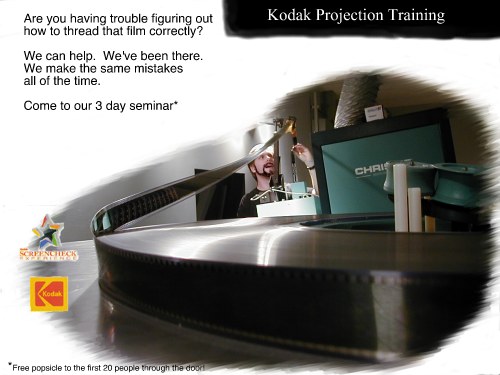
This is all trick photography to capture reader interest. Just check out Mark DeLettera's Screencheck ad a couple years ago. He was dealing with 6 perf film that was impossibly threaded (re: could not be threaded like it was in the picture even if you tried). Mark was holding a flashlight to examine something odd and he also had a digital beard.That's just Kodak for ya. They're fun.
Posted by Randy Stankey (Member # 64) on 05-14-2001, 05:39 PM:
By the way... Where IS this guy's digital beard?I have two thoughts on this:
1) They don't give digital beards to guys in England. (Some kind of cultural difference?)
2) This guy already HAD a beard and they digitaly REMOVED it! 
Posted by Danny Hart (Member # 659) on 05-14-2001, 07:07 PM:
We’ve been inspected by a few of the Kodak guys. None have worn guards or gloves or body gear when inspecting the lamphouse.Having said that, they do it before the lamp is struck for the first time in the day, so there is no chance of the lamp being warm.
It’s highly unlikely that a cold lamp should burst just because the door has been opened. They don’t “poke about” as you suggest, merely examine with their torches.
Still, I think we should all stick to the “If you don’t have protection, don’t enter” school of thought. Not just in the projection room. 
If your employer supplies you with masks, gloves etc, USE THEM. If they don’t, either demand that they do or refuse to do that task.
Posted by Danny Hart (Member # 659) on 05-14-2001, 07:10 PM:
P.S. With regard to your other point about the picture having no warning captions, I DO agree there SHOULD have been a stern warning.
Posted by Joe Redifer (Member # 3) on 05-14-2001, 08:15 PM:
Hmmmm, maybe there aren't as many Photoshop artists in England. Kodak should turn to me for their overseas digital beards. Having the beard digitally removed is a good theory, though. Maybe that is the case with Pytlak?Below is the picture I made in response to Kodak's crazy ads a while back:
Posted by John Wilson (Member # 269) on 05-14-2001, 10:28 PM:
Anyone can see the error in that picture...obviously the soundtrack is about to be threaded the wrong way around!
------------------
Children really brighten up your life...they never turn off lights.
Posted by Randy Stankey (Member # 64) on 05-15-2001, 02:01 AM:
Hmmm... Easman Kodak: Pioneering "Digital Beard Inversion".
(Kodak DBI for short)
Has a nice ring to it, don't ya' think?
Posted by Leo Enticknap (Member # 534) on 05-15-2001, 04:37 AM:
(i) Lamps can explode when they're stone cold. It happened to me while I was removing one for replacement (I'd left it overnight as a safety precaution). OK the lamp in question was previously heat damaged from having been overrun, but surely it would be possible for an inspector to find a situation like that on a site visit. If I hadn't been wearing a visor, jacket and gloves whilst handling that lamp I don't think I'd be here writing this message.(ii) I wasn't suggesting that the Screencheck engineer would 'poke about'. The point I was trying to make is something like this. Some arts centre or community theatre shows films once or twice a month. The A/V technician runs them, whose only projectionist training is having been taught to lace up and do changeovers. One day the Kodak literature arrives in the post with that picture in it. This gives him or her the idea 'Hmm, the bulb has been a bit flickery for a while, let's open up the lamphouse and see if I can find anything obviously wrong'. While looking, the bulb explodes in his or her face. I've worked in one or two of these places where they really didn't have a clue as to how dangerous xenon lamps can be, and it is for that reason I thought that publishing this photo was a bad idea, even if it does show an empty lamphouse.
As for beards, you wouldn't need to digitally add or remove them after a few lamp blowups. Nature would have done something just as impressive!
Posted by John Pytlak (Member # 331) on 05-15-2001, 07:26 AM:
I quickly got a copy of the brochure (actually a reprint of an article in the March 2001 issue of BKSTS "Cinema Technology"). Page 4 of the brochure has an excerpt from the Kodak ScreenCheck procedure manual (which I wrote) which CLEARLY says:"Using proper safety equipment and procedures (turn off power supplies, use Xenon lamp safety equipment), have operator open up the lamphouse. Examine condition of lamp, reflector, wiring, etc."
I believe the engineer pictured is Richard Boaste, one of the ScreenCheck Auditors for the UK. I can only assume the distraction of having a photographer tagging along on the inspection of the Salisbury Odeon led to a momentary lapse in proper safety procedures. I will reinforce the need for proper safety equipment.
Overall, the BKSTS author Jim Slater was impressed with the comprehensive Kodak ScreenCheck certification.
------------------
John P. Pytlak, Senior Technical Specialist
Worldwide Technical Services, Entertainment Imaging
Eastman Kodak Company
Research Labs, Building 69, Room 7419
Rochester, New York, 14650-1922 USA
Tel: 716-477-5325 Cell: 716-781-4036 Fax: 716-722-7243
E-Mail: john.pytlak@kodak.com
Web site: http://www.kodak.com/go/motion
Posted by Leo Enticknap (Member # 534) on 05-15-2001, 08:25 AM:
Points taken. As I wrote above, my concern was with the way that picture was presented in the article rather than the schedule of tests in the Screencheck programme. The article as a whole could give the impression that the schedule calls for safety procedures to be observed, but in the real world they tend to be overlooked. I gained that impression (and so did 3 projectionists I have shown it to since first reading it) because the printed extract from your manual appears as a separate insert and not in the main text of the article which described the inspection process.I'm sure that many projectionists and engineers have on one or two occasions opened up a lamphouse without wearing the full 'Iron Giant' costume, but at least they're only exposing themselves to the risk of explosion. To have a senior engineer photographed doing so in corporate marketing literature is surely to imply that there is no health and safety problem. If Danny Hart's experience - that Screencheck engineers regularly inspect lamphouses without wearing protective gear - is representative of the wider picture, then this surely does not offer a good example for the projectionists in the cinemas being inspected.
And I was also very impressed with the Screencheck schedule we were sent with that article. It appears to cover a lot more ground than THX, which seems to be 90% concerned with sound issues. If I were staying in the cinema industry any more than another week, I would pass the stuff onto our head office and suggest that they go for it.
Posted by John Pytlak (Member # 331) on 05-15-2001, 09:44 AM:
I checked with Denis Kelly, Manager of the Kodak ScreenCheck program for Europe. He indicated that the photo in question was indeed taken AFTER the xenon lamp had been safely removed from the lamphouse. It was felt that taking the photo without the "Iron Giant" safety equipment made for a clearer illustration. Ironically, at the time, the participants thought there might be some misinterpretation. In hindsight, they should have shown the use of the proper safety equipment.------------------
John P. Pytlak, Senior Technical Specialist
Worldwide Technical Services, Entertainment Imaging
Eastman Kodak Company
Research Labs, Building 69, Room 7419
Rochester, New York, 14650-1922 USA
Tel: 716-477-5325 Cell: 716-781-4036 Fax: 716-722-7243
E-Mail: john.pytlak@kodak.com
Web site: http://www.kodak.com/go/motion
Posted by Leo Enticknap (Member # 534) on 05-15-2001, 11:12 AM:
I'm glad to hear it, for the sake of the engineer and the photographer! A caption saying 'the lamphouse shown in this photo is empty' would have been fine.Perhaps Joe Redifer could deploy his formidable Photoshop skills to give the engineer a digital visor, jacket and gloves! 
Posted by Bill Langfield (Member # 818) on 05-15-2001, 02:34 PM:
Leo,
A stone cold Xenon has 2 pounds of pressure
in it, that is around the same as a hot fluo.
If you had a stone cold (24 hours no less)xenon explode on you while removing it, I suggest you review how much care you were
taking while removing it.My freind, Im not having a go but, I've been in this game since 1978, and have removed
bulbs that were damned HOT (with gear on) in the middle of a show, and never had one explode.
You mentioned it was beyond its useful life.
Perhaps that explains things.
Tell your M1 you need a need bulb before
you have to wait 24 hours cooling to remove it.
You should have at least 2 spares on hand.
Change as required, then inform H/O you need a new bulb.
Perhaps you were just unlucky, but the best part is that you were wearing protective
gear that saved you you from harm.
I'm done with dragging out bulbs as long as can, giving the patrons a crap flicking (cylcing) picture, I just order new bulbs.
Regards Bill.
Supply and demand might bring the price down?
Who knows.
Posted by Bill Langfield (Member # 818) on 05-15-2001, 02:50 PM:
Quick note
When I say, 'In the miidle of a show'
I mean, shutting down, waiting 10 minutes
for bulb to cool, then removing /raising lamphouse door, directing room fan towards
lamphouse for 5 minutes, then moving in to remove bulb with FULL gear on.
This is scarey..However you can take MORE time, it just depends on how you explain the situation to your patrons.. are they willing to wait longer
or will they rather come back the next day.
THIS IS DANGEROUS
Those of you who just finshed making your last choc-top should not attempt this.
Posted by Leo Enticknap (Member # 534) on 05-15-2001, 03:37 PM:
The lamp failed because (thanks to an incorrectly rated ammeter shunt fitted in the lamphouse as originally installed) it had been run at more than the recommended current. It failed during a show and the remainder of that day's shows were run on the other projector. It was not beyond its recommended useful life: I forget the exact hours at the point of failure but it was well under 1,000.The explosion happened as I was inserting the anode end into the plastic sleeve. It (and the flylead) was seriously blackened and so could well have been abnormally weak. As you point out, the explosion did not carry as much force as would a hot lamp blowing up, but the quartz fragments left afterwards looked extremely sharp. Judging from the indentations on the visor and jacket I would have regretted it if I had not been wearing them.
I may not have been handling lamps since 1978 (1991 in my case) but none have been lost after my handling of them before or since this incident.
If anyone wants to handle xenon lamps unprotected that is their choice. Just as long as no-one else is in the room with them, they are not risking anyone else's safety by doing so. But I do have a problem with advertising material being sent to cinemas which could, however unintentionally, give people the impression that this is safe.
Posted by Jerry Chase (Member # 660) on 05-15-2001, 04:15 PM:
Xenon handling at NASA- http://osat.lerc.nasa.gov/GSM/GSM-26.htm This thread has me curious. What are the actual design pressures in a cold short arc 2000 watt XBO at 70 degrees, and a bulb at operatng temp? (Measured in PSI and/or atmospheres)
Posted by Leo Enticknap (Member # 534) on 05-15-2001, 04:31 PM:
The Osram guidebook I have ('Lighting Program 97-98, Photo Optics') doesn't say. The info it gives (on p. 31) is as follows:Type of current = DC
Wattage = 2,000
Lamp voltage = 27
Current = 70 amps
[luminance data skipped]
Current control range = 50-85 amps
Average life = 1,500 hours
and then its dimensions. No mention of gas pressure.
BTW, how did you know that the lamp which blew up on me was a short arc 2,000 watt XBO? 
Posted by Jerry Chase (Member # 660) on 05-15-2001, 05:15 PM:
LOL
I'm psychic. I'd guess, based on how they sound exploding in a dumpster, that the pressure is normally about 2 and some fraction atmospheres (35PSI). The 2 lbs of pressure statement doesn't sound right, as it would mean an implosion would occur.
Posted by Randy Stankey (Member # 64) on 05-15-2001, 11:45 PM:
How much pressure is in a xenon lamp?!According to Osram's literature, there is 8 to 10 Bar. That means there can be as much as 147PSI, right?
Have you ever SEEN a lamp explode? It's impressive!
Let's just say, for discussion's sake  , that somebody took a xenon lamp way out into the woods, set it up on a old tree stump then shot it with a .22 cal. rifle...
Pieces of glass ranging from the size of grains of sand to as large as 3 or 4 inches (10 cm.) would fly over distances of several metres! The metal ends would fly a couple of feet as well. 
This hypothetical experiment would be done from a good distance away. (Say, 50 yards or so.) One reason for this would be that this is a more "manly" distance to shoot from. However, if you saw this in person you would be GLAD that you were that far away.
I'm not recommending that anybody ACTUALLY do this experiment but IF they did, this is what would happen.
Posted by Joe Redifer (Member # 3) on 05-16-2001, 01:08 AM:
Usually I just place the bulb into its little plastic case, put it into the box it came in and tape it shut as well as I can. Then I toss the box about 10 feet across the booth and let it land on the floor. Boom. Usually not deafening but still it is loud. I always check the box for glass poking out before I pick it up to toss it into the trash. The box usually has dents in it where the glass tried to escape. These are usually 4000 watt Christie bulbs. It is very rare when I need to change a 2k bulb since they last so long. The 2k bulbs' explosion is so pathetic it is almost embarrassing.
Posted by Leo Enticknap (Member # 534) on 05-16-2001, 04:14 AM:
Oh bugger! Firearms are illegal in England. Pity - that experiment sounds kinda fun...
Posted by Brad Miller (Member # 2) on 05-16-2001, 04:45 AM:
Someone send me a used 15,000 watt bulb from an IMAX projector and I'll shoot some high speed (slow motion) video of it exploding from a gun shot and have Joe make a Quicktime download.
Posted by John Pytlak (Member # 331) on 05-16-2001, 06:18 AM:
I recall seeing a NASA safety film that did show large xenon lamps exploding in slow motion. They put a metal weight on a pendulum, and let it swing down to hit the lamp. Even with a cold lamp, I would not want to be anywhere near the shards of quartz blown violently around. I've looked for another copy of the film, and have not been able to find it.AFAIK, NASA uses these large lamps in searchlights and in solar energy simulators.
I agree with Leo --- ALWAYS wear protective gear even with "stone cold" lamps.
------------------
John P. Pytlak, Senior Technical Specialist
Worldwide Technical Services, Entertainment Imaging
Eastman Kodak Company
Research Labs, Building 69, Room 7419
Rochester, New York, 14650-1922 USA
Tel: 716-477-5325 Cell: 716-781-4036 Fax: 716-722-7243
E-Mail: john.pytlak@kodak.com
Web site: http://www.kodak.com/go/motion
Posted by Steffan Laugharne (Member # 800) on 05-16-2001, 02:25 PM:
I remember when I was running my University Film Society, our Chief Projectionist would enlist us in the sport of Xenon smashing. All 4 projectionists would make our way up to the stage fly gallery, and with the screen out, each drop a 2kW Xenon over the edge. Whoever managed to get the anode embedded deepest in the theatre's rear wall was the winner. Needless to say, this was done with the theatre empty, and all doors locked. You'd be very surprised how many people in the West End were involved in this scheme!!!! No names, no pack drill!
Cheers
Steff