This is topic Philips/Norelco FP20 in forum Film Handlers' Forum at Film-Tech Forum ARCHIVE.
To visit this topic, use this URL:
https://ft-forum.com/ft/cgi-bin/ubb/ultimatebb.cgi?ubb=get_topic;f=1;t=002363
Posted by James Robertson (Member # 888) on 06-08-2001, 05:07 AM:
I've been out of projection for many years (in T.V. location sound recording now) but have many fond memories of 20 years behind the porthole. During that time among my favourite projectors was the Philips/Norelco FP20. Very advanced for it's time with curved gate, greatlens and aperture plate system-possible to change from flat to'scope in 5 seconds manually( long before motorised lens turrets) There is not a single one shown in any of the cinemas featured on this site. Did they all fall apart? Were they too expensive to maintain? Did Philips provide lousy service?
I'm aware that Kinoton took over the Philips designs and patents and I can see the Philips lineage in some of their products but how come none of the FP 20's seem to have survived?
Posted by John Pytlak (Member # 331) on 06-08-2001, 07:35 AM:
Stefan Adler's site for the Draken theatre in Sweden shows Norelco FP20 projectors being used for 3-strip Cinerama:
http://www1.tripnet.se/~adler/draken/teknik.html
http://www1.tripnet.se/~adler/draken/index.html
http://www1.tripnet.se/~adler/widescreen/ ------------------
John P. Pytlak, Senior Technical Specialist
Worldwide Technical Services, Entertainment Imaging
Eastman Kodak Company
Research Labs, Building 69, Room 7419
Rochester, New York, 14650-1922 USA
Tel: 716-477-5325 Cell: 716-781-4036 Fax: 716-722-7243
E-Mail: john.pytlak@kodak.com
Web site: http://www.kodak.com/go/motion
Posted by Thomas Hauerslev (Member # 566) on 06-08-2001, 07:40 AM:
The designer of the FP20 (and most of the Philips projectors) Mr. Jan J. Kotte is featured in an article written by his son Anton Philips Kotte. Read more here
Please note some pictures are missing.
------------------
Cheers, Thomas
..in70mm - The 70mm Newsletter
www.in70mm.com www.dp70.com www.70mm.dk www.hauerslev.com http://hjem.get2net.dk/in70mm
Posted by David Kilderry (Member # 142) on 06-08-2001, 08:50 AM:
James, the FP 20 was and is a fabulous projector.Hoyts first used them in the mid 1970's when they stopped buying Cinemeccanica Vic 8's. Hoyts Midcity Cinema 6 in Melbourne was the first I knew of in 1976. Soon after HEC in Sydney used them in conjuction with the DP75. All Hoyts mutiplexes opened with them (or FP30's) up until the early 1990's when they started using Christie to cut costs. (I should point out here that the FP 20 essentially was replaced in the line-up by the FP30 during the 1980's).
Hoyts re-equipped some drive-ins and hardtops with FP20's in the late 1970's. Village started using FP30's in the mid 1990's and today have most of the circuit on FP 50's that still use the same picture head thread path. Changes have been made to the soundhead for digital and you would not recognise the machine if you looked in the back.
I agree that the FP20 had a rock steady picture, was easy to thread and work on and was ultra reliable. I first turned my nose up at the plastic gate and running strips, but when you saw the image quality you were converted.
I can assure you almost every FP 20 and 30 I have known is still in service. The first FP 20 I mentioned above was sold to Israel! They were always popular here in Australia and I have rarely seen them in the US, but they are around.
Were the machines you used older than 1976?
David Kilderry
Posted by Pete Naples (Member # 761) on 06-08-2001, 10:10 AM:
There are plenty of Phillips / Kinoton FP20's going strong here in the UK, and also plenty of the descendant machines, FP30's, FP38's etc etc. All utilise near identical mechanics, the only major differences being in the sound head and the support structure. The later machine are mush less of the 'gym locker with sprockets on' construction.I've got a couple on service that are the oldest I've ever seen, the chief there has pictures of them being installed in the '60s. I have another one on a island that left the factory with one of those SPP lamphouses, but now has a Strong Super Lume-X behind it.
They're good old reliable machines, if looked after they'll outsee us all I reckon.
Posted by Tom Hutchinson (Member # 876) on 06-08-2001, 12:54 PM:
Every FP-20 originally sold around this territory is still in use with the exception of 4 that were destroyed in a fire. We have also imported some from the US. They are a great machine. We generally take out all the European electrics and wire them the same as a US made projector, since the European circuitry was difficult to troubleshoot in the field.
Posted by Gordon Bachlund (Member # 124) on 06-08-2001, 02:33 PM:
I am fortunate to have two FP-20s and one FP-16 in my home theater, and I love them! They are all that the previous posts have said AND MORE. 
Posted by Gordon McLeod (Member # 33) on 06-08-2001, 04:06 PM:
The FP20 is probably one of the best 35mm machine built. If only they had never built that pulse light system 
Posted by Steve Guttag (Member # 268) on 06-08-2001, 10:26 PM:
There are plenty of FP-20s in service today in the states too (I'll include FP-26 and FP-28 since they are merely an FP-20 with either an FP-16 or FP-18 on the back). When in the DC area, many museums and similar venues use the FP-20:Holocoust Museum (has two pair)
Freer Gallery of art
Baird Auditorium
National Gallery of Art (just pulled within the last year in favor of a pair of new FP-38ES but they WILL return in another auditorium)
National Archives II (College Park, MD) has two pair and can run side-by-side or 3D.
The National Museum of Women in the Arts has a pair of FP-23s
For theatre chains in the US, Malco theatres is known to have a bunch of FP-20s going.
In many ways, I prefer the FP-20 over the FP-30...the FP-20 was more stable and had a vastly superior base.
Steve
------------------
"Old projectionists never die, they just changeover!"
Posted by Christopher Seo (Member # 7) on 06-08-2001, 11:34 PM:
Gordon,I'm curious, what exactly is a pulse light system and what was it used for?
Posted by Stefan Scholz (Member # 147) on 06-09-2001, 03:43 AM:
There are many FP 20s in operation in Germany. The one I owned was one of the first(S-Nr. FP 20 001), put in operation around 1960 in a theatre in Hamburg as a field test from Phillips. I was running film on this for some years, but 1991 it was replaced with an Italien projector. So I carried it home.
It was a fully automated system with 12000 ft reels, 3 lens electric turret, remote frame focus, slide projector attachment, sound control. Originally this was scheduled to run with the SPP Pulse Lamp system, but this one used an early Xenon lamp using a so called "Shamrock" (for it's look) condensor system with 1600 W vertical bulb design.
The projector ran very stable with little maintainance. Only weak point was this early lens turret, which was of real crappy design, but keep in mind it was an experimental one.
The projector still serves in a friend's appartment with fabulous picture quality, converted to a 400 W halogen kit, after 30 years of commercial use, and about 10 years of home usage.
Basicly all FP 30 spares can be used on FP 20's. FP 30 is practically the "19 inch" rackmount version of the mechanism.
The original "gym-locker design" with it's folded 7/16" sheet metal structure was simply too difficult to build.
The soundhead on FP 20 was the sameon any FP 30 before the combo rtroscanning/ Digital head was intruced about 4 years ago.
Still many FP 30's in operation are using the original soundhead.
Posted by James Robertson (Member # 888) on 06-09-2001, 09:07 AM:
David Kilderry
Hi Dave I used the FP20 in London in 1963.
We ran 11 of them in a circular arrangement (called Circlorama)The projectors were first rate and never missed a beat.
The pulsed light system worked well enough but was very high on maintenance and cost.
Basically the lamp pulsed on and off and did away with the need for a shutter.
The lamps were water cooled and the plumbing for eleven projectors got a bit complex:-)
The Xenon lamp with it's simpler maintenance and much better light output killed it off eventually. But it was a very interesting concept.I suggest you ask one of our resident gurus e.g. Gordon McLeod nicely for a technical explanation as I'm sure he can do it much better than I
Jim Robertson
Posted by Gordon McLeod (Member # 33) on 06-09-2001, 11:30 AM:
The pulse light was a royal pain in the ***
It was a mercury lamp and as such had very poor spectral colour rendition especiall with reds.
There was amagnet mounted on the intermittent flywheel that syncd the pulsator which used big tyrotron tubes to pulse the water cooled lamp.
There were 2 lamps mounted in the lamphouse that would automatically change if one failed (yeh rarely worked)
The pulsators would give greif you had to kick them sometimes when they would not opperate on a changeover.
The lamp didn't start unitl the changeover button was pushed
Light distribution was quiet poor
The 1st phillips horizontal lamphouse was quiet interesting as the lamps was mounted with 4 condensor lens around it focuesd onto 4 flat mirrors that were converged into a cloverleaf lens in the snood.
Very efficient and flat light but also expensive whne the lamp went bang
Posted by John Pytlak (Member # 331) on 06-10-2001, 07:12 AM:
High pressure xenon lamps, although not perfect, have a broad spectral output, much like daylight. Mercury vapor lamps have an irregular spectral output, which is very deficient in red:
http://www.uvlamp.com/TechArt/disch.htm Park a red automobile in a parking lot illuminated with mercury vapor lamps, and it will appear very "gray".
------------------
John P. Pytlak, Senior Technical Specialist
Worldwide Technical Services, Entertainment Imaging
Eastman Kodak Company
Research Labs, Building 69, Room 7419
Rochester, New York, 14650-1922 USA
Tel: 716-477-5325 Cell: 716-781-4036 Fax: 716-722-7243
E-Mail: john.pytlak@kodak.com
Web site: http://www.kodak.com/go/motion
Posted by Larry Shaw (Member # 388) on 06-11-2001, 03:56 PM:
The pulse light wasn't Philips' finest hour, but one has to give it to them (and their sucessors Kinoton) for innovation.
Posted by Bernard Tonks (Member # 809) on 06-28-2001, 10:21 AM:
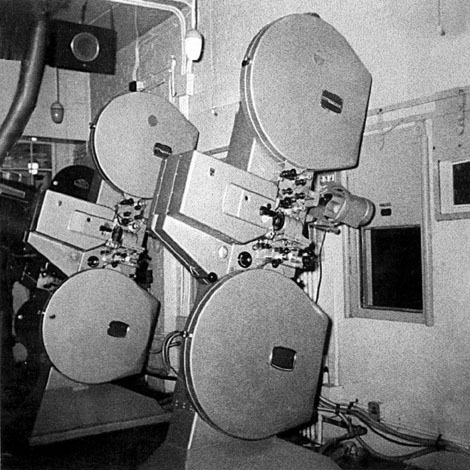
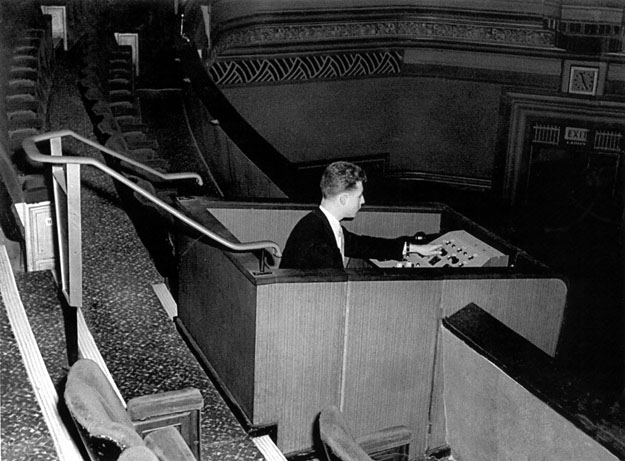
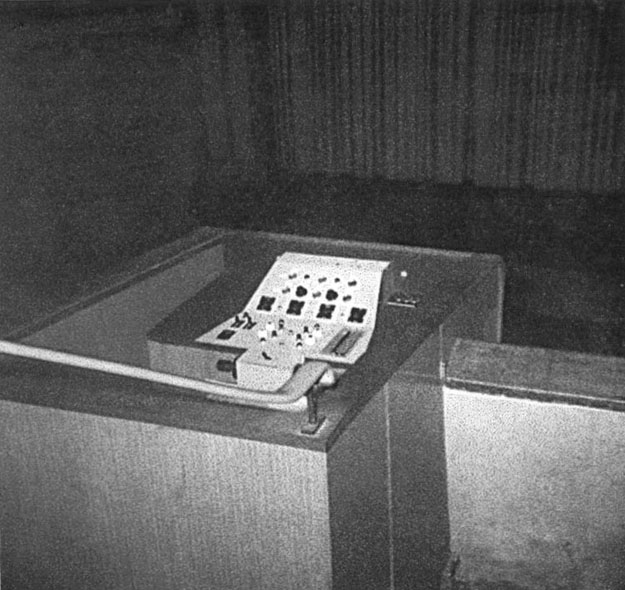
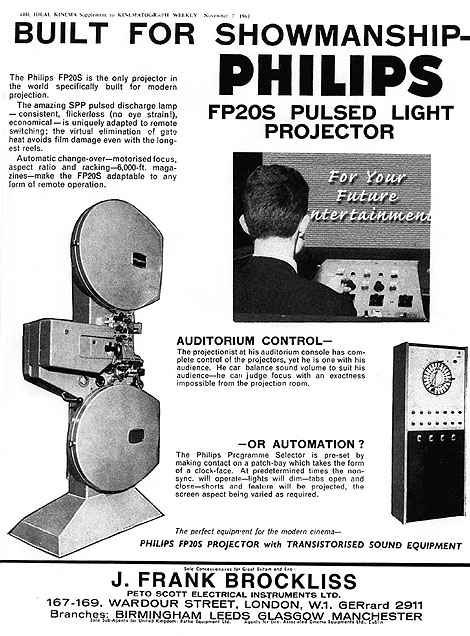
Further to James Robertson’s interesting Topic, Philips / Norelco FP 20 projectors. In 1960 Philips and Associated British Cinemas did an experimental installation at the ABC Queens Cinema Bayswater, London, with Philips FP.20.S pulsed lamp projection equipment with auditorium remote control. There would be one projectionist in the projection room for lacing up the projectors, rewinding, and standing by for any emergency. Presentation and projection was entirely from a console in the front of the circle by the other projectionist, with remote controls for houselights, 3 colour footlights, tabs & masking, projectors start / stop, lamp level adjustment, motorised framing & focus, and of course non-sync start with sound format change and fader control. With 6,000’ spools there was normally never more than two changeovers which were automatic from a single pulse on the motor cue dot, the changeover dot was activated by a micro switch on a cam timer.One of the hidden drawbacks with the system was that the projectionist could easily fall asleep, which I did on a re-issue of “Quo Vadis” on a Saturday 2nd house, just waking up in time to close the tabs for The End (no long cast lists in those days). Another unfortunate didn’t wake up at all, blank screen, everything had come to a grinding halt. The chief had to rouse him in view of a very amused audience, when a mop of black hair suddenly appeared to shoot skywards from the console like from a Tom & Jerry cartoon. Controls were not duplicated in the projection room at all, with the exception of projectors start & stop, and houselights only!
This was not to be the future of cinema, with xenon lamps and single manning projection rooms introduced. There was only a 2nd remote control installation which was at the Classic Cinema Baker Street, London, but this was short lived like Bayswater.
To quote from a manual, the SSP.800 gas discharge lamp consists of a quartz tube only 3-1/8” (80mm long), 72 impulses per second or three impulses per frame, there of course being no flicker shutter. The average life of lamp was 33 hours under full load. The average bulb life at Bayswater was between 60-70 hours, and many did upto 115 hours. The size of scope screen was 36’.
If I am able to send the pictures, I am the person pictured in the console and on the Philips advert.
Posted by William Hooper (Member # 71) on 06-29-2001, 12:14 AM:
Thanks for posting that.It's interesting to think of the fun involved with the architects when cutting out the front center section of the balcony.
It is also interesting to think about the projectionist on the balcony rail, exposing the back of his head during kiddie matinees.
Definitely a hard-hat job.
Posted by Gordon McLeod (Member # 33) on 06-29-2001, 11:05 AM:
Kalee Varamorph on the front of FP20's lucky the column didn't twist or flip over under those heavy light eaters
Posted by Mark Lensenmayer (Member # 134) on 06-29-2001, 11:08 AM:
Didn't the ZIEGFELD originally have a set up something like the one mentioned above? There was a console on the main level that contolled the presentation. I don't know how many operators it took. The remnants of the console were there when I visited the theatre, but I believe it was removed in the remodeling a few years ago. I also recall someone far back mentioning that there was still some circuit boxes in the booth from this system. I'd love to know any details from this.Mark Lensenmayer
Posted by John Walsh (Member # 168) on 06-29-2001, 11:19 AM:
"Didn't the ZIEGFELD originally have a set up something like the one mentioned above?"No, it was just an audio control panel. It was so the theater could be used as a dubbing stage for setting levels during production. Once in a while, a guy would sit there and adjust the volume during high profile films (opening nights, special events). It was rarely used, so they took it out.
Posted by Larry Shaw (Member # 388) on 06-29-2001, 11:28 AM:
Here's what I recall from about 1979 (it was already decomissioned):
-2 Prevost 35/70 projectors
-Very early ORC 4kW lamphouses with Hobart (welder) rectifiers
-An automation controlled by a rack mounted roughly 10" dia. exposed drum
-Video cameras so the console guy could see the projectors
-Console on center just forward of the cross-aisle separating the sloped-floor section from the stadium section ------------------
Larry Shaw, Chief Weasel (when others aren't in charge)
Boston Light & Sound, Inc.
North American Distributor of Kinoton GmbH
290 North Beacon Street
Boston, MA 02135-1990
Tel: 617-787-3131 x104 Fax: 617-787-4257
E-Mail: larry@blsi.com
Web site: http://www.blsi.com/kinoton
Posted by Gordon McLeod (Member # 33) on 06-29-2001, 01:22 PM:
According to Ed McCormack who was the head engineer of Atlantic Audio Visual that supplied and installed it the console controlled all projector functions focus framing motor start and changeover.
The projectors were Zies Favorite 35/70 (prevost) with xenosol 3 lamps
Posted by Bernard Tonks (Member # 809) on 06-30-2001, 11:02 AM:
Gordan: You are so right about those Kalee Varamorph heavy light eaters. The light on 1.75 wide was acceptable, but 2.35 scope was too much loss. I could never understand why ABC didn’t install Bausch & Lomb anamorphics.In reply to Jim’s e-mail: The foot lamberts never seemed to be revealed, but my guess would have been about 12fl on 1.75 wide. New lamps did always fall into place with an almost imperceptable flicker, which I only witnessed a couple of times during my short tenure. I was only on loan to that cinema during the installation and trial runs, and for a short period when the equipment was commissioned. Nice experience, but I was only too glad to get back to my permanent base theatre, and be able to show pictures again from a projection room with Peerless carbon arcs, and the newly installed Philips FP 20 projectors.
In the background of the first Bayswater picture you will notice No 1 Ross GC3 projector with a Peerless Magnarc, the pair of machines were moved to the spotlight portholes and used in this position for 3 months before changing to the Philips projectors.
The article and photographs posted first appeared in The Projected Picture Trust Magazine. Preserving The Magic Of Cinema! Visit website www.pptrust.org
------------------
Posted by Gordon McLeod (Member # 33) on 06-30-2001, 07:00 PM:
Did Brockliss go out of business or were they eventually bought out?
Posted by John Walsh (Member # 168) on 07-01-2001, 01:45 AM:
When I looked at that console (at the Ziegfeld) it looked like just audio to me... but Larry and Gordon are right on with the projectors being Zeiss; I saw one of them (with many parts removed) sitting in the back booth hallway. I spoke to a guy there that said they thought the Ziess projectors were OK, but the reason they replaced then was they simply could not get parts in a reasonable time frame. Last time I was there, they had Xetron lamps, a platter and two Century JJ's.Thanks for those pictures, Bernard! they are really cool. It's neat to see different ways people tried to bring quality to a show. It seems showmanship has a long way to go - to get back to what was done 40 years ago.
Did you ever see/read that SMPTE article about the wireless remote control? I think it was an experiment done by Rank in the early 1960's. A projectionist was given a wireless remote control for adjusting focus, framing, volume, etc. He cound walk right to the screen and set the focus. If I remember, they used Cinemecannica V8's.
Posted by Bernard Tonks (Member # 809) on 07-01-2001, 11:10 AM:
Gordon: J. Frank Brockliss eventually became Pathe’ Equipment for many years, but are no longer trading. Kinoton equipment I believe is now supplied and installed by Bell Theatre Services. BTS also supply and service Century projectors.John: Glad you liked the old pictures, I think I gave Brad a rough time when I sent them but eventually they got through. I believe the experiment with radio remote control of the projectors was an invention by a projectionist at the Odeon Haymarket, London. I seem to remember Rank stopping the use of the remote control although it did work very efficiently.
Ziegfeld: While in NYC last November, I was surprised to see so many theatres in the dark. Did some of these theatres also have cinema use but no longer viable ? Just interested as all London theatres are in full use.
------------------
Posted by Pete Naples (Member # 761) on 07-03-2001, 11:09 AM:
Bernard,Thank you for posting that fascinating information.
You are quite correct, BTS now deal Kinoton / Phillips, and also Strong equipment.