I had just finished explaining that with D.T.S., if timecode is lost for a short duration, the unit will "coast" for 4 or 5 seconds. If time-code is re-established during that time, no problem, otherwise it will default to optical.
"Does this mean", I was asked, "that if I have two trailers, the first one DTS, and the second one analog, that the first four of five seconds of the analog trailer will be muted until the DTS defaults?"
As if this wasn't enough, the smart-ass then asked:
"What if a soundtrack score called for a 1KHz note to be played for exactly one second, but the projector was running at, say, 10 % below speed (possible with drive-belt slippage on some older projectors)? Would the note, like on analog be played at 900 Hz, or would we hear the 1KHz note, but at a longer duration?"
Would someone please field these for me while I thaw my brain out in the microwave again?
To answer your second question. The dts player does not vary it's speed to compensate for a slower machine. If a machine is running to slow the timecode may not read properly plus there would be a sincronization problem. It is rare to see a projector run to slow. And if it did it is time for a new motor or get the belts changed to a slip proof gear pully system.
quote:
"Does this mean", I was asked, "that if I have two trailers, the first one DTS, and the second one analog, that the first four of five seconds of the analog trailer will be muted until the DTS defaults?"
Yes. This drives me nuts, so I usually add some opaque film in between (ie, policy tags) or try to run the analog trailer first.
quote:
"What if a soundtrack score called for a 1KHz note to be played for exactly one second, but the projector was running at, say, 10 % below speed (possible with drive-belt slippage on some older projectors)? Would the note, like on analog be played at 900 Hz, or would we hear the 1KHz note, but at a longer duration?"
Never experienced this, but I would guess one of two things would happen. (1) You would not be sending valid timecode to the player and it would not run in digital. (2) You'd get the 1kHz tone and the sound would "skip" like a CD, but maybe without the "click" since DTS has a 5ms cross-fade for timecode jumps.
I believe the 2nd question has already been sufficiently answered.
If there was a "end of file" flag, surely they would put one at the end of the feature.
Also, OK maybe 10 % slow was a little much, but assuming a slight (say 1 %) drop in speed, would the DTS be correcting itself during the whole performance? And how long would that 1kHZ note play?
#1 Disconnect the wire to the non-sync automation connector so that ONLY the dts unit can pulse back into non-sync. This of course is not desirable if you are going to run a non-dts film in that auditorium.
#2 Time out your end of show cue so that the ENTIRE blue rating band is shown (which should be done anyway). This way the automation will pulse into non-sync at the last possible second and you shouldn't have the problem any more.
With a fully uncompressed linear digital audio bitstream, you can do DSP tricks to it to cause pitch shifts, slow downs and other stuff like that. You don't really have that capability when dealing with a packeted data compressed format like DTS. The audio pretty much has to play as is. Basically, it either works or doesn't work. If the projector slows down to too slow a rate for the DTS player to maintain proper synch, the audio is just going to pop back and forth between digital and analog failsafe tracks.
For dealing with the first question about trailers, projectionists really have to be careful about just what kind of black leader they are adding to a clip. I recall seeing a DTS Digital Experience trailer played at one theater that had some damage to the tail end of it. To extend some black on the back end, they merely cut some of the lead in on the clip and put that on the back end. The result was a trailer that was virtually unlistenable. Without some of the needed time code up front, it took too long for the DTS unit to kick in. The word "digital" is already doing its flyaround gag by the time you start hearing it in digital. Then when the trailer is finished and going to black --you hear the damned beginning whoosh of the disc fixing to fly into frame. Even if the film frame on that leader is black, that doesn't mean the timecode will always synch up to silence.
I have done something similar to what Brad suggested by putting the digital default line in series with the micro-switch on the change-over so that it can only default if the change-over is up.
(Cinemeccanica console automation and Victoria 5 projector).
As Brad mentioned, there is no problem with the three deck units.
Thanks for the clarification, Bobby, btw, I have heard that too.
(Someone pointed out a few weeks ago that it may also be the studio's fault, but whoever is doing this really needs a good slap.)
I would also imagine that the playback unit will allow the timecode to become up to 3 or 4 frames off sync before it jumps. At 24fps, 1% difference in speed is .24 frames per second out of sync and it would take 12.5 seconds to become 3 frames out of sync. A 1/8 second jump (3 frames of audio) every 12 seconds with a 5ms crossfade will probably be unnoticeable. Of course, what are the chances that your motor is running at exactly 24.0 fps anyway?
When timecode is lost, the unit "freewheels" for 4 seconds or so through the rest of the file, emptying it's buffer of timecode info. It will not jump to another trailer or to another reel unless that timecode is in the buffer. It will not be in the buffer until it is read off the film by the DTS reader.
The DTS reader will not read timecode from a projector running offspeed by more than 5%. A CD-ROM is not like a record, it won't slow down, it simply stops playing.
Karen at DTS
Karen at DTS
Yes, the DTS players can work properly also when speed is more or less 5% of 24 fps. But can the player adjust its playing speed to compensate little variations? Once I tried to move with my hands the print before entering the timecode readers and the sound after few seconds changed its speed. So I thought that, in the speed range, DTS players are able to make little corrections.
About splicing analog trailers to DTS trailer, I never tried (in Italy, unfortunately, we don't have DTS encoded trailers...) but I think that if a trailer is well done it will have an "end of trailer" tag at the end of the trailer so that you'll have your player drop out of digital at the exact point where the trailer finish.
Many times I saw my player dropping to analog at the end of the show also if the projector was still runnning at the end of credits with timecode still present on the print.
Finally, if a trailer before the film is in the same file of the reel 1, cutting the trailer and adding a DD or SR trailer will cause the player to go forward with the first 4/5 seconds of reel 1. There aren't problems if after that trailer you splice a DTS encoded trailer (like a THX trailer). Karen can correct me if I'm wrong.
Bye
Antonio
What also is weird is that the UA Blade Runner 2 (Odyssey) has DTS timecode (at least the first ones did, not sure if they still do) but there was never any DTS audio for them on any disc ever made! Sounds like DTS has the Mann thing and the UA thing backwards!
As far as getting film that has timecode and no discs - like policy trailers - it could have been that they were going to make the trailer in DTS and put down timecode when the print was struck. Then, for whatever reason, the client backed out and no discs were made. We don't randomly print timecode on film for the fun of it. We only do it if someone approaches us to do their film/trailer in DTS.
Antonio, yes, DTS will compensate for speed fuctuactions with 5% of 24fps. More or less than that, DTS will not be able to read the timecode and revert to analog or never start.
Karen at DTS
Karen at DTS
I am not sure what you mean about a trailer being part of reel one. If you mean it is part of reel one of the feature, I've never seen that and we never arrange it in that way. Each and every trailer has it's own serial number and is assinged reel 14. The feature is always a different serial number and starts with reel one.
What could be happening is that some of the timecoded film for the trailer was left on when attaching the feature.
Karen at DTS
Thanks for your reply.
As I wrote we don't have DTS trailers in Italy (do you know why?). I saw sometimes some dts encoded trailer shipped with the movie, at the head of reel 1. I thought that that kind of trailers were recorded in the same file of reel 1.
Antonio
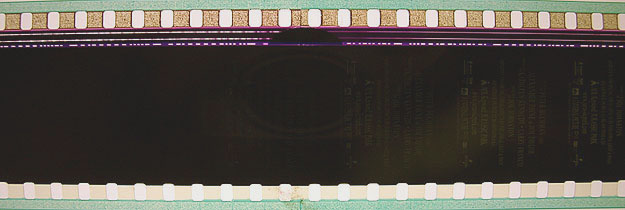
Take a close look at this. First thing is the fact that the Universal logo's audio starts on the final frames of the attached trailer's fade out. (That is hard to see in this picture, but it goes about 3 frames past the lab joint.) Next, there is a nice audio blip dead center of this picture, which means the film must be cut one frame before the titles finish fading out. Adding more problems, the dts timecode for the feature starts at the end of the trailer, meaning that if your automation is not configured to force pulse the processor back into analog or into a mute at that point, the first bits of the Universal logo will play while the 4 second dts buffer runs out. As if that isn't enough, even just looking at the analog track here reveals that the first bit crescendo of the Universal logo is completely cut off! That's right, it just cuts right in about 1/4 second too late. When listening to this splice in dts, the player couldn't get up to speed in time (with the new 32x Teac drives too), so the first fraction of a second had the Universal logo cut on from the analog track, followed a split second later by the switch into digital. These sort of errors simply can not be remedied by the projectionists. This is a lab defect.
WHAT IS WRONG WITH THESE PEOPLE AT THE LAB??? I would just love to be that guy who walks calmly into a lab, finds the guy responsible for this continuing nonsense and gives him a good slap in the face followed by my yelling "WAKE UP!" in his face. 
Brad, if that is the cut negative that was supplied to the lab, the fault likely lies upstream of the lab.
------------------
John P. Pytlak, Senior Technical Specialist
Worldwide Technical Services, Entertainment Imaging
Eastman Kodak Company
Research Labs, Building 69, Room 7419
Rochester, New York, 14650-1922 USA
Tel: 716-477-5325 Cell: 716-781-4036 Fax: 716-722-7243
E-Mail: john.pytlak@kodak.com
Web site: http://www.kodak.com/go/motion
John, who is responsible for doing this? I see it on basically everything that comes out of Deluxe labs. I don't think I've ever seen it from Technicolor labs, which is why I am pointing my finger towards someone at the lab for now.
The trailer could be part of the original cut negative, in which case it would be carried through the answer print and the duplicate negatives and release prints along with the feature.
Or the trailer duplicate negative and sound negative could be added to the printing negatives at the last minute in the lab. If this were the case, I would expect to see the image of an ultrasonic frameline splice in both the picture and soundtrack negatives, 21 frames apart, as that is what the lab would have to use.
------------------
John P. Pytlak, Senior Technical Specialist
Worldwide Technical Services, Entertainment Imaging
Eastman Kodak Company
Research Labs, Building 69, Room 7419
Rochester, New York, 14650-1922 USA
Tel: 716-477-5325 Cell: 716-781-4036 Fax: 716-722-7243
E-Mail: john.pytlak@kodak.com
Web site: http://www.kodak.com/go/motion
I believe that at the present time, we are only doing trailer discs for North America only. The disc is a subscription item that the studios pay for and, so far, no deals have been made to territories outside North America.
Karen at DTS
This point needs to be made then. As you say, there are no trailer discs for outside USA. Our unattached trls are about 98% dts-less and even the attached trailers are the same in almost all cases.
So, that means we have to go straight into the dts tag from analog or SRD, and the lead in time given on the Sonic Landscape tags is not sufficient for the discs to get up to speed and allow for the CP500 to switch to dts. So the first note of the piano is invariably played in SR analog. I tried to leave as much leader attached to the tags intact, but found I was limited by very small imperfections (a series of dots) in the analog track which has to be removed and thus made the dts lead-in time much shorter.
Any chance when these tags are done again before the next print run there could be a bit more lead-in?
John
------------------
"If you think THIS is fantastic...wait until you see the full effect with the HIMP!"
- Chief Inspector Clouseau.
So it was not my unit and/or my Sonic Landscapes Trailer... 
I noted that Sonic Landscapes started "while" the first piano note was playing and that there were some noisy during first moment of trailer if played in analog...
I feel better... I thought that our unit was defective again...
Bye
Antonio