This is topic Shutter Problem in forum Film Handlers' Forum at Film-Tech Forum ARCHIVE.
To visit this topic, use this URL:
https://ft-forum.com/ft/cgi-bin/ubb/ultimatebb.cgi?ubb=get_topic;f=1;t=002452
Posted by Mike Carro (Member # 232) on 07-04-2001, 11:15 PM:
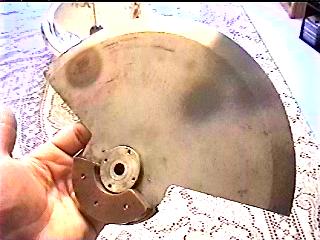
I have a Crown Nichion 35mm/70mm projector. I'm told it's very similar to a Norelco. The problem is I get ghosting on the top and the bottom of the picture. These projectors came from a drive in so I assume they wanted as much light as possible. But for a home screening room it sucks. I'm going to attempt to email the pictures so they can be posted here. My question is there another brand shutter that will work? I think if I could get a 180 degree shutter, it would fix the problem.
Thanks. 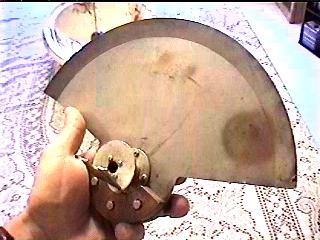
Posted by Mark Gulbrandsen (Member # 72) on 07-04-2001, 11:54 PM:
I had a pair of these projectors too at one time. They are in a museum now. The best thing to do for these is to go to a metal spinning shop and have two new shutters spun from alumnium sheet. The DP-70 shutters are similar but not the same. 180 degree would work fine. These may also still be available from Japan if you can locate a technician over therethat knows how to locate them(there must be a Wolk type of place in Japan). I have the manuals someplace if I can find it. For this special type of shutter it is almost always cheaper to go to a metal spinning shop than to the manufacturer. I have gone this route in the past for DP-70 shutters. They ended up costing a tenth of what Arriflex wanted back when they distributed Kinoton.
Also be careful as these have to be carefully balanced. The present counterweight is probably good enough for a 180 degree shutter but then it may not be quite enough, just be careful. If this is not in balance you will tear up the fibre shutter drive gear. Then its off to a gear shop as this is the only place you could get a gear for them.
Mark @ GTS
Posted by John Pytlak (Member # 331) on 07-05-2001, 08:49 AM:
Theoretically, a conventional maltese cross "Geneva" intermittent movement requires 90-degrees of cam rotation to completely pull each frame into position. In practice, the film may actually be moving slighty for even more than 90-degrees, plus there is always a bit of "play" between the shutter and intermittent drive. Going to a wider shutter blade reduces the risk of travel ghost, at the expense of some light efficiency.For your projector that uses a single blade shutter rotating at 2880 rpm, a 180-degree shutter should help eliminate the travel ghost you are seeing.
------------------
John P. Pytlak, Senior Technical Specialist
Worldwide Technical Services, Entertainment Imaging
Eastman Kodak Company
Research Labs, Building 69, Room 7419
Rochester, New York, 14650-1922 USA
Tel: 716-477-5325 Cell: 716-781-4036 Fax: 716-722-7243
E-Mail: john.pytlak@kodak.com
Web site: http://www.kodak.com/go/motion
Posted by Jerry Chase (Member # 660) on 07-05-2001, 09:34 AM:
I remember having similar problems with the DP75 models, where slight travel ghosting occurred both at the top and bottom of the screen on high contrast credits. Mechanically, I never could figure out why it was happening, as the shutters were full size and when I did hand rotation there was plenty of coverage before and after pulldown.I'll admit that since most people didn't notice the problem and the shutters were full size, I let it slide and haven't thought much about it for years.
Looking at the pic of the shutter, and remembering the layout of the Norelcos, I'm wondering if something else might be the culprit. The light colored shutter and a light colored housing might allow enough light bounce to partly illuminate the image during the pulldown phase. I wonder if just painting the light side of the shutter a flat black could improve the image?
Posted by John Pytlak (Member # 331) on 07-05-2001, 09:45 AM:
Jerry said: "The light colored shutter and a light colored housing might allow enough light bounce to partly illuminate the image during the pulldown phase. I wonder if just painting the light side of the shutter could improve the image?"One way to tell would be to advance the unloaded projector slowly by hand while putting light on the screen (you may need to prop open the centrifugal "fire" shutter). Be careful to limit the light to only a few seconds, or you may damage the lens or shutter with the high radiant energy! If light is "bouncing around", you would see light on the screen when the shutter is supposed to be blocking all light. But anodizing or painting the shutter black will make it absorb much more energy, and may result in it overheating and warping.
------------------
John P. Pytlak, Senior Technical Specialist
Worldwide Technical Services, Entertainment Imaging
Eastman Kodak Company
Research Labs, Building 69, Room 7419
Rochester, New York, 14650-1922 USA
Tel: 716-477-5325 Cell: 716-781-4036 Fax: 716-722-7243
E-Mail: john.pytlak@kodak.com
Web site: http://www.kodak.com/go/motion
Posted by Jerry Chase (Member # 660) on 07-05-2001, 09:53 AM:
"But anodizing or painting the shutter black will make it absorb much more energy, and may result in it overheating and warping."Good warning, John. Hopefully that wouldn't be the case in a screening room using a less intense light source. Judging from the hot spot, someone has already opened the zipper without the motor running, which can be a good way to warp a shutter whether it is black or not.
Posted by Gordon McLeod (Member # 33) on 07-05-2001, 10:01 AM:
One possibility is that the cone of light is overshooting the shutter since it is possible on some euoprean projectors to have problems with working distances on northamerican lamphouses
I had a problem once with a christie and a DP70 where we had to have the lamphouse to far back to make it fit and to get a flat field we had to overshoot the shutter by defocusing it
Posted by John Pytlak (Member # 331) on 07-05-2001, 10:14 AM:
Thanks Gordon. It's worth mentioning that the shutter is normally blocking a "cone" of light, and depending on the distance between the shutter and aperture, the shutter may not "cut" the light cleanly. Just another reason you may need a shutter blade slightly larger than "theory" says.------------------
John P. Pytlak, Senior Technical Specialist
Worldwide Technical Services, Entertainment Imaging
Eastman Kodak Company
Research Labs, Building 69, Room 7419
Rochester, New York, 14650-1922 USA
Tel: 716-477-5325 Cell: 716-781-4036 Fax: 716-722-7243
E-Mail: john.pytlak@kodak.com
Web site: http://www.kodak.com/go/motion
Posted by Mike Carro (Member # 232) on 07-05-2001, 06:38 PM:
Wow, thanks for all the tips. I think I will take Marks advice and find a sheet metal shop to see what they can do. As for the light I'm at over kill with my 1000watt xenon. As for spare parts I have a complete second projector that I used to use with changeovers but have since simplified to one machine and use the other for parts as the condition arises.
I have another question. The crowns have a curved gate. I have a hell of a time focusing film. I used to have a Motiograph and it focused perfect. Is this a problem innate with curved gates showing on a flat screen? I wonder if there are lenses available for the different type gates.
Posted by Will Kutler (Member # 770) on 07-05-2001, 06:45 PM:
Hey guys,Why not experiment with an adjustable blade such as on the E-7?
Having a sheet-metal shop spin on can be expensive, as a form will need to be made. Plus properly balancing the thing.
I know one old-time very talanted craftsman who was forced to scratch build his own shutters for a rare restoration project. Used simple/basic sheetmetal tools.
Posted by Gordon McLeod (Member # 33) on 07-05-2001, 06:48 PM:
The gate may be worn so that the film lying in the focus of the lens
Also heat could be fluttering the image especially since christies can be hard to get at the right distance with the NorelcoAAII
I recomend glueing velvet bands to the gate rails
Posted by Will Kutler (Member # 770) on 07-05-2001, 07:02 PM:
Gordon,Would using velvet not cause a dirt/lint problem for the film?
I remember that the lateral guide sound drum pressure roller on the RCA soundheads were felt at one time, and they were discontinued because of oil and dirt problems.
Diffirent applicatio but similar potential problem?
Posted by Gordon McLeod (Member # 33) on 07-06-2001, 08:50 PM:
Velvet bands are standard on ernamann and were an option on the DP70 from day 1
Posted by Mark Gulbrandsen (Member # 72) on 07-06-2001, 09:04 PM:
Believe me, having them spun by a local metal shop is THE ONLY way that shutters for these projectors can be made. The form is no big deal at all. It is made as a circle, the metal spun, and then machined to the same shape as the old one except it will be 180 degrees. The original counterweights can be removed and installed on the new shutter very easily, just be sure that the new metal is the same as the old....thickness and alloy. I've been there,done this. It IS the only way. Simple sheet metal shutters will not suffice here as the edges are folded out to clear a part of the trap. A pile up of a shutter will ruin at least several fibre gears in this machine.
I'd bet they would cost no more than 100.00 each to have made. The main thing here is to do the job right, not half assed. Also do not have them anodized or blackened. It is better to reflect the heat back off from the shutter.
Velvet gate bands are great. I've used them on my dailies machines, and on my VV machine.
Mark @ GTS