
Well-designed and properly maintained platter systems or tower systems can both be used with low risk of film damage.
------------------
John P. Pytlak, Senior Technical Specialist
Worldwide Technical Services, Entertainment Imaging
Eastman Kodak Company
Research Labs, Building 69, Room 7419
Rochester, New York, 14650-1922 USA
Tel: 716-477-5325 Cell: 716-781-4036 Fax: 716-722-7243
E-Mail: john.pytlak@kodak.com
Web site: http://www.kodak.com/go/motion
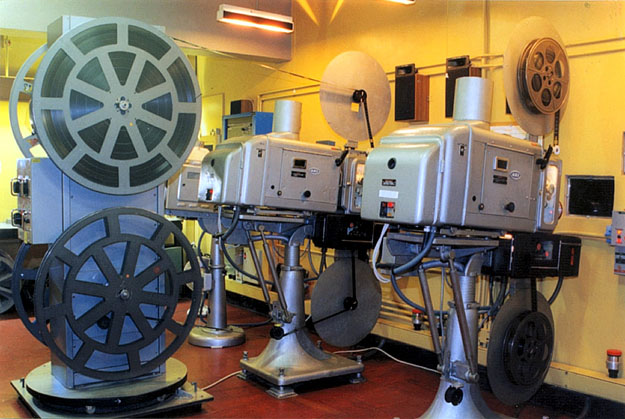
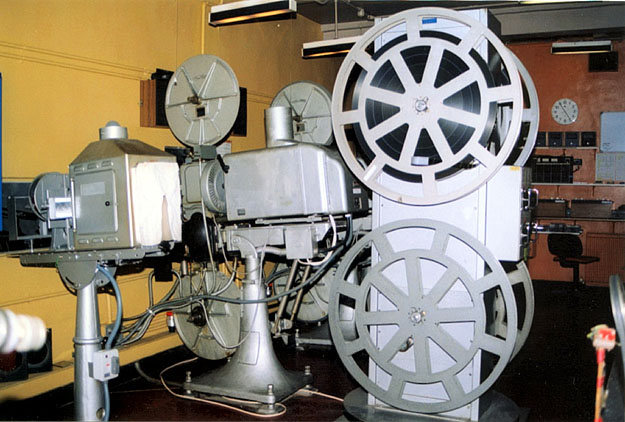
The Westrex Towers I found the Premire spool hubs were too small and after a while by lifting the fully loaded spool,the spool flanges would buckle.
Long Play Towers are fine for one off screenings or where space is limited, but the platter system is far better (if used correctly) for handling prints.
As for the Cinemmecancia CNR platters, they are fine as you can make or break up prints on any level, but that friction brake they make is a waste of time.
The best make of platter in my view is the Philips/Kinoton.
For one, the 14,000-foot reels were just too damn heavy to fool with, and I had to roll them along on the floor when the show was moved to another auditorium. Then, you had to have the strength of a truck driver to mount those heavy reels on the tower. The rewind clutches always seemed to give a problem, and I understand the weight of the film could seriously damage the innermost convolutions.
The other major problem was on start-up, the towers could not ramp up properly if you had a fast-start projector. We had to slow our motors down to a start-up crawl by placing a rather large "dog bone" in the start winding, and that made the motor ramp up to full speed in about 7 seconds. And, if the clutches got goofy in the towers, we had to give them a shove at times to help them along. The end results of inexperienced operators was always the same: Lots of *snaps* and breakages in the leaders and previews. Many times the mylar leader was rendered useless due to distortion, etc.
The towers I am reference to were the Cinemechannica towers. When I ran relief operator for the Oakland Local in the '70's, some theaters were equipped with them. The Victoria had a 3-step start-up (low-median-run) so the tower could ramp up with the projector motor without busting the crap out of everything.
The Eprad Sword was a little more forgiving, but it was still a major pain in the butt when it came time to mount or dismount the print. Of course, this was in a drive-in, so we really didn't give two hoots about the print anyway. They were junk prints when we got them, and they were still junk prints when we shipped them out.
The Cinemachannica Towers were finally taken out of service and sold for 50 bucks a pop. Platters took their place.
The Eprad at the drive in went the toast route, and we replaced them with 6,000 foot reels running with BX-60's. Very nice combination.
It was a relief to see those towers find their way to the landfills.
Just my $.02 worth......
Paul
Is that blood on your finger from a patron?
Two good points about towers:
1. I Never worried about scratches on film, just didn't happen, i only started having to worry on the change to platters.
2. You can rewind! sounds simple but imagine - bulb goes off, 5 minutes before someone tells you, so you can go back five minutes and show the audience what they missed. Also - Show starts, 15mins later and still nobody has come in, hell you can just stop, rewind back to the beginning, and load up the next show, no need to run the hole thing through.
Although for number 2 my only experience with platters is CFS (i know those suckers inside out, but have no experience with other makes) so forgive me if there is a platter system that can 'rewind' although i'm damn sure its not possible!
A very lucky projectionist to miss that happening!
Aaron
The Westrex (5035 Film Carrier)Tower is controled by three variacs, one controls the pay off, the other for the take up. the third is for rewinding.
The Variacs control the current to the motors, and with the (Double Sided) can be four (two each side).
------------------
My Tower 'horror' story is not really a horror story but its close. We were running a movie of a Cinemecanica tower system, and as the projector started (trailers on the other projector) for the changeover the film snapped at the bottom roller of the projector. Since there was two of us in the booth we decided in an instant not to stop. My mate went to the tower and started to reattach the film to the takeup reel while I took up position at the bottom of the projector making sure that the film fed out ok and didnt get looped or knot up (and tried to minimise the amount of film on the floor). Suffice to say after about 5 mins we caught up and kept the show on the sheet!. Ran it through the film cleaner afterwards and did a nice splice and all was ok. Try doing that with a platter!!!!
regards
Steve Brown
You asked if anyone was using Cinemeccanica machines with platters. I use 4 Victoria IVs and 3 Victoria 8s all with Strong platters (4 are the A3 model and 2 are the AP3). I like the Strong system. I have had very little problems with them. And don't even think about trying to take my Cinemmecannica Vic IVs away from me. I like 'em.
You can have the Vic 8s if you want.
Platters combined with a quality automations system (properly
installed) and well maintaned projectors make for a nearly trouble free booth.
Fully loaded, they probably were pretty damned heavy. Were the 48" reels the ones commonly used on the Eprad Wall-MUT? The reels I have always seen on those seemed pretty damn large.
Aaron
Done it. The beauty of a platter is of course that you have a nice smooth, constant takeup tension, so I've never actually had a film break like that. I have however been in a theater where the leader to trailer splice was so poorly made that it caught in the failsafe and started dumping film onto the floor. I caught it during the second trailer (timer starts, 1 projectionist running two complexes) and was able to prop the failsafes up with a Q-tip while I got the film back onto the takeup platter without ever stopping the show. I fail to see your beneficial argument over towers vs. platters though. The takeup on a platter and tower is the same thing, just one is turned horizontally.
Its not very difficult if there are two of you, but if your on our own, it's a bit harder!
Also, with a 4 or 5 deck platter, you can have up to 4 separate programmes in one hall without having to lift a print. And each one up to 270 mins long, too!
We quite often have alternate programmes in our cinema (Film A at noon, Film B about 3pm, Film A again about 6pm and film B at 9pm). Which means, using platters, we can join both shows together, trailers and ads too, into one giant roll of film requiring only 2 lace-ups per day. Quite handy when it's down 2 flights of stairs, through a screen, down more stairs, through the foyer then up three flights of stairs!!!
Just out of interest, what's the longest running time you’ve dared to put on a platter OR tower?
I did see an abnormally large film being shown on a tower - it had been slightly raised off the floor and the take-up spindle had been extended or offset somehow so the reels wouldn't clash. They were using 12k spools but running far too much onto it (not recommended!!!)
PLATTERS:
(Single Features)
Branaugh's 'Hamlet'(Estar) and 'Das Boot: The Director's Cut'(acetate) on a 48" CFS Super Platter took it to within 1/2" of the edge.
'Amistad' on a Christie MW3 Miniwind (42" discs) came to within 3/8" of the edge.
I have also placed double features on AW2, AW3 and Norelco platters that came pretty close to the edge as well.
TOWERS:
'Amadeus' overfilled the reel by about 4" on the Cinemeccanica DGB tower (and amazingly stayed put) Usually i would split looong films like that in half.
Aaron
I've run 'Pulp Fiction' with 10 minutes of ad's on a Westrex tower, using a small hub Rigby spool, adds up to about 163 minutes. It is within about 1/4" of the edge. I used to use the 'tri-pair beer mat theory' to extend the spool capacity for one off screenings. Basically you gaffer tape pairs of beer mats (unused!) around the cheeks of the spool so support any over the edge film. Not something I'd dream of doing regularly, but for something like '2001 A Space Odyssey' starting at midnight, it gets you home a smidging earlier. 2001 was of course, tri-acetate and that went slightly over those same small hub spools. (36" O.D.)
Danny, We also used to get excited about the fact you could put two features together on one reel on the platter, before we realised what a bloody hassle it was at the end of the week when one was going to one screen and the other, well to another! I think it lasted one week. Why make more work for yourself in order to shave a couple of mins hassle?
Tell Eric I've recently been on the receiving end of a Simplex pedestal, painted blue... If he'd like it back for the boiler house, where it came from!! I'm sure he could make MAXimum use of it, as it's travelled all over Scotland.
I encountered Georgia recently - what a misfortune!!! I would never revisit anything resembling Georgia ever again.
I know very well the pedestal you refer to, and I was glad to see the back of the thing. At last I could align Eric's lamphouse correctly. Oddly enough some philistine has painted the Westrex one I replaced it with a truely awful shade of blue. Some things never change. I thought MAXimum use had already been made of it. Might make a good ships anchor!
I've not encountered Georgia for some time now, that's me and my low profile for you!
I have VERY little problem with them.
While rewinding is a pain, the flexibility is affords is priceless.
For instance, I had an exiter bulb go out on me one night. I always have an extra ready to go, so that was no problem, but what my customers absolutely LOVED was when I annouced that I was rewinding the film a few minutes to make sure they didn't miss any of the movie.
Never before have I gotten so many positive comments about a show interuption. The "other theatre in town" could never do this with their platter systems.
I have 48" reels. Switching movies between houses is a breeze (although you have to be able to lift about 80 pounds ). The only thing you have to watch is that you don't bend the reels when you are moving them.
I think the largest movie I've run was "Lawrence Of Arabia". For that one I made sure to grease the bearings well before hand, since there was so much tension on them.
Tony
Cya
Darren
-Claude
As for tower from hell try servicing a "Tall Texan Tower" for fun 
I think the Waikiki Twins has always used the regular full size platters and if Chris Siu who worked at the Twins would be kind enough to confirm this, that will be great. All I remember my friend telling me that a 70mm print was offered but the company had to decline because of the inability to play the entire movie without pausing for an intermission. What is at the twins are the same size at another friends booth when he had to fit the entire "TITANIC" print with four trailers on to a single platter and how nervous he was everytime he had to run the film at his theatre. It is very amazing how a movie like "TITANIC" that takes a full platter can fit on to a single sided DVD. Wow!
-Claude
well as far as DVD's go with the type of compression used and the abillity to use duel layers. (When the laser reads the disc it gets to the end of one layer and starts reading the second layer going back in the other direction.) Wow is right.
The fact that the lamp house can sit on this thing with not much more space taken up by a regular pedestal makes it absolutely ideal for a small booth. I have a booth in a small 140 ft theatre -- and I mean SMALL. This unit would be the only way the booth would be used for 35mm projection -- a platter would never work; even 6000ft reels would be too high. Since the Sword unit itself is actually the rewind table, that is even more space that it would save.
I also heard, but never saw, so perhaps someone can confirm, that Eprad made a caddy with wheels that was able to slide under the reel, much like a car jack. The handle would be turned and a clamp would come up and meet the bottom of the reel. The reel would then be rolled to the storage bin -- no lifting involved at all. I would like to see one of these things.
Frank
Pete, I am OVERJOYED when I find the roadshow elements still in the cans -- consider that Good Fortune as they are precious as gold! Many times they are just 'gone with the wind,' just like all the music-in-black from that title usually is, leaving music crescendos chopped off, opening music missing and Intermission titles gone.
These people who distroy roadshow print elements out of laziness and/or incompetence need to be forced to E A T equal amounts of estar junk footage. Or be flogged in public. Or barring that, be forced to watch GLITTER over and over. Or maybe 'N Sync (or is it Lip-Sync?) "music" videos for a week.
Once when I prep-ed MY FAIR LADY, I found all that material missing; I was so upset that I had to go out an relax for half an hour before I could face the booth again.  A gets kid gets caught jumping over a turnstile in the subway and he gets hauled off by cops and spends a night in jail for theft of service -- a $1.50 token. Same should be applied to a projectionist who deliberately robs a print of essential roadshow elements. Cops marching the SOB right out of the projection booth in handcuffs....and never mind protecting his head as he gets into the police car either.
  Bet if that happened a few times, you wouldn't find film missing from prints very often.
Frank
I always made it a point to add a little extra leader to those rolls and very clearly write on there what the film on the roll was. For example: "Reel 1 with 5 minute orchestral intro on black picture". It was hoped that would help clear things up for the next guy who played it.
As for platters being more difficult with respect to changing ads etc, then I will disagree. With a bit of forethought, and the right equipment it is possible to change ads in seconds on a platter. In order to make up ads for platters I modified a 6000’ spool to handle platter take up rings. I simply removed one side of the spool, drilled two holes for the platter take up ring plates and we could make up the ads on the rewind bench. As for changing the ads, all you had to do was make sure you inserted a spacer into the film as it wound onto the plate after the end of the ads and when the old ads were removed at the end there was plenty of space to insert your new ad reel.
There are also lots of other little tricks that make using a platter easy, allowing ads to be put in when you have forgotten the sponge, or how to deal with a situation where you stop and want to rewind the film slightly, but I will refrain trying to explain for safety’s sake.
The longest thin I ran was a French Art Film double bill that left about ¾” on the edge of the plate. We inserted black leader between the two to allow for an intermission, although on a least one occasion it was forgotten and the whole thing just ran through.
In my first venue we ran changeovers on 6000’ reels and due to a lack of reels and no budget (this was a student film society in London) we used the extended spokes technique (i.e. bits of card taped on like Peter was suggesting) to ensure we could get that seven reeler on only two reels (polyester was still uncommon at the time).
I believe both systems, if used with care, in the correct situations will do the job.
------------------
Martin Dean
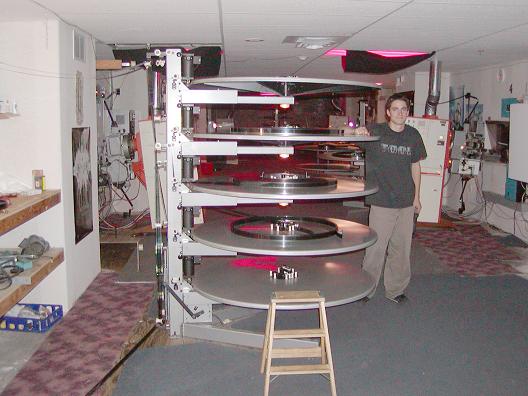
Two-speed Micro-switches on removable pay-out heads.
Brad, this is a Xetron XNR-535 1984 vintage platter. I bought two of them for Cinema 5 in Mount vernon. Upon the final closing of Cinema 5, I transplanted them to River City Cinemas in Post Falls, Idaho. I took this picture yesterday. It is one of the most trouble-free platters I ever worked with. The projectionist in this picture will be joining us on Film-Tech very soon.
The upper platter might looked warped. Since the out-riggers are adjustable, the projectionist (Byron Bridges) and I were able to "true it up" with minimal effort after this picture was taken.
By the way, I have had the chance to play with some of Strongs's SCDC platters this week and I am exceedingly impressed with their payout design! (Not the actual design of the brain, but the manner in which the speed of the platter pays out the film.) Now if only they would fix my other issues with the machine they would have one damned impossible to beat platter. Until then though the rating remains a solid F!

Inside those pods, they have big dog-bone resistors that can "fine-tune" the feeding almost right down to a gnat's butt. If you saw these Xetrons well-tuned and running, I am sure you would at least give them a grade of E!
When Xetron came out with these machines, they used magnetic reed switches. Those failed very quickly, and were re-fitted with very light-pressure micro switches. Those switches were so sensitive that, if someone were to blow on the pay-out control, it could actuate or de-actuate the the switches because of the mechanical advantage of the pay-out control arm. When the the variable dog-bone resistors were set up properly, the pay-out just seemed to "float." No violent whipping, jerking, or anything like that we see today with micro switch platters. Just smooth......If these old Xetrons ever threw a print, it was because they were grossly out of adjustment. Just like the AW-3 (if set up properly) it would almost be impossible for the early-to-mid 1980-vintage Xetron's to throw a print.
Xetron had two other problems, one was with the with the drive wheels. That was solved with a new style. The other problem was the pay-out head locating pins could fall out. A good machine shop would correct that. After these improvements, they just ran and ran and ran just like a swiss watch. Three problems with design upon introduction? Hmmmm...not too bad considering all the feeble attempts other manufacturers tried to make a good machine!
No LED's, SCR's, Triacs, DC power supplies, blinking lights, phase controls, or other electronic crap that usually fails on a Friday night during a full house was present in that machine. All it had was lots of wires, huge over-rated radio transmitter resistors, a variac, and switches.
But, I will admit, much has happened in the platter industry that makes some of today's platters a little better - but not as long. The AW-3 is a fine machine, but it has too much electronics in it to do the job. I want something that I can fix if it dies, just like an old Chevrolet, Ford, or Chrysler without having to buy a $200.00 part and waiting a minimum of 24 hours to get it, or calling a tow truck. To hell with all this computerized crap! I like to fish stuff out of my junk laying around in the booth and have the machine running in 10 minutes.
Personally, I wait for a while and see how they do. When they prove themselves over a period of time, then I will buy it.
The true test is going to be in the "Long Haul" - not just one or two years.
Example....Phase controls. They start losing it in about two years or so.
Time will tell.
And you said about platters: >No LED's, SCR's, Triacs, DC power supplies, blinking lights, phase controls, or other electronic crap that usually fails on a Friday night during a full house was present in that machine. All it had was lots of wires, huge over-rated radio transmitter resistors, a variac, and switches.<
Yup. I use the simplest of all film trasport systems so far: the reel-to-reel transport -- it never threw a print, never had a brain-wrap, no wires, no resistors, variacs or switches. Only thing to adjust is a felt pad and the lenght of a piece of rollothane. Simplicity itself. And of course, a well maintained human being to make change-overs.
As to the SCDC...I'll take one of them over the XNR platter any day and twice on saturday..Furthermore, I'll be willing to wager the SCDC will still be standing tall 10 years later. The SC part of the SCDC is the "self-calibrating" part. We have been installing them for years and not ONE has needed any calibration nor repair part whatsoever. Thus far, even the drive tires have been going strong (no pun intended).
The XNR, depending on vintage will throw a print due to its jerky operation at the end...the motors have more torque than they need for such lightweight decks. The microswitches are definate wear items as are the cheeseball phone plugs. Another silly part of the XNR is that the "rest" position for the centerfeed has the payout in its "slower" speed postion (film itself has to push one microswich to the off position).
I have modified the only two XNRs we have to have two slip rings on the power resistor so both top speed and low speed can be set. Also I have a series resistor in line to take the torque out of the motors...since doing this...no more thrown prints.
Steve
------------------
"Old projectionists never die, they just changeover!"
You have to remember - these machines are close to 20 years old now, and like I mentioned, there are better things out there now although it takes more money to keep them running. After the factory recommended changes in mine were installed over a 1 year period, I never bought any parts to support the machine. We didn't need to. When we sold to Plitt, Plitt's crew ran them into the ground. When Plitt went bankrupt and we got our theatre back, the platters were really beat to a pulp. Busted spindles, (his people must have used them as a step ladder), warped discs, broken pay-out heads, you name it. All was due to negligence on the projectionist's part for about a 8 year span.
It costed us about 100 bucks to get all the spindles refurbished, and another 25 bucks or so to repair the smashed pay-out heads. Try to beat that that with an electronic Strong or Christie. By looking at the condition of those platters when we got the theatre back, I'll bet it would have costed close to $1000.00 or more to get an electronic Strong or Christie back on their feet again.
Like I mentioned before, let's see how many dollars it takes to keep the the SCDC machines running like new 10 years from now. Until it proves itself, I'll settle for a new AW-3R, a 1984 Xetron, or a late-model micro-switch Strong/Potts machine. If and when the SCDC machine proves itself to be a simple machine that will run for years without investing a ton of money to keep it running, then I will be happy have and use them, but not until then.
You are correct. Some Xetron vintages are crap. Total crap indeed because of those old style drive pucks that would separate, and those funky reed switches that were a disaster from the day one. I think it was 1985 or 1986 Xetron changed the entire design, (probably to keep up with Christie) and really produced a hunk of raw garbage. Mine were 1984 vintage.
By the way, what else don't you like about them? But remember, they are old, and compare them with shit that hit or was in the market at the same time. There was tons of that stuff - like Potts, CFS, Eprad, AW-2's, and some other off-the-wall stuff that never really took hold. Throw in the old ORC's that used a 10-turn potentiometer on the pay-out, and the old Drive-In Manufacturing Company that built the LP-270 (which really was not that bad of a machine.) What else was out there then, besides the AW-1 and Simplex Air Platter? I don't think Strong had one then, did they?
This reminds me of the EMD Diesel Engines. The current 645 V-16 EMD engine block comes from 1938 technology, and it is essentially the same block used today. They know....if they have something good, why change and screw it up?
Washington State Ferries, for the most part, use 1938 EMD technology. Whenever they try to make it better, all they accomplish (it seems) is ramming the dock because some stupid SCR failed or their computer program controlling the propulsion system crashed.
I am old-fashioned. I was not born with a push button or a computer keyboard hanging out of my butt like the kids in the mid 60's and beyond...
I am not opposed to new technology. I will just wait until it proves to be reliable, dependable, and yet be relatively inexpensive to maintain.
Titanic nearly filling a platter vs a DVD: Hardly reflective of the amount of image info there. Since this was a Super 35 production and given that print stock is capable of greater rez than negative, audio requirements aside a slight reduction and repositioning of the Super 35 extraction into 2-perf Techniscope format would have cut that footage in half while still carrying all the resolution (not that Techniscope was ever a projection format).
There is a new engine--for the first time a 4-stroke-cycle design--called the 265H but it's having teething problems.
*********************************************************************
Thank you, Steve. You said it better that I did. The key words are "but it's having teething problems."
Now you all know why I lay in the weeds and observe its cost effectiveness, maintenance and reliability before I buy a new contraption...
It does not make any difference...from a damn locomotive engine to a Dolby CP-650 including a SCDC platter....it is all the same shit, only on a different shovel. The key words now are "Not so fast in buying, Dude!"
Be patient and let it prove itself over several years before you take the plunge. To me, it is basic common sense.
Whereas the AW-3 came out around 1979, I'd say it classifies as a vintage piece. The SPECO (DITMCO) LP-270 was around is way better than the XNR. As for cost of operation...the SPECO platters are also on the low-cost side. An occasional magnetic reed switch or SCR. Nothing big.
I predict the SCDC will still out do the XNRs in longevity.
Steve
------------------
"Old projectionists never die, they just changeover!"
As far as the SCDC is concerned, it just might do as you say. But as for now, the jury is still out. I want to give them a little more time. When new construction happens, I would definately want to consider the SCDC machines because so far, I have had some very good feedback on them.
I had some good feedback on the phase controls until they started taking a dump 2 years later. Then, as the Late President Harry Truman said, "The manure hit the ventilator."
One year Harley-Davidson came out with a new Electra-glide. It looked just like the year before it. Only one problem....that particular year had a bad engine. They were fitted with "soft" crank pins. Just like clockwork, at about 10,000 miles the engines were in a serious need of rebuilding. Mine came out 1 year later, and I bought it new.....it didn't have a soft crank pin. It had a soft clutch push rod that would mushroom out very faithfully once every 4 months to the point where it was impossible to dis-engage the clutch.
What looks nice is not necessarly nice....
Even in microswitch form, they are brilliant. The admittedly new IR payouts, while new, seem even better.
Best platter I've ever worked with - micro or not. Serious.
The SCDC and it's predecessor, the DMC have now been out for a few years so they are starting to get some "time-testing" but do what you feel is best.
Steve
------------------
"Old projectionists never die, they just changeover!"