 ) but that eventually passed and I feel as comfortable threading one backwards as I do any other machine.
 I could tell from the trailer - which I saw earlier in the week - that this was video sourced and not film-originated. Even on the rewind bench, studying the individual frames, one can spot the visual differences from a traditional movie. Still, I look forward to seeing this one because it was shot by John Bailey, ASC, one of the truly great cinematographers working today, so it will be interesting to see the results that someone like that can obtain from the video medium.
From watching the trailer, the immediate giveaways that this is not film are the way that motion is captured, and the way that highlights blow out rather than being rendered gradually. Also, there is a 'ringing' around edges which is remarkably different to the way that film stock renders edges. Overall, there is a sterility to it which I find disconcerting and certainly a lack of true resolution which is replaced by the overemphasis on contours. Sometimes, it is impressive when using soft lighting and low contrast, and it's pretty good for what it is.
This brings me to my question: Is there any reason to believe that 'Star Wars Episode Two' will look any different from 'The Anniversary Party'? Is the camera or tecnnology that Lucas is using better somehow? If so, in what way? Essentially, if it is the same, I can't believe that they would settle for it for a production that large.
Would anyone like to speculate on what we might expect in the future that might dramatically improve on what I saw? Will it reach the point where the differences aren't obvious?
From what I have seen thus far, video cannot match the look and feel of film, even if the resolution approaches film. Motion and grain structure just seem too different with photochemical and electronic means of acquisition.
The 'Anniversary party' was shot using a Sony DSR-500 camera, this is a standard definition digital video camera (480 visible lines for NTSC and 575 visible lines for PAL). It uses the DVCAM tape format which is exactly the same as miniDV with regards to data. They may have used the DSR-500WSP model, this has 16:9 ccds and would convert better to 1.85:1 35mm prints.
Because of the way the data is compressed (5:1) it dosen't look great when blown up to 35mm. Digi-Beta would be a much better choice since it has much lower data compression and records much more colour detail.
The new star wars video is shot on a Sony HD camera - running at 24fps with a resolution of 1080 by 1900(ish) lines. The camera has a native aspect ratio of 16:9(1.77:1), so to produce a 2.39:1 print the image will have to be cropped or an anamorphic lens will have to be used. The camera I think uses the same sort of tape as a digi-beta camera with higher data compression(5:1 ish I think).

Kodak's website has a wealth of information. There's more to the story:
http://www.kodak.com/US/en/motion/story/
Read about what leaders of the movie industry think in "The Future of Cinema":
http://www.kodak.com/country/US/en/motion/newsletters/notes/march2000/
See what Tom Wallis, Kodak Entertainment Imaging's Chief Technical Officer, has to say:
http://www.kodak.com/country/US/en/motion/news/wallis.shtml
There has been quite a bit of discussion of features shot using digital cameras on the Cinematography Mailing List (CML).
Here's what some reviewers have said about "The Anniversary Party":
http://www.chireader.com/movies/archives/2001/0106/010622.html
"The Anniversary Party was shot on digital video (in this case by a well-known cinematographer, John Bailey). DV clearly made the project much easier to shoot, but it also makes the film look rougher and cheaper."
http://nypost.com/movies/27457.htm
"The film was shot in 19 days on digital video, but top cinematographer John Bailey shows that in the right hands, DV can look almost as sharp and rich as real film."
Here is what editor Carol Littleton (John Bailey's wife)had to say:
http://www.editorsguild.com/newsletter/JulAug01/dv_filmmaking.html
"When Alan and Jennifer said that they wanted to make a DV film, I was initially against it. But they had talked their actor friends into working for a fraction of their usual salary and the rest of the movie-making process had to be done in the same spirit – an ensemble cast with an ensemble crew. The film had to be done for a price. In fact, the deciding factor was the difference in cost between shooting on 16mm negative with a blow up to 35mm, and shooting on DV with a transfer to film. So the decision to go with DV was a budgetary rather than aesthetic choice...During our prep time, we tested both image and sound in a systematic way. We tested three, 3-chip DV cameras: the Sony DSR 150, the Canon XL-1 and the Sony DSR 500. It was evident that the PAL systems had superior image quality, and we eliminated the NTSC format very quickly. We wanted our tests to tell us which DV camera to use, which lenses and which process would be best to take us to film. My husband John, who was shooting the movie, decided to use the DSR 500, which had the largest memory and a 2/3" 16x9 chip which was closer to the 1.85 aspect ratio in which the film would ultimately be released...In choosing the PAL format, we threw our entire postproduction off kilter. Yes, PAL could deliver superior image quality, but the fact that our project was at 25 fps complicated the entire post process. From an editing point of view, it meant the film would ultimately run 4% slower than the video because material that was photographed at 25-fps would be projected at 24. When we went DV to film, the 4% decrease in speed was not only palpable, but also devastating, until we adjusted our eyes and ears to seeing a whole different movie. The pace of the film was altered significantly."
For a description of the technical challenges:
http://www.editorsguild.com/newsletter/JulAug01/anniv_party_technical.html
Features that were shot using the 24P Sony HDW-F900 camera (similar to the specially modified cameras being used by Mr. Lucas) include "Jackpot" and "Vidocq".
------------------
John P. Pytlak, Senior Technical Specialist
Worldwide Technical Services, Entertainment Imaging
Research Labs, Building 69, Room 7525A
Rochester, New York, 14650-1922 USA
Tel: 716-477-5325 Cell: 716-781-4036 Fax: 716-722-7243
E-Mail: john.pytlak@kodak.com
Web site: http://www.kodak.com/go/motion
I must have been misinformed about 'Anniversary Party' - it was not shot on HD after all. I don't know where I heard that it was.
All those links are very revealing and insightful. I tend to feel that electronic and film-based imaging will always take on a different look, much in the same way that oil and acrylic are chosen by painters for their respective looks. I think where the whole matter becomes dubious is when we try to make one medium a replica of another, whereas I think they both have a place, depending on the application and the desired result.
I thought they would use a 16:9 camera but was not sure.
I think digital cinematography is a god-send for low/no budget film-makers just starting out. If lit correctly you can get very good results. If your carefull you can avoid blowing out the high-lights but the image looks a lot 'flatter' than film. If your shooting on video you have to accept its limitations and not attempt dramatic film style lighting.
But if you can afford it film is the way to go. Thats what annoys me about Lucas, digital is quite good, but not as good as film and he can afford film. I keep hearing more about the technology of the new Star Wars movies than the story. Maybe by using the 'latest digital technology' is the only way George Lucas can be seen as an innovative film maker.
However, I also agree with Phil. Shooting video can be a great learning tool, and I think it's often the most viable medium for documentary work. You can shoot DV forever and not have to concern yourself with costs. It can allow documentarians the freedom to shoot snd shoot and not worry about missing that one moment because you had already shot all of the rolls of film you could afford for the day. Film looks better, but digital is better than not getting the shot.
Your machine comes with a 25fps switch to accomodate 25fps. The D projectors have it behind the cover...in the PK-60D's case it is above the bank of relays and labled appropriately.
Steve
------------------
"Old projectionists never die, they just changeover!"
What an utterly superb projector they are, too. The best I've ever used by far.
Michale, what model of Kinoton projector do you use? I have described to you the features that I find anoying on mine, and they are FP-23C's. I am wondering if the new ones are any better. thx.
This machine is very different in design to all others I've used, but I found that it was only a matter of time adapting to it. At first, I was all thumbs and felt like a total amateur (not that I don't feel like a total amateur now! ) but that eventually passed and I feel as comfortable threading one backwards as I do any other machine.
Performance-wise, I think they have no equal.
From what I gather here Star Wars Episode 2 might look a lot like Bamboozled. The video sourcing will be plainly visible in the 35mm release.
On the other hand, 24p formats don't look so bad. John Pytlak mentioned "Jackpot". That was shot with the exact same Sony high-def 24p camera that Lucas used for SW Ep. II, and it looks fairly decent. I haven't actually seen "Jackpot", just its trailers, but from what I did see, it looked pretty good. It still has some of the video-ish look to it, and I saw at least one jagged edge during the trailer (2K resolution is not enough!), but overall, it looked about 1000% better than anything shot in 60i and transferred to 35mm film.
Eventually, CCDs will get to the point where they have the same dynamic range as film, and they will eventually (I hope) reach the same resolution as film, and at that point it will be hard to tell the difference between something that was shot on video or on film.
However, I think people will still use film even at that point, just because it's a fun, hands-on artistic medium. Today, you can sit down with a Wacom drawing tablet and a PC and draw using purely electronic means, but people still choose to use real paint and canvas, which is literally a prehistoric technology. Why? Because they like it. I think it will be the same with film. No matter how popular video becomes, there will still be some people who occasionally choose shoot on film.
Those of you who ran or saw "Session 9" this summer have seen a film shot with this camera, and while anyone on this forum could have marked it as a video origination, it's photography certainly passed muster with audiences.
Or read a disappointed moviegoer's review of the French feature film "Vidocq" shot with the Sony 24P camera, on Perry Sun's DCinemaZone:
Review of "Vidocq" 24P Quality by Didier
------------------
John P. Pytlak, Senior Technical Specialist
Worldwide Technical Services, Entertainment Imaging
Research Labs, Building 69, Room 7525A
Rochester, New York, 14650-1922 USA
Tel: 716-477-5325 Cell: 716-781-4036 Fax: 716-722-7243
E-Mail: john.pytlak@kodak.com
Web site: http://www.kodak.com/go/motion
Interesting to note the disappointing results reported from the 24P origination.
Regarding the digitally projected 'Crimson Rivers', it doesn't surprise me that it looked good, but then again, I showed a 35MM print of this, and I have to say that it was the sharpest, most detailed 35MM release print I have seen in some time (I'm willing to bet it looked a great deal better than the digital projection of the same movie). Thierry Arbogast's anamorphic photography was sheer perfection!
The photochemical process is a very obvious difference, and I'm sure "Episode II" will go through a lot of filtering and color correction techniques to try to imitate the film look. The other chief difference is that videotape photography works in the additive RGB color model. Film works in the subtractive CMY color model with a more muted color gamut range. It is hard to take a wide-gamut RGB image and tone it down to match CMY. Just ask print makers about the headaches they deal with on handling RGB images for CMYK output.
35mm film photography is just plain better than this 24fps 1080i videotape system, even with the "digital" buzzword taken into account. What is George Lucas going to do with Ultra HiDef TV's and video playback equipment gets developed over the next decade or so? Embargo this series of "Star Wars" films from that format just as he has done with the original trilogy from DVD?
It would have been a lot more forward looking of George Lucas to film this new trilogy IN 70MM. Even with a HD video playback system 4 or 8 times sharper than 1080i, anything originated in 70mm is going to look GREAT on it. 35mm sourced material wouldn't look all that bad either, given it is an organic natural, and yes analog, medium. In some cases, like film photography, analog can often be better.
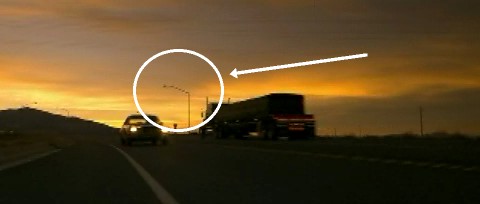
If you look at the area I circled, you will notice a case of the jaggies.
Note that I'm talking about how the trailer looks ON FILM. I'm NOT talking about how it looks in the Quicktime version that is available on the web (which is where I took this image from). Any jaggies you see in the QT version are simply due to the relatively low resolution. On film however, there is no such excuse.
The fact that images sourced from 24p HDTV still show jaggies, even after being transferred at full resolution to 35mm film, demonstrates that HDTV resolution is just not enough to replace film.
I realize this is merely one instance, but I was able to spot that on the first viewing of the 35mm trailer. Who knows what I would have seen if if I had sat down and watched all of "Jackpot" (I never actually saw the movie; just the trailer). And yet some people still maintain that 2K resolution is "indistinguishable" from film.
I'm looking forward to playing "spot the jaggies" when I see the new Star Wars trailer this weekend. 