This is topic Guess What It Is? in forum Film Handlers' Forum at Film-Tech Forum ARCHIVE.
To visit this topic, use this URL:
https://ft-forum.com/ft/cgi-bin/ubb/ultimatebb.cgi?ubb=get_topic;f=1;t=002734
Posted by Joshua Lott (Member # 240) on 10-18-2001, 01:35 PM:
I had this picture sent to me today and the sender was inquiring as to what was the top piece shown in the picture is. I do not know as I have never seen any thing like this before. If anyone could help it would be greatly appreciated. 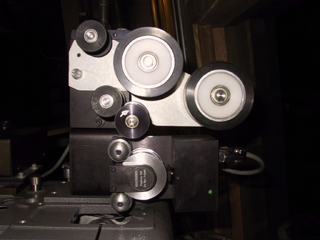
Thanks All
Posted by Joe Redifer (Member # 3) on 10-18-2001, 01:50 PM:
It is a PTR (particle transfer roller) film cleaner. What this does is attempt to remove dirt particles by adhering them to the roller as film passes. The rollers must be cleaned after every showing. Usually as the film passes, the dirt is put back on the film (transferred, hence the name). They are not worth the money and are completely impractical in real booth scenarios where prints can tend to get very dirty. Best used in labs and "clean rooms".There is a review on the site. Click "Reviews" below.
Posted by John Pytlak (Member # 331) on 10-18-2001, 02:01 PM:
It's a Particle Transfer Roller (PTR) Film Cleaner. The incoming print is looped over the two soft polyurethane PTR rollers, which have a soft and slightly "sticky" surface that removes loose dirt particles from the film surface. The PTRs are cleaned by washing in water or gently removing the dirt buildup with adhesive tape, and are capable of cleaning up to 10 million feet of film. Although PTRs are very effective and safe in removing loose dirt from the print, they can become overloaded if the print is excessively dirty or abraded. PTR cleaners are especially safe, useful, and effective in film cleaning applications where foreign materials cannot be applied to the film (e.g., IMAX, printing negatives, archival materials). IMHO, Joe Redifer's bad experience when he reviewed PTRs was because he tried to clean film badly abraded by the projector, overloading the PTRs. PTRs are successfully used by hundreds of film labs, film-to-video telecines, and theatres (especially special venue). I was the project leader in developing the PTR film cleaning technology for Kodak.
------------------
John P. Pytlak, Senior Technical Specialist
Worldwide Technical Services, Entertainment Imaging
Research Labs, Building 69, Room 7525A
Rochester, New York, 14650-1922 USA
Tel: 716-477-5325 Cell: 716-781-4036 Fax: 716-722-7243
E-Mail: john.pytlak@kodak.com
Web site: http://www.kodak.com/go/motion
Posted by Gordon McLeod (Member # 33) on 10-18-2001, 02:19 PM:
I have never had any complaints with PTR's haveing used them since day 1 on the first IMAX as well as on 35mm nor did I have any complaints with DryPur before them (except with photoguard)
Posted by Paul Mayer (Member # 355) on 10-18-2001, 05:41 PM:
I'll echo Gordon's comments. Once Dave took over as head projectionist we used PTRs on every show at the old Caesars Palace Omnimax. That's up to approx. 15,000 ft of 70mm every hour. Quite effective for us, especially on newly shipped prints covered with roadbox dust. We bought two sets of rollers which were used on alternate showings. We cleaned them with soap and water after each show, blew 'em off with compressed air, then let them air dry while the alternate pair handled the next show. They worked great for us.We never ran Photoguard'ed prints (too much bad luck with relief operators forgeting to not use the tightwinds) so I don't know about PTRs and Photoguard.
Regards,
Paul
Posted by Joe Redifer (Member # 3) on 10-18-2001, 06:43 PM:
I'm sure they're OK for IMAX (the only choice actually). But usually you have one guy responsible for that one projector and not much else. Plus the IMAX films rarely run longer then a few minutes so they get "cleaned" even more. 'cept for Fantasia 2000 which shed like a bitch.Running PTR's on every screen in a 16 plex with one operator? Moronic. Filmguard does a better job, eats up less of your time and the results last longer.
Posted by John Pytlak (Member # 331) on 10-19-2001, 06:50 AM:
Joe ---I agree that washing and drying 16 sets of PTRs after every show would be difficult for a single operator. So, many theatres effectively clean the rollers by using adhesive tape to remove the dirt buildup. It takes only a few seconds to "see-saw" a piece of tape over the dirty roller, removing all the dirt particles the PTR took off the print. A quality "low stick" tape like artists or architects tape is best, as it is just sticky enough to remove the dirt, yet not so sticky to risk "plucking" the soft polyurethane of the PTR.
Washing PTRs with mild dishwashing detergent and water should still be done occasionally (e.g., once per day, with an overnight to dry), to remove any oil residue picked off the prints and maintain the cleaning efficiency.
As I said, I think your "bad" experience with PTRs was because the rollers overloaded with dirt from the severe projector abrasion you were encountering at the time.
------------------
John P. Pytlak, Senior Technical Specialist
Worldwide Technical Services, Entertainment Imaging
Research Labs, Building 69, Room 7525A
Rochester, New York, 14650-1922 USA
Tel: 716-477-5325 Cell: 716-781-4036 Fax: 716-722-7243
E-Mail: john.pytlak@kodak.com
Web site: http://www.kodak.com/go/motion
Posted by Gordon McLeod (Member # 33) on 10-19-2001, 07:25 AM:
I use them ever 35mm show and that is usually with old rep prints and they clean up quiet nicely
I use 3M packing tape to clean them
I also use a mix of FPC and SanLab rollers
Posted by Brad Miller (Member # 2) on 10-19-2001, 01:17 PM:
PTRs are plain and simple not as effective as a wet cleaning, ideally with a media cleaner, for field use. They appear to be fine for labs and IMAX booths where everything is kept to white glove room quality, but for the typical theater, they are just useless. Even with that being said, I've not seen an IMAX presentation that I did not feel was in need of cleaning."Pristine" condition varies horribly from person to person. What another person thinks is a perfect print is a shit print to me. I've rejected dozens of prints that were ran only one single time at another theater because of damage that was unacceptable to me, but perhaps not even noticeable to other people. I know Joe is also very picky as I am and I've received tons of emails from people telling me that they *thought* they had a great presentation before switching over to media cleaners and FilmGuard. Most people really do not know any better until they see it. Even brand new prints straight from the lab are NOT in pristine condition, I don't care what anyone says, they are not. There is always dirt on them, most times objectionable amounts to me. No doubt a lot of this comes from the clip together reels that the depots use, but regardless my first presentation is always the worst (even though it would be on par with the first presentation of PTR theaters) and mine only gets better from there. The theaters in town that use PTRs have their best presentation on the first day and it all goes downhill from there. This is a repeated decaying pattern of print quality with PTRs. Again, it all just depends on how much you care about achieving a perfect (and I do not mean a "good", but perfect ) presentation.
Once someone has tried BOTH properly and according to the instructions, I've yet to hear anyone still side with PTRs. Unfortunately, IMAX prints only have the option of PTR cleaning, which is why I feel the comments from the IMAX guys is out of place here for they can not honestly compare fairly. Also, IMAX is a ridiculously larger frame, which means that each speck of dirt is magnified to a far lesser degree than the typical booths running 35mm prints. Those IMAX comments are very deceptive and do not apply to 99% of the members here.
Posted by John Pytlak (Member # 331) on 10-19-2001, 01:44 PM:
Wet cleaning with a solvent IS more effective than methods that attempt to brush, blow or adhere the dirt off the film, especially for "oily" or embedded dirt. Cleaning a print with a DRY web cleaner risks scratching the print if an abrasive particle gets caught in the web. Using cleaning solvents to apply a lubricant to release prints is a well established practice. Concealing base scratches with application of a liquid that matches the refractive index of the base is also a well-established practice (e.g., wet printing).
Proper application of Film-Guard to release prints using a dampened web cleaner DOES effectively clean release prints, provide lubrication, and help conceal scratches. But, over-application is an acknowledged risk that can cause excessive slipperyness.
Particle Transfer Roller (PTR) film cleaners provide a safe, effective and low cost method of cleaning film when solvents cannot or should not be used, or when solvent/lube residues are not desireable.