This is topic RCA SoundHead Rebuild? in forum Film Handlers' Forum at Film-Tech Forum ARCHIVE.


To visit this topic, use this URL:
https://ft-forum.com/ft/cgi-bin/ubb/ultimatebb.cgi?ubb=get_topic;f=1;t=002990

Posted by John Westlund (Member # 913) on 01-20-2002, 10:39 PM:
 
We have an RCA MI-9030 soundhead that leaks oil really bad. I was wondering how much work and time is involved in rebuilding the gear box and where to get the parts for it. Thanks.
John
 
Posted by John Anastasio (Member # 607) on 01-20-2002, 10:57 PM:
 
Parts are available from a number of suppliers like Ed Wolk in Chicago or John Eickhoff at NTE and they're not terribly difficult to rebuild. There are only three gears in the 9030. The new drive gears are made of bronze instead of brass and last a lot longer. You might just have to replace the upper gear, since that's the one that usually goes. Once you've replaced all the seals, it shouldn't leak.
 
Posted by Ken Layton (Member # 133) on 01-20-2002, 11:12 PM:
 
The gear box is a snap once you have removed it from the machine. The top gear is usually the one that wears the most. A good cleaning, check the bearings, and fresh gaskets are usually all you need. Don't forget to refill the oil!

 
Posted by Paul G. Thompson (Member # 655) on 01-20-2002, 11:21 PM:
 
......And make sure you get the right parts in the right places, especially the oil deflectors and thrust springs. Some of those parts can be installed bass ackwards. If it is your first rebuild, pay attention to the actual placements and orientation of the parts as you dismantle the gearbox.

The parts blowup diagram leaves a lot to be desired for clarity.


Posted by Josh Jones (Member # 447) on 01-21-2002, 07:17 AM:
 
Might I also add that you will not get these machines to stop leaking. I rebuilt my gearbox and the damn thing still leaks. I even used that blue sealant and it still leaks. It is coming through the gaskets I would guess. Be very sure you put that thing together again in the right order. I can never remember where those stupid spring washers are supposed to go.
One last thing, if you are pulling it apart, replace all the bearings while your at it. all the replacement bearing for a 9050 only cost me 42 bucks, and that has two more than your 9030. If you take your time, it is fun and a good experience.

josh


Posted by Will Kutler (Member # 770) on 01-22-2002, 01:26 PM:
 
Before spending money on new bearings, inspect the ones that you have for damage, and reuse if they are ok. Remember w/bearings to not spin them unlubed!

Pay special attention to the manuals regarding oilshield and spring orientation! The manuals are correct--if you need to, blow up the drawings!

Remember that when tightening the gear cover back down to use a proper torque pattern. Under or overtightening bolts can cause leaks and ruin the seal. You may also check for burrs on the mating surfaces, and can inspect surfaces for flatness.

Make sure that you use the rubber style lateral guide roller, and always store it in the open position when not in use--prevents flat spots. Also, if you opt to replace the lateral guides pressure roller bearings, then use metal shielded type as they will be less "stiff" than the rubber!

Wolk is also marketing new motors for older RCA and Simplex soundheads @ $300.00

You may also look into a stereo cell or reverse scan conversion...check w/John Eickhof.

Also inspect your slit lens for damage. If it was not kept clean, it may have filled w/oil.


Posted by Mark Gulbrandsen (Member # 72) on 01-22-2002, 07:59 PM:
 
One thing to pay particuluar attention to in an RCA, or Simplex gearbox is the worm gear. If it gets really worn you'll see wear marks(like little teeth) on the face of its teeth. This is a situation where the worm will just chew up the new bronze gear in a short time, the oil will get dirty(black) quickly as well.
Mark @ GTS


Posted by System Notices (Member # 2357) on 06-21-2010, 10:55 AM:
 

It has been 3071 days since the last post.


Posted by Eric Robinson (Member # 2966) on 06-21-2010, 10:55 AM:
 
quote:
you'll see wear marks(like little teeth) on the face of its teeth
Does anyone have a picture to show an example of this type of wearing? Is there perhaps other types of wear I should look out for as well?
 
Posted by Robert Koch (Member # 3728) on 06-22-2010, 07:56 PM:
 
As Mark and others have said ALWAYS change the pinion when replacing the worn bronze upper gear. Another popular practice that should never be done is reversing the top and bottom gears. The pinion will soon cut them out.
 
Posted by System Notices (Member # 2357) on 02-02-2019, 01:58 PM:
 

It has been 3146 days since the last post.


Posted by Craig Hardy (Member # 10648) on 02-02-2019, 01:58 PM:
 
Not sure if this is right place to ask, but here goes:
1.Where might I find original exciter lamp socket and photocell/holder to change 9030 head back to original mono?
2.OR, is there a cheap way to use 9030 that's been upgraded with Kelmar ATD-1275 but missing the CP-650?

I was given everything from a theatre that converted to digital 5yrs ago. 2 each: Brenkert BX-100's, Strong Super LUME-X with power supplies, Century base units, about 20 lenses scope and flat, splicers, rewinders, etc.

I'm no an exhibitor--I'm 78 and this is just home use hobby, so limited funds. I don't really care about stereo and Dolby---just want to read regular old optical sound tracks!

When these basement readers are installed the old parts probably just get tossed---or has someone saved some???
 
Posted by Louis Bornwasser (Member # 3063) on 02-02-2019, 09:48 PM:
 
The reverse readers will output 2 channel which you tie together and plug in a mono preamp as normal. Any low impedance microphone input will work OK. Contact Thomas Mohr at Kelmar.
 
Posted by Lindsay Morris (Member # 1430) on 02-02-2019, 10:28 PM:
 
Craig, IF you are running Cyan tracked movies then going back to an exciter lamp will cause you some grief with Low level.

As Louis said stick with the Kelmar and run the output as a mono feed.

The older black & white do reproduce OK with a red light source but some sound a tad harsh most likely due to the higher freq response available with the Kelmar reader.

Theoretically it is best to use a white light source for the older tracks but a bit of top cut when using a red reader gives acceptable sound.
 
Posted by Craig Hardy (Member # 10648) on 02-03-2019, 10:23 AM:
 
OK, guys, I'm encouraged now! So I guess supplying DC to the LED is a simple matter if I look at a connection diagram.
I'll contact Thomas Mohr, thanks!
 
Posted by Craig Hardy (Member # 10648) on 02-13-2019, 04:13 PM:
 
Louis, Thomas Mohr responded promptly to my email sending me three docs I'd already found and downloaded: instructions for installing the basement reader, and schematic for the AT-1200-PS Narrow Line power supply. I thanked him and wrote again last night asking what the AT 1200 looks like physically so I could search the old theatre that gave me all this stuff, and haven't heard back yet today.

So now I'm going to bother you again about this matter!
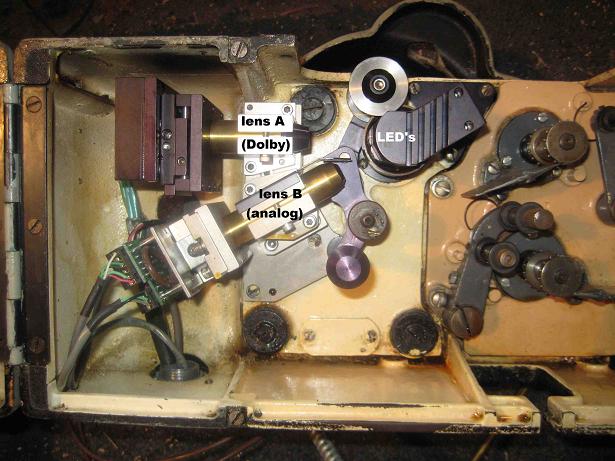
1. Today I verified that the small brown cables from LED box were what they appeared to be: using a 3V button battery, I lit the LED's and tagged the cables "upper (Dolby)" and "lower (analog)".
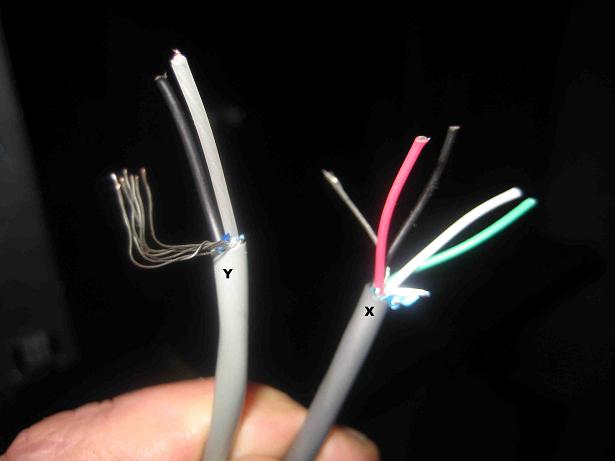
2. From some of my reading, it seems the ATD-1200 is a 120 watt amp. I don't need that--have plenty of amps already. So I'm wondering if I don't need any more stuff, but just need to connect one of the existing cables into an amp like you mentioned.
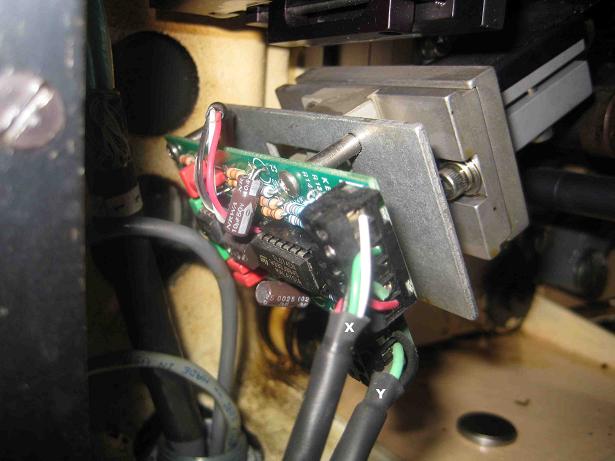
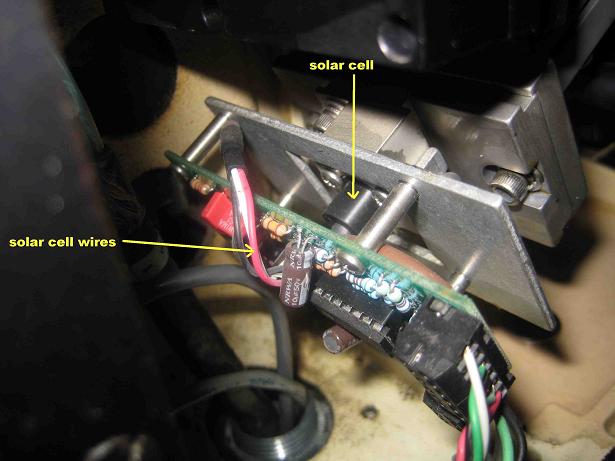
Or do I need to supply 12V to the card on back of lens B because it's a pre-amp?
Or do I disconnect solar cell wires from that card and feed them directly to my own amp?
The Super Simplex carbon arc lamp units I recently parted with had old WE sound heads with the old vacuum tube pickup. Parked a Radio Shack solar cell in front of the vac tube and fed signal right to a PA amp and they worked fine.
I've included a few pics for this discussion.
 -

 -

 -

 -
 
Posted by Will Kutler (Member # 770) on 02-13-2019, 08:55 PM:
 
If you are serious about a pristine soundhead, then you need to go all the way with a complete disassembly, cleaning and refinishing!

This includes repetitive medial blasting and overnight oven burn-out to purge the iron castings of oil along with washing the iron casting with phosphoric acid.

You can then have the ferrous and non-ferrous castings either powder coated or use the authentic black Japanning available from Liberty on the Hudson. There are powder coating additives designed to eliminate bubbling caused by out-gassing, and they work quite well.

For the interior white, I have a particular brand I use that does not go brown when heated, is oil-resistant, has excellent adhesion and mechanical durability and is easy to clean...and can also be easily touched up if needed.

Refinishing is a lot of work, short-cuts don't cut-it! But the finished product is amazing!

Door glass is reproduced thru graphic art software used to create a decal or mask used for either sand blasting or etching. I have reproduced RCA Photophone 1040 door glass and am also working on Century.

The natural rubber isolator bushings are probably dry rotted. There are modern materials specifically designed for audio isolation applications that may need to be custom machined from bar stock or modified from available shapes.

Gearbox gasket will need to be replaced. Auto parts stores normally stock gasket material, which you will need to cut by hand.

Robbins and Myers motor may need attention...I have restored/overhauled and balanced a few of those! This is a process in of itself! Reputable electric motor service shop can help out. Keep in mind that the flywheel is a nickel-plated iron casting!

Hope this gets ya going!

Cheers!

Kutler
 
Posted by Craig Hardy (Member # 10648) on 02-14-2019, 10:18 AM:
 
I'm all set now!
Thomas Mohr just emailed me with more info, so now I know exactly where to supply voltages and take out signals.


Powered by Infopop Corporation
UBB.classicTM 6.3.1.2