This is topic Wenzel Pro 50 restore/rebuild in forum Film Handlers' Forum at Film-Tech Forum ARCHIVE.
To visit this topic, use this URL:
https://ft-forum.com/ft/cgi-bin/ubb/ultimatebb.cgi?ubb=get_topic;f=1;t=003008
Posted by John Schulien (Member # 215) on 01-25-2002, 03:39 PM:
The weather's been nice for the last few days, and I've been in my garage working on my projector project. I picked up this projector last summer -- it's a Wenzel Pro 50 head with a Ballantyne RSM Model 6 soundhead.
The main problem I'm having is vibrational noise. When I remove the fiber gear that couples the soundhead to the projector head, the soundhead operates silently. Well, that's good. However, with the coupling gear installed, and the motor driving the projector head, something is vibrating loudly.
If I put my finger on the large fiber coupling gear, I can feel the vibration. The soundhead->head gears are all pretty worn. I looked through the Ballantyne parts manuals, and found that at some point, this set of coupling gears had been redesigned -- my projector uses straight gears, and the redesigned gears are helical gears.
Ah, I thought. They must have done that to reduce the vibrations! These gears are very worn, and mesh loosely.
So I have a couple of questions for those familiar with projector repair ...
o Can anyone suggest a method of verifying that this is where the vibration is originating from, or otherwise tracking it down?
o Assuming that I do want to replace the gear chain with helical gears, how expensive would that be? I'd be replacing parts:
RSM 61, 62H, 63H, 64H (27/32" hole), 65 (27/32" shaft).
o Should I also replace the oil bearing parts:
RSM 67, 68, 70, 71, 72, 73
at the same time? They have a fair amount of uneven wear, and leak oil. I would imagine I should, to avoid damaging the new gears.
o There is extensive gear wear throughout the projector head. Just for the sake of completeness, what would be the cost of a new complete set of gears and bearings to do a complete rebuild?
This projector is for my personal use, and will most likely see very light duty. My goal is to have it run reliably and quietly enough that I can run it in the same room as the screen and not need soundproofing. Is this something I'm likely to achieve?
Thanks,
John Schulien
jms@uic.edu
Posted by Mark Gulbrandsen (Member # 72) on 01-25-2002, 04:21 PM:
John,
Straight mesh gears usually run alot noisier than helical gears do, but....Listen to a Motiograph 7500 running sometime and you'll see what I mean. Although these are even helical cut (although only slightly cut that way) they are still quite noisy. Motiograph went through a similar change in the gearing of this soundhead with the first gear type being very fine tooth, and the later being coarser tooth, both were however helical. While you can't get parts for any of these soundheads(unless someone can make them or happens to have them still laying around) anymore you might want to consider chain drive for them. This guarantees you silent running requireing a minimum of lubericant. If its possible to do something like the chain drive as done in a Norelco FP-20 that would be a nice solution. A second choice would be to use timming belt drives. Its easy to make or have made custom timming pulleys. All you need to do it is a lathe and some timming pulley bar stock of the appropriate number of teeth. The only other way is to replace the sound head with something still servicable such as a Simples SH-1000, RCA, or that sort of thing from the same time era as the projector mechanism.
As far as the projector goes check very carefully the bushings in the main frame before you spend alot on any new gearing. If the bushings are ovaled then new gearing will be for naught, you may also possibly even destroy some of the new gears. If the bushings are not worn then new gears, or good used gears would be an ok idea. Personally, I wouldn't go overboard restoring it unless the machine has alot of sentimental value to you.
Mark @ GTS
Posted by John Anastasio (Member # 607) on 01-25-2002, 04:58 PM:
I have the same problem with the fibre drive gear that couples my Super Simplex to the SH1000 soundhead. On my machine, all the gears are in beautiful shape and the machine is finely tuned. Run the projector head with any other type of drive....no noise. Run the soundhead alone, absolutely silent. As soon as you install that gear, it's noisy. I've replaced the gear, swapped it with the one on my Brenkert, tried everything short of tying a pillow around it, but it just wants to whine. It's the difference in the shape of the teeth. The older gears made for the machine had a slightly different cut and the newer ones are made to be used for a number of different machines. They work fine, they're just noisy. When the Brenkert runs, you can hardly hear it, despite having more gears in it than an adding machine, but it's on an RCA 9030 which mates up nicely with that fibre gear. I only have the problem with the SH1000. I think Mark's got the best idea....change to a belt or chain drive.
Posted by Mark Gulbrandsen (Member # 72) on 01-25-2002, 07:36 PM:
John,
Your problem stems from having a fibre gear with the wrong gear pitch. RCA and Simplex had slightly different pitch but either will work with the others sound head, albiet with some gear noise. The best thing you could find is one of the old black Simplex rubber shock mounted drive gears. These will run absolutely quiet. The new gears that are available from Wolk are also very noisy and even in a continous operation theatre it can take a year or better to grind itself to the same pitch as the cast iron gear on the sound head. You could also try some Clover medium grit running in compound, but that might end up contaminating the fibre itself, however it still may be worth a try though.
Mark @ GTS
Posted by John Anastasio (Member # 607) on 01-25-2002, 10:34 PM:
Thanks for the tip on the abrasive, Mark. Maybe I'll just throw a little sand in there next time I come home from the shore. One of these days on a warm summer afternoon when I've nothing better to do, I'll attack the gear with my jeweler's file and open up the pitch. Nah....I'm too lazy. It's a perfectly nice little whine that I'm okay with. At the rate at which I use that machine, it would take until 3002 before it wore itself in. I think I spend more time oiling it and keeping it clean than I do running it.
Posted by John Schulien (Member # 215) on 09-23-2002, 01:39 PM:
Time for a followup. I've been working on the projector head for quite some time.
At some point, someone had done a really bad repaint job, using non-enamel beige paint applied with a paintbrush.
I did a complete teardown -- dismantled the entire head. I found that straight acetone did a great job of removing the lousy repaint, and all of the grease, without damaging the original baked white enamel. After about three days and a couple hundred Q-tips and cotton balls, I got the mainframe casting cleaned. A repaint was completely unnecessary -- the original enamel is in very good condition -- there are only a small number of dings.
I used acetone to clean and degrease all of the parts. When I dismantled the aperture section, I discovered why the fire shutter wasn't working -- the entire area was packed solid with gummed grease and dirt! I've now rebuilt about half of the machine -- I had to replace the vertical shaft spiral gear, which was broken. Everything seems to be working so far, including the fire shutter, after releasing it from its prison of muck.
I'm about at the point of reinstalling the shutter shaft, and have a choice to make. The shutter shaft spiral gear, Simplex part G-248, is partly damaged. It looks like at some point the shutter shaft either froze, or was locked, and one end of the gear is shattered. A previous owner solved the problem by turning the gear around, but I might as well replace it while I'm rebuilding the mechanism.
The original gear is Formica. I emailed a fellow who has been helping me out with this project, and he has two different types of this gear -- steel and nylon.
On the one hand, the steel gear would be MUCH stronger, and probably last forever. On the other hand, the reason I had to dismantle the entire head was that I accidently stopped the shutter shaft during operation, and the part that was destroyed was the far-more-expensive vertical shaft spiral gear. I'm leaning towards the nylon gear for the simple reason that if the shutter shaft were ever to lock again, I would expect the nylon gear to take the damage.
This model (Wenzel Pro 50) had an engineering change made to it. The original design called for oilite bearings throughout the mechanism. The revision replaced the shutter bearing with a ball-bearing. The engineering change states that this was done to prevent the shutter shaft from locking up. I'm speculating that the shutter gets hot, transmitting heat to the shutter shaft, and into the bearing, causing the oil to harden. Unfortunately, my unit was manufactured just before the engineering change, and I suspect that it's just a wee bit too late to get the replacement parts to "modernize" this head.
A couple of questions --
o Is anyone familiar with the shutter shaft problem on the Wenzel?
o Will a nylon gear quickly wear out?
o I can't get the upgrade parts anymore, can I?
o The Simplex manuals talk about using special high temperature grease on the shutter bearing. However, this head has a regular oilite bearing. Should I lubricate this bearing with regular Simplex oil, or do I need high temperature oil? I don't think that the tube grease would work, because the oil is applied through one of those capped tubes.
----------
I solved the problem of the noisy transmission gears quite nicely. I replaced the gear train with a sprocket chain. I was able to find a pair of ANSI sprockets that duplicated the gear tooth ratio, and they fit onto the drive shafts without any additional machining or modification. I'll add some pictures later. This modification completely eliminated the vibration from the straight gears, and greatly reduced the noise level. There is still some noise -- but instead of a loud grinding noise, it's a quiet clicking noise as the chain enters and leaves the sprockets. When I'm finished I'm planning to fabricate a cover that should muffle the noise.
I decided not to repaint the mainframe casting, but I am repainting the exterior case and also the shutter. The grey crinkle paint was too far gone -- More than half of the paint flaked off when I cleaned it. I went ahead and stripped all of the casing parts down to bare metal. I briefly considered repainting with crinkle paint, but that would be boring. Instead, I'm using a custom automobile paint system, and the final color is going to be candy purple with white glitter flakes and a glossy clearcoat. This should look really good with the Wenzel logo, which I've polished to a high shine. The main reason for using crinkle paint was probably to disguise the rough castings. Instead, I'm using automobile filler primer and sandpaper to get the castings completely smooth before I apply the base and top coats. I'm applying the paint with an airbrush, driven by a CO2 tank. For the shutter and the inside of the shutter box, I'm using flat black heat-resistant enamel.
I'll get some pictures up soon.
Posted by John Schulien (Member # 215) on 09-26-2002, 12:49 PM:
The current state of construction, showing the chain drive that replaced the gear drive: 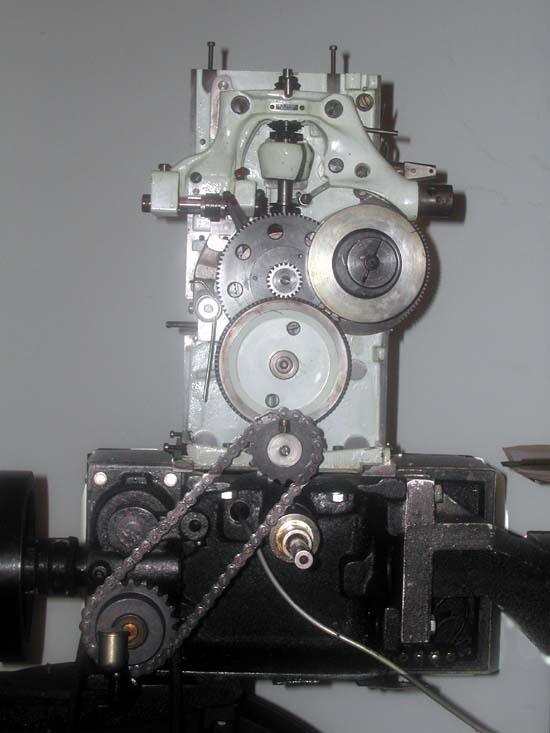
Posted by Steve Kraus (Member # 476) on 09-26-2002, 08:17 PM:
Beautiful and ingenious. What happened to the Wenzel company?
Posted by Bob Koch (Member # 1062) on 09-26-2002, 11:14 PM:
Anything Fred Wenzel ever made was a complete and inferior, and I underline inferior,copy of someone elses design. You are trying to restore a Super Simplex in its original design in 1931. Why don`t you get the Super parts from LaVezzi or some one else and not perpetuate some copy of Fred Wenzel`s abortions.
Posted by John Schulien (Member # 215) on 09-27-2002, 11:58 PM:
Bob, I read your note. I've torn down and rebuilt the mechanism, and I haven't found anything inferior about it so far. The entire mechanism is quiet running. It has the spiral gear set and fox sprockets. The bearings hold their oil, everything seems to be in good shape. The gears and bearings are unworn to the eye, and the shafts are unworn to the eye and touch. With the exception of the broken G-248 gear that I am in the process of replacing, there is only one component with ANY visible wear on it. That, plus the poor repaint job, leads me to suspect that this projector was rebuilt recently.
Plus, the intermittent has a little LeVezzi plate on it, so they either manufactured or rebuilt it.
If I were to rebuild this projector with LeVezzi parts, it would cost me many times over what I paid for it on eBay. Plus, I can only identify two parts that are candidates for replacement.
I've never worked on a Super Simplex though, so I'll ask -- what specific parts or design features are inferior? The only potential issue that I'm aware of is the rear shutter shaft bearing, which I don't think I can do anything about, but I'd appreciate any specific information on what else to watch out for.
- John
Posted by Paul G. Thompson (Member # 655) on 09-28-2002, 01:04 AM:
Fred Wenzel worked for IPC at one time, didn't he? Or was it Lavezzi? I have seen Wenzel Projectors, but I never ran them. I thought it was a Simplex Regular under a different name.
In 1954, I think the old Empire Theatre on 18th and Marshall Street in Manitowoc, Wisconsin was equipped with them. I went to that theatre every Friday night. Admission was 10 cents. They ran the old Captain Video serials starring Judd Holdren, and some off-the-wall cowboy movies that were only worth a 5 cents at best. 
But back to the subject, that theatre was run down and was a true rat-hole equipped with wooden seats and cold stickey floors. There were times I wanted to visit the booth, but the stares leading up to the booth were so rottin' that I was afraid to journey up them.
But those old Wenzels, if that is what they were, just kept grinding away....and never missed a show.
Posted by Richard Fowler (Member # 893) on 09-28-2002, 06:29 AM:
Wenzel was bought out by Wolk when they closed down. Wenzel built a projector for Ballentyne in the late 1940's and 50's and where a common machine with the Ballentyne model six soundhead ( which some people also hated ). This equipment was a common drive in theater / small town cinema package which was built for price. When I was in the theater business in the early 1970's, one of my locations was a 450 car drive in with these units, which gave me far less problems than the "better brand" hardware that I had in my other locations.
The Wolkomatic large reel rewinder which is still available is made from the 1950's mold of the Wenzel unit.
Richard Fowler
TVP-Theatre & Video Products Inc. www.tvpmiami.com
Posted by Steve Kraus (Member # 476) on 09-28-2002, 08:40 AM:
Ah ha...that explains it. I have a couple of those (from a defunct drive-in) in my junk box. I had been wondering if Wenzel had given up on projectors but continued to make things like that.
Posted by John Schulien (Member # 215) on 10-25-2002, 05:06 PM:
Updates --o New shutter shaft gear installed
o I need to learn how to balance the shutter blade.
I've received a replacement G-248 gear and installed the shutter shaft.
I had the choice of either a steel gear, or a nylon gear. I chose the
nylon gear for two reasons. First, it's supposed to run quieter, and
second, because of an accident where the shutter was stopped during operation, and the impact destroyed a much more expensive gear deeper in the mechanism. This way, if that ever happens again (and I'm taking great care to prevent it), hopefully the less expensive nylon gear will be the one that breaks. At any rate, the new gear and shutter shaft operate smoothly and quietly.
Now the issue of why the shutter stopped during operation in the first place. The shutter blade was heat-warped -- apparently someone let the projector head stop with the lamp burning and the dowser open. Something caught, and it was all over for the vertical shaft spiral gear.
The shutter on a Wenzel Pro is identical to a Super Simplex shutter. I've taken the shutter apart, and flattened the two blade parts -- the main part, and the part that rotates to adjust the light time. I've reassembled the shutter, and it's more or less flat, but not exactly.
This is a problem. I remounted the shutter on the shutter shaft and powered up the projector. This increases the overall vibration of the projector. That's a bad thing. It means that the shutter is unbalanced. I can't run it that way, or it will begin to wear out the shutter shaft oil bearings.
I suppose that I need to replace the warped shutter blade, and rebalance the blade.
My options appear to be to either spend a bunch of money on a new shutter blade, or cut a new one myself out of sheet aluminum, which I'm willing to try (Jigsaw with a hacksaw blade mounted) Either way I will need to carefully balance the shutter blade to keep it from wearing out the bearing. Does anyone have a procedure for doing this or any advice on this part of the project?
Thanks, John
Posted by Mark Gulbrandsen (Member # 72) on 10-25-2002, 09:25 PM:
John,
You need to go see Tony at The Wolk Co. and get a new blade for it. They should have them......
Mark
Posted by Gordon McLeod (Member # 33) on 10-25-2002, 09:44 PM:
The Wenzel was a copy of the Simplex Standard and many companies built copies of the standard
There was nothing inferior about them in fact the trap cosure was better builkt than Simplexs was
Posted by John Schulien (Member # 215) on 12-26-2002, 01:57 PM:
I spent some time on my lamphouse over the weekend. It's a Simplex High 19000 series arc lamp that was long ago converted to use giant DTJ mogul bulbs. Those bulbs are getting tough to find, they are pricy when I can find them and they don't last very long. Besides, the way the socket was installed (basically bolted to the ash pan), I had no way of adjusting it to focus the light spot, and as I received it, the lamphouse put out very, very little light.
Whoever did this hack conversion on the lamphouse removed most of the carbon arc parts in the process. The entire front jaw, arm, and magnet assembly is gone. I had a conversation with a fellow who thought I should restore the lamphouse to use carbons, but there are too many parts missing. Plus, I'm installing this projector in the basement of a 1920s era frame house, which I have no desire to burn to the ground.
The light bulb was the first problem. The second problem was the mirror. The mirror is a back-surface mirror, and the silvering was pitted and flaking. I went through the entire process of stripping away the old silver, cleaning the glass with nitric acid, and re-silvering the mirror. Unfortunately, the problem was that the back glass surface of the mirror is pitted with a crazing pattern, and when I stripped the silver off, I was left with the same crazing pattern in the glass. When I resilvered the mirror, I was left with essentially the same problem as before, except that the flaking problem was fixed.
I found a company that professionally restores mirrors. I got an estimate of about $400.00 to regrind and resilver the mirror. This would bring the mirror to like-new condition. That's over my budget. I just reinstalled the mirror, moved on, and actually, as you'll see, the mirror works nicely, even with the surface damage.
About a year ago I had a bulb burn out in my 16mm projector. I paid too much for a brand new bulb, which promptly burned out a month later. In a fit of pique, I went to ebay and purchased every CTT/DAX bulb I could find, at an average price of about $4.00. I found 20 of them. They seem to be one of the most commonly available projector bulbs. I decided to refit the lamphouse to use these bulbs for two reasons.
First, they are commonly available and turn up as surplus regularly.
Second, unlike the mogul bulbs, these bulbs have an internal back reflector. The mogul bulbs cast light out in all directions. Only the light rays heading in the direction of the mirror (and the negligable amount of light that travels straight from the filament to the gate) are put to use illuminating the film. This means that over half of the light is wasted. I positioned the light bulb facing backwards, towards the mirror, so the light that would otherwise be wasted (by illuminating the inside front of the lamphouse) is instead reflected back into the mirror. In practice, using the bulb with an internal reflector in place of the mogul bulb nearly doubled the light output from the lamphouse.
I wanted to be able to adjust the bulb position in all directions -- forward and back, up and down. Left/right wasn't such a concern -- I just wanted to get that right the first time. I also wanted to minimize the profile of my mechanism so that it wouldn't block too much of the light coming back from the mirror.
I took advantage of the one part of the original carbon arc mechanism left in the cabinet -- the forward travel arm. I cut a piece of hollow bar stock, and drilled three holes in it. One to attach it to the travel arm, the other two to attach the socket. I purchased a new CTT/DAX style socket from Bulb Direct, and mounted it to a small rectangle of aluminum. I drilled holes in the aluminum plate to match the holes in the hollow bar stock, and created an adjustable riser using two bolts and stiff springs.
Here is a picture showing the entire assembly, and the state of the mirror as well. The lamphouse is running at low power on a variac for this picture. If you look inside the bulb, you can see the reflector.

I can adjust the filament height with the bolts and springs. I can adjust the filament distance from the mirror using the travel arm control on the back of the lamphouse.
Once I had assembled everything, I tested it by positioning a piece of white board at the aperture distance, and started adjusting things to make the spot as small as possible. I was able to focus the light beam down to about a two inch spot. I know that I'm not achieving the full potential of this lamphouse, because the lamphouse was originally designed to focus a spot of light, not a grid of light.
In this case, the sweet smell of success was burning paper. Yep. the piece of paper I was focusing the beam on caught fire. That's when I was pretty sure that things were going to work out. As things stand, the lamphouse puts out enough light to nicely light a six foot screen, which is exactly what I was trying to do.
Here's an image showing how the light cone converges on the projector fire shutter. The lamphouse is running at low power on a variac. Notice how little stray light there is in the front half of the lamphouse.

Once I resolve my intermittent problems, it will be time to move on to the sound. I have the original amplifier, but it's battered and in poor shape. I suspect I'll be rebuilding it completely.
My test reel is an odd reel from a foreign film with subtitles, so it's been actually quite enjoyable to make the adjustments, and see everything work so far. I have the shutter adjusted so there is no travel ghost, and the picture is completely steady.