
So let me give you the brief scoop on what has recently happened. This super tech decided for whatever reason to try and scare the pants off of one regional person by taking a lighter and burning a piece of film that he had submerged in a bowl of FilmGuard. Needless to say his idea worked. The regional person panicked and has banned the use of the product, now only allowing "safe" items in the booth.
Funny the description of "safe" here. Just what IS safe in this person's eyes? Apparently only items that will not burn if direct flame is put to it. I guess that means that the bricks and foundation of the building are safe since damn near everything else will burn when directly ignited. This video will hopefully wake a few people up from their fairyland comas.
We have received numerous emails from projectionists and booth managers at these theaters and the rumors are getting more and more bloated by the day. These projectionists have been using the product for some time now and all have been very pleased with it's results, but are no longer allowed to use it because of these made-up rumors. Three of these theaters (that I know of) have already performed their own tests and proven what we are about to show you below. They also found out that a LOT of chemicals in the building (used in the booth as well as outside of the booth) actually ARE insanely flammable, though I did not get a list.
In celebration of this tech's super genius, we now present a short video of Joe playing pyromaniac with a few commonly found booth items. By no means is this video attempting to emulate a laboratory testing environment, but we feel it more than demonstrates the point. Yes there are some video edits used to compress time because we are not professional smokers and we purchased poor quality lighters that Joe had a hard time getting to light, but the final results in the video were not altered. As is clearly stated in the video PLEASE FEEL FREE to perform these exact same demonstrations in the parking lot of your own theater if you have any doubt whatsoever. Again, the examples contained in the video were not faked nor staged in any way, just edited to compress time on the download.
The reason this video is being placed here on the forum instead of the traditional "videos" page is to elicit comments from the members. Out of respect for this theater circuit, I am not going to disclose their name. However I will gladly tell you that this tech who hates the Film-Tech website, the quality of presentation we stand for and everyone associated with it initials are J.D.R. That theater chain certainly is lucky to have such an outstanding example of showmanship on their team.
Please download and view this video BEFORE you read further in this thread. There are 3 download options to best suit your internet connection's speed and your computer.
Click here to go to the download page.
Not to fear, something very entertaining is on the editing table right now and will be uploaded in about a week.
I believe I know the tech in question and he had a bug up his ass about FilmGuard two years ago when I worked for that company. The claim was that he didn't know what was in FilmGuard. Like he knew what was in Xekote. 
We stopped where we did because igniting items like WD-40, projector oil, static guard and so forth was getting a bit overly flammable for the simple point that was being made in the video.

Seriously, though...we have been using FilmGuard at our theatre as part of our weekly routine for some time and the only side-effects so far are (much) cleaner prints. There is no cause for concern, apart from negative people who don't understand when they are on to a good thing...
GTS is a very diverse company and the theatre supply end of things is but a small part of us. At present we have begun to move into a brand new building and we are expanding all divisions of our company to suit its growth. Just being able to do this shows that we keep our customers on board. We sell on the average several cases of Film-Guard in a year, most to theatres and some to home film collectors, who obviously don't think there is a hazard to have it in their homes. We love the product and many of our customers swear by it. I'd gladly back up the product any day, any place, any time, and will continue to sell it as long as you manufacture it. There is no safety concern of any type as far as my experience with the product goes.
Another thing I'd like to state is that any supply dealer posting here that does not offer Film-Guard to their customers obviously does not care about presentation quality either and should be rounded up and run out of buisness!
Mark @ GTS
www.getgts.com
mark@getgts.com
Not so much as a counter to your statement, but perhaps as a reason why such a plan can work and be unique, I remind you of the business realities of such things as the "we demand" note about the Austin Powers advertising. These "business people" supposedly wanting to continue a long term relationship with exhibitors sent a threatening letter out of the blue to customers, with no attached explanation or, from what I read here, even a "please" or "thank-you." Such attitudes permiate the business world. In my experience, the larger the business, the more rigid the thinking, and the greater the chance of questionable or even unreasonable demands, of employees, suppliers, and customers.
In theatre circuits, sometimes one individual will institute a strict policy within a district or area and it will get institutionalized and expanded without proper review or even a reality check. I remember one chain that had a policy of ushers having to puncture every drink cup picked up in the auditoriums, supposedly to prevent recycling of the cups. Never mind that in such scams the ushers are almost always already involved, never mind the problems with coke still in the cups dripping onto floors and into leaky cheap garbage bags, never mind the time wasted or coke-sprayed uniforms, this was a written-in-stone policy because nobody had the balls to risk their job by standing up and saying in a loud, clear voice "This is stupid!"
The average middle management leader won't often dare to admit a wrong decision, and speaking pragmatically, pissing off a tech who must be depended upon, without damned good cause, might not seem to be a good decision, even if the alternative was dirty prints. In such a case, a public demonstration can be useful as damage control. The issue isn't so much the already lost business as it is the rumor and potential for greater loss. Unrelated example of public demonstration damage control: Requiring FAA personnel to fly in planes soon after a recent plane safety scare made many people feel more comfortable about flying.
Like the tech mentioned, I am one who likes to know what is in the chemical mixtures I use, and I can understand the POV of a tech that has had past reservations about something new that could have been a snake-oil. However, since Brad does have an MSDS on the product, any health concerns can be checked out. Experience from users is public knowledge even to the point of Brad allowing dissatisfied customers to post their problems here and then personally responding. Perhaps if that tech would be willing to post his concerns here publicly, he would been taken more seriously.
Making the exact formulation of film-guard public would only encourage rip-offs and inferior copies, plus reduce funding for this repository of manuals, knowledge, and water-cooler talk. BTW, I'm very curious why someone would have some sort of grudge against this site.
Unless Brad is selling direct, any attempts to change minds should first come from the sales team. That is part of the sales job.
I don't know about Brad, but I know in my own business that I'm not cut out to be a salesman. Some folks have that gift, while others of us have skills that go in other directions. Be that as it may, defending one's work or product in a straightforward manner is the right of any workman or product developer.
 )
) I have always bent over backwards to do a "make good" anytime a customer is not happy. Two years ago when we first started selling media one of the rollers was cutting short rolls. My solution was to replace those rolls directly to the theaters that were involved 150% and I had them keep the "short" rolls to use on smaller prints. In some instances theaters bought as much as 10 boxes of media, so in return they ended up with 15 boxes of media, plus 10 boxes of "short" media that could be used on small movies. I did this with a number of theaters until I could get those defective cases out of circulation. Just this year I had an equipment sale freight miscalculation and I feel I more than made up for it by eating the excess freight costs and in addition to make sure there wasn't any hard feelings I sent the theater a case of FilmGuard and a case of media. Believe me, if this was as simple as "doing whatever it took to make the customer happy", I would have done it a long time ago. I am not aware of anyone who has ever walked away from a transaction with me that felt cheated or ripped off and I want to keep it that way. Unfortunately, this is not an option due to the person involved.
The video was not my first option. And yes I do like this chain as a whole, which is why I intentionally did not mention their name out of respect, not legal fear. However, when this idiot's rumors start to leak out of that theater circuit and into others, something must be done and since most people who are "presentation quality conscious" hang out here, this was the quickest way to demonstrate the reality of why that rumor is simply not true. Say Mark, did ya know that using an R2 puts cancerous agents into the air? Oh no! Better not allow Mark to EQ an auditorium with his R2! See how stupid it is?
If J.D.R. wants to post here, he is welcome just like anyone else who wishes to register. Also, no company buys direct, all go through CPI just like everyone else, although if the order is big enough we will make special pricing.
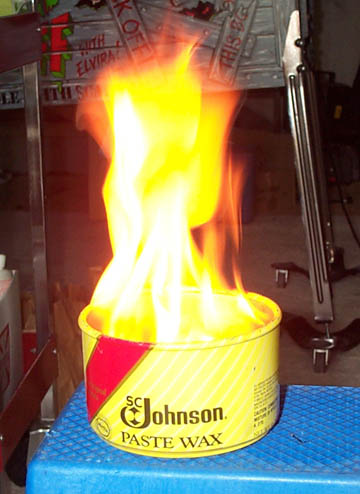
Johnson Paste Wax is used by a lot of pinball machine collectors to wax playfields on their games. A fellow pinhead kept insisting that Johnson Paste Wax contains no petroleum distillates, so I performed this test. All I had to do was drop in a lighted match. Nothing was used to prime it -- the can had nothing but wax in it. Legend has it the pic was sent to the chemists at SC Johnson Co., who reportedly had this to say: "Oh, my. Heh heh."
------------------
- dave
Stay away from the meadow...
You must have Quicktime to view this. You can get it for free at http://www.apple.com/quicktime/download/ . If you already have Quicktime you might want to upgrade to version 5. It sounds like you were trying to play it in Windows Media Player.
Obviously experiments of this nature will vary slightly from batch to batch of FilmGuard, different film stocks, processing chemicals, different labs, lab waxing and so forth. Still, in the end the bottom line to be proven here is that of all "common" booth items, FilmGuard is the least flammable. So any booth using these "common" items should not have any problem with FilmGuard. Any booth that does not allow anything that will burn when a direct flame is put to it should not even be running film.
For those who are as crazy as we are, gather these common items from a projection room and see for yourself:
FilmGuard
XeKote
Isoprophal alcohol
Generic film cleaner (the fast evaporating kind)
WD-40
Johnson's Paste Wax
Projector oil
Now go out into an open area in the parking lot where nothing anywhere near can possibly catch on fire and see for yourself which is the least flammable. That is the point to be made here, along with the fact that film DOES burn straight out of the lab DRY. Also the important thing to take note of here is that of all these commonly found items, FilmGuard burns the LEAST of them all. If you are not going to test all or most of of these items, don't even bother with the comparison test.
DISCLAIMER: Anyone who believes we faked the video download above and is insistent on performing their own experiments, please use common sense and make sure there is a second person, say 20 feet away with a fire extinguisher in case you do something stupid or something goes up more than you thought! Also, use just a TINY BIT of whatever you are going to burn for safety's sake. (Soaking 2-4 frames should be more than sufficient.) Most importantly, perform the test holding the film the exact same way that Joe did in the video. Do NOT get a strip of film and let gravity pull it downward while you hold the top of it and light it at the bottom. This is just begging for you to burn your hand off since fire burns upwards! Hold a short piece of film (6-8 inches) upright with your hand at the bottom (fold the film if you have to in order to make it stiff) and light the TOP edge and let it burn down like a candle for safety.
Also take note of the most obvious aspect of this...if the building is already burning down from whatever cause, the prints are toast anyway! Other than a building fire, there is no time that a print will ever be exposed to DIRECT FLAME like this anyway. Worst case senario is the film will brain wrap (although that's extremely rare with a FilmGuarded print) and the film will "melt" in the gate as we have all seen many times in the past. Even with a 7000 watt bulb and a piece of film drenched in FilmGuard, it will not ignite.
Now for silliness, will a PTR burn???
Steven Gorsky
Why?
Reason #1 because that is one more thing that would have to be added to each kit. We are trying to keep it as basic as possible to keep costs down.
Reason #2 because most people do not know how to interpret an MSDS sheet and have never seen one.
Reason #3 because the dealer who sold you the product has them readily available just by asking for one, plus we have an email address printed on each bottle that you can just request one via email. Other than the WD-40 company (which is by far too large of a company to deal with individual people for such requests), I don't know of any product that is found in a projection booth that actually keeps MSDS sheets online for download. Like I said, many people will misinterpret what they read and "freak out", so it's actually better in my opinion to send them out as requested so any questions that arise may be addressed directly.
Do you have MSDS sheets for all of the items in your booth? (Some states actually require this, but not many.) Have you ever read an MSDS sheet? (Like I said, most people have not.) Regardless, if you want one, just ask.
After opening one of their theatres and receveing mass complaints about the sound quality (not the volume) and trying to work with the "technician" that did the installation, we went round and round with potential causes, from amplifiers, crossovers, to someone screwing with the sound system. When calling out a 3rd party technician to resolve an unrelated emergency issue, we aske him to take a look at some of the sound problems, low and behold only 5 out of 20 auditoriums had ever been eq'ed. They only thing that had been done was levels adjusted (by the staff at HIS direction). Of course instead of fixing the problem or admitting that the problem was his fault to begin with, he blamed it on the staff. (Keep in mind no one ever actually EQ anything to begin with). That technician "trained" this tech everyone is having problems with today, and why their presentation continues to be hampered.
I think posting this stuff for general consumption for people who do not know how to interpret it would not make good business sense.
OTOH, I don't agree with the idea of keeping MSDS hidden away. If a child were to swallow a liquid, it could be vital to have quick access to the information on the sheet. I don't think I would be able to stomach a kid dying or having permanent damage because of such a policy. If one does have that policy, IMO a poison control center should have the MSDS info and there should be an indelible phone number for that center on the containers. Phone numbers to a business or address of a website aren't sufficient because of the possible delays in getting the info.
FWIW, I haven't seen the film-guard MSDS and have no idea if it is even poisonous, although I must assume so in the absence of that information. I just am of the opinion that the safety of kids trumps most other concerns. Industrial chemicals can find their way into the home, and folks with super 8, 16mm or 35mm home movies probably already have small quantities of film-guard in their houses.
However, that file is kept out of sight of people who have not been taught to correctly interpret the information it contains. Almost all substances are dangerous/lethal if misused. For example, water can kill you and it's possible to drown with a surprisingly small amount, and washing up liquid will kill you (the enzymes in it break down the stomach lining) if swallowed in any significant quantity.
Right I'm off to the pub for a long, cool Filmguard on the rocks...
------------------
John P. Pytlak, Senior Technical Specialist
Worldwide Technical Services, Entertainment Imaging
Research Labs, Building 69, Room 7525A
Rochester, New York, 14650-1922 USA
Tel: 716-477-5325 Cell: 716-781-4036 Fax: 716-722-7243
E-Mail: john.pytlak@kodak.com
Web site: http://www.kodak.com/go/motion
 and I have NO patience.
Many fellow pinheads accused me of faking the J-Wax pic. They just knew I poured gasoline or lighter fluid in that can to get it to burn that well. Nothing I said was going to change their minds. People have become cynical, tend to see conspiracy or deception everywhere. I blame The X-Files .
Re: Lighter fluid. Naphtha-based (sp?) lighter fluid (i.e. Ronsonol) is a great product for removing gummy residue from smooth hard surfaces. Seems a little harsh for use on film though.
------------------
- dave
Stay away from the meadow...
------------------
Greg Mueller
Amateur Astronomer, Machinist, Filmnut
http://www.muellersatomics.com/
Thanks, I'll check that out. I am not on that machine right now so can't verify if it has QT or not (I thought it did) but you are right, the file was trying to play on Windows Media Player.