This is topic 16/35mm Projector? in forum Film Handlers' Forum at Film-Tech Forum ARCHIVE.
To visit this topic, use this URL:
https://ft-forum.com/ft/cgi-bin/ubb/ultimatebb.cgi?ubb=get_topic;f=1;t=003185
Posted by Bill Enos (Member # 440) on 03-09-2002, 12:41 AM:
I ran a 20 min 16mm short a few days ago for a local semi pro. film maker. He asked why we had a 16mm only machine instead of having one of our XLs set up to do both. I've never heard of a 16/35 projector. Does or has such a machine existed?
Posted by Ken Layton (Member # 133) on 03-09-2002, 12:49 AM:
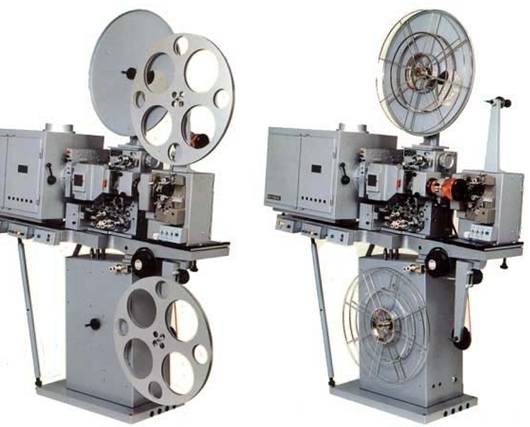
Yes, Philips/Norelco/Kinoton had model FP-28 that was 16mm on the left side of the machine and 35mm on the right.
Posted by Steve Kraus (Member # 476) on 03-09-2002, 12:59 AM:
The only machine I've ever seen that had 16mm and 35mm in the same path (as opposed to the left side / right side Norelco/Kinotone) was a MagnaTech machine made for mixing stages. The film components were very obviously Norelco in origin so I'm not sure if there is perhaps a common path Norelco but this machine was a specialty unit, with stepper drives that could reposition the film at high speed by rolling it non-intermittently through the gate before resuming its normal projection. The controls were similar to an MTE dubber and it interlocked directly with them. As with a dubber the 16mm portion of the drive sprockets was only a bit smaller than the 35mm section--they were simply driven more slowly in 16mm mode. But the intermittent sprocket had a size differential that was in proportion to the differing amount of film to advance per frame and thus the 16mm section was way down in the middle of the 35mm part; you could easily not even notice it was down there.I rather doubt your client ever saw 35/16 on anything resembling a conventional theatre projector.
Posted by Scott Norwood (Member # 30) on 03-09-2002, 01:07 AM:
There's a single-path 16/35 Kinoton that is a current model. The 16mm soundhead is _above_ the gate and the sound is delayed digitally to match the picture. The concept seems weird, but apparently it works.There was (is?) also some weird Russian (?) 16/35 machine that I have never actually seen, but I once saw some poorly xeroxed schematics for it. If anyone has more info on this, I would be interested.
Posted by Richard Fowler (Member # 893) on 03-09-2002, 01:16 AM:
Ernemann has for many years offered a 16/35mm projector....by rotating a knob the 16mm components and soundhead would shift into the path.
Tokiwa of Japan has a 16/35 available which involves sliding a 16mm mechanism in the light path of the existing 35mm. Inchol in Brazil made a unit from 1960 to 1990 which was a combination projector with the same threading path since the 16mm gate was recessed within the 35mm trap and the xenon lamphouse had a sliding light table to focus for 16mm or 35mm.....many of these are still in use in government agencies.
Richard Fowler...just off the plane from ShoWest
TVP-Theatre & Video Products Inc. www.tvpmiami.com
Posted by John Walsh (Member # 168) on 03-09-2002, 07:58 AM:
Yes, Richard is correct; the Ernemann 15 is convertable. I saw an FP-28 while on a cruise ship, although I think most of them have been replaced with video projectors by now.
Posted by Pete Naples (Member # 761) on 03-09-2002, 09:07 AM:
I installed a 16/35 Ernemman last year, lovely machine. The sprockets are dual profile, save for the intermittent (there are seperate units for 35 and 16mm). Also hase separate sound heads, both are Raytheon laser units, it also has a Dolby SR.D basement reader.To change from 35 to 16, all that is required is to change the gate/trap assembly (one screw), rotate the turret to bring the 16mm lens into position and to thread the 16mm film accordingly. The projector makes all the adjustments to speed, take-up, sound etc.
There's a 'back to back' Kinoton 35/16 in Edinburgh, about 3 years old, although it's not really a dual guage machine. It's two machines glued together. Must be quite expensive as you have two projectors, two lamphouses and two rectifiers. It's also been somewhat tempremental.
Posted by Serge Bosschaerts (Member # 298) on 03-09-2002, 11:50 AM:
Bauer have also made a 16/35mm projector, the U 4 Combi with a Bauer Selekton II O head on the left for 16mm, sharing the same lamphouse, aprox. 40 machines produced.
Even more rare is the Bauer U4 C Combi also with Selekton II O head for 16mm on the left but on the right 35/70 mm combi head from the U3, aprox. 20 machines produced.
Posted by Leo Enticknap (Member # 534) on 03-11-2002, 03:47 AM:
I agree with Pete's point that maintanence and repair of FP-anythings is not for the faint-hearted (or pocketed), but IMHO the FP-18 gives quite simply the best picture of any 16mm machine I've ever encountered - so stable it looks nailed to the screen, and the mechanism is very kind to shrunk and brittle film stock, too.Given that (as discussed in another thread) 16mm is now effectively a 'legacy format' as far as cinema exhibition is concerned, then for me this is a major point in favour of FPs. I can't comment on Ernemanns as I've never used one and (AFAIK) have never seen a film projected by one.
Posted by Pete Naples (Member # 761) on 03-11-2002, 12:49 PM:
The Erneman (spelling!) is mech that I've always thought of as being gentle on film, and gives a nice steady picture. In 35mm it uses velvet gate bands, I can't remember if that's true for 16 either. It's a sprocket 16mm mech, which is definitely better than the claw type of most machines. Take up is motorised and adjustable, as is star-up ramp, the motor being invertor controlled. If I had to pick, based on the experience I have of the two machines, I'd take the Erneman because I don't feel there's anything to choose between them performance wise, actualyl I take that back, I've always thought the Ernemans Raytheon sound head sounded better, probably due to the on board pre-amp and equalisation (I've never had to apply any slit loss eq' with these), but the Kinotons I've dealt with have been somewhat tempremental to say the least. One other little thing for us installers; if you tell Erneman what CP you will be using, and how far it will be from your projector, they supply a pre wired cable with the projector. To set up the 'A' chain with the two I've installed all that was required was to plug in both ends, set Dolby level, set SR.D frame delay and off you go! I checked the 'A' chain and reader alignment of both machines as they came out of the box, and couldn't fault them, in fact I felt that if I messed with it I'd probably make it worse. Quality engineering like this atttacts a quality price tag, but like everything else in life, you get what you pay for!
Posted by Larry Shaw (Member # 388) on 03-14-2002, 03:44 PM:
There's a photo low on the http://www.blsi.com/kinoton/fp30e.htm page.
The back-to-back FP 38, and its predecessors, have been out of production for years.-Larry
Posted by Steve Guttag (Member # 268) on 03-14-2002, 06:47 PM:
There is nothing I have seen to lead me to believe that the Ernaman has ANYTHING over the Kinoton FP-38E. The current 16mm soundhead is better beyond description. It is a complete davis loop system that, quite frankly, rivals just about any soundhead 16, 35 or 70mm. The only thing I wish Kinoton would add the 16mm soundhead is a flywheel decoupler for reverse and/or shuttle operation. Currently, it only detensions. The current Kinoton preamps are also top notch with very nice, crisp sound not normally associated with typical 16mm.35mm wise, the FP-38 will still spank the Ernaman in both picture and sound categories. Furthermore, the studio soundhead option will allow the flywheel to be accelerated prior to being engaged so there is no slipping on the film. Another big plus, the Kinoton doesn't use the Raytheon laser pick up!
Now I will give you that the older FP-16, FP-18 and FP-28 soundheads can be tempermental. While they certainly were capable of supurb sound they had to be messed with a bit too much to keep them that way. The preamps were also wanting, in my opinion, up until about 1993.
Also, I haven't found a non-American projector yet that has good changeovers.
Steve
------------------
"Old projectionists never die, they just changeover!"
Posted by Mark Gulbrandsen (Member # 72) on 03-14-2002, 07:40 PM:
I have a Japaneese 16/35 machine that is quite unique. Both gauges run in the same film path. No double sided stuff for those guys! The sprockets are 16/35 and the 16mm gate which sits in front of the 35mm gate removes for 35mm operation. There is a seperate 16mm intermittent sprocket. The gear side looks like a Simplex X-L a bit. It also has a conical shutter. I think Steve G may have seen these as they were originally located near him. The 35mm performance is great. The 16mm performence is average.
Mark @ GTS
Posted by Gordon McLeod (Member # 33) on 03-14-2002, 08:08 PM:
At one time ernamann had a 16mm attachment that was a standalone head that mounted in the 35mm lensmount on the ernamann VIIIb
Posted by Mark Gulbrandsen (Member # 72) on 03-14-2002, 10:52 PM:
here is a link to pictures of A strange pair of Bauer projectors. They are a mirrored pair. http://www.kinoteam.de/kt/kt_pr_bau_b_11.html
Mark @ GTS
Posted by Ken Lackner (Member # 1002) on 03-15-2002, 02:00 PM:
When you say there are a mirrored pair, do you mean that the operator side of the right-hand projector on the left of the projector rather than the right? It's hard to tell from the pics.
Posted by Pete Naples (Member # 761) on 03-15-2002, 02:33 PM:
I can't comment about the FP38E, the one I have the unfortunate task of servicing in Edinburgh is not that model. As for picture and sound, I genuinely feel that there is nothing to choose between them, based on what I've seen and worked with, at any rate. Certainly the reliability of those Kinotons has left a huge amount to be desired, I don't think that theatre will buy Kinoton again, if they add more screens or refurbish the other existing ones. At the price two Kinotons, one being the 35/16 type, and a Kinoton dubber come in at you'd expect them to be able to at least supply the correct manual for the equipment, so that when it doesn't work you've a chance of figuring it out, but alas, no.Steve I do agree with your comment about change over, the last Prevost job I was involved in, the change over operated so badly that we disconnected all the on board stuff and wired in our own. Now it changes over when you press the button, like any sensible system. From the factory you started the motor on cue, and the machines changed over, seven seconds after motor start, on their own, with no operator pushing the C/O button! You can't miss Kelmar change overs going 'CLUNK' as confirmation that you've done it! Wire the same buttons into a simple relay system to change over sound and you're away.
Posted by Mark Gulbrandsen (Member # 72) on 03-15-2002, 10:27 PM:
Ken, Yes. If you stand between the two machines there is a film side of each projector on both sides of you!
If you look at this photo you can see the spindles on the upper cans. http://www.kinoteam.de/kt/image/big/bauer_b_11_anordnung.jpg
Pretty strange, ha?
Mark @ GTS
Posted by Scott Norwood (Member # 30) on 03-16-2002, 09:48 AM:
Does Kinoton still put the c/o switch on the _front_ of the machine? I assume that this can be reworked to use a button on the booth wall or a footswitch instead, but to put the switch in a difficult location by default seems a bit silly.What would be the advantage of a "mirrored pair" of projectors? If anything, it would seem to be a disadvantage since many parts would presumably be non-interchangeable between machines. Apparently many of the theatre-model 16mm projectors are left-hand-thread models so that they can share a porthole with a 35mm machine, but that doesn't seem to have been an issue in the booth that Mark is talking about.
Posted by Pete Naples (Member # 761) on 03-16-2002, 10:42 AM:
Scott, yep the Kinotons in Edinburgh have the C/O button on the front of the machine, where it's really easy to get to, he said with a hint of sarcasm!The 16mm side of the Nº2 projector there is on the left, as per stand alone Phillips/Kinoton 16mm.
I suppose having a mirrored pair would mean that they can be closer together which would be useful in s small booth, or where lateral keyston distortion is an issue.
Posted by John Hawkinson (Member # 1135) on 03-16-2002, 01:10 PM:
A mirrored pair would also be quite useful if you're doing rapid changeovers between a pair of projectors, for instance if you have a pile of scope trailers on the left and flat trailers on the right, and need to run them in a particular order. This lets you stop the motor on the inactive projector almost immediately after you execute the changeover on the now-active projector.(That's is a frequent scenario for us here at MIT, where we do changeover and don't have any automated lens turrets.)
This is assuming we're talking about a case where the operator sides are facing each other.
--jhawk
Posted by Gunter Oehme (Member # 499) on 03-16-2002, 07:39 PM:
Mirrored projector pairs have been pretty popular in Germany.
Bauer introduced the first left sided projector in 1925. Production of mirrored pairs ended about 1960.
The reasons for mirrored pairs are the safety regulations of the pre safety film era.
German law required in those times two projectionists on duty for change over with two right sided projectors. For mirrored pairs only one operator was required.
Posted by Steve Guttag (Member # 268) on 03-16-2002, 11:55 PM:
Scott:The current kinotons do have the buttons stupidly facing front. There is an option (for money) to have the buttons face the operator. One can also make any sort of foot or other type of switch of their liking. Using dry contact closures, all of the projector functions are remotable.
Steve
------------------
"Old projectionists never die, they just changeover!"
Posted by Larry Shaw (Member # 388) on 03-20-2002, 06:40 PM:
Pete,There are fairly good manuals for those projectors in existence, I'd yell at whoever sold them until I got them. Sometimes the seprate FP 30 and FP 16 books have more details than the combined book. That stuff must be much older than 3 years, Kinoton hasn't made dubbers for a long time. The newer equipment has much, much better manuals, and they're improving all the time. The factory now has a full time manual writer. While many years ago Kinoton projector manuals were pretty lame, I don't know of anyone currently producing better ones.
Steve,
What was the last machine you got with front buttons? The only model that may still have front buttons is the basic FP 30D, and we'll continue to get rid of them. When I used to run a booth with the front buttons I got used to them pretty quickly, so they didn't really think of them as a problem, but that's not to say there aren't better locations. I actually really like our current backlit buttons in that small switch box, especially when its mounted fairly high up. When its down low because the upper space is used for digital readers, I'm still fighting to get the factory to angle the box up. The parts of me at that elevation have no eyes.
------------------
Larry Shaw
Boston Light & Sound, Inc.
North American Distributor of Kinoton GmbH
290 North Beacon Street
Boston, MA 02135-1990
Tel: 617-787-3131 x104 Fax: 617-787-4257
E-Mail: larry@blsi.com
Web site: http://www.blsi.com/kinoton
Posted by Steve Guttag (Member # 268) on 03-21-2002, 10:54 AM:
>>"Steve,What was the last machine you got with front buttons?"<< An FP38ES last April because we didn't order the optional operator facing panel that you mention in your post. In that installation, there was a full remote contol to be used for 95% of all operation so the operator facing panel wasn't deemed necessary.
For your reference, the option is part number 0040 140 001200 and must be ordered for each projector (this is a factory installed option for the FP-30E series) and carries a list price of $270.00.
I believe for the PK-60E it is standard equipment. As to the panel location, high or low depends on the particular installation. A high mount is mostly preferred unless the projector must mounted on a riser. Mounting it above the lens brings the operator's arm (and possible bracelets) close or into the projection beam. Mounted low (below the lens) tends to have the controls somewhere near pocket height.
We have taken to having a separate control box with just the motor and changeover functions since at changeover time, having a mass of identical looking buttons (except STOP which is red) can be confusing and lead to botched changovers (and no-no in my book). One shouldn't have to look for their controls when making a changeover.
Now before picking on Kinoton too much on their control panel, one must reflect on just how many other projector manufacturers provide any manual buttons! While they once may have provided a motor switch (and on some that was on the pedestal) and some may have provided a changeover pushbutton (if you bought their sound system) not too many now have manual switches since they are presummed on the automation. Kinoton also provides for one to install any manual switches they choose...all with low-voltage using dry contact closures.
------------------
"Old projectionists never die, they just changeover!"
Posted by Richard Fowler (Member # 893) on 03-21-2002, 11:16 AM:
Cinemeccanica gives out a manual switch panel / slow start set up if requested....It must the European mentality to provide as much as possible in the basic package.
Richard Fowler
TVP-Theatre & Video Products Inc. www.tvpmiami.com
Posted by Erkan Umut (Member # 330) on 12-09-2002, 04:08 PM:
Nippon Denshi Kogaku (Brand: Cineforward) and Victor Arcs (Brand: Fuji-Central) of Japan manufacture 16/35 dual gauge projectors as well.
For more info you may visit my web page at www.erkanumut.com/j.htm
[ 03-20-2007, 11:25 AM: Message edited by: Erkan Umut ]
Posted by Dick Prather (Member # 1136) on 12-09-2002, 04:48 PM:
The 35/16 Mark speaks of is a Nichion model NA-101. Mark, I was there when you picked it up at Wolk. At that time it was missing the 16mm intermittent but I think most of the rest was there. It was a combined picture and soundhead for both 16 and 35. B.F. Shearer sold them on the west coast from the spec sheet.
Posted by System Notices (Member # 2357) on 04-23-2011, 01:48 AM:
It has been 3056 days since the last post.
Posted by Paramjit Singh (Member # 6236) on 04-23-2011, 01:48 AM:
Hi all. I am a new member to this forum. Professionally I am working as Executive producer in ALL INDIA RADIO, the largest Govt Broadcasting Network in India.
I have tremendous interest in Film Projectors. In my collection I have a 8mm, super 8mm, 16 mm Projectors. I was looking for a portable 35mm projector in affordable cost. But I could not get one. So I purchased an old FUJI Japan Projector Head, worked on it for 6-7 months in spare time and converted it into a complete portable unit with 24v 250 Watt halogen lamp, optical sound with, in built Amplifier, plain as well as anamorphic lenses. I did it all with hand tools in my home work shop. I ll soon post its photographs
Posted by Jeff Taylor (Member # 443) on 04-23-2011, 02:28 PM:
If anyone wants to check out one of those Erneman 16/35's mentioned earlier in this thread, Steve Krams has had one or more listed on ebay for months. They're supposedly from a cruise line.
Posted by Bajsic Bojan (Member # 4928) on 04-23-2011, 03:20 PM:
since i did work 4 years on the ernemann 15 combo 16/35 unit w/ changeovers, i can say:
- fair share of 'general' problems with the machine (2 or 3 igniters went, couple belts, about 10 broken reel axle things)
- 16mm we couldn't get decent/fair sound, magnetic or optical, maybe also because of disastrous prints
- inconsistent changovers soundwise(sometimes no sound on changeover, required restarts of projector)
- 16mm gate was quite hard on film and had to be loosened alot => enter wow and flutter in sound and image
- revolver issues (kept 'falling apart' and slipping, damn rotary screw thingies)
otherwise a nice machine for 35mm for picture stability and light uniformity, real nice and gentle on 35mm prints (ran a heck of a lot of acetate in various states).
Posted by Marin Zorica (Member # 1716) on 04-24-2011, 03:05 AM:
Too bad ernemann is so bad, i knew they have some problems, but that is too much! Kinoton is far better when you take 35/16mm version, but also price is about 50% more with kinoton, but with kinoton you are problem free!
That ernemann's on ebay are late 8's Ernemann 12.
Posted by Jim Cassedy (Member # 4115) on 04-24-2011, 10:09 AM:
![[Mad]](mad.gif) A wonderful thing to have happen during a changeover.
A wonderful thing to have happen during a changeover.