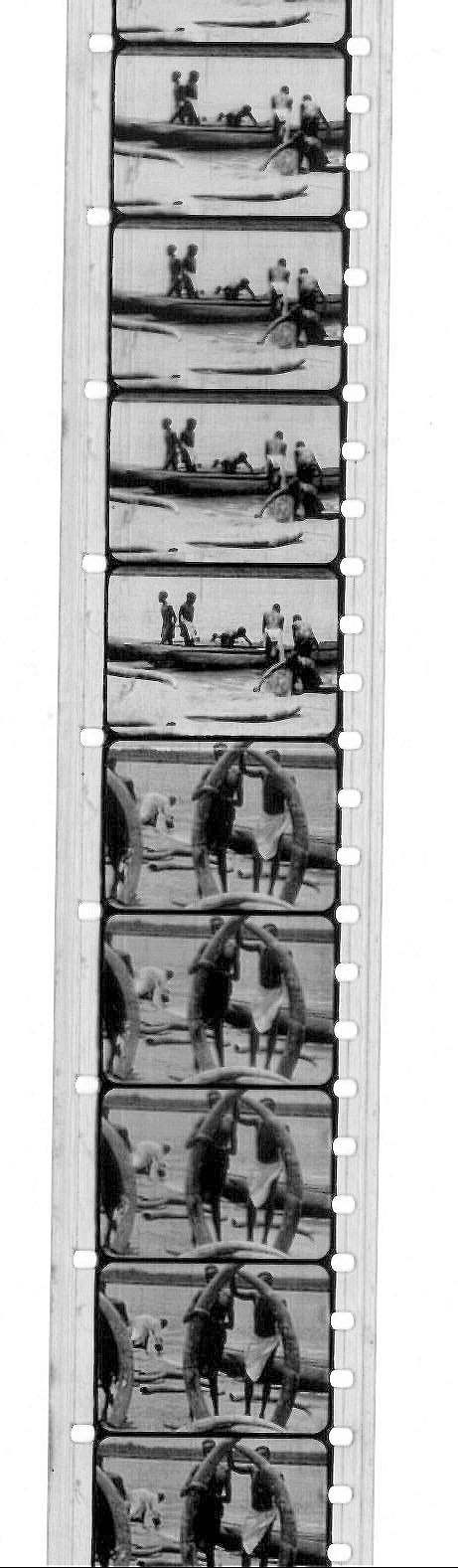
I have sent a sample picture of some frames, which are poor quality, as I don’t have a transparency scanner, but you should be able to see the type of perforations adopted.
28mm camera:
http://members.tripod.lycos.nl/cinemat/Pathescopcam2x.jpg
28mm film and projectors:
http://www.xs4all.nl/~wichm/pathkok.jpg
http://people.a2000.nl/awichman/victor28.jpg
http://www.xs4all.nl/~wichm/bing28mm.jpg
http://members.tripod.lycos.nl/cinemat/28mmproj.jpg
Other links:
http://www.sci.fi/~animato/filmhist/filmhist.html
------------------
John P. Pytlak, Senior Technical Specialist
Worldwide Technical Services, Entertainment Imaging
Research Labs, Building 69, Room 7525A
Rochester, New York, 14650-1922 USA
Tel: +1 585 477 5325 Cell: +1 585 781 4036 Fax: +1 585 722 7243
E-Mail: john.pytlak@kodak.com
Web site: http://www.kodak.com/go/motion
The perforation pattern you show prevented the film from being threaded reversed laterally. But this was abandoned for later films
which had the same pattern on both left and right.
The films that came with it are short documentaries. "Oil Well Fire"
was printed on red/orange stock (or tinted) to enhance the subject.
A cartoon is on yellow stock. Each film is about 200' to 400' in length, and came in a colored can with printed label. Of course 28mm
film is safety stock. I think it was invented to prevent standard
(35mm nitrate) film from being used in homes, churches or other places
for safety, and to bypass Edison's strictly enforced patent monopoly
on the manufacture, sale and use of perforated 35mm stock.
I agree with Gerard - the Motion Picture Patents Corporation had something to do with this. I'll have a look in Raymond Fielding's 'Technological History of Motion Pictures and Television' this evening and see if there's any info there. David Puttnam's 'The Undeclared War' also has a chapter on Edison, the MPPC and European attempts to break it, but I don't think he goes into much technological detail.