
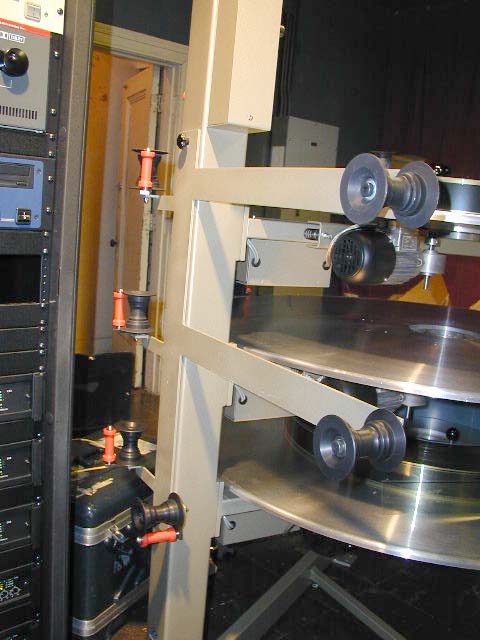
The ST-200's that we have at work are exactly the same as the one shown at this link:
http://www.kinoton.com/iprodukte.htm
From that link, click 'Cinema Products', then 'Non-Rewind Systems', for a photo of all models.
Actually, it looks more like the ST-270, the 35/70MM equivalent. The difference is that those extension arms are present in the 35/70 version to facilitate more gentle twists for 70MM operation.
Either way, going by the method that the ones we have at work take up to the bottom plate, you don't thread to the bottom-left return roller the way you do to go to the middle or top plates. Instead, you simply bypass it and go directly to the perpendicular roller (the one directly corresponding to the lower plate) just behind it. From there, you simply go to the control arm roller on the lower plate then wrap the film to the centre ring to take up counter-clockwise as per usual. I hope that description makes sense.
When you take up to the lower plate, the film barely twists at all. From the lower gimbled magazine under the projector, all the film has to do is become perpendicular - a 45 degree twist at best, so it's suitable for 70MM operation. Obviously, the height of the projector's lower gimbled magazine roller must be similar with the take-up rollers on the lower plate of the platter for this to function. It's only when the film must travel to the middle or top plates that the extension arms come into play for a 'Z' shaped take up pattern. (Top plate take-up would go: lower roller, across to middle extension, then up to top extension, then twist to top roller next to column, then control arm, then centre ring.)
My description applies to the platter being on the operator side of the projector. If the platter is on the other side of the projector, then the film simply wraps around that lower perpendicular roller next to the main column from the other side, goes to the control arm then back around to the centre ring for a 'Z' pattern (viewed from the top). The degree of film twisting is identical.
John Wilson comes back next week with his digital camera so we can take pictures of film returning to the lower plates if you like. We have examples of both operator and non-operator paths.
If you go to http://www.blsi.com/kinoton/technical.htm and look at Tech Note # 01-5 you will find a link to a image of exactly how to thread that deck on that platter.
I'm a lot of things, but, at least in this case, I'm not stumped.
-Larry
------------------
Larry Shaw
Boston Light & Sound, Inc.
North American Distributor of Kinoton GmbH
290 North Beacon Street
Boston, MA 02135-1990
Tel: 617-787-3131 x104 Fax: 617-787-4257
E-Mail: larry@blsi.com
Web site: http://www.blsi.com/kinoton
Even though I am not a fan of turning the film upwards to run onto the deck, I see no reason why to take up on the bottom platter the lower magazine roller on the projector HAS to be the same height off of the ground. I find this quite foolish. If Kinoton would just add one more of those "arms" like is on the top two decks and another roller at the base of the tree, the problem would be solved.
Also, please do consider making the exit and enter roller on the platter adjustable. I hate having to pivot the platter around so that it "points" to the projector. This is just not possible in some booths.
Steve, the Christie AW3 platter can switch from makeup to breakdown mode with the flip of a switch too.
Few people have complained about this issue, however if customers want something we try to accomadate the request. What I'm thinking about now is having additional holes put in the column to accept a "input & output swivel roller kit" that could be ordered by those that want it.
Of course I'd be happy to hear any comments.
-Larry
------------------
Larry Shaw
Boston Light & Sound, Inc.
North American Distributor of Kinoton GmbH
290 North Beacon Street
Boston, MA 02135-1990
Tel: 617-787-3131 x104 Fax: 617-787-4257
E-Mail: larry@blsi.com
Web site: http://www.blsi.com/kinoton

Note how this gains better access to the film cleaner mount (which Kinotons should have, but don't) as well as access to the back of the tree (most particularly useful with Strongs, SPECOs and any platter with an "elevator" on the back of the tree) for the projectionists to be able to easily walk around the platter during threading. (Whoever instaled the Kinoton platter in the picture Steve posted at the top of this thread was either completely out of room or had no thought process put into what a major pain threading would be with the platter so close to the sound rack.)
I still fail to understand why having the receiving roller from the projector set to the height it is at is beneficial. If the platter to projector distance is very great, that makes the lower magazine roller have to be even higher, which means the film must make more of a twist over a smaller distance. Plus, your *better* operators out there do not thread through the lower magazine roller when initially lacing the platter. They make a triangle like this, which absolutely prevents the film from hitting the floor. See next pictures.


Just check out Christie, SPECO and Strong platters (to name a few) to see what I mean when you design a swivel roller kit. It will use less rollers, will not be so confusing to some of these *operators* out there and will be an improvement to the overall design of the platter. I was quite impressed with the payout design of the Kinoton platter that I saw at ShoWest, but these items would prevent me from ever recommending one.
My reasoning for disliking angled magazine rollers is that it wears out the leader 3 times as fast, which isn't well thought out in terms of the theater's expense in purchasing new leaders more frequently. Plus angled rollers do not easily permit speed winding of the film when needed. For theaters that run platter and reel to reel, there is little option though.
If you look at the picture above, you will notice the keeper roller was removed from the upper magazine roller. This was done because for some oddball reason the open side of the keeper was toward the lamphouse, making threading an extra pain. By having the rollers straight up and down, the keeper became unnecessary and could be removed...so long as gravity continued to function, of course.
Below is a picture of a very common, but poorly thought out alignment of the upper magazine roller. Sure this setup runs fine, but having the roller aligned at an angle like this kills the life of the leader as it is dragged over the flange of the roller during threading. (Notice two pictures above how the film enters and exits the roller without dragging over either flange during threading.)

The lower magazine roller doesn't matter how it is angled.
Regarding the angling of the platter (which I do understand as I've installed hundreds of non-Kinoton platters) it's not really required in the 35mm 3-deck Kinotons as all threading is done from the location about where the film cleaner is on the AW-35. There's just nothing to do on the other side. With the 5-deck 35mm or 35/70 platters usually a set of front wall rollers accomplishes anything that's needed to get the platter away from the wall. But again I hope to have the kit mentioned in the previous post available soon, even though Steve G. told me platters were almost dead anyway.
Regarding the cleaner shown in that beautiful installation, we use the Kinetronic or PTR cleaners mounted on the projector. I'm not sure I see a great advantage to the platter mounted cleaners, but maybe thats just because I've come up and bonked my head on a few over the years.
And as far as the height of the input roller,
1. It seems most of the operators these days are *worse*, and might not know what a triangle is.
2. When I mentioned film dragging on the floor, sadly, I didn't mean during threading, I meant the whole length of the print being dragged over the floor each showing.
3. When you get as old as me, that bottom roller looks awful far down!
-Larry
------------------
Larry Shaw
Boston Light & Sound, Inc.
North American Distributor of Kinoton GmbH
290 North Beacon Street
Boston, MA 02135-1990
Tel: 617-787-3131 x104 Fax: 617-787-4257
E-Mail: larry@blsi.com
Web site: http://www.blsi.com/kinoton

 Just please don't put the film cleaner mount at the top of the tree like Big Sky did!!!
1. It seems most of the operators these days are *worse*, and might not know what a triangle is.
Of course operators today are not as good overall as the operators of yesterday, but it is much quicker and easier to not thread that lower magazine roller, so once the newbies are shown, I've never had one not follow the recommendation. The operators of yesterday had training, why can't we give today's operators the proper training?
2. When I mentioned film dragging on the floor, sadly, I didn't mean during threading, I meant the whole length of the print being dragged over the floor each showing.
If the platter is THAT far away, then a jumper roller should be used. However, I've worked with Christie and SPECO platters that were 20-25 feet away from the projector and neither of them had any problem. That sounds like an installation error.
3. When you get as old as me, that bottom roller looks awful far down!
When you are as short as me, that bottom roller is still far down, but is still the best approach. 
