
I'm just about to go and blow a fat load of cash on a nice new set of lenses. I'd rather not go and order the wrong sizes so if anyone has 2 minutes to check my calculations I'd be happy to buy them a drink
Screen dimensions x=7.68m, y=3.57m - approx 2.2:1 ratio.
Throw = 19.5m. I don't have the projector angle but its only a few degrees or so.
So I'm going to work from a fixed height for 1.85:1 flat, and fixed width for 2.35:1 scope - this screen unfortunately has no masking 
Scope comes out as 106mm focal length (image height=3.28m)
Flat comes out as 62mm (image width=6.58m)
These are slightly different to the current lenses - the flat lens is 65mm which is pretty much there but the scope lens is 120mm - which would give us a smaller image - however the projected image size just about fills the screen as per the calculations for the 106mm lens.
I think the varomorph (door stop?) might have something to do with it - either that or I got the numbers wrong!
Rob
Steve
------------------
"Old projectionists never die, they just changeover!"
Example:
Throw = 60 feet
Desired image height on the screen = 14 feet.
60 divided by 14 = 4.285
4.285 times .446 (for flat) = 1.911 inch lens.
4.285 times .700 (for scope) = 2.999 inch lens.
Works the same for scope, too, but remember the aperature size is .690, .700, or .715 - whatever ratio you are going to use.
To convert the lens size (in inches) to millimeters, multiply the lens size (in inches) by 25.4, and you will see that the 1.911 inch lens is actually a 48.53 mm lens.
A 2.999 inch lens times 25.4 will calculate to a 76.17mm lens.
Use your aspect ratios to calculate the picture widths.
Your 3.57 meter screen height is 11.713 feet. Your throw of 19.5 meters is 63.976 feet.
The flat lens calculates to 61.87mm for a .446 aperature.
The scope lens calculates to 97.11mm for scope using a .700 aperature.
Remember you can "fudge" this a little, since they don't make a 61.87mm lens, nor do they make a 97.11mm lens, either. If I recall correctly, lens sizes come in 2.5mm increments.
My calculations should be correct, unless I had my fingers in the "wrong hole" on my handy TI-83 calculator. Please check my figures.
Frank, I understand the orginal reason for 1.85 ratio was to get away from the television look as much as possible in the 1950's. I have heard many times the 1.85 was called the "Bastard Ratio" because nothing would fit it.
Your 'Scope is the awkward one. To fill the screen height, you are going to have to crop the sides by quite a bit, if you don't fill teh height you can shopw the whole 'Scope picture, but you run the risk of showing neg flashes if the plates aren't cut VERY carefully. Also I hate seeing unused, unmaskes screen surface. Perhaps this is why someone installed a Varamorph, by adjusting the squeeze you could get the picture to fit the screen, without losing any of it. Albeit with some distortion. I've seen it done and it looks a bit like some of those dodgy Sunday afternoon Westerns on BBC2!
Based on the information you gave, and assuming a 5 degree downward rake, I get the following.
'Scope 2.39:1 95mm, 8.53m x 3.63m, cropping sides quite severaly.
1.85:1 60mm, 6.75m x 3.71m
1.66:1 70mm, 5.79m x 3.54m
This is based on the readily available IscoOptic lenses. There are inbetween sizes available from Schneider, which may give a slightly more accurate result. Stick to Isco or Schneider lenses though, they are worth the extra cash over the other brands around.
Question: How did you derive the throw? Is it screen to gate?
Download yourself the Schneider or Isco programs and take a look for yourself too.
The throw is always from the gate to the screen. On the Schneider program it is the straight line throw, then tell it where your projector is in relation to the screen (how high and to what side). It will give you a very accurate dipiction of what you picture will look like. If you are curving the screen, there is a glitch in it. You will need to add in the cord-depth to your throw so if you had say a 50 foot throw on a flat screen and you curve it 2 feet deep, you will need to make your throw 52 feet.
As to hand calculations and slide rules...if you know what you are doing with them, you can come away with just as good a result. With them you should use a throw that goes from gate aperture to center of screen...if you have to go to bottom of screen you will need to use some trig. to calculate what the throw to center of screen is.
As to focal lengths...Schenider's variable primes are for those people that just don't want to crop the picture. Admittedly, with the 2.5mm increments now available on shorter focal lengths, it isn't so bad anymore. Still the Schneider variable prime is a good way to have a perfect lens size without paying a performance penalty.
Magnacoms and zoom converters still have their place in the world too. They offer a greater range than most and can provide the desired affect on the image. For instance on a curved screen that is optimized for maximum light reflectance, a magnacom can often provide the best image.
Steve
------------------
"Old projectionists never die, they just changeover!"
Thanks for the many suggestions.
Pete, could the varomorph have been reducing the effective focal length of the system? The backing lens was 120mm but the Varomorph is only ever set to a horizontal expansion of 2 which should give the right ratio. Whatever... its going in the skip anyhow
I've stuck the numbers (they were measured with a tape measure so should be reaonably accurate) into both Isco and Schneider's software and they both come back with 60mm for 1.85:1. Pete, you were right, Scope was a bit awkward, but the amount of necessary cropping with the 95mm lens seemed a bit extreme - P"aramount picture"s comes to mind!
Projector is almost dead centre horizontally (counting ceiling tiles) and the vertical offset wasn't great enough to make any big difference.
In the end 105mm seemed to be a reasonable compromise - a little bit of an overshoot at the sides, a bit of space at the top and bottom, but adding on a couple of feet extra from the port to the gate makes it just about fit - went with the Isco Ultra MC for 1.85:1 and the Schneider super-cinelux anamorphic combo for scope.
Rob
I think the oldest magnacom I saw was in Green Bay, Wisconsin. It was about 8 inches long and looked like a Cinemascope attachment. There was a slide groove in the sides with some lock-down thumb screws. When the screws were loosened, the inside lense could be positioned fore and aft. I wonder if this was the first magnacom series ever made? It looked like it was at least 50 years old then.
Rob, by all means, download that Schneider lens calculator program. It is the very best out there. I have used it several times, and it is accurate down to the gnat's backside. That program will also show other problems that will develope with severe projection angles laterally and vertically. I have also discovered that the folks at Schneider Optics will bust their butts trying to help you select the right size lens for your application.
The person who developed the software really had his act perfected. Now I wish he would write something for Microsoft. 
One thing the Schneider program does is accurately show how their lenses will perform in real life. Check out what happens when you use one of their "WA" anamorphics or "ES" series anamorphics are used vs. just a theoretical 2:1 expansion...The "WA" anamorphic is often greater than 2:1.
Steve
------------------
"Old projectionists never die, they just changeover!"
Steve
------------------
"Old projectionists never die, they just changeover!"
Steve
------------------
"Old projectionists never die, they just changeover!"
quote:
I think the oldest magnacom I saw was in Green Bay, Wisconsin. It was about 8 inches long and looked like a Cinemascope attachment.
A Pacific Optical "Xpansa Lens", perhaps?
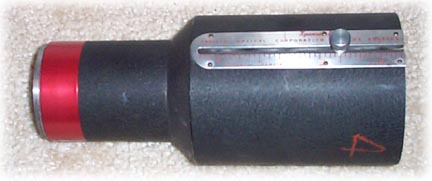
It's not the most efficient thing on the face of the earth, and the optics are marginal at best on this example. I'd much prefer a modern Magnacom over this beast, but, well, it served its purpose in its day.