This is topic High Speed FilmGuarding in forum Film Handlers' Forum at Film-Tech Forum ARCHIVE.
To visit this topic, use this URL:
https://ft-forum.com/ft/cgi-bin/ubb/ultimatebb.cgi?ubb=get_topic;f=1;t=003550
Posted by Mitchell Dvoskin (Member # 751) on 06-07-2002, 12:14 PM:
As I run a lot of older film, generally only once or twice, so I have my Kelmar film cleaner mounted on my Kelmar winding table, and clean the films in advance of the showing. As of yet, I have only run film though it slowly, simulating projector speed. Of course, the question comes to mind, how fast can I go before I am going to fast for FilmGuard to be applied effectively./Mitchell
Posted by Jeff Taylor (Member # 443) on 06-07-2002, 12:23 PM:
Mitchell: Brad will undoubtedly repudiate what I'm about to say, but here goes. I value Film-Guard as much to hide base scratches and "wet gate" as I do to clean, and I routinely "pre-apply" the product at speeds of 500' / minute with handheld moistened cleaning cloths. The results are highly satisfactory to me and I've had no mishaps. From the color of the cloths after application there is clearly a good deal of cleaning going on, and I get about six months of scratch-free "glowing" projection of a typical print after application. As I said, however, don't look for this answer on the instruction sheet!
Posted by Brad Miller (Member # 2) on 06-07-2002, 12:27 PM:
Overapplication is *almost* a non-issue with acetate film stock. It's polyester film stock that you want to be careful about not overdoing it. That being said, since you do not have to wait for the cleaner to evaporate before it is wound back up (since spotting is a non-issue), you can wind at a pretty good speed. 3-5X normal projection speed is ok, but I do recommend for the best results that the first and second pass be done no faster than 2X-3X projection speed.
Posted by Mitchell Dvoskin (Member # 751) on 06-07-2002, 02:50 PM:
Thanks.../Mitchell
Posted by Steve Guttag (Member # 268) on 06-07-2002, 07:44 PM:
As someone that has been studying this very subject (film guarding/cleaning on a Kelmar rewind bench)....I have done some extensive tests (and am still testing on the quest of perfect presentation).
How fast you go is not as big an issue as you might think. I have varied the speed of the rewind bench from about 15% to about 50% (using 4500' reels with 8" hubs) to try and induce a scratch...so far, safe at 50% out to about a 21" diameter pack (the film is booking through the cleaner). I run it slower because _I_ am not comfortable with it at that speed. My policy has been 20% on the first pass (the application pass) and 30% thereafter until fresh media/film-guard is applied.
The liklihood of scratching, I have found, is a function of the cleaner vintage (old chain drive vs new newer machined gear drive) and the media itself. The older cleaners are more fussy about which media will yeild scratch free results. This is true for on the rewind bench, on the platter or on the projector cleaner mounting.
Steve
------------------
"Old projectionists never die, they just changeover!"
Posted by Kara J. McVay (Member # 1285) on 06-12-2002, 07:55 AM:
The theater I am buying currently does not have any form of media cleaners. I am concerned that I won't have the funds right away to equip 3 booths with new media cleaners. So, by reading the above comments, do I understand that it will still help if I apply FilmGuard on my rewind bench when I build the print? This would be a great help.I have been away from a booth for 11 years, when I left we were still running reel to reel and carbon arcs. So any help with all this "new" stuff is greatly appreciated.
------------------
Posted by Dave Williams (Member # 299) on 06-12-2002, 11:22 AM:
Kara, It will cost you around $500 to get one unit and film guard, and possible three additional brackets.
Use the cleaner on build up, and rotate the cleaner through the week as the prints run. It will give you impeccable performance and your customers will notice.
I would sell blood if I had to to get the cleaner. In a theater, you really can't live without it, and still have great presentation.
Customers don't notice when its perfect, and dont say anything until it starts to suck...
And they notice when it sucks!
Dave
Posted by Paul Mayer (Member # 355) on 06-12-2002, 12:07 PM:
I haven't had a chance to use FilmGuard at my place yet (I'm working on that but there are "issues"), so please forgive my ignorance. Some questions for those of you applying FilmGuard during print buildup:I take it you're applying during rewind, after making up onto a 6k reel? Or is it OK to apply to each reel as you're building/inspecting?
And I take it that two passes/applications are needed? Like once during building (if that's OK), and again during rewind?
Cheers!
Paul
Still hobbling around the booths, faster every day
Crown Neonopolis 14
Sin City, NV USA
Posted by Steve Guttag (Member # 268) on 06-13-2002, 08:31 AM:
As to my current us at the Uptown, yes, it is applied on the rewind bench when the print is rewound. Since I do Film-Guarding, and since I work on Saturdays only, the 2nd show of the day is what gets to see the first application. One advantage of doing it on the rewind is that the streaking isn't nearly as noticable as when the FG is applied immediately before projection between the payout platter and projector). The film is then cleaned/FGed on every show thereafter. As to a platter theatre such as yours, most people clean their film while showing the movie. That is, you should either have a platter mount (Crown's standard) or a projector mount film cleaner bracket.
Steve
------------------
"Old projectionists never die, they just changeover!"
Posted by John Schulien (Member # 215) on 06-13-2002, 01:50 PM:
You'll probably all blanch at this, the crazy amateur abusin' the product, but this works for me. I hand apply FilmGuard to 16mm prints for the wet-gate properties and scratch protection, and the best way I have found, if you don't have a Kelmar machine, is as follows.
I thread up the film on the rewinds with a high rewind tension, using a split reel as the takeup reel. I give each side of the film pack about two full spray shots of FilmGuard, spreading it as evenly as possible. Then I spray one shot onto a coffee filter, fold the coffee filter once around the film as it passes through the rewinds, and hold the filter between three fingers, so that the wetted paper contacts both side of the film evenly as it passes through. Filter paper is lint-free, great at absorbing dirt, and, when saturated with FilmGuard, it's so slippery that it won't scratch the film. Coffee filters are also about as dirt cheap a cleaning media as you will ever find.
Next I wind the film onto the takeup reel. I probably wind at 5X projection speed. The filter paper acts as a buffer, evenly spreading the FilmGuard onto both sides of the film. I watch the filter paper and when it starts to get dirty, I refold it to expose clean paper to the film.
Once the film is completely wound tightly onto the split reel, I separate the split reel and wipe both sides of the cored film with a clean, dry cloth to absorb any excess FilmGuard that may have been squeezed out during the wind.
I let it sit for a little while at this point, to allow the FilmGuard to dissolve the dirt, but I don't know if that is really necessary.
Next, I rewind the film back onto the original reel, using a new, coffee filter slightly moistened with FilmGuard. This is where the dirt really comes off. If Im still getting dirt on the second pass, I'll sometimes make more passes, until the coffee filter comes out clean.
Once the film is rewound, it's ready for projection. Did I say CLEAN? The base scratches disappear. The dirt is gone. Unless the film has emulsion scratches, the image is generally about as close to perfect as you can get. I LOVE the stuff. The only problem I've ever had is that the sprayer mechanism died halfway through the bottle, and I had to replace it. Other than that, no problems at all. It even smells nice. 
Posted by Jeff Taylor (Member # 443) on 06-13-2002, 02:00 PM:
John: Your technique with the coffee filters isn't that far from what I've been doing. If my free supply of Webril Wipes ever dries up (no pun intended) I'll give it a try. Brad is probably shaking his head, grinding his teeth, muttering under his breath, and cringing all at the same time, but if he refrains from bashing us I guess we're OK.
Posted by Brad Miller (Member # 2) on 06-13-2002, 03:05 PM:
It's definitely bizarre application techniques, but if they work, then they work.
Posted by John Schulien (Member # 215) on 07-25-2002, 08:29 PM:
Filmguard is also great for cleaning up old film for frame scans.Here's a dirty, worn frame from an unknown silent movie on kodak 1917 stock:
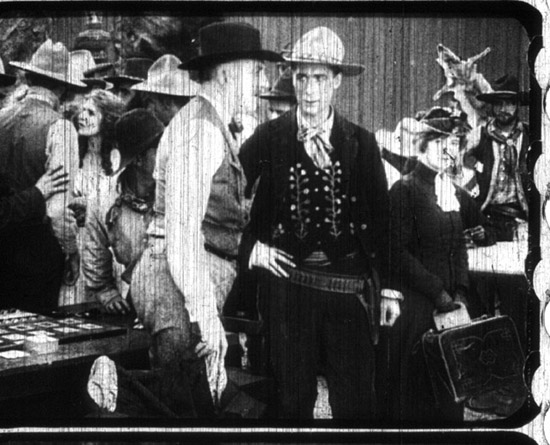
A quick wipe on both sides with a filmguard wetted cotton ball ...
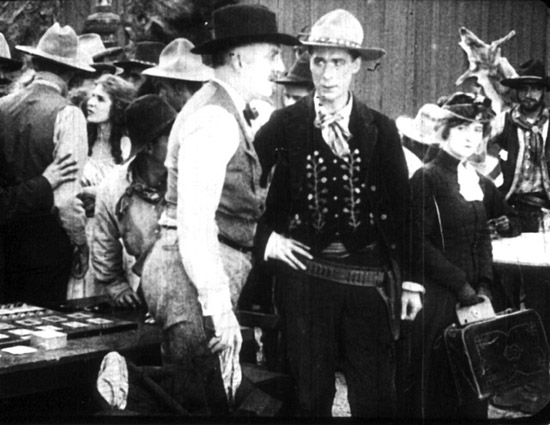
Ahh! Much better.
Afterwards, I wiped off the filmguard with fast-drying film cleaner.
BTW, anyone recognize any of the actors?
Posted by Mathew Molloy (Member # 666) on 07-25-2002, 11:52 PM:
I have a fairly nice IB print of West Side Story, however reels 1-4 are vinegared and when I got the print they were warped beyond use. So I wound reels 1-4 as tight as possible onto a 6K reel, put it in a plastic garbage bag and poured on probably half a bottle of film-guard. Yes I am a big goof but after letting it sit there for a few weeks I pulled out the reel, wound it onto another 6K and let it sit a few more weeks. I did this two more times once emulsion in, the other emulsion out. Then I wound it back onto 2000' reels and ran it through the Kelmar to clean it up. Although there is a sleight warp to the first few hundred feet of reel one,(the overture) the rest of the warping is gone and I am very happy with the results.
Of course the vinegar is still there and I keep these four reels seperate from the rest of the print.
That's my funky FilmGuard experiment.
Posted by Dave Williams (Member # 299) on 07-26-2002, 01:15 AM:
I too once had the wonderful time of working with a vinegared print. I first soaked each reel and tied them up in a garbage bag overnight. Then the next day I ran them by hand through this little device I built that basically runs the film slowly through a small vat of filmguard. Then wound up the reels and let them soak for two days.The results were amazing. The day before projection we ran each reel seven times through a series of cloth rags (no cleaner availabe to us at the time). When the print hit the screen that night for preview, it was friggin amazing. Not a speck of dust or a scratch in site.
As for the vinegar, it was faint but not too noticable after the film guard. The reason we didn't just get a different copy was that this particular film had no other copies available at the time and we did not want to cancel the showing if we didnt have to.
Dave
Posted by David Rigby (Member # 1301) on 07-26-2002, 05:11 AM:
Having recently taken delivery of my first bottle of FilmGuard I'm also extremely happy with the results. I used it on some 16mm B/W footage that was so filthy and scratchy I didn't want to even attempt run it through the projector. Once FG had been applied it went through the projector no problem and all be the most sever base scratches were gone (and even the worst were only faint). Having said that, when I bought the stuff a friend of a friend who's a longtime projectionist was positively disparaging about FG on the basis that it sticks the print together so that the umulsion pulls off when unwinding (so he said)! Is this an issue with overapplication on polyester prints, or might there have been something else at work here? I can't say that any of the film I've subsequently applied FG to has displayed anything but positive effects - a fine creation indeed Brad!!I have a lot of film that's been wound without cores so all the ends are warped (WHY do folks do this?! It's not like cores are expensive!) - they're all going to get some serious FilmGuard treatment!
David
Posted by David Rigby (Member # 1301) on 07-26-2002, 05:13 AM:
Having just looked over the rash of typos in my last post I once again marvel at a) how a keyboard makes me lose all semblance of literacy
b) how anyone makes any sense of anything I post, ever!
David
Posted by John Pytlak (Member # 331) on 07-26-2002, 08:39 AM:
Brad: Do you know the refractive index of FilmGuard? Judging from its' scratch-hiding properties, it's probably close to the 1.48 index of triacetate support.------------------
John P. Pytlak, Senior Technical Specialist
Worldwide Technical Services, Entertainment Imaging
Research Labs, Building 69, Room 7525A
Rochester, New York, 14650-1922 USA
Tel: +1 585 477 5325 Cell: +1 585 781 4036 Fax: +1 585 722 7243
e-mail: john.pytlak@kodak.com
Web site: http://www.kodak.com/go/motion
Posted by Steve Scott (Member # 630) on 07-26-2002, 03:08 PM:
I've never had the chance to use Film guard during building, but I've never had any problems running it during public showings. The image never really got streaky (I had the only complaints when I ran dry pads!)I did experience trouble during once during an employee show of Spy Game at my old theater. The cleaner was penthouse mounted with an SDDS 2K reader directly below it, and that seemed to be the only time I noticed visible streaks and blur. But when running the cleaner with SRD or DTS readers this never happened.
Okay, so I guess it did happen once, but ONLY once!
Posted by Carl King (Member # 398) on 07-26-2002, 03:27 PM:
I've been using Film Guard lately and I love it. Works like a charm.
For the last two weeks I've been on vacation. During the first week my manager worked most of the shifts in the booth. When my regular relief guy started the 2nd week he called me to tell me that the machines were filthy and that the prints were dirty and that he would be Film Guarding them. When I went to work today all the prints looked great. Film Guard cleaned them well.
Posted by Steve Guttag (Member # 268) on 12-02-2002, 09:57 PM:
Ok...here are some pictures. I've been cleaning film at the Uptown in DC for a year now on the rewinder. I took an Autowind bracket and adapted it to the film-counter bracket (both made by Kelmar though never intended to go together). One trick for the Uptown is that we use 35/70 reels so the centerline of the film is 17.5mm out. The footage-counter bracket was drilled and tapped to mount the Film-Cleaner bracket.
So here is the whole system "whipping" by at 20% (I've safely tested it up to 50% but why bother).

This shot is a close-up of the Film Cleaner itself

And lastly, here is a shot of the bracket itself.

Steve
Posted by Mitchell Dvoskin (Member # 751) on 12-03-2002, 08:32 AM:
This is very similar to how I mounted my cleaner. Only the mounting bracket has been changed to protect the innocent.
What is a 35/70 reel? Yes, I assume it is a reel that handles both 35 & 70, but how does it work?
/Mitchell
Posted by Steve Guttag (Member # 268) on 12-03-2002, 10:39 AM:
No, a 35/70 reel is a 35mm reel that will fit on a 70mm spindle so the 35mm film is centered. If you look at the reels in the first picture, look at the spindle area. You will see that there are round discs that space the reel out.
Steve
Posted by Steve Guttag (Member # 268) on 12-03-2003, 02:10 AM:
<bump>
(I was questioned about this subject recently)
Steve
Posted by Christopher Seo (Member # 7) on 12-03-2003, 03:48 AM:
Has anyone experienced scratching due to hand cleaning? I have encountered a couple prints which were significantly more susceptible to scratching than I have generally found. Both were polyester prints which scratched easily on the base side (the emulsion was unaffected). One was on older Kodak stock, and the other on new (2003) Agfa stock. In both cases I used excellent cleaning material (Kimberly-Clark ScottPure Critical Task Wipers) with Film-Guard, cleaning at high speeds. Upon cleaning, I noticed a light line or two on the Kodak print that was not present in the un-cleaned section. The Agfa print was far worse, displaying numerous light lines (some of which showed up on screen) after just one pass.
It's hard to say how the amount of Film-Guard I use and the pressure I apply to the cloth compare to a typical media cleaner setup, but I do know from tests that scratching is not a problem on newer Kodak and Fuji polyester stock. It seems that older/cheaper polyester is much more fragile.
Posted by John Pytlak (Member # 331) on 12-03-2003, 06:11 AM:
One of the features of Kodak VISION Color Print film is the scratch-resistant conductive anti-static backing. Older Kodak polyester print film (2386) used rem-jet, which was removed during processing, leaving just the "bare" polyester support, that had no scratch or static protection. Kodak invested over $200,000,000 in the technology needed to make this improved film base:
http://www.kodak.com/country/US/en/corp/pressReleases/pr19960509-01.shtml
Posted by Jeff Taylor (Member # 443) on 12-03-2003, 08:36 AM:
Getting back to the earlier question about cleaning individual reels on makeup, just be aware that tape splicing a freshly FG'd print will take some work. Even a light coat will make it difficult to get a tape splice to hold. Similarly, FG, if applied excessively by hand will weaken and stretch tape splices.
Posted by Christopher Seo (Member # 7) on 12-03-2003, 12:16 PM:
Thanks for the info, John. Is 2386 the stock identified by a "386" in the edgecode? And out of curiosity, did acetate print stock use rem-jet backing as well?
Regarding Jeff's post, I have found that naphtha will easily remove Film-Guard from the film, definitely important in a splicing area.
Posted by Scott Norwood (Member # 30) on 12-03-2003, 12:33 PM:
I'm not John, but I believe that the "386" emulsion was (is?) available on both acetate ("5386") and polyester ("2386") base. The 16mm acetate variant was (is?) "7386" and the ESTAR variant would be "3386."
Posted by John Pytlak (Member # 331) on 12-03-2003, 02:52 PM:
Scott is correct. Rem-jet was used on both the triacetate (5386/7386) and ESTAR (polyester) base (2386/3386) EASTMAN Color Print Film. The edgeprint was "EASTMAN 386 Safety Film", although some had no edgeprint due to SDDS. These films replaced EASTMAN Color Print Film 5384/7384 ("LLP" edgeprint) and the ESTAR base "Special Order" versions in 1993. It's all in the "Chronology of Kodak Motion Picture Films" on the Kodak website:
http://www.kodak.com/country/US/en/motion/about/chrono4.shtml
Kodak VISION Color Print Film 2383/3383 and Kodak VISION Premier Color Print Film 2393/3393 were introduced in 1998, featuring the improved scratch-resistant conductive anti-static backing. The Kodak VISION Color Print films completely replaced the rem-jet base print films by 2000. Color print film for release prints is no longer available on triacetate base:
http://www.kodak.com/US/en/motion/products/lab/2383.shtml
http://www.kodak.com/US/en/motion/products/lab/2393.shtml
Posted by John Hawkinson (Member # 1135) on 12-04-2003, 06:37 AM:
You know, John, it's too bad the chronology doesn't state explicitly what edge code refer to what stocks, especially for those cases where it may not be so obvious to everyone (e.g. 386).
Maybe Kodak should consider updating it for Christmas ![[Smile]](smile.gif)
--jhawk
Posted by John Pytlak (Member # 331) on 12-04-2003, 08:11 AM:
Some information is already on the Kodak site, in another place:
http://www.kodak.com/country/US/en/motion/support/h1/identificationP.shtml
Earlier versions of 35mm print film did not always have a specific edgeprint ID code. My records show that 5383 (introduced in 1974) was "SP", but earlier films like 5381 and 5385 may not have had product ID codes. When 5384 was introduced in 1982, it was "LLP", and later became "LPP".
In those days, the edgeprint ID was exposed during slitting. The slitters were used for a variety of products, and a stencil change (to change the ID) required considerable down time to change and verify. So the edgeprints were more "generic" than is done with more modern technology today.